

Introduction
Most American investors hold the overwhelming majority of their real estate exposure in the U.S. market — yet economic cycles, interest rate policy, and demographic shifts don't move in lockstep globally. As of early 2026, the Federal Reserve maintained its target rate at 3.50% to 3.75%, while the European Central Bank held its deposit facility rate at 2.00%. This divergence creates meaningful dispersion in how markets are absorbing rate changes, opening entry opportunities abroad that don't exist domestically.
This guide is for investors in the $100,000–$600,000 range looking to add international property to their portfolio — whether for the first time or as a deliberate expansion. Here's what we'll cover:
- Core strategies for international real estate diversification
- How to evaluate and select target markets
- Managing legal, currency, and execution risks
- Sizing your allocation relative to your broader portfolio
The aim: give you a clear, practical framework for accessing international markets while reducing transaction risk and protecting your capital from domestic concentration.
Key Takeaways
- International real estate diversification reduces portfolio volatility and opens access to growth markets not correlated with U.S. economic cycles
- Four main investment vehicles exist: direct property ownership, listed REITs, private real estate funds, and crowdfunding platforms
- Market selection drives returns — evaluate macro conditions, structural demand, and where capital is flowing before committing
- Managing cross-border risk requires on-the-ground expertise in local regulations, transaction norms, and legal structures
- Start with a 5–15% allocation concentrated in one or two high-conviction markets, not scattered across many
Why American Investors Are Looking Beyond Domestic Real Estate
Domestic real estate conditions have shifted in ways that make international diversification harder to ignore. Three pressures are pushing American investors to look abroad:
Compressed Cap Rates and Elevated Pricing
U.S. commercial real estate cap rates held steady through the second half of 2025, settling in the 3.9% to 4.2% range. Looking into 2026, cap rates are expected to compress by just 5 to 15 basis points — modest movement that reflects pricing stability but limited upside. Entry points in major U.S. markets remain challenging, particularly for investors seeking yield-driven returns.
Concentration Risk
Investors who already own U.S. property carry single-country exposure to economic cycles, regulatory changes, and policy shifts. Over-concentration in domestic real estate leaves capital vulnerable to localized downturns that can erode wealth with no offsetting position elsewhere.
Portfolio Volatility Reduction Through Diversification
Real estate markets across different regions historically don't move in lockstep. The numbers bear this out:
- The FTSE EPRA Nareit Developed ex US Index posted a 26.1% year-over-year return in 2025, driven by earlier rate stabilization in Europe and APAC
- International REITs carry a 0.78 correlation with MSCI EAFE, offering measurable portfolio diversification
The end of near-zero global interest rate policy has created measurable divergence. Some international markets have absorbed rate changes better than the U.S., creating entry opportunities that don't exist domestically right now.
The Four Core Strategies for International Real Estate Diversification
The right vehicle matters as much as the right market. Your choice between direct and indirect ownership will determine your transaction costs, liquidity profile, and ultimate returns.
Direct Property Ownership
Direct ownership means purchasing physical property abroad — you hold title, collect rental income, and control the asset directly.
Advantages:
- Full control over property decisions
- Potential for strong rental income
- Lifestyle optionality (personal use)
- Long-term capital appreciation potential
Trade-offs:
- Higher minimum commitment ($100,000+)
- Legal complexity varies by jurisdiction
- Currency exposure (both opportunity and risk)
- Critical disadvantage: information asymmetry
Foreign buyers pay an average premium of 3.6% to 3.7% compared to local buyers for comparable properties. This isn't a small cost — on a $300,000 property, that's an immediate $10,800 overpayment. Research shows it takes an average of four local acquisitions for a foreign investor to learn the market and offset this initial information disadvantage.
Without local presence or knowledge, investors consistently pay more and earn less than local buyers.
If direct ownership's information costs concern you, listed REITs offer a fundamentally different entry point.
Indirect Investment via Listed REITs
International REITs provide liquid, lower-minimum exposure to foreign real estate markets without requiring property management.
Key characteristics:
- Daily liquidity with real-time or end-of-day pricing
- Lower minimum investment (typically a few thousand dollars)
- Must distribute significant share of income (typically 90%+)
- Professional management by local teams
Important limitation: REIT performance can correlate with equity markets during volatility, reducing diversification benefit at exactly the wrong time. During market stress, liquidity evaporates precisely when you want it most.
For investors who can tolerate illiquidity in exchange for institutional access, private funds occupy a different tier entirely.
Private Real Estate Funds
Private funds pool capital from multiple investors to acquire and manage properties, typically with a holding period of 7–12 years.
Advantages:
- Managers operate with longer-term mandates
- Less short-term pressure than publicly traded vehicles
- Access to institutional-quality deals
- Professional local management
Requirements:
- Typically available to accredited investors only
- Illiquidity during the fund lifecycle
- Secondary market exits face average discounts of -5.5% (and up to -55%)
- Settlement can take 6 to 9 months after cut-off date
Crowdfunding platforms sit at the opposite end of the access spectrum — lower entry points, but a heavier due diligence burden on you.
Real Estate Crowdfunding Platforms
Crowdfunding allows investors to pool smaller amounts into larger projects globally. Lower minimums ($10,000–$50,000 typical) make it accessible, and deals often span multiple markets or property types. The trade-off: quality assessment shifts entirely to you — evaluating platform reputation, sponsor track record, and project fundamentals rather than relying on institutional oversight.
The platform's vetting process is only as good as its incentives to get it right.
How the Four Strategies Compare
| Strategy | Min. Investment | Liquidity | Control | Info Advantage |
|---|---|---|---|---|
| Direct Ownership | $100,000+ | Low | High | Requires local knowledge |
| Listed REITs | ~$1,000–$5,000 | High | None | Professional mgmt |
| Private Funds | $50,000–$250,000+ | Very Low | None | Institutional access |
| Crowdfunding | $10,000–$50,000 | Low–Medium | Limited | Platform-dependent |
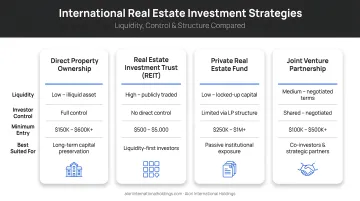
Academic research confirms that direct international investment underperforms indirect investment due to local information costs. For most investors, indirect exposure through locally-operated vehicles — or partnering with in-country experts for direct deals — produces better risk-adjusted outcomes than going it alone.
How to Identify and Evaluate High-Conviction International Markets
Not all international markets deserve your capital. The discipline of choosing fewer markets and understanding them deeply consistently outperforms spreading thin across many markets.
Evaluating a market runs across three layers: macroeconomic conditions, structural demand fundamentals, and capital market dynamics. Each filters out markets that look attractive on the surface but carry hidden risk.
Macroeconomic Conditions
What to assess:
- GDP growth trajectory
- Inflation environment
- Currency stability
- Interest rate policy direction
- Political/regulatory stability
Markets with falling or stabilizing interest rates tend to see faster real estate recovery and re-pricing. The ECB's 2.00% deposit facility rate versus the Fed's 3.50%–3.75% target range creates a 150–175 basis point advantage for European borrowers — directly impacting property yields and financing costs.
Structural Demand Fundamentals
Supply-and-demand dynamics are your second filter. Look for markets where demand drivers are durable and supply is constrained.
Durable demand drivers:
- Urbanization
- Tourism growth
- Population growth
- Housing shortages
Supply constraints:
- Geographic limitations
- Regulatory restrictions
- Development costs
Vacancy data makes this concrete. Premium CBD space in Paris shows 0.9% vacancy and London shows 1.2%, while Dublin's total vacancy rate sits at 17.5%. That gap — same continent, same asset class — illustrates why theme-by-market analysis matters more than blanket geographic allocation.
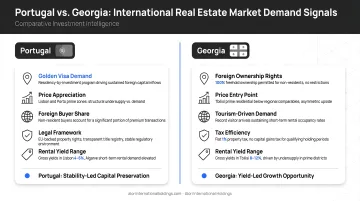
Two markets that pass this demand filter on current fundamentals:
| Market | Key Demand Signal | Source Indicator |
|---|---|---|
| Portugal | 29.0M non-resident tourist arrivals in 2024 (+9.3% YoY) driving hospitality, short-term rental, and lifestyle real estate demand | INE Portugal, 2024 |
| Georgia | 7.5% GDP growth in 2023; foreigners represented 17%+ of total property transactions in 2024 | US State Dept., 2024 / Kachreti Apartments, 2025 |
Capital Market and Legal Conditions
Evaluate who is active in the market and how transparent the transaction process is.
Key questions:
- Who is investing (institutional capital flows)?
- How transparent is the transaction process?
- Are title/ownership structures clear and enforceable?
- What exit options exist?
Weak legal frameworks can erase returns that macro conditions built. In-market professionals who understand local regulations, transaction customs, and deal mechanics are essential — not optional.
Alori International Holdings focuses on Portugal and Georgia precisely because both markets demonstrate clear title structures, enforceable ownership rights, and well-defined foreign investment frameworks. That legal clarity shapes every deal in the portfolio.
Understanding and Managing the Risks of Going Global
International real estate isn't inherently more risky than domestic — but it contains different risks that require active management.
Currency Risk
Foreign exchange movements can amplify or erase returns independently of property performance. A property that appreciates 10% in local currency terms may deliver only a 4% return to a U.S. dollar investor if the local currency has weakened.
Example: In 2025, the USD fell 11.9% against the Euro. For unhedged U.S. investors, this created a significant return boost. But the reverse scenario erases gains just as quickly.
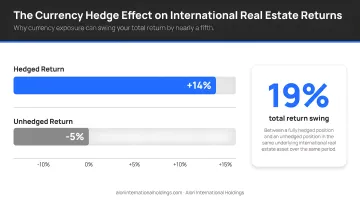
During periods of severe USD appreciation, unhedged investors suffer. From March 2014 to March 2015, the unhedged MSCI Europe Index returned -4.94%, while the currency-hedged version returned 14.34% — a 19% performance swing driven entirely by currency.
Management approaches:
- Natural hedging (match rental income currency to mortgage currency)
- Geographic diversification across currencies
- For larger allocations, structured hedging instruments
- Focus on markets with currencies that maintain relative stability against USD
Information Asymmetry and Legal Risk
American investors going international consistently underestimate this risk — and it's the one most likely to cost them on the first deal. Without local knowledge, investors tend to overpay on acquisition and underprice risk because they can't access the private information that local market participants have.
The research confirms this cost is real and measurable: foreign buyers pay 3.6%–3.7% premiums on average.
Solutions:
- Invest indirectly through locally-operated vehicles
- Work with partners who have genuine in-country presence
- Vet deal flow carefully
- Ensure clear understanding of local legal structures and exit paths
Geopolitical and Regulatory Risk
Policy changes, foreign ownership restrictions, tax law revisions, or political instability can impact returns or create forced-exit scenarios.
Example: Portugal enacted Law No. 56/2023 in October 2023, which officially removed direct real estate acquisition as an eligible route for the Golden Visa program. The new law prohibits any form of direct or indirect real estate investment for the visa. Investors must now use alternative routes, such as transferring €500,000+ into specific, CMVM-regulated non-real estate collective investment funds.
Advice: Prioritize markets with stable, transparent regulatory environments. Avoid markets where returns depend on speculative policy continuation.
Liquidity Risk
Direct international property is inherently illiquid. The median time to transact commercial real estate is 190 days. Selling a foreign property can take months, involve local legal processes, and be complicated by currency conversion.
Investors should size their international allocation with this in mind and avoid relying on these positions for short-term liquidity.
How to Build Your International Real Estate Allocation
How much of a portfolio should be international real estate? There's no universal answer, but most institutional frameworks suggest a total real estate allocation of 10–20% of a diversified portfolio, with international exposure representing a meaningful share of that.
Investors closer to $100,000–$300,000 in international allocation may start with one well-researched market. Those with larger allocations can layer in geographic and vehicle diversification.
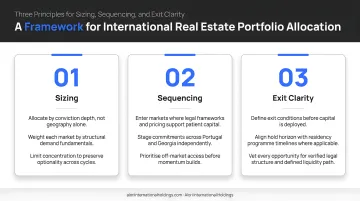
Three principles shape a sound allocation framework:
- Sizing: 5–15% of a portfolio in international real estate is a reasonable range, depending on risk tolerance, liquidity needs, existing domestic exposure, and investment horizon
- Sequencing: Start with one or two markets you understand well rather than spreading across five you understand superficially — depth in a single market consistently outperforms surface-level exposure across many
- Exit clarity: Whether the goal is rental yield, capital appreciation, or currency diversification determines the market, vehicle, and holding period; investors with defined exit strategies outperform those treating international real estate as speculative
For investors new to international markets, partnering with a firm that combines in-country execution with verified legal structures and defined exit parameters reduces transaction risk significantly. Alori International Holdings focuses specifically on this — curating high-conviction opportunities in Portugal and Georgia where the fundamentals, legal frameworks, and exit strategies are already stress-tested.
Frequently Asked Questions
What percentage of my investment portfolio should be international?
There is no universal percentage, but most diversification-focused investors start with a 5–15% international real estate allocation. The right amount depends on total portfolio size, risk tolerance, existing domestic exposure, and liquidity needs.
What are the biggest risks of investing in international real estate?
The four key risks are currency fluctuation, limited local market knowledge, geopolitical and regulatory changes, and illiquidity. Each can be managed with the right strategy or local partners.
Should I invest directly in foreign property or through a fund or REIT?
Most non-institutional investors are better served by indirect vehicles — funds, REITs, or locally-operated platforms — where information costs and execution risk are already absorbed. Direct ownership makes sense only with genuine in-market expertise or a trusted local partner on the ground.
How do I know if an international real estate market is worth investing in?
Evaluate three layers before committing capital:
- Macroeconomic conditions — GDP trajectory, interest rates, currency stability
- Structural demand — supply/demand balance, demographic drivers
- Capital market conditions — legal clarity, transaction transparency, capital flows
Markets that score well across all three are worth deeper investigation.
Do I need to be an accredited investor to buy international real estate?
Direct property ownership abroad generally has no accreditation requirement. However, private funds and certain platforms do require accredited investor status. Requirements also vary by the country where the property is located.
How does currency risk affect my international real estate returns?
Currency movements can add to or subtract from returns regardless of property performance. Investors can manage this through diversification across currencies, natural hedging strategies, or by focusing on markets with currencies that historically maintain relative stability against the U.S. dollar.