
Introduction
Two of Europe's most popular residency-by-investment programs have closed in the past two years — Portugal eliminated its direct property pathway in late 2023, and Spain followed in April 2025. For American investors who had those programs on their shortlist, the map just changed significantly.
Demand hasn't slowed, though. A 2023 National Association of REALTORS® survey found that 16% of respondents reported clients actively seeking to purchase property abroad — reflecting real appetite for international real estate exposure across financial diversification, lifestyle, and immigration goals alike.
What remains — Greece, Cyprus, the UAE, and others — still offers genuine pathways. But with five major European programs closed or restructured since 2022, knowing which programs are stable, what they actually cost, and what they deliver is the starting point for any serious investor.
What Is a Real Estate Golden Visa and How Does It Work?
A golden visa is a government-issued residency permit granted in exchange for a qualifying financial investment. The OECD defines residence and citizenship by investment (RBI/CBI) schemes as programs allowing individuals to obtain residence rights through local investments. Real estate has historically been the most popular qualifying asset class.
Understanding Residency vs. Citizenship
Most golden visa programs grant temporary or permanent residency first, not citizenship. The Council on Foreign Relations distinguishes Residency by Investment (RBI) from Citizenship by Investment (CBI): RBI grants foreign investors the right to live, work, and study, while CBI allows investors to directly acquire foreign citizenship.
Converting residency to citizenship is a longer process with additional requirements.
To eventually qualify for citizenship, investors generally must meet:
- Defined holding period (usually 5+ years)
- Physical presence requirements
- Language proficiency tests
- Clean criminal record verification
- Demonstrated ties to the country
How the Real Estate Route Works
The investor purchases qualifying property at or above a government-set minimum threshold. That minimum refers to purchase price only. Renovation costs, taxes, and transaction fees do not count toward the qualifying amount.
Standard requirements include:
- Minimum investment threshold met through purchase price
- Property held for specified period (typically 5+ years)
- Clean title and legal compliance verification
- Proof that funds originated from legitimate sources
Countries Where Real Estate Still Qualifies for a Golden Visa
While Portugal and Spain have restricted their programs, several countries maintain active real estate routes. Program rules change frequently—verify current status before proceeding.
Greece
Greece operates one of the most accessible real estate routes in Europe, with tiered minimum investment thresholds:
| Investment Tier | Minimum Amount | Applicable Regions |
|---|---|---|
| Prime Regions | €800,000 | Athens, Attica, Thessaloniki, Crete, Mykonos, Santorini, cities over 3,100 population |
| Standard Regions | €400,000 | All other regions |
| Conversion Exception | €250,000 | Commercial-to-residential conversions, any location |
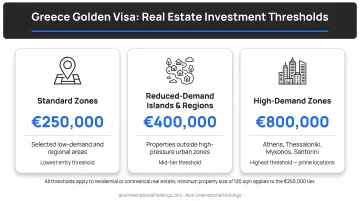
Greece also accepts 10-year lease arrangements in tourist complexes valued at €400,000+. The program requires no strict residency obligations—just one biometric visit every five years to renew.
Cyprus
Cyprus offers Fast-Track Permanent Residence under Category F (Regulation 6(2)):
- Investment: €300,000 (plus VAT) in a first-sale house or apartment from a development company
- Income: Minimum €50,000 annual income from abroad, plus €15,000 per spouse and €10,000 per dependent child
- Residency: Permit holders must not be absent from Cyprus for more than two consecutive years
UAE and Emerging Markets
Outside Europe, several programs offer lower thresholds or different lifestyle benefits. The UAE stands out for tax efficiency: it levies no personal income tax or capital gains tax on individuals, making it attractive for yield-focused investors. The 10-Year Golden Visa (Federal) requires property ownership of at least AED 2 million (approximately $545,000). Dubai separately offers a 2-year renewable residence permit for properties valued at AED 750,000 ($204,000).
Emerging markets with lower thresholds:
- Cambodia: $100,000 minimum for a 10-year visa through the "Cambodia My 2nd Home" program
- Costa Rica: $150,000 investment in real estate or approved assets for two-year renewable residency
- Panama: $300,000 real estate investment for permanent residency through the Qualified Investor Visa
Portugal and the Shift Away from Real Estate
Portugal officially ended its real estate Golden Visa route with Law No. 56/2023, published October 6, 2023. This legislation explicitly states that new applications for residence permits based on property acquisition (previously €500,000 or €350,000 for rehabilitation) or €1.5 million capital transfers are no longer accepted.
Current qualifying investment routes:
- €500,000 into non-real estate collective investment funds
- €500,000 for scientific research
- €250,000 for artistic production or cultural heritage
- €500,000 for company formation creating five permanent jobs
What Portugal Still Offers
Portugal's program remains attractive for investors willing to pursue the fund route:
- Schengen Area access for visa-free travel across 27 European countries
- Path to permanent residency after five years
- Minimal physical presence requirement (average of 7 days per year)
- Eventual eligibility for citizenship (note: proposed law changes may extend citizenship timelines, so confirm current legislation before committing)
These benefits still make Portugal a compelling option — but the fund route requires more due diligence than a straightforward property purchase. Selecting compliant funds, verifying fee structures, and understanding redemption timelines are where investors typically need qualified guidance. Alori International Holdings focuses specifically on Portugal as one of its primary markets, helping investors identify qualifying fund opportunities that align with both residency goals and long-term capital strategy.
Why Georgia Stands Out for Real Estate-Linked Residency
Georgia offers foreign nationals residency linked to property ownership at relatively low entry points. The Short-Term Residence Permit requires ownership of property (except agricultural land) with market value exceeding $150,000. An Investment Residence Permit for properties exceeding $300,000 leads to unlimited residence after 5 years.
Georgia's Tax and Ownership Advantages
The residency pathway is one piece. The tax structure is the other reason investors pay attention:
- Flat 5% income tax rate on rental earnings
- 0% annual property tax for property owners
- 0% VAT on property purchases
- Expanding expat population and year-over-year tourism growth, particularly in Batumi and Tbilisi
- 24-hour digital property registration with a straightforward foreign ownership framework
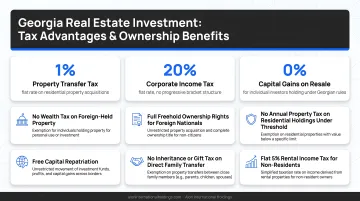
Georgia has maintained positive GDP growth in recent years, supported by open-market policies, infrastructure investment, and its position as a transit corridor between Europe and Asia. In Batumi and Tbilisi specifically, active construction pipelines, rising rental demand, and tourism-driven occupancy point to markets with identifiable fundamentals rather than speculative momentum.
Alori International Holdings focuses specifically on Georgia as one of its two core markets, vetting developer track records, title structures, and micro-location demand so investors aren't piecing that picture together on their own.
How to Choose the Right Country for Your Investment Goals
The right country depends on your primary objective. These are rarely identical: some investors prioritize lowest cost of entry, others want EU access, others want rental income, and some want the fastest path to a second passport.
Key Variables to Evaluate
Investment threshold and what counts:
- Does the minimum include only purchase price, or can renovation costs qualify?
- What transaction costs (10–20% typically) sit on top of the minimum?
- Are there ongoing investment or income requirements?
Residency requirements:
- How many days per year must you spend in-country?
- Can you maintain status with minimal physical presence?
- What triggers loss of residency status?
Path to permanent residency and citizenship:
- How long until permanent residency?
- Does citizenship require language proficiency or cultural integration tests?
- Are there minimum holding periods before property sale?
Treatment of dependents:
- Do spouse and children qualify automatically?
- Are there additional financial requirements per dependent?
- What age limits apply to dependent children?
Once you've mapped your objectives against these variables, the next layer is execution — specifically, what overseas real estate purchases involve that domestic transactions don't.
Due Diligence Considerations Unique to Overseas Real Estate
Verify title and ownership restrictions before signing anything. Many countries lack MLS-style listing transparency, and some restrict foreign ownership of agricultural land or coastal zones entirely. Use local legal counsel — don't rely on developer representations.
Budget beyond the minimum threshold. The purchase price qualifies you for the program, but transaction costs add 10–20% or more on top of that. In Dubai, buyers typically pay a 4% registration fee. In Greece, real estate transfer tax is approximately 3.09% including municipal surcharge.
Evaluate any golden visa property as an investment, not just a legal instrument. Key performance factors to assess:
- Rental yield potential (3–10% range across markets)
- Capital appreciation prospects driven by local demand fundamentals
- Liquidity at exit — how quickly can you sell?
- Currency risk for USD-based investors
Program Stability Risk
Golden visa programs have been suspended or significantly restructured in recent years. Portugal removed real estate in 2023, Spain abolished its program in April 2025, the UK closed its Tier 1 (Investor) visa in February 2022, and Ireland closed its Immigrant Investor Programme in February 2023.
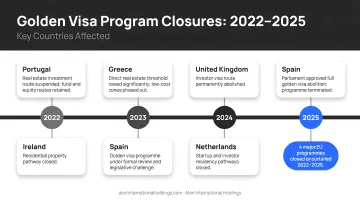
Assess a country's regulatory trajectory, not just its current rules. Look for markets with a track record of stable property law, predictable tax treatment, and governments that have historically separated investment visa policy from domestic housing politics — those are the markers that tend to correlate with program longevity.
Frequently Asked Questions
How much property investment is required for a golden visa?
Thresholds vary widely—from approximately $100,000 in markets like Cambodia to €800,000 in prime Greek regions. The threshold typically refers to purchase price only, excluding taxes, legal fees, and transaction costs, which add 10–20% or more.
Can you get a Greek golden visa through real estate investment?
Yes. Greece uses a tiered minimum system:
- €800,000 for prime regions (Athens, Thessaloniki, major islands)
- €400,000 for standard regions
- €250,000 for commercial-to-residential conversions
Verify current thresholds and eligible property types with a qualified advisor before proceeding.
Which country is the easiest to get a golden visa?
Greece and UAE are frequently cited for straightforward processes and no strict residency requirements. Georgia stands out for lower financial thresholds (from around $150,000–$300,000), though it doesn't carry EU access benefits. The right answer depends on whether you prioritize simplicity, cost, or mobility.
How does someone get a green card from investing $800,000 in the US?
The U.S. EB-5 program is a separate immigrant investor visa — not a golden visa — requiring $800,000 (Targeted Employment Areas) or $1,050,000 invested in a U.S. business that creates 10 full-time jobs. It's administered through USCIS and requires an immigration attorney. This falls outside the international golden visa category covered here.
Is real estate still a valid route for Portugal's golden visa?
No. As of late 2023, Portugal removed direct real estate purchases as a qualifying investment. Current routes include €500,000 fund subscriptions, company formation, and cultural donations. Verify the latest status with an advisor.
Can Americans own property abroad through a golden visa program?
Yes. Most golden visa countries allow Americans to purchase qualifying property as foreign nationals, though some impose restrictions on specific land types or zones (such as agricultural land in Georgia). Due diligence on foreign ownership rules in the target country is essential before committing capital.