

Introduction
Are you an American investor watching domestic real estate yields compress month after month while home prices drift further out of reach? If inflation is quietly eroding your portfolio and traditional markets feel overheated, Georgia — the country at the crossroads of Europe and Asia — is worth a serious look. Most American investors haven't put it on their radar yet, which is part of the opportunity.
Georgia is pulling in record foreign direct investment, posting some of the fastest GDP growth in the region, and offering a tax structure — 0% on retained corporate profits, 5% flat tax on rentals — that competes with purpose-built low-tax jurisdictions. Its real estate market is priced where U.S. values were two or three decades ago.
This article covers the macro investment case, the strongest sectors, tax advantages, how foreigners buy property, and the key risks to weigh before committing capital.
Key Takeaways
- Georgia's GDP is projected to grow 6% in 2025—the highest in Eastern Europe
- Tbilisi rental yields average 8-9%, outperforming U.S. metros
- Foreigners can freely own residential property with 1-2 day registration
- 0% corporate tax on retained profits, 5% flat tax on rental income
- Property investments of $100,000+ qualify for renewable residency permits
Why Georgia Is Drawing Global Investment Attention Right Now
Georgia's economic momentum is structural, not cyclical. The European Bank for Reconstruction and Development (EBRD) projects Georgia's GDP growth at 6% for 2025, positioning it as the highest in Eastern Europe and the Caucasus. This growth is underpinned by consistent policy discipline, infrastructure expansion, and sustained international capital inflows that signal confidence from institutional investors.
Geographic Advantage Translating to Trade Growth
Georgia sits at the physical junction of Europe and Asia. Its participation in the Middle Corridor trade route, the Baku-Tbilisi-Kars railway, and Black Sea port expansions in Poti, Batumi, and Anaklia position the country as a critical logistics hub. That infrastructure investment is already driving sustained trade activity and long-term real estate demand in surrounding corridors.
Market Access Through Free Trade Agreements
Georgia holds free trade agreements with the EU (Deep and Comprehensive Free Trade Area), China, UAE, UK, and CIS countries. For investors operating inside Georgia, this translates to preferential access to a market of over 2 billion consumers—making the country a practical base for regional headquarters and manufacturing operations.
A Business Environment Built for Speed and Clarity
Georgia ranks in the top 3 out of 50 countries in the World Bank's Business Ready assessment. Company registration takes a single business day. For American investors accustomed to bureaucratic friction in foreign markets, Georgia has deliberately removed those barriers at the regulatory level.
External Validation Through FDI
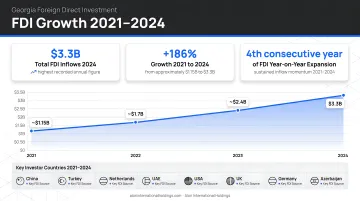
From 2021 to 2024, Georgia attracted $6.7 billion in foreign direct investment. Norwegian and UAE energy firms, alongside European manufacturers, are already operating in-country. When institutional capital at that scale has stress-tested a market and committed, it shifts the risk profile for individual investors entering behind them—particularly in real estate, where infrastructure spending and population inflows drive long-term asset demand.
Top Investment Opportunities in Georgia for Foreign Investors
Georgia's investment landscape covers three distinct verticals: real estate, tourism and hospitality, and energy and technology. Each carries a different risk profile, entry cost, and return mechanism — the breakdown below helps match the right category to your capital objectives.
Real Estate: Tbilisi and Batumi
Georgian real estate is the primary entry point for American investors in the $100,000–$600,000 range. Property prices sit well below Western European and North American equivalents, while Tbilisi rental yields currently average 8–9% gross — returns that are nearly impossible to find in U.S. metros.
Rental Yield Breakdown by District
According to Global Property Guide and TBC Capital, Tbilisi's citywide gross rental yield in Q1 2025 ranged from 7.78% to 9.0%. Yields vary significantly by neighborhood:
| District | Price per sqm | Gross Yield Range |
|---|---|---|
| Vake (premium) | $2,146 | 5.0–5.65% |
| Saburtalo | — | 6.38–8.36% |
| Gldani (emerging) | $1,333 | 7.38–10.18% |
| Didi Dighomi | — | 7.38–10.18% |
| Samgori (emerging) | $1,288 | Higher upside |
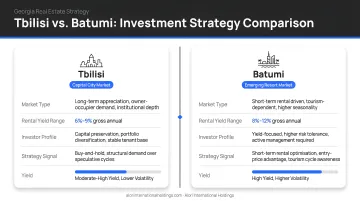
Two Distinct Market Strategies:
- Tbilisi Long-Term Rentals: Stable, year-round demand driven by locals, expats, students, and digital nomads. Lower management intensity, consistent cash flow. Target neighborhoods like Saburtalo and emerging districts like Gldani for higher yields (6.38–8.36%).
- Batumi Short-Term Vacation Rentals: Black Sea coast properties attract seasonal tourism and produce higher peak-season yields but require more active management. Batumi's tourism-driven market recorded over $4.5 billion in revenue in 2024.
Price Appreciation and Entry Points
Tbilisi's premium districts have seen meaningful appreciation over five years. Vake averages $2,146 per square meter today. Emerging areas like Gldani ($1,333/sqm) and Samgori ($1,288/sqm) offer lower entry costs and more upside for investors willing to move early.
Market Normalization Context
Rental rates are stabilizing after the wartime migration spikes of 2022–2023. Average rents dropped 11% year-over-year to approximately $10.6 per square meter in early 2025, pulling yields down from 12%+ peaks to a more sustainable 8–9% range. That normalization is actually a positive signal — current projections are more reliable for long-term underwriting than the anomalous peak figures.
Tourism and Hospitality
Real estate and hospitality intersect significantly in Georgia. The country recorded over $4.5 billion in tourism revenue in 2024, driven by European, Asian, and Middle Eastern visitors. New airport infrastructure in Tbilisi and government-backed sustainable tourism initiatives support continued growth for hospitality-focused investments.
Investment Opportunities Include:
- Boutique hospitality properties in historic Tbilisi districts
- Guesthouses and vacation rentals along the Black Sea coast
- Short-term rental management platforms targeting international tourists
- Branded residences with professional management delivering 7–12% yields
Energy and Technology
For investors looking beyond property, Georgia's energy and technology sectors offer structured entry points backed by government incentives.
Renewable Energy: Georgia generates roughly 77% of its electricity from hydropower but has tapped only about 25% of its hydropower potential. The government offers Contracts for Difference (CFD) for renewable projects and actively courts international energy investors. Norwegian and UAE firms are already active in this market — a signal that both the resource base and regulatory framework hold up to scrutiny.
IT and Business Process Outsourcing: Georgia's Virtual Zone status for IT companies provides 0% corporate tax, 0% VAT on transactions within the zone, and dividend tax exemptions. The standard corporate rate for tech companies sits at 5% with 0% on retained profits — drawing remote teams and tech operators seeking a low-tax base on Europe's periphery.
Georgia's Tax Advantages: One of the Most Investor-Friendly Systems in the World
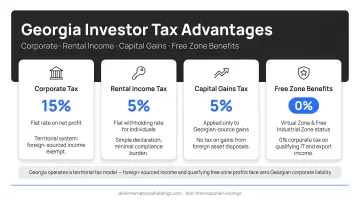
Georgia operates an Estonian-style corporate income tax model: profits retained inside a Georgian company are taxed at 0%. The 15% corporate income tax is only triggered upon distribution of dividends. For investors building a holding structure, this means capital compounds without a tax drag until the moment you choose to distribute.
Taxes That Don't Exist in Georgia:
- No capital gains tax on shares (under most conditions)
- No inheritance tax
- No wealth tax
- Capital gains on residential real estate held more than two years are generally tax-free
For American investors accustomed to federal capital gains rates of 15–20% and state-level taxes on top, these absences represent a structurally different cost environment.
Real Estate-Specific Tax Advantages:
- 5% flat tax on residential rental income
- No VAT on long-term residential leases
- No annual property tax for most residential holdings (a threshold applies only when rental income exceeds defined limits)
This makes Georgia a low-cost jurisdiction for holding income-producing property compared to most Western markets.
Free Industrial Zones and Virtual Zone Status:
Free Industrial Zones (Poti, Kutaisi) and Virtual Zone status for IT companies offer some of the most favorable structures available to business investors beyond real estate:
- 0% corporate tax within the zone
- 0% VAT on transactions conducted inside the zone
- Dividend tax exemptions for qualifying businesses
For investors pairing a Georgian operating company with a real estate strategy, these zones extend the tax efficiency across the full structure.
How Foreigners Can Buy Property in Georgia: A Practical Overview
Georgian law allows foreign nationals to purchase and fully own residential property with no restrictions—freehold title under your name, no residency or citizenship required. The only limitation is agricultural land, which is restricted for non-citizens. This openness is rare and valuable compared to most international markets.
The Buying Process:
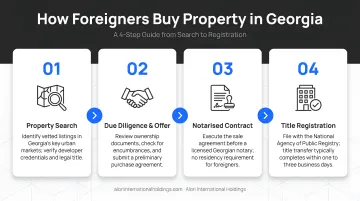
Property transactions in Georgia are streamlined:
- Property Identification: Work with local partners to identify suitable properties
- Legal Due Diligence: Verify ownership history, encumbrances, and debt through the public land registry
- Purchase Agreement: Execute sale contract with seller
- Registration: Complete registration with the National Agency of Public Registry—typically 1–2 business days
Most transactions are completed via cash or international wire transfer. The digital registry system ensures transparent and rapid ownership transfer.
That simplicity is an advantage—but navigating it confidently still requires experienced local guidance. A qualified local lawyer and real estate partner who understand Georgian transaction law can verify legal title structures and define clear exit strategies before you commit capital.
Alori International Holdings brings exactly this combination: off-market access, in-country legal vetting, and a disciplined investment framework built for American investors entering Georgian real estate. The firm focuses exclusively on properties with verified legal structures, defined exit strategies, and rental yield potential supported by market data—not promotional claims.
Risks and Considerations Before Investing in Georgia
Georgia offers a compelling investment case, but three structural risks deserve clear-eyed attention before committing capital.
Geopolitical Risk
Georgia shares a border with Russia and experienced military conflict in 2008. Regional tensions remain a background consideration. In practice, the primary investment zones — Tbilisi, Batumi, and Kutaisi — sit geographically distant from conflict-affected areas. Monitor political developments actively, and work with advisors embedded in the market rather than those reviewing it from abroad.
Currency Risk
The Georgian Lari (GEL) has seen periods of volatility against the USD. Key considerations for managing exposure:
- USD-denominated lease agreements are common in Tbilisi for expat-facing properties and act as a natural hedge
- GEL-denominated income requires factoring exchange rate dynamics into yield projections
- Currency movements affect both rental returns and capital appreciation when measured in USD terms
Evolving Regulatory Environment
Georgia's legal and tax framework has modernized rapidly. However, ongoing changes — including updates to accounting standards, business registration deadlines, and sector-specific licensing — mean staying current is an active requirement, not a one-time setup. The investors best positioned here are those with in-country legal and compliance partners who surface changes before they become surprises.
Frequently Asked Questions
Is Georgia a good country to invest in?
Yes, Georgia offers strong investment fundamentals: consistent GDP growth projected at 6% for 2025, one of Europe's most business-friendly regulatory environments, low tax burden, and a real estate market offering yields (8–9% in Tbilisi) that significantly outperform mature Western markets. Due diligence and local expertise remain essential.
Can foreigners buy property in Georgia country?
Yes, foreigners can fully and freely own residential property in Georgia with no restrictions. Registration typically takes 1–2 business days through the digital public registry, and the process is straightforward. The only exception is agricultural land, which is restricted for non-citizens.
How much to invest in Georgia to get citizenship?
Residency and citizenship follow separate pathways. A property purchase with a certified appraisal value of approximately $150,000 or more qualifies the buyer for a renewable Georgian residence permit. Full citizenship requires a longer, distinct process — Georgia does not offer automatic citizenship by investment.
What are the property taxes for foreign investors in Georgia?
Individuals generally owe no annual property tax unless rental income exceeds a defined threshold. Rental income is taxed at a flat 5%. Capital gains on property held more than two years are generally tax-free. Rates can vary by municipality and income level, so verify current thresholds when structuring your investment.
Who is the largest trading partner of Georgia?
The EU collectively represents Georgia's largest trade bloc through the Deep and Comprehensive Free Trade Area (DCFTA), while China, Turkey, Russia, and the UAE are among its largest individual trading partners. That breadth of trade relationships helps buffer Georgia's economy against single-market exposure.