Introduction
Over 19,000 Americans now call Portugal home—a 36% increase from 2023—making it one of the fastest-growing expat destinations in Europe. Much of that growth is driven by Americans racing ahead of the 2026 tax regime transition—Portugal's NHR program ended, and its replacement, IFICI, has already changed the calculus for remote workers and retirees alike.
But there's a critical distinction every American must understand: while US citizens can visit Portugal visa-free for up to 90 days, anything longer requires a formal residency visa. The right pathway depends on your income source, lifestyle goals, and financial situation—choose wrong, and you'll waste months reapplying.
This guide covers the four main residency routes—D7 passive income, D8 remote worker, D2 entrepreneur, and Golden Visa—alongside the current tax landscape under IFICI, and the five-year path from first application to Portuguese citizenship.
TLDR: Key Takeaways for US Citizens Seeking Portuguese Residency
- Americans can stay 90 days visa-free, but long-term residency requires applying through the Portuguese consulate before arrival
- Four main visa routes exist: D7 (passive income/retirement), D8 (digital nomads), D2 (entrepreneurs), and Golden Visa (investment from €500,000)
- A US-Portugal tax treaty prevents double taxation on your income
- Social Security benefits continue uninterrupted while living abroad
- Five years of legal residency leads to permanent residency or citizenship eligibility
- The NHR tax regime closed in 2023. Its replacement, IFICI, applies only to specific professional categories.
Residency Visa Options for US Citizens in 2026
Choosing the right visa means matching your income source to the correct legal pathway. The most common mistake Americans make? Picking the wrong visa category and having to restart the entire process.
Here's what determines your route:
- Passive income (pensions, Social Security, dividends, rental income) → D7 Visa
- Active remote earnings (salary from US employer, freelance contracts) → D8 Visa
- Starting a Portugal-based business → D2 Visa
- Qualifying investment (€500,000+ in funds or business ventures) → Golden Visa
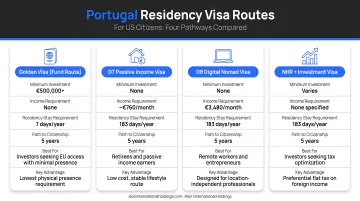
Each visa has distinct income thresholds, documentation requirements, and processing timelines. The sections below break down exactly what you need for each route.
D7 Visa: For Retirees and Passive Income Earners
The D7 is Portugal's most popular visa for Americans living on Social Security, pensions, dividends, or rental income. It's designed for passive earners who won't be working in Portugal.
2026 Income Requirements:
- Main applicant: €920/month (Portugal's minimum wage)
- Spouse or second adult: €460/month (50%)
- Each dependent child: €276/month (30%)
Important reality check: €920/month is the legal minimum, not a comfortable living budget. Consulates typically expect a buffer above the baseline and consistent income history over 12 months. Most Americans planning an actual move to Portugal should budget well above that minimum, especially in Lisbon or the Algarve.
Key benefits:
- Schengen travel across 27 countries
- Path to permanent residency after five years
- Family inclusion (spouse and dependents)
- Access to Portugal's public healthcare and education systems
Documentation required:
- Proof of passive income for at least 12 months
- Bank statements from the previous six months (stamped and signed)
- Tax returns from the previous three years
- Valid passport (with sufficient validity remaining)
- FBI criminal background check (apostilled)
- Private health insurance
- Proof of Portuguese accommodation
The D7 works best for Americans with stable retirement income or substantial investment portfolios generating consistent dividends.
D8 Visa: For Remote Workers and Digital Nomads
The D8 is Portugal's visa for salaried remote workers, independent contractors, and online professionals earning income from outside Portugal. This is the fastest-growing visa category among American expats.
2026 Income Requirements:
- €3,680/month (4x Portugal's minimum wage)
- Income must be proven for the previous three months minimum
Key distinction from D7: The D8 covers active remote earnings (salary, freelance contracts, consulting fees), not passive income. If you're employed by a US company and working remotely from Lisbon, the D8 is your route.
Practical advantage: You can keep your US employer or client base while living legally in Portugal. No need to establish a Portuguese business entity or change your employment structure.
Documentation required:
- Employment contract or client agreements proving remote work arrangement
- Proof of monthly income averaging €3,680+ over the last three months
- Standard residency documentation (passport, criminal check, health insurance, accommodation proof)
If your income travels with you, the D8 is the most straightforward path to legal residency without restructuring how you work.
D2 Visa: For Entrepreneurs and Business Founders
The D2 is for Americans building economic activity inside Portugal—opening a local company, launching a service business, or relocating an existing venture.
Key distinction from D8: D8 covers remote work for foreign clients; D2 covers business operations physically based in Portugal with local employees, customers, or infrastructure.
Core requirement: A credible business plan explaining:
- What the business will do in Portugal
- Who the target customers are (local, EU, international)
- Financial resources available to sustain operations
- Why Portugal makes sense as the operational base
- Job creation potential or economic contribution
Common D2 business models:
- Consulting firms serving EU clients from Portugal
- E-commerce companies with Portuguese fulfillment operations
- Tourism-related businesses (vacation rentals, tour operations)
- Tech startups targeting European markets
Documentation requirements reflect the business-first nature of this visa:
- Detailed business plan with financial projections
- Proof of capital to fund operations (varies by business type)
- Company registration documents in Portugal
- Standard residency documentation
The D2 is the right route if you're building something in Portugal — not just working remotely from it.
Golden Visa (ARI): For Qualifying Investors
Portugal's Golden Visa underwent major changes in 2023. Direct residential real estate purchases no longer qualify. Current routes require higher capital commitments but offer lighter physical presence requirements.
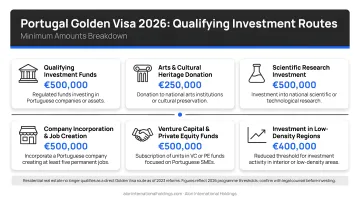
Current Qualifying Routes (2026):
- **€500,000 investment in non-real estate collective investment funds**
- €500,000 business investment creating 5 permanent jobs (or reinforcing capital maintaining 10 jobs for 3 years)
- €500,000 scientific research funding
- €250,000 cultural heritage or arts support
Physical presence requirement: Minimum 7 days in Portugal during the first year, then 14 days in each subsequent two-year period—lighter than standard residency visas.
Key advantages:
- Right to reside and work anywhere in Portugal
- Family reunification for spouse and dependents
- Schengen travel across 27 countries
- Eligibility for permanent residency or citizenship after five years
- Minimal time-in-country obligations
Important note: The Golden Visa is now an investment-first pathway, not a real estate purchase program. For Americans evaluating qualifying fund investments, working with an advisor who understands both the legal structure and the underlying asset matters. Alori International Holdings focuses specifically on this market, vetting opportunities for legal compliance, capital structure, and exit clarity.
The Golden Visa suits Americans who want a legal foothold in Portugal — and the EU — without committing to a full-time relocation.