

Introduction
US cap rates in major metropolitan markets have compressed to 4–5% in many asset classes—often below what alternative investments offer with less complexity. When every domestic market feels crowded and properties trade at peak multiples, generating meaningful risk-adjusted returns requires more than simply buying property. It requires knowing where the structural demand actually is.
This guide covers three things:
- How to measure ROI accurately across different property types
- Which strategies consistently deliver superior returns
- Why geographic diversification into markets like Portugal and Georgia is an underutilized lever for reducing domestic concentration risk while accessing stronger growth fundamentals
Key Takeaways
- ROI measures net profit as a percentage of total invested capital, and the formula shifts depending on whether you're holding rentals, flipping, or betting on appreciation
- Benchmarks vary by asset type and market, but most investors target returns that outpace equity index funds, which have historically averaged around 10% annually
- Core ROI drivers include strategic financing, targeted value-add improvements, vacancy reduction, and disciplined cost control
- Geographic diversification into fundamentals-driven international markets can unlock higher yields and reduce exposure to domestic economic cycles
- Common mistakes like underestimating costs, overrelying on appreciation, or lacking an exit strategy can destroy returns just as surely as a bad deal
What ROI in Real Estate Actually Measures (and How to Calculate It)
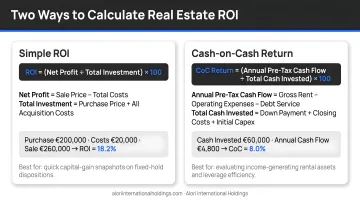
Most investors undercount their total investment — and that single mistake inflates every ROI figure they use to make decisions. ROI is the percentage return on every dollar deployed, calculated as net profit divided by total investment cost, multiplied by 100. That denominator must include purchase price, closing costs, renovation expenses, financing fees, and transaction costs — not just the acquisition price.
Two Primary ROI Calculation Methods:
| Method | Formula | Best Used For |
|---|---|---|
| Annual cash-flow | Annual net income ÷ total investment | Rental properties, ongoing yield |
| Net profit | (Sale price − total costs) ÷ total investment | Flips, appreciation plays, exit gains |
How ROI Differs from Related Metrics:
- Cap Rate: Measures unlevered property performance—stabilized net operating income (NOI) divided by current market value. Useful for comparing properties but doesn't account for financing.
- Cash-on-Cash Return: Measures annual pre-tax cash flow divided by initial equity investment (levered). Captures actual liquidity earned on financed deals.
- Net Operating Income (NOI): (Rental income + ancillary income) − direct operating expenses. This is pre-financing profit, not bottom-line return.
ROI synthesizes all of these inputs into one number — the true return on every dollar committed. That's what makes it the right starting point for comparing opportunities across asset types, markets, and strategies.
What Is a Good ROI for Real Estate?
Benchmarks vary by asset type and market context:
- Residential rentals: 8–12% annual ROI
- Commercial properties: 6–10%
- Short-term rentals (high-demand tourism markets): 12–15%, though operational demands increase sharply
Many experienced investors use alternative investment benchmarks as a floor. The S&P 500 has averaged 10.12% annually from 1928 through Q3 2025. If real estate doesn't beat this threshold after accounting for illiquidity, management effort, and transaction costs, the risk-reward tradeoff weakens.
"Good" is context-dependent. A 7% ROI on a stable urban apartment with minimal vacancy risk may outperform a 12% ROI on a volatile short-term rental requiring hands-on management and seasonal income fluctuations.
Proven Strategies to Maximize Real Estate ROI
Strategy 1: Use Leverage Strategically
Financing allows an investor to control a larger asset with less upfront capital, amplifying percentage returns on invested equity. A $400,000 property purchased with $100,000 down generates returns on that $100,000 investment, not the full property value. When appreciation or rental income exceeds debt service costs, that gap magnifies ROI significantly.
The risk side: higher debt service can crush cash flow if rents fall or vacancies rise. Positive leverage works only when rental income consistently clears all carrying costs:
- Mortgage payments
- Insurance and property taxes
- Maintenance reserves and management fees
Strategy 2: Execute Targeted Value-Add Improvements
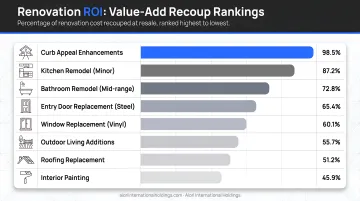
Not all renovations deliver equal ROI lift. According to the 2025 Cost vs. Value report, exterior upgrades drastically outperform upscale interior remodels at resale:
- Garage door replacement: 267.7% cost recouped
- Steel entry door replacement: 216.4% cost recouped
- Minor kitchen remodel (midrange): 112.9% cost recouped
- Bath remodel (upscale): 42% cost recouped
Focus capital on kitchen and bathroom modernization, energy-efficient systems, and curb appeal—upgrades that directly move rents or resale value—rather than cosmetic improvements that don't shift tenant willingness to pay.
Strategy 3: Minimize Vacancy Through Disciplined Pricing and Marketing
Even one month of vacancy per year erases a meaningful portion of annual yield. A property generating $2,000 monthly rent loses $2,000 in revenue for every vacant month—plus marketing costs, turnover expenses, and delayed cash flow.
Primary vacancy reduction tools:
- Competitive rental pricing based on current market comparables
- Fast tenant placement through professional marketing and responsive screening
- Strong retention incentives (responsive maintenance, lease renewal incentives, tenant communication)
Strategy 4: Reduce Operating Costs Without Sacrificing Asset Quality
Shrinking costs directly lifts net profit without requiring higher rents. Key levers include:
- Insurance benchmarking across multiple carriers
- Preventive maintenance schedules to reduce expensive emergency repairs—reactive maintenance costs 3-5 times more than preventive maintenance
- Smart home technology for utility cost control
- Vendor rate negotiation and service contract review
Each dollar trimmed from operating expenses flows directly to net returns — without raising rents or taking on additional risk. Cost discipline and tax efficiency together form the two quiet multipliers most investors underutilize.
Strategy 5: Optimize for Tax Efficiency
Tax deductions reduce taxable income from rental properties, improving after-tax returns. Key deductions include:
- Depreciation
- Mortgage interest
- Operating expenses
- Capital improvements
Advanced tools for scaling portfolios:
- Cost segregation allocates building costs to shorter 5- or 7-year recovery periods, accelerating depreciation write-offs and front-loading tax savings
- 1031 exchanges (US domestic properties) defer capital gains by rolling proceeds into a replacement property — identify within 45 days, close within 180. Note: 1031 treatment does not apply to foreign real estate; international investors should consult a cross-border tax advisor on applicable treaties and local capital gains rules in their target market
International Diversification: The ROI Strategy Most Domestic Investors Overlook
Geographic diversification is a structural ROI strategy, not just risk management. Markets earlier in their growth cycle — where inbound capital flows are accelerating and regulatory environments favor foreign ownership — can offer appreciation and yield profiles that mature domestic markets simply cannot match. Low property taxes, tourism-driven demand, and residency incentive programs amplify that gap further.
Key macro signals distinguishing high-conviction international markets:
- Strong demographic tailwinds (population growth or inbound migration)
- Rising GDP and employment trends
- Structural undersupply of quality housing
- Regulatory stability and transparent foreign ownership frameworks
- Growing foreign investment interest—before the market becomes crowded and entry prices inflate
Risk factors investors must account for:
- Currency exposure
- Title and legal verification
- Unfamiliar transaction processes
- Local tax implications
These risks are real but manageable. Working with in-market professionals who understand local regulations, cultural nuances, and off-market deal flow reduces exposure significantly — the gap in outcomes between investors who go it alone and those with on-the-ground infrastructure is substantial.
Portugal and Georgia: Two Markets Attracting Data-Driven Investors
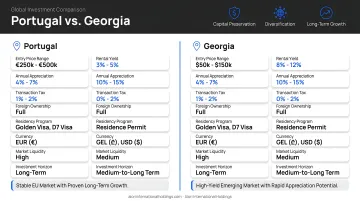
Portugal continues to attract Western European and American buyers through stable governance, high tourism demand, and rising expat communities. However, gross rental yields in Lisbon have compressed to 3.82%, and the real estate route for the Golden Visa has been eliminated. Foreign investors poured €3.9 billion into Portugal's property market in 2025, accounting for 45.9% of total FDI.
Georgia offers 7.42% gross rental yields in Tbilisi with zero property transfer tax and a 5% flat income tax on rental earnings. In Q1 2025, residential property prices rose 11.53% year-on-year. The economy has grown faster than most regional peers, backed by open-market policies and sustained infrastructure investment.
Alori International Holdings operates on a "fewer markets, deeper understanding" model. That means pairing macroeconomic and demographic analysis with in-country professional networks to source opportunities that come with defined entry points, verified legal structures, and clear exit strategies — built for investors in the $150,000–$600,000 range.
Mistakes That Quietly Destroy Real Estate Returns
Mistake 1 — Underestimating the Full Cost Stack
Many investors calculate ROI using only purchase price and projected rent. The real cost stack runs deeper. Operating expenses consistently exceed projections by 15–25%, and the culprits are predictable:
- Closing costs and financing charges
- Vacancy periods between tenants
- Maintenance reserves and unexpected repairs
- Insurance premiums and property management fees
A property that looks profitable on a surface-level calculation can turn negative once these costs are layered in. Build conservative expense assumptions from the start.
Mistake 2 — Treating Appreciation as a Guarantee
Appreciation is market-dependent — it can stall, reverse, or lag for years. Cash flow is what keeps a deal solvent while you wait. Strong investments should pencil out on income alone, with appreciation as upside rather than a requirement for the deal to work.
Mistake 3 — Entering Without a Defined Exit
Investors who enter without a defined exit strategy — hold for income, refinance after appreciation, or sell within a set timeframe — tend to hold underperforming assets too long or exit under pressure. Knowing your exit at acquisition keeps both ROI and capital protected.
Each of these mistakes compounds the others. Overpaying on costs, betting on appreciation, and holding without a plan is how promising deals quietly erode over time.
How to Evaluate Whether a Market Is Worth Your Capital
Market selection is upstream of every other ROI strategy. The right market with an average property beats the wrong market with a perfect property.
Key Variables to Analyze
- Rental demand and vacancy trends
- Local employment and income growth
- Population trajectory
- Property price-to-rent ratios
- Regulatory environment for landlords and foreign buyers
Momentum-Driven vs. Fundamentals-Driven Markets
| Market Type | What's Driving Prices | ROI Outlook |
|---|---|---|
| Momentum-driven | Sentiment and optimism | Compresses as cycle matures |
| Fundamentals-driven | Workforce growth, housing undersupply, inbound migration | Supports durable appreciation and rental income |
Entering a market late in a momentum cycle compresses future ROI. Fundamentals-driven markets — where structural demand precedes price growth — are where durable returns get built.
Alori focuses specifically on markets where the data supports this structural case: analyzing demographic trends, capital flows, and regulatory frameworks to identify opportunities built for the long term, not the current news cycle.
Frequently Asked Questions
How to maximize real estate investment profits?
Combine disciplined market selection, strategic leverage, cost control, vacancy minimization, and tax efficiency. Returns accelerate when these strategies reinforce each other — consistent execution across a well-selected portfolio matters more than any single move.
What is a good ROI for real estate?
"Good" depends on asset class, market, and risk tolerance. Most investors benchmark against the S&P 500's historical ~10% average; residential rentals typically target 8–12%, while international or value-add opportunities may offer different profiles depending on hold period and entry strategy.
Where does real estate have the highest ROI?
Emerging and growth markets, particularly in Southern and Eastern Europe, Southeast Asia, and select Latin American cities, often show higher yield and appreciation potential than saturated US or Western European markets. Portugal and Georgia, two of Alori International Holdings' core focus markets, attract data-driven investors for precisely this reason: strong fundamentals with less competition from institutional capital.
Can a financial advisor help you invest in real estate?
A generalist financial advisor can help with portfolio allocation, but international or alternative property deals require specialists with direct in-market expertise. Local regulatory knowledge and transaction coordination are not areas where a general practitioner adds enough value.
What does a 24% ROI mean?
A 24% ROI means the investor earned 24 cents in net profit for every dollar invested, which is strong by most benchmarks. Context matters: verify it against accurate cost inputs (not optimistic projections) and compare against the risk profile of the investment to ensure the return justifies the exposure.
What is the 70 20 10 investment strategy?
This framework allocates 70% of capital to core stable investments, 20% to growth-oriented plays, and 10% to higher-risk opportunities. Real estate investors can apply it across property types and geographies — for example, stable urban rentals, value-add properties, and emerging international markets in proportionate balance.