

Introduction
American investors are increasingly looking beyond domestic markets to protect and grow wealth. With US home prices up roughly 47% since 2019, stock market volatility creating uncertainty, and inflation eroding purchasing power, capital is flowing toward international real estate as a tangible, diversified asset class. Roughly 40% of high-net-worth Americans plan to purchase property abroad within the next year, drawn by geographic diversification, currency hedging, and markets with fundamentals that many saturated US cities can no longer offer.
This guide covers the strategic case for international real estate, how to evaluate foreign markets with data rather than hype, and the legal and tax landscape you need to understand before committing capital. It also highlights which markets currently merit attention from American investors. Whether your goal is rental income, capital appreciation, or a residency pathway, the principles here will help you invest abroad with clarity and confidence.
Key Takeaways
- International real estate reduces exposure to domestic economic cycles while accessing higher-growth markets
- Evaluate markets using GDP trends, rental yields, political stability, currency dynamics, and foreign ownership laws
- Portugal and Georgia offer accessible entry prices, solid rental yields, and clear legal frameworks for foreign buyers
- US investors must report worldwide income to the IRS, including rental proceeds and eventual capital gains
- Vetted projects with verified legal structures and defined exit strategies give investors clearer risk controls from day one
Why Invest in International Real Estate
Portfolio Diversification
Holding real estate across multiple geographies reduces exposure to any single country's economic downturn, regulatory changes, or market saturation. The principle is straightforward: spreading risk across uncorrelated assets produces more consistent long-term performance. When US residential markets cool or domestic policy shifts hurt landlords, international holdings in structurally sound foreign markets can provide ballast and continued income generation.
Capital Appreciation Opportunity
Markets in high-growth or underpenetrated economies often deliver faster property value increases than mature domestic markets. Georgia experienced 9.7% real GDP growth in 2024, while Portugal maintained steady 2.1% growth—both outpacing many saturated Western markets. Properties purchased early in a market's growth cycle capture appreciation as infrastructure expands, tourism increases, and international capital flows in.
Rental Income Potential
Many international markets generate gross rental yields of 6–12% annually, well above the sub-4% yields common in high-priced US cities. Strong demand drivers sustain this income across market cycles:
- Tourism corridors like Portugal's Algarve attract consistent short-term rental demand
- Expat hubs like Tbilisi draw digital nomads and long-term international residents
- Affordable entry points relative to yield make returns more defensible than in saturated Western markets
Inflation Hedging and Currency Diversification
International real estate is a tangible hard asset that holds value against currency devaluation. For US investors, owning properties denominated in euros (Portugal) or Georgian lari alongside dollar-based assets creates a natural hedge across economic cycles.
When the dollar weakens, foreign-currency assets gain in relative value. When it strengthens, purchasing power abroad improves. Either way, the exposure works in your favor.
Lifestyle and Residency Upside
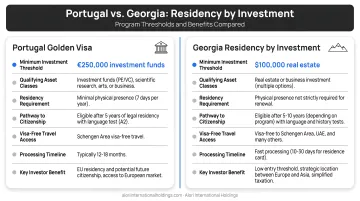
Some countries offer residency-by-investment pathways tied to property purchases, making international real estate a dual-purpose asset. Portugal's €500,000 investment fund route and Georgia's $150,000 property threshold provide qualified investors with residency permits, opening doors to greater global mobility, healthcare access, education opportunities, and eventual citizenship pathways. For investors weighing lifestyle migration alongside capital growth, that residency optionality is a meaningful part of the overall return.
Key Factors to Evaluate Before Investing Abroad
Market Fundamentals
Before committing capital, analyze GDP growth trends, population demographics, urbanization rates, and historical property appreciation data. Strong fundamentals signal durable demand, not a short-term speculative run. Georgia's urbanization reached 61.0% in 2024, up from 60.0% in 2022, concentrating housing demand in Tbilisi and other major hubs. Portugal's urbanization similarly reached 61.3%, supporting sustained rental demand in Lisbon and Porto.
Look for markets where:
- GDP growth exceeds regional averages consistently
- Population is concentrating in urban centers (increasing housing demand)
- Tourism and foreign direct investment are trending upward
- Infrastructure development (airports, highways, digital connectivity) is accelerating
Rental Yield Analysis
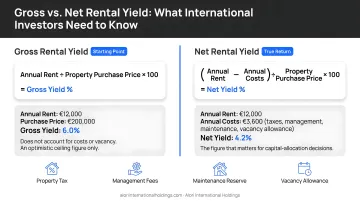
Gross rental yield is annual rental income divided by purchase price. Net rental yield subtracts property taxes, management fees, maintenance costs, and vacancy periods. Net yield is the number that actually matters for profitability. A property generating $12,000 annually on a $200,000 purchase price has a 6% gross yield. After $2,000 in annual costs, the net yield drops to 5%.
Target markets should be benchmarked on net yield before entry:
- Calculate realistic occupancy rates (70–85% for vacation rentals, 90–95% for long-term)
- Factor in local property taxes, insurance, and management fees (10–20% of gross income)
- Compare net yields across similar property types in different markets
Markets offering 5–8% net yields with strong appreciation potential generally outperform those offering 3–4% yields with limited capital growth.
Political Stability and Rule of Law
Stable governance, enforceable property rights, and low corruption scores are the foundation of durable foreign investment. Review the World Bank's Governance Indicators and Transparency International scores for target countries. Markets with weak legal systems or histories of expropriation carry elevated risk — and attractive pricing rarely compensates for it.
Portugal benefits from EU membership and established legal frameworks. Georgia, despite being outside the EU, offers transparent property registration, digital title systems, and clear foreign ownership rights. Both markets rank favorably on governance and corruption indices relative to many emerging economies.
Foreign Ownership Rights and Legal Framework
Each country has distinct rules on what foreigners can own, where restrictions apply (coastal zones, agricultural land, military areas), and what approvals are required. Portugal imposes **no restrictions on foreign buyers** and provides transparent registration through the Conservatória do Registo Predial. Georgia similarly allows unrestricted foreign ownership with freehold property rights and 24-hour digital registration.
Some markets require permits, impose ownership caps, or restrict certain property types. Clarifying ownership rules upfront — before you've identified a specific property — keeps your due diligence efficient and your shortlist realistic.
Currency Risk and Exchange Rate Dynamics
Fluctuations between the USD and a foreign currency affect both purchase price and ongoing returns. A property purchased in euros when EUR/USD is 1.10 costs more dollars than the same property at 1.05. Similarly, rental income in euros converts to fewer dollars when the euro weakens.
Assess:
- Historical currency volatility between USD and the target currency
- Whether the investment creates a natural hedge (euro exposure when you have dollar liabilities) or adds concentrated single-currency risk
- Whether you can finance in the local currency to match income and debt obligations
Currency exposure is a real variable — but it's a manageable one. Investors holding positions across both euro-denominated (Portugal) and GEL-denominated (Georgia) assets reduce their sensitivity to any single currency's movement against the dollar.
Top Markets Worth Watching Right Now
Portugal
Portugal has emerged as a high-conviction market for American investors seeking European exposure without Western European price tags. The country combines EU membership, stable governance, a thriving tourism economy (over 30 million annual visitors), and growing digital nomad and expat communities. Lisbon and Porto have seen consistent property appreciation, with Portugal's GDP projected to reach $364.53 billion by 2026.
Market Characteristics:
- Pricing: Lisbon apartments range from €3,000–€6,000 per square meter; Algarve coastal properties from €2,500–€5,000/sqm
- Rental Yields: Gross yields of 5–10% in tourist-driven coastal areas and urban centers
- Legal Framework: No restrictions on foreign ownership; transparent registration; EU legal protections
Portugal offers one of Europe's more accessible entry prices relative to France, Spain, or Italy, while delivering similar lifestyle appeal and rental demand. The country's Non-Habitual Resident (NHR) tax regime drew significant international interest; though reformed in 2024, Portugal remains tax-competitive for foreign residents. Strong tourism fundamentals—beaches, cultural heritage, safety, climate—support both vacation rental income and long-term appreciation as international demand continues rising.
Georgia (The Country)
Georgia represents an emerging high-yield opportunity with investor-friendly policies and very low property prices relative to yield potential. The country's flat 5% income tax on rental earnings, 0% annual property tax, and 0% VAT on purchases create a favorable ownership environment.
Tbilisi's urban market is attracting international capital as the city modernizes infrastructure and tourism expands.
Market Characteristics:
- Pricing: Tbilisi luxury apartments $100,000–$300,000; Batumi waterfront properties $150,000–$600,000
- Rental Yields: Gross yields of 6–12% in urban centers and coastal resort areas
- Legal Framework: Unrestricted foreign ownership with freehold rights; 24-hour digital registration
Georgia's strategic position between Europe and Asia, liberal ownership laws, and growing tourism infrastructure are driving rental demand. The country welcomed over 9 million visitors in recent years, with Tbilisi and the Black Sea coast (Batumi) seeing rapid hotel and residential development.
Properties purchased in the $100,000–$150,000 range also qualify investors for permanent residency — a meaningful lifestyle option that most comparable emerging markets don't offer at this price point.

Alori International Holdings' Focused Approach
Rather than spreading capital thinly across dozens of markets, Alori identifies a small number of high-conviction regions—including Portugal and Georgia—where macroeconomic data, demographic trends, capital flows, and local intelligence all align to support durable long-term investment. This curated, selective approach reduces speculative risk and improves deal quality by concentrating expertise and local partnerships in markets the firm understands deeply.
Legal, Tax & Ownership Considerations for US Investors
US-Specific Tax Obligations
American investors are taxed on worldwide income, meaning rental income from foreign property must be reported to the IRS annually on Schedule E. Key deductions and rules to know:
- Depreciation: Foreign residential property follows a 30-year schedule (vs. 27.5 years for US property)
- Deductible expenses: Management fees, repairs, insurance, and mortgage interest generally qualify
- Foreign Tax Credit (Form 1116): Offsets US tax liability with foreign taxes already paid under applicable Double Taxation Agreements (DTAs)
Both Portugal and Georgia have tax treaties with the US, though specific provisions vary. Work with a cross-border tax advisor early on to structure income reporting correctly.
FBAR and FATCA Reporting
If you use a foreign bank account to hold rental proceeds or purchase funds, you may need to file:
- FBAR (FinCEN 114): Required when foreign financial accounts exceed $10,000 at any point during the year
- FATCA (Form 8938): Required when foreign financial assets exceed $50,000 (single) or $100,000 (married filing jointly) on the last day of the tax year, or $75,000/$150,000 at any point during the year
Failing to file these forms carries significant penalties. Many foreign banks now report account information directly to the IRS under FATCA, so noncompliance is easily detected.
Ownership Structures
Three common approaches exist for holding foreign property:
| Structure | How It Works | Key Tradeoffs |
|---|---|---|
| Personal Ownership | Property titled in your individual name | Simplest to execute; no liability protection; potential US estate tax exposure on foreign assets |
| Foreign LLC / Local Entity | Georgian LLC or Portuguese Lda holds the property | Provides liability protection; may trigger Form 5471 reporting; doesn't reduce US income tax |
| US-Domiciled Entity | US LLC or corporation holds the asset | Simplifies US tax reporting; may complicate foreign tax treatment; limited liability protection abroad |
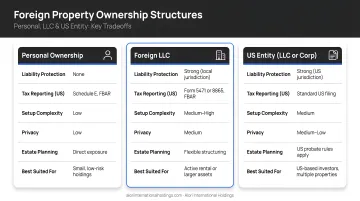
The right structure depends on your investment goals, portfolio size, estate planning needs, and the destination country's rules. Consult both US and local tax advisors before structuring your purchase — the wrong choice early can be costly to unwind.
How to Get Started: A Practical Roadmap
Step 1: Define Investment Goals
Clarify whether you're prioritizing rental yield, capital appreciation, lifestyle use, or residency pathways. A vacation property in Portugal's Algarve serves different goals than a Tbilisi apartment purchased purely for rental income and appreciation.
Step 2: Select a Target Market
Use fundamentals research—GDP growth, urbanization trends, tourism data, rental yield benchmarks—to identify markets offering the best risk-adjusted returns aligned with your goals. Avoid chasing speculative momentum in overhyped markets.
Step 3: Build a Local Professional Team
Assemble a real estate attorney, licensed local agent, and cross-border tax advisor before viewing properties. These professionals navigate legal procedures, verify title structures, assess developer credibility, and identify micro-locations with genuine demand. Skipping this step is the most common and costly mistake international investors make.
Step 4: Conduct Thorough Due Diligence
Verify:
- Legal title and ownership history
- Zoning and permitted uses
- Outstanding liens or encumbrances
- Developer track record and financial stability (for new construction)
- Comparable sales data supporting pricing
- Realistic rental demand and management options
Step 5: Close Through a Properly Structured Legal Entity
Execute the purchase through the ownership structure identified with your advisors, ensuring all tax reporting obligations are understood upfront. Obtain comprehensive insurance and establish property management before the first rental guest arrives.
Vetted Projects and Defined Exit Strategies
One of the highest risks in international real estate is purchasing a property without a clear resale market or rental demand. Only enter deals where:
- Legal structures have been verified by local counsel
- Comparable sales support pricing (not developer projections alone)
- A realistic exit path (resale, long-term rental, or conversion) has been identified in advance
Alori International Holdings applies this framework directly — sourcing opportunities in Portugal and Georgia where structural demand, legal transparency, and exit liquidity are confirmed before a deal reaches investors.
Common Pitfalls to Avoid
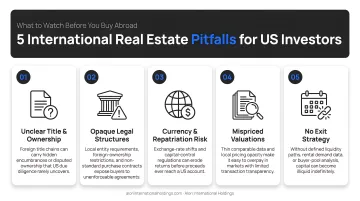
- Speculative momentum buying — when pricing disconnects from fundamentals, returns collapse once the hype fades
- Underestimating ongoing costs — local management, currency conversion, international banking fees, and maintenance typically run higher than projected
- Using domestic-only advisors — your US accountant or attorney likely lacks the specialized knowledge required for Portuguese or Georgian transactions
- Ignoring currency conversion drag — moving dollars to euros or lari incurs fees of 0.5–2%, plus exchange rate fluctuations that erode returns if not modeled in advance
- No exit strategy — a property that's hard to resell and doesn't generate enough rent to cover costs is a liability, not an asset
Frequently Asked Questions
How to get into purchasing international real estate?
Start by defining your investment goal (yield, appreciation, or lifestyle), selecting a stable foreign market with strong fundamentals, and assembling a local professional team including an attorney, agent, and tax advisor to guide you through the legal and transactional process.
Is investing in international real estate worth it?
Yes — for investors who choose markets carefully. International real estate offers diversification, inflation protection, and access to higher-growth economies. Returns depend on market selection, correct ownership structuring, and reliable local expertise.
Can a US citizen buy property abroad?
Yes. US citizens can purchase property in most countries with minimal restrictions, though some nations limit foreign ownership in specific zones or require permits. US investors must also comply with IRS reporting requirements on foreign income, assets, and overseas bank accounts.
Which country is best to buy property for foreigners?
The right country depends on your investment goals. Portugal and Georgia consistently rank highly for foreign buyers — both offer open ownership laws, accessible price points ($100,000–$600,000 range), strong rental demand, and favorable tax environments. Market fundamentals matter more than country prestige.
What is the 2% rule for property?
The 2% rule is a US-centric benchmark suggesting monthly rent should equal at least 2% of purchase price to indicate positive cash flow. This rule rarely applies in international markets where yield benchmarks, tax structures, and management costs differ significantly—calculate country-specific net yields instead.