

This guide cuts through the noise with a disciplined investment lens. It answers the questions that matter: whether the case for Portugal still holds, where the best opportunities are, what the buying process looks like for foreigners, how much it truly costs, and what risks to weigh honestly.
Who This Guide Is For: American and international investors in the $150,000–$600,000 range evaluating Portugal as a long-term, income-generating, or lifestyle-linked asset—not speculators chasing short-term gains.
What You'll Learn: Whether the investment case still holds, where the best opportunities are, what the buying process looks like for foreigners, how much it truly costs, and what risks to weigh honestly.
TLDR: Key Takeaways for the Busy Investor
- Foreigners, including Americans, can own property in Portugal with no restrictions—straightforward with proper legal guidance
- Property prices have risen significantly since 2014 but vary widely by region—entry opportunities still exist outside Lisbon's prime core
- The Golden Visa real estate route closed in October 2023; residency now runs through D7, D8, or investment fund pathways
- Rental yields average 4.33% nationally, with coastal and urban short-term markets consistently outperforming that figure
- The 2026 investment case favors long-term, structurally-driven buyers over those chasing rapid price appreciation
Why Portugal Real Estate Still Makes Sense for Long-Term Investors in 2026
Macroeconomic Stability as the Foundation
Portugal's economy posted 2.4% real GDP growth in Q3 2025, outperforming many European peers. The European Commission forecasts 2.2% growth for 2026, while the IMF projects 2.1%. Steady, controlled growth — backed by disciplined debt management and structural reforms — is exactly what long-term property investors need. Growing economies support housing demand, wage growth, and rental affordability without the volatility that follows speculative cycles.
Structural Demographic Demand: The Migration Tailwind
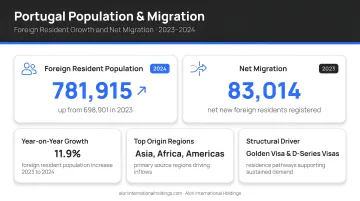
Portugal's foreign resident population reached 1.54 million by December 2024, up from just over 1 million in 2023. The drivers are structural: Northern Europeans relocating to escape high energy costs, persistent inflation, and cost-of-living pressure at home. Portugal offers sun, safety, low living costs, and EU membership. Net migration in 2023 reached 155,701, translating into durable housing demand across a 5–10 year horizon.
Tourism-Driven Income Potential
Portugal logged 29 million non-resident tourist arrivals in 2024, a 9.3% increase over 2023. Short-term rental occupancy reflects that volume: Lisbon averages 67% and Porto 66% year-round. For income-focused investors, those occupancy rates support predictable cash flow in both coastal and urban markets.
Dollar Purchasing Power: The American Advantage
For American buyers, the EUR/USD exchange rate is a variable worth tracking closely. A €300,000 property in Lisbon costs roughly $330,000 at current rates. During periods of dollar strength, that same asset may price between $310,000 and $320,000 in USD terms — a 3–6% reduction before any negotiation. Euro-denominated assets become more accessible when the dollar strengthens, creating periodic entry windows that US-based investors can plan around.
Structural Demand vs. Speculative Boom
The Golden Visa era attracted passport-seekers, not income investors. That chapter has closed. Today's demand comes from a different profile entirely:
- Lifestyle migrants relocating permanently from Northern and Western Europe
- Digital nomads seeking EU-based residency with low tax exposure
- Retirees drawn by climate, healthcare access, and purchasing power
- Short-term rental demand from 29 million annual tourist arrivals
This demand base supports steady rental yields and measured appreciation — the kind built on fundamentals rather than policy cycles.
Portugal Property Market in 2026: Prices, Hotspots & Rental Yields
Where to Invest: Regional Breakdown
Portugal's five primary investment regions each serve a different buyer profile — from capital appreciation plays in Lisbon to lifestyle-driven entry points on the Silver Coast. Here's how they compare on price and investment case.
| Region | Median Price | Best For |
|---|---|---|
| Lisbon (Greater Lisbon) | €3,567/m² | Capital appreciation, short-term rentals |
| Algarve | €3,203/m² | Holiday rentals, lifestyle use + income |
| Madeira | €2,512/m² | Expat communities, lower entry point |
| Porto Metropolitan Area | €2,350/m² | Mid-market rentals, long-term growth |
| Silver Coast | Sub-€2,000/m² | Entry-level appreciation plays |
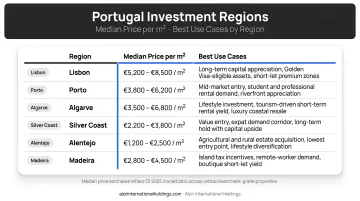
Lisbon commands the highest prices nationally — strong liquidity and high transaction velocity, but limited affordability for first-time investors. Best suited for buyers targeting tourist and expat rentals with an eye on capital growth.
Porto offers better value with rising international visibility. The historic Ribeira district and waterfront Foz do Douro attract young professionals and students, keeping rental demand steady and yields competitive.
The Algarve is Europe's most-visited beach region. The Golden Triangle (Quinta do Lago, Vale do Lobo, Vilamoura) delivers strong short-term rental yields through year-round tourism — properties here work for both income generation and personal use.
Madeira trades on its Atlantic island setting and subtropical climate. Prices run below mainland coastal markets, and a growing expat base is steadily building rental demand and resale liquidity.
The Silver Coast (Nazaré, Peniche, Óbidos) offers the lowest entry prices nationally, with apartments available under €200,000. Returns here are better framed as a long-term appreciation play than an immediate income strategy.
From €763/m² to €2,111/m²: A Decade of Structural Rerating
National median property prices rose from approximately €800/m² in 2014 to €2,111/m² in Q3 2025 — a structural rerating driven by EU integration, migration inflows, and sustained tourism growth. Another decade of similar appreciation is unlikely, but full reversal is equally improbable given persistent housing undersupply, continued migration, and Portugal's entrenched position as a global tourist destination.
Investment Brackets: What Your Budget Buys
€150,000–€200,000 (~$165,000–$220,000):
- Entry-level apartments in Porto or Silver Coast secondary cities
- Studio or one-bedroom units in emerging neighborhoods
- Long-term rental or personal use focus
€300,000–€500,000 (~$330,000–$550,000):
- Two-bedroom apartments in Lisbon suburbs (Cascais, Oeiras)
- Beachfront or golf-adjacent properties in the Algarve
- Branded residences with hotel management in emerging projects
€500,000–€700,000 (~$550,000–$770,000):
- Prime Lisbon neighborhoods (Príncipe Real, Santos, Chiado)
- Golden Triangle villas in the Algarve with short-term rental infrastructure
- Larger Madeira properties with sea views and strong expat resale market
Rental Yields and Income Potential
National average gross rental yield: 4.33%. City-level breakdown:
- Lisbon: 3.82% average (1-bedroom: 4.34%)
- Porto: 4.02% average (1-bedroom: 4.07%)
- Faro (Algarve): 4.23% average (Studio: 5.23%)
- Setúbal: 5.09% average
- Braga: 4.70% average
Short-term holiday rentals (Alojamento Local) typically deliver 5–7% gross yields in coastal and urban markets, but require licensing and active management.
The Off-Market Advantage
Prime listed inventory moves fast — and listed prices reflect that speed. Off-market access changes the equation. Properties sourced through local networks before public listing typically offer better entry prices and arrive with pre-verified legal structures, meaning fewer surprises during due diligence.
Alori International Holdings operates specifically in this space, sourcing curated Portuguese opportunities through in-country relationships rather than open-market searches. The focus is on projects with verified ownership chains, defined exit strategies, and pricing grounded in fundamentals — not momentum.
Buying Property in Portugal as an American: Process, Advantages & Requirements
Foreign Ownership Rights and Key Requirements
Zero restrictions. Americans have identical property ownership rights to Portuguese citizens under Article 14 of the Portuguese Civil Code. The legal prerequisites are minimal:
- Portuguese Tax Identification Number (NIF): Can be obtained remotely through a legal representative with power of attorney—no initial travel required
- Proof of identity: Valid passport
- Portuguese bank account: Practical for transactions, though not legally required
American-Specific Cross-Border Considerations
US buyers face a handful of reporting obligations that Portuguese buyers do not. Before purchasing, confirm you understand these with a US-qualified international tax advisor:
- Tax treaty: The US-Portugal tax treaty covers rental income and capital gains. Portugal taxes income from Portuguese property first; the US taxes it too, though foreign tax credits typically offset double taxation.
- FBAR: If your Portuguese bank account exceeds $10,000 at any point during the year, you must file FinCEN Form 114 annually.
- US return reporting: All rental income from Portuguese property must appear on your US federal tax return, regardless of where it's earned or held.
The Buying Process: Step-by-Step
- Obtain NIF through Portuguese tax office or legal representative
- Open Portuguese bank account for funds transfer and ongoing payments
- Engage licensed Portuguese lawyer for due diligence and title verification
- Conduct property search, make offer, negotiate terms and price
- Sign Promissory Contract (CPCV) with deposit (typically 10%)
- Complete due diligence on title, encumbrances, planning status
- Sign Final Deed (Escritura Pública) before notary
- Register ownership at Land Registry (Conservatória do Registo Predial) and Tax Office
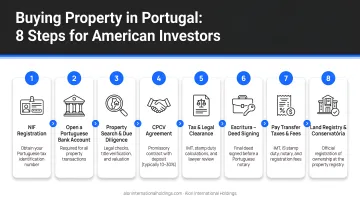
Timeline: 30 to 90 days from offer to final deed. Off-plan developments run longer, though they typically offer staged payment structures that make capital deployment more predictable.
Working with an in-market partner who understands investment fundamentals alongside the transaction process — not just a listing agent — reduces legal and pricing risk at every stage. That's the difference between closing a transaction and making a sound investment.
Taxes, Transaction Costs & Ongoing Ownership Expenses
Understanding the full cost stack before you sign is essential — transaction costs in Portugal run higher than many investors expect, and tax obligations vary significantly based on residency status.
One-Time Purchase Costs
IMT (Property Transfer Tax):
- Progressive scale from 0% to 7.5% depending on property value and use
- Commercial property: flat 6.5%
- Primary residence: lower brackets with exemptions up to €106,346
Stamp Duty: 0.8% of purchase price
Legal and Notarial Fees: Approximately 2.5%
Land Registry Fees: Approximately €250
Total Transaction Costs: Typically 9–11% above purchase price. A €300,000 property may cost €327,000–€333,000 all-in.
Ongoing Annual Costs
IMI (Municipal Property Tax): 0.3% to 0.45% of cadastral value, set annually by municipality
AIMI (Additional Municipal Tax): 0.7% on cadastral values exceeding €600,000 for individuals; higher rates above €1M
Condominium Maintenance Fees: €25–€200/month depending on building
Utilities: Approximately €120–€150/month for electricity and water
Exit and Income Tax Obligations
Rental Income: Taxed at 25% flat rate for non-residents
Capital Gains: 28% tax on property sale for non-residents
- Exception: Portuguese tax residents who reinvest sale proceeds into a primary residence qualify for a full capital gains exemption
2026 Legislative Changes: The State Budget for 2026 adjusted IMT brackets upward for mid-range properties. Before signing the promissory contract (CPCV), verify current rates with a local tax advisor (fiscalista) — bracket thresholds can shift year to year.
Risks and Honest Considerations for 2026
Price Appreciation Slowdown
Portuguese property prices rose 16.1% year-on-year in Q3 2025. At current valuations—especially in Lisbon prime and coastal Algarve—further rapid appreciation is uncertain. This isn't a deterrent for income-focused investors, but it does mean the investment thesis should center on rental yield and structural demand rather than short-term capital gains.
Policy Risk Environment
- Golden Visa real estate route closure (October 2023): Removed a key demand driver
- NHR tax program replaced by IFICI regime (2024): The new IFICI regime offers a 20% flat tax on Portuguese income and foreign exemptions, but eligibility is restricted to highly qualified professionals
- Tighter immigration controls: While not targeting investors, broader immigration tightening creates uncertainty
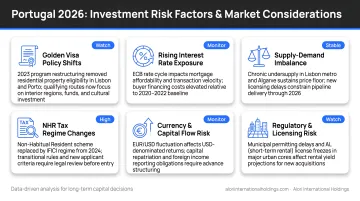
These shifts reflect market normalization, not structural decline. The buyers who remain are organically motivated: lifestyle migrants, digital nomads, and retirees — not visa seekers chasing residency perks.
Currency and Liquidity Risks
Two factors US-based investors should model from the outset:
- Currency exposure: Entry costs and exit proceeds fluctuate in dollar terms with EUR/USD movements. The rate averaged 1.1601 across 2024–2025, but variance can meaningfully affect net returns.
- Exit timeline: Urban centers are reasonably liquid, but Portugal moves slower than US markets. Budget a 6–18 month exit window depending on location, and define your exit strategy before you buy.
Visas & Residency Pathways for Property Buyers
Critical: Purchasing property does not automatically grant residency to non-EU buyers.
D7 Passive Income Visa
Designed for retirees and passive investors, this visa requires proof of €920/month in passive or pension income — tied to Portugal's 2026 minimum wage. Add-on income requirements apply for dependents: spouses need an additional €460/month (50%) and children €276/month (30%). Processing time runs 3–6 months after biometrics are submitted.
D8 Digital Nomad Visa
Built for location-independent professionals, the D8 requires €3,680/month in verifiable remote income — four times the national minimum wage. Processing time is 3–6 months, comparable to the D7.
Golden Visa (Current Routes)
The real estate route is closed, but the program remains open via:
- €500,000 minimum in qualifying investment funds (regulated by Portuguese Securities Market Commission)
- €250,000 minimum donation to cultural heritage projects
The Golden Visa provides a 5-year pathway to permanent residency and eventual citizenship eligibility. It now operates as a standalone investment vehicle with no link to property ownership. Expect 12–18 months of processing time due to ongoing AIMA backlogs.
Frequently Asked Questions
Can foreigners own real estate in Portugal?
Yes, foreigners—including Americans—face no restrictions on property ownership in Portugal. You have the same rights as Portuguese citizens and simply need a NIF number and valid identification to proceed.
Is Portugal a good place to invest in property?
It depends on your objective. For long-term rental income, lifestyle diversification, and structural demand plays, yes. Investors expecting rapid capital appreciation similar to the 2018–2022 cycle should calibrate expectations for a more moderate environment in 2026.
Why are Americans buying property in Portugal?
Favorable dollar-to-euro purchasing power, Portugal's safety and warm climate, English-language friendliness, low cost of living relative to Western Europe, and straightforward residency pathways like the D7 visa align well with retirement or semi-retirement goals.
Is Portugal still welcoming American expats?
Yes. Portugal remains one of the most accessible European countries for American expats, with established D7 and D8 visa routes, no property ownership restrictions, and a historically welcoming attitude toward international arrivals.
What is the €250,000 Golden Visa in Portugal?
This refers to the cultural/scientific donation route under the Golden Visa program (donating €250,000 to qualifying cultural heritage projects), not a real estate route. The real estate investment option was permanently closed in October 2023.
Can I live comfortably in Portugal on $3,000 a month?
Yes. $3,000/month is sufficient for a comfortable lifestyle in most Portuguese cities outside Lisbon's prime neighborhoods, covering rent, utilities, food, transport, and leisure.