

Introduction
For American investors, European property offers something US markets increasingly struggle to provide: affordable entry points, genuine diversification, and exposure to tourism-driven economies where demand stays structurally intact. Markets like Portugal and Spain still price well below comparable US gateway cities — and they come with residency pathways and tax advantages that add a layer most domestic investments can't match.
The complexity, though, is real. Cross-border purchases mean foreign legal systems, currency exposure, unfamiliar tax obligations, and transaction norms that diverge sharply from US practice. Getting these right determines not just your returns, but your legal protection, liquidity, and long-term wealth position.
TLDR:
- Americans can successfully buy European property with market-specific research, local legal counsel, and a disciplined entry strategy
- Vet market fundamentals, foreign ownership rules, tax treaties, currency risk, and transaction costs before committing
- Due diligence, proper ownership structure, and a vetted local team are your primary risk controls
- Define your exit strategy before purchase — not after
Why More Americans Are Buying Property in Europe
American buyers are increasingly active in European markets, driven by several broader economic shifts. Dollar strength relative to the euro has improved purchasing power, while entry price points in markets like Lisbon, Madrid, and Barcelona remain accessible compared to US coastal cities. In Spain, foreign buyers accounted for 18% of all home purchases in the year leading to Q1 2025, with US buyers emerging as the top foreign nationality in five autonomous communities.
The appeal extends beyond price. European property offers genuine portfolio diversification away from US-correlated domestic risk — exposure to different economic cycles, currencies, and demand drivers.
The structural case is also hard to ignore. Select markets combine strong migration inflows with constrained housing supply and active tourism economies. Portugal's tourism exports reached €4.3 billion monthly, while Spain recorded net external migration of over 626,000 people in 2024 — both figures pointing to structural rental demand that supports cash flow and long-term appreciation.
For American investors, the case is both financial and personal. Key drivers pulling capital toward markets like Portugal and Spain include:
- Portfolio diversification away from US equities and domestic real estate
- Lifestyle value — climate, cultural access, and quality of life that US cities can't replicate at similar price points
- Rental income potential backed by sustained tourism and migration demand
- Favorable regulatory environments — transparent legal systems, tax treaties, and clear pathways for foreign buyers
Together, these factors have made Portugal and Spain two of the most consistent destinations for US capital in European real estate.
How to Choose the Right European Market
Market selection is the single most consequential decision in a cross-border purchase. The wrong market can mean poor liquidity, weak rental demand, or title complications regardless of how well the individual property is priced. Check ownership rules before evaluating any specific property — Portugal and Spain welcome US buyers with no restrictions, while other jurisdictions may limit access to agricultural land, coastal properties, or designated zones.
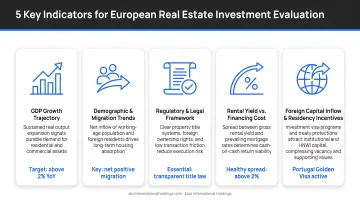
Key Indicators to Evaluate
Start by assessing macroeconomic and structural fundamentals:
- GDP growth trajectory: Spain's GDP is projected to grow 2.9% in 2025 and 2.3% in 2026, outpacing broader Eurozone averages
- Population trends: Portugal's resident population reached 10.64 million in 2023, growing for the fifth consecutive year entirely due to positive net migration of 155,701
- Tourism demand: Sustained tourism flows create rental income opportunities and support property values in gateway cities and coastal regions
- Infrastructure investment: Transportation, digital connectivity, healthcare, and urban development signal long-term demand sustainability
- Regulatory environment: Not all European markets allow foreign ownership equally — some countries restrict non-EU buyers' access to certain property types or areas
Market Archetypes: Gateway vs. Emerging
Established gateway markets (France, Spain) offer:
- Proven liquidity and resale depth
- Transparent legal frameworks
- Strong institutional infrastructure
- Higher entry prices
High-growth emerging markets offer:
- Lower entry price points
- Earlier-stage appreciation potential
- Greater execution risk
- Less standardized transaction processes
Portugal sits between these two archetypes. It combines robust tourism demand (over 1.28 million international arrivals in 2024), entry price points in the $150,000–$500,000 range, bilateral tax treaties with the US, and demographic tailwinds from expat and remote worker inflows — without the execution risk of less-established markets.
Alori International Holdings applies a "high-conviction market" methodology — assessing macroeconomic data, capital flows, and regulatory frameworks before committing to any location. Individual buyers should adopt the same discipline: resist momentum-driven markets and focus on locations where structural demand — constrained housing supply, growing employment, solid tourism infrastructure — supports value through market downturns.
Legal and Regulatory Requirements Every Foreign Buyer Must Know
European property law is not standardized across the EU. Each country maintains its own land registry, ownership rules, purchase procedure, and title verification process. That means what applies in Portugal may be entirely irrelevant in Spain — and assuming otherwise is one of the most common mistakes foreign buyers make.
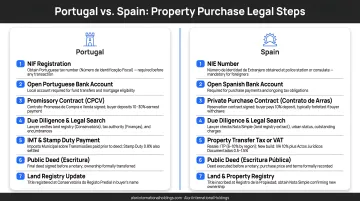
Core Legal Steps in a Typical Purchase
Portugal:
- NIF Acquisition: Obtain a Número de Identificação Fiscal (tax identification number) before executing any contracts or opening local bank accounts
- CPCV (Promissory Contract): A legally binding preliminary contract where buyers deposit 10-30% of purchase price; default by buyer forfeits deposit, default by seller requires return of double the deposit
- Escritura Pública: The final deed of sale executed before a notary, followed by registration at the local land registry
Spain:
- NIE Acquisition: Obtain a Número de Identificación de Extranjeros at a Spanish consulate or police station
- Contrato de Arras: Preliminary agreement involving a deposit (typically 10%) with similar penalty structures for withdrawal
- Escritura Pública: Public deed signed before a notary who verifies identities, capacity, and property registry status
Critical Importance of Independent Legal Counsel
Never rely solely on the agent's recommended solicitor. Engage an independent local property lawyer to:
- Verify that the title is clean with no outstanding debts or encumbrances (claims, easements, or liens against the property)
- Confirm all building permits and planning documentation are in order
- Conduct a full title search via the local land registry
- Review any condominium or homeowners' association rules and fees
Key Legal Risks for Cross-Border Buyers
Three risks consistently catch foreign buyers off guard:
- Hidden debts on the property — Liens and mortgages can transfer to the new owner if not uncovered during due diligence. A title search via the local land registry is non-negotiable.
- Unpermitted construction — Common in rural Spain and parts of Southern Europe, buildings without proper permits can face demolition orders. The regional government in Andalusia recently executed demolitions of illegal homes built on rustic land.
- Unclear freehold title — Some sellers do not hold clean ownership, creating complications that may only surface when you try to resell.
These risks aren't theoretical. Verify the Licencia de primera ocupación (First Occupation License) in Spain — or its equivalent in other countries — to confirm the property is legally habitable and free from enforcement action before contracts are signed.
Financing, Currency Risk, and Tax Implications for US Buyers
The Financing Landscape
Most American buyers face restrictions on obtaining local mortgages without European residency or local income, making cash purchases more common. Where European mortgages are available to non-residents (Portugal, Spain, France), lenders typically require:
- Down payments of 30–40% (LTV ratios capped at 60–70% for non-residents)
- Proof of foreign income and financial stability
- Local bank account setup before mortgage approval
Currency Risk Management
Purchasing in euros means US dollar fluctuations can impact your effective purchase price and ongoing costs. A 5% currency swing can add or subtract thousands of dollars from your transaction.
A few practices help manage this exposure:
- Research hedging tools such as forward contracts and limit orders through FX specialists
- Build a currency strategy into your purchase timeline from the start
- Time euro purchases when exchange rates are favorable where possible
- Factor currency volatility into your return projections
US Tax Obligations
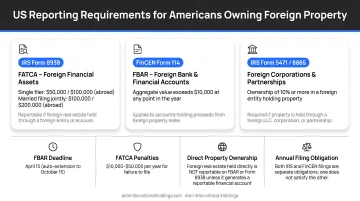
Currency management is only part of the financial picture. American owners of foreign property also face several IRS and FinCEN reporting requirements:
- FBAR (FinCEN Form 114): Required if foreign bank accounts exceed $10,000 at any point during the calendar year
- FATCA (Form 8938): Unmarried US-resident taxpayers must report foreign financial assets exceeding $50,000 at year-end or $75,000 at any point during the year
- Foreign rental income: Reported on US tax returns and taxed as ordinary income
- Capital gains on sale: Subject to US taxation; foreign tax credits apply for taxes already paid in the host country
Bilateral Tax Treaties
Many European countries have bilateral tax treaties with the US that affect how rental income and capital gains are taxed. Under the US-Portugal Tax Treaty, Article 6 grants Portugal (the source country) the right to tax rental income from Portuguese property, while Article 14 allows Portugal to tax capital gains from real property sales. However, US taxpayers can claim foreign tax credits to reduce double taxation. A US CPA with international real estate experience can map the specific treaty provisions for your target country before you commit to a purchase.
Conduct Proper Due Diligence and Build a Local Team
Thorough due diligence extends well beyond the property inspection. Before signing anything, verify:
- Full title search at the local land registry
- Condominium or homeowners' association rules and fees
- Planning permissions and current energy certificates
- Realistic renovation cost estimates for older properties
Building a Credible Local Team
Your local team should include:
- Independent property lawyer — hire your own bilingual counsel (not the agent's referral) to verify title, check for liens, and review contracts
- Licensed local real estate agent — with verifiable transaction history in your target market, not just language skills
- Local accountant or tax advisor — one who knows both local tax obligations and US reporting requirements
- Property manager — if rental income is part of your plan, confirm they understand local licensing, tourism regulations, and tenant law
Alori International Holdings pairs global investment strategy with in-country legal and transaction networks — particularly useful in markets like Portugal, where off-market access and local regulatory knowledge often determine whether a deal closes cleanly or stalls.
Red Flags to Watch For
- Pressure to sign without adequate review time
- Agents or developers discouraging independent legal counsel
- Unusually low prices relative to comparables (may indicate title problems or unpermitted construction)
- Properties with unclear or complex ownership histories
- Missing or incomplete building permits
- Outstanding community fees or property taxes
Energy Performance Certificates
Documentation gaps are among the most common red flags — and Energy Performance Certificates (EPCs) are a prime example. Both Spain and Portugal require EPCs for any property sale or rental. In Portugal, listing a property without one can draw fines between €250 and €3,740. Always confirm the EPC is current and accurate before proceeding.
Plan Your Entry Structure and Exit Strategy
How you structure property ownership—as an individual, through a foreign holding company, or via a trust—has significant implications for estate taxes, wealth taxes, rental income taxation, and ease of transfer. What works in the US rarely maps cleanly onto European tax law. Run the numbers on each structure before you sign anything.
Ownership Structure Considerations
- Individual ownership is the simplest path, but exposes you to higher estate and wealth taxes in many European jurisdictions
- Foreign holding companies give you estate planning flexibility across multiple properties — at the cost of added compliance overhead
- Trust structures offer asset protection and succession benefits, though they require careful alignment with both US and host country law to hold up
Consult with both US and local tax advisors to determine the optimal structure for your specific situation.
Define Your Exit Strategy Before Purchase
Define your exit strategy before you sign — not as an afterthought. Four factors shape how cleanly you'll be able to exit:
- Local resale market depth: Verify that your property type and location has a demonstrable buyer pool — both domestic and international — before assuming a liquid exit is available
- Time-on-market: Research comparable sales to set realistic timelines; some European markets move slowly outside peak seasons
- Sale-side transaction costs: In Portugal, capital gains are taxed at progressive rates up to 28% (with exemptions available); in Spain, non-residents face a flat 19% capital gains rate — plus notary fees and agent commissions on both
- Buyer pool composition: Properties targeting only international buyers face real liquidity risk during currency volatility or economic downturns
Transaction Costs on Purchase
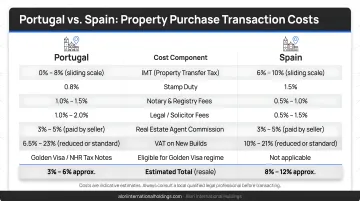
Understanding exit costs feeds directly into purchase budgeting. On the way in, plan for an additional 10–15% of the purchase price in closing costs.
Portugal:
- IMT (Municipal Property Transfer Tax): Tiered rates up to 8% for secondary homes, with specific rates based on property value
- Stamp duty: Flat 0.8% of purchase price
- Notary and registration fees: Approximately 1-2%
Spain:
- ITP (Property Transfer Tax): Varies by region; Andalusia applies a flat 7% rate on resale properties
- Notary and registration fees: Approximately 1-2%
- Legal fees: Around 1% of purchase price
Frequently Asked Questions
Can Americans buy property in Europe?
Yes, US citizens can generally buy property in most European countries, though ownership rules, purchase procedures, and tax implications vary by country. Portugal and Spain welcome foreign buyers with no ownership restrictions, while others impose limitations on certain property types or zones.
What are the 2% rule, 3-3-3 rule, and 7% rule in real estate investing?
These are US-derived investing benchmarks:
- 2% rule: Monthly rent should equal 2% of the purchase price
- 7% rule: Property should generate at least 7% annual return
- 3-3-3 rule: Spend no more than 3x your income on property, with 30% of income on housing costs
All three apply differently in European markets, where price-to-rent ratios tend to be lower than US norms.