

Introduction
US real estate is increasingly overpriced and over-leveraged. Meanwhile, Tbilisi—a European capital—still offers city-center apartments under $1,500 per square meter with rental yields that would be unthinkable in Los Angeles or New York. According to the IMF's 2025 projections, Georgia's economy is expected to grow 7.2%, vastly outpacing the US at 2.0%. This is a market where data, fundamentals, and timing align for serious international investors.
This guide covers why Tbilisi attracts American capital, how the market is structured, what the tax framework looks like, and how to execute a purchase as a foreign buyer. Whether your priority is portfolio diversification, tax-efficient rental income, or residency access, this is the entry point that makes those goals achievable in 2025 without the pricing distortions built into Western markets.
TLDR: Key Takeaways
- Foreigners can own non-agricultural property in Georgia with the same rights as citizens — no restrictions, no stamp duty
- Tbilisi prices remain among Europe's lowest, with gross rental yields from 6–18% depending on strategy and location
- Georgia offers 0% capital gains tax after two years and a flat 5% tax on registered rental income
- Transactions close in 1–2 business days — fast by any standard, though local expertise is essential to due diligence
- Property investments above $150,000 qualify buyers and families for renewable Georgian residence permits
Why Tbilisi Real Estate Stands Out for American Investors in 2025
Strong Economic Growth in a Low-Correlation Market
Georgia's projected 7.2% real GDP growth in 2025 runs well ahead of both the US (2.0%) and the Euro Area (1.2%). That gap matters. For American investors, it means accessing appreciation that moves on its own cycle — not in lockstep with US housing or equity markets.
Holding GEL- or dollar-denominated assets in Georgia reduces domestic concentration risk without requiring complex structures or offshore vehicles.
The 2025 Market Moment
After the sharp price spike driven by post-2022 migration inflows, Tbilisi rent prices normalized through 2023–2024, returning closer to pre-spike levels. This normalization creates a more sustainable and attractive entry point for long-term investors rather than signaling weakness. Transaction volumes stabilized at over 40,000 units in 2024, with price growth moderating to a sustainable 11.6% year-over-year.
That combination — stable transaction volume plus moderate price growth — is the profile of a market consolidating after a demand shock, not one losing momentum. It's the kind of entry window that's harder to find once the next migration or capital flow cycle begins.
Purchasing Power and Diversification
Consider what $200,000 actually buys:
- Tbilisi: A renovated two-bedroom apartment in Saburtalo or Vake, generating 6–9% annual rental yield
- Los Angeles: A down payment on a small condo in a secondary neighborhood, with minimal cash flow after mortgage and taxes
Georgia ranks 35th globally in the 2025 Heritage Foundation Index of Economic Freedom, reflecting a regulatory posture that has consistently favored foreign capital. Foreign nationals can purchase freehold property with no ownership restrictions, no capital gains tax on long-term holds, and a flat 20% income tax rate — a combination rare in emerging markets at this price point.
Tbilisi Neighborhoods and Market Prices: Where to Invest
Price Tiers and Neighborhood Categories
Tbilisi's property market operates across distinct price tiers, each offering different risk-return profiles:
| Neighborhood Tier | Districts | Avg. Price per Sqm (USD) | Long-Term Gross Yield |
|---|---|---|---|
| Prime Central | Mtatsminda, Old Town (Kala) | $2,471 | 5.0% - 5.65% |
| Established Inner | Vake, Vera, Sololaki | $2,146 | 6.24% - 6.67% |
| Modern Mid-City | Saburtalo | $1,568 | 5.89% - 7.07% |
| Outer/Developing | Gldani, Didi Dighomi, Isani | $1,288 - $1,394 | 7.12% - 10.18% |
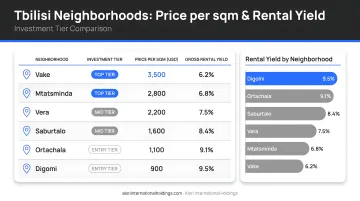
Data sourced from Global Property Guide (May 2025).
Matching Neighborhood to Investment Strategy
Each price tier maps to a different investor profile. Here's how to align your strategy to the data above:
Target short-term/Airbnb returns → Old Town, Mtatsminda, Vera: Tourist proximity supports strong nightly rates. Premium entry prices protect capital but compress long-term yields.
Target stable long-term income → Saburtalo and Vake: Consistent demand from expats, university students, and local professionals keeps vacancy low. These districts offer a reliable tenant pool with steady appreciation.
Target growth over income → Gldani and Didi Dighomi: Lower entry prices and ongoing infrastructure investment create appreciation upside. Better suited to investors comfortable with a 5–10 year hold horizon.
Yield Expectations by Rental Type
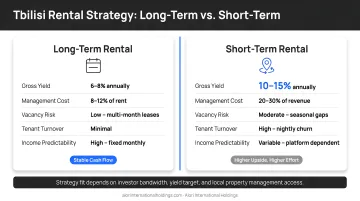
Neighborhood choice also shapes which rental strategy is realistic. The yield gap between approaches is significant:
- Long-term rentals (6+ months): 6–9% gross annually — lower management burden, more predictable income
- Short-term rentals (Airbnb-style): 12–18% gross at strong occupancy, though median Tbilisi Airbnb occupancy sits at 63% with an average daily rate of $42
- Management fees: Budget 15–25% of gross income for professional short-term rental management — a necessary cost if you're operating remotely
New-Build vs. Resale Decision
New developments offer:
- Modern amenities and cleaner legal histories
- Developer-backed rental management programs
- Below-market entry pricing (15–30% discount on off-plan purchases)
- 0% interest installment plans up to 48 months
Resale properties in older Soviet-era buildings:
- Lower purchase prices
- Renovation risk and unclear title histories
- Shared building decisions (repairs, common areas) can be difficult to coordinate among Soviet-era co-owners
- Higher due diligence requirements
For first-time foreign investors, new developments provide lower execution risk.
Georgia's Tax Advantages for Real Estate Investors
Capital Gains Tax Structure
Property sold after two years of ownership is subject to 0% capital gains tax. Property sold within the first two years is taxed at 5% on the gain.
Comparison to US rates:
| Tax Category | Georgia | United States (Federal) |
|---|---|---|
| Long-Term Capital Gains | 0% (after 2 years) | Up to 20% + 3.8% NIIT |
| Short-Term Capital Gains | 5% (under 2 years) | Up to 37% (ordinary income) |
| Depreciation Recapture | N/A | Up to 25% |
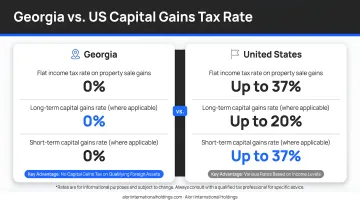
US investors must still report global income to the IRS, but Georgia's 0% local rate prevents double taxation drag on the Georgian side.
Rental Income Tax Rules
Registered residential landlords pay a flat 5% on gross rental income. Unregistered landlords default to the standard 20% personal income tax rate — four times higher.
The registration process is simple and the tax difference makes it a clear default choice:
- Registered landlord: 5% flat tax on gross rental income
- Unregistered landlord: 20% personal income tax rate (standard default)
Annual Property Holding Costs
Georgia charges no stamp duty on purchases. Annual property tax is capped at 1% of appraised value for most residential property and often lower depending on municipality and income level. By comparison, US effective property tax rates average 0.9%–2.2% annually depending on the state — and that's before factoring in transfer taxes and local assessments Georgia doesn't impose.
Georgian Tax Residency Option
For investors who plan to spend significant time in the country, Georgia's low holding costs open the door to a more structural tax planning option. Spending 183+ days per year qualifies for Georgian tax residency, granting access to the territorial tax system where foreign-sourced income is not subject to Georgian tax. This is an advanced strategy — consult a qualified tax advisor before acting on it.
How to Buy Property in Tbilisi: The Step-by-Step Process
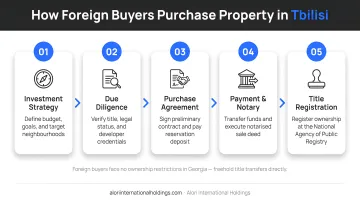
The Purchase Process
1. Define your investment strategy and target neighborhoods Identify whether you're prioritizing cash flow (long-term rentals in Saburtalo/Vake) or appreciation (emerging districts or off-plan developments).
2. Engage vetted local legal representation Verify cadastral code, ownership history, and absence of liens through the Public Service Hall register. This digitized public cadastre is accessible online and reveals the legal owner, exact square footage, and any registered encumbrances.
3. Negotiate and finalize terms Georgians rarely negotiate aggressively on price. Don't expect significant discounts from the asking price.
4. Execute the purchase agreement Contracts are in Georgian with certified translation. A Power of Attorney allows the entire process to be completed remotely.
5. Register ownership transfer Registration takes 1–4 business days via the Public Service Hall. Same-day service is available for a premium (350 GEL, approximately $128 USD).
Practical Transaction Realities
Most deals are conducted in cash or via international bank transfer. Mortgages are available for foreigners through Bank of Georgia or TBC, though the terms differ significantly from US norms:
- Down payment: 30%+ required
- Loan term: Maximum 20 years
- USD loan rate: Around 7.5%
- GEL loan rate: Around 10.7%
Opening a Georgian bank account before closing is strongly advised to facilitate transfers and avoid withdrawal fees.
Where Alori International Holdings Fits
For American investors, the process above is manageable — but only if you know which agents to trust, which listings are accurately priced, and which legal structures hold up at exit. Alori International Holdings removes that uncertainty by providing pre-screened property opportunities with verified legal structures, transparent pricing, and defined exit strategies.
Working with Alori gives investors direct access to:
- Off-market opportunities through established developer relationships
- Priority entry into select developments before public launch
- Legal coordination across jurisdictions with vetted local partners
- Below-market entry pricing through developer relationships (typically 15–30% below completed market value)
Alori functions as an independent advisor, not a listing portal. The focus is selective: a small number of well-researched opportunities where the fundamentals — demand drivers, legal clarity, and realistic exit paths — have already been stress-tested.
Common Pitfalls and How to Avoid Them
Unregulated Real Estate Agent Market
Anyone can call themselves a real estate agent in Georgia with no qualifications or accountability. Many listings on public portals like myhome.ge or ss.ge are outdated, duplicated, or entirely fake.
Protect yourself by:
- Refusing to rely on a single agent's portfolio or verbal assurances
- Conducting independent legal verification before committing to anything
- Working with established firms that have verifiable track records
Foreigner Premium Risk
Some sellers inflate prices when they identify a foreign buyer. A Georgian-speaking representative who initiates contact and handles early negotiations can neutralize this premium before it takes hold.
Agricultural Land Restriction
Foreigners cannot purchase agricultural land. Some properties on the outskirts of Tbilisi or in villages may sit on land still zoned agricultural — a legal red flag that can render a purchase unenforceable.
Always verify zoning through a qualified Georgian attorney before committing. Check the property's cadastral code through the Public Registry to confirm residential classification.
Foreclosure and Informal Claim Risks
Foreclosed properties in Georgia can carry hidden exposure that doesn't appear in registry records. Family members, neighbors, or informal co-claimants may assert rights to a property after sale — disputes that can be difficult to resolve through standard legal channels.
Before pursuing any foreclosure purchase, have a Georgian attorney conduct a full title history review and confirm there are no pending claims or unresolved disputes attached to the property.
Frequently Asked Questions
Can Americans buy property in Tbilisi, Georgia?
Yes. US citizens and other foreigners can purchase non-agricultural real estate in Georgia with the same rights as Georgian citizens, with no residency requirement and no foreign ownership restrictions. The one exception—agricultural land—is off-limits for non-citizens.
What are typical rental yields for Tbilisi real estate in 2025?
Long-term rentals (6+ months) typically yield 6–9% gross annually. Short-term/Airbnb-style rentals in tourist-heavy neighborhoods can reach 12–18% depending on occupancy and management quality, though oversupply in the short-term market is creating yield compression risks.
How much does it cost to buy an apartment in Tbilisi?
Prices vary significantly by location and building quality. Prime central areas run $2,471 per square meter while mid-city and suburban areas offer more affordable entry points at $1,288–$1,568 per square meter. Investment-grade apartments commonly targeted by foreign buyers typically range from $150,000 to $400,000.
Do foreigners pay capital gains tax when selling property in Georgia?
Property held more than two years qualifies for 0% capital gains tax. Property sold within two years is taxed at 5% on gains. This is one of Georgia's most investor-friendly tax features compared to US capital gains rates of up to 20% plus 3.8% net investment income tax.
Can buying property in Georgia qualify you for residency?
Yes. Property ownership exceeding $150,000 USD qualifies the buyer and dependents for a renewable annual residence permit (threshold rising from $100,000 effective March 1, 2026). A $300,000 investment unlocks a 5-year permit with a fast-track to permanent residency.
Is Tbilisi real estate a safe investment in 2025?
Tbilisi offers real strengths: a transparent property registry, 7.2% GDP growth projected for 2025, rising international investor interest, and low taxes. That said, an unregulated agent market and an evolving regulatory environment mean due diligence and local legal representation aren't optional — focus on established districts with proven rental demand and work with experienced local partners.
Want to explore specific Tbilisi opportunities? Reach out to Alori International Holdings at info@aloriinternationalholdings.com — we vet properties for legal compliance, pricing integrity, and realistic exit paths before they reach investors.