

Introduction
US real estate valuations are near historic highs, the dollar remains volatile, and European property markets are recovering. For American investors, that combination is hard to ignore.
Europe offers advantages that domestic markets can't replicate:
- Lower entry prices in select markets, often $150K–$400K for income-producing assets
- Strong rental yields driven by structural housing shortages and high tourism demand
- Currency diversification across EUR and GEL, hedging dollar exposure
- Residency pathways — such as Portugal's Golden Visa — tied directly to property investment
This guide covers five European markets with the strongest fundamentals for 2025, what to look for before investing, and what American buyers specifically need to know. For investors who want curated access with in-country guidance — particularly in Portugal — Alori International Holdings works exclusively with US-based capital to source, vet, and execute high-conviction property deals.
Key Takeaways
- European real estate is recovering from a 2022–2023 correction, with valuations still below peak in many markets
- Top-performing 2025 markets offer gross rental yields above 5%, price appreciation, and straightforward entry for foreign buyers
- Five markets stand out for 2025: Portugal, Spain, Italy, Greece, and Poland — with Portugal offering the deepest combination of yield, lifestyle appeal, and residency pathways
- US citizens can legally buy property in almost every European country without restrictions
- Dollar weakness against the euro creates a potential currency advantage for American buyers entering euro-denominated markets
Why European Real Estate Is Worth Investing in Right Now
Post-Correction Opportunity Window
European real estate values dropped significantly from 2022 to 2024 in response to ECB rate hikes. With rates now easing and valuations stabilizing, many markets offer entry prices at a discount to their structural value. European real estate transaction volumes are recovering from their 2023 lows, a sign that capital is returning as borrowing costs fall back toward historical norms. For buyers who can move now, the correction window may not stay open much longer.
Currency-Driven Entry Advantage for US Investors
Currency movement between the US dollar and the euro is a factor American investors cannot afford to ignore. Depending on where the EUR/USD rate sits at the time of purchase, exchange rate dynamics can either reduce or amplify the effective cost of European assets in dollar terms. Timing entry alongside favorable rate conditions compounds the return potential — any appreciation in asset prices is further magnified when converted back to USD. American investors should treat the exchange rate as part of the investment thesis, not an afterthought.
Structural Supply-Demand Imbalance
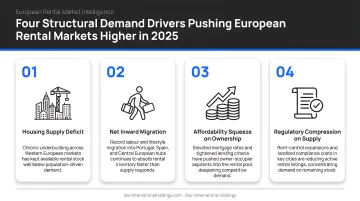
Construction has lagged demand in most major European markets, and the gap is widening. Several overlapping forces continue to drive rental pressure upward:
- Urbanization concentrating population in key city centers
- Tourism demand sustaining short-term rental occupancy in coastal markets
- Remote worker migration from Northern Europe and North America into sunbelt cities
- Foreign buyer demand outpacing new housing supply in markets like Portugal and Greece
This structural imbalance means rental income has a durable floor — not because of speculative momentum, but because the underlying demand is real and persistent.
Best European Markets to Invest in Real Estate in 2025
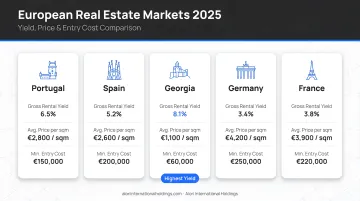
These five markets were selected based on gross rental yield, five-year nominal price performance, foreign buyer accessibility, and structural demand drivers—not lifestyle reputation alone. The analysis covers the broader European opportunity set; Alori International Holdings operates specifically in Portugal, where it provides in-country expertise for American buyers. Use the comparisons below to understand where each market sits relative to your return targets, risk tolerance, and entry budget.
Portugal
Portugal ranks among Europe's most consistent performers for foreign real estate investment, driven by expats, digital nomads, and lifestyle migrants—particularly in Lisbon and the Algarve. Alori International Holdings focuses specifically on Portugal as one of its core markets, providing in-country expertise, pre-screened deal access, and legal clarity for American buyers.
What makes Portugal resilient:
- Non-EU buyers face no ownership restrictions
- Transparent legal framework with full title protection
- Structural housing demand in Lisbon continues to outpace supply
- Growing expat and remote worker communities support rental demand
Portugal's market combines accessibility with fundamentals. The country's progressive IMT transfer tax structure reaches up to 7.5% for investment properties, with an additional 0.8% stamp duty, but the clear regulatory framework and unrestricted foreign ownership make execution straightforward.
| Metric | Portugal 2025 |
|---|---|
| Entry Price Range | €200,000–€500,000 for quality residential property in Lisbon and Algarve |
| Gross Rental Yield | 5.0%–6.5% in Lisbon; 4.5%–6.0% in Algarve |
| 5-Year Nominal Price Change | +15% to +25% (2020-2025) |
Spain
Spain offers a well-regulated market with high rental demand, especially in Valencia, Málaga, and coastal areas. Valencia in particular delivers strong yields at more accessible entry prices than Madrid or Barcelona.
Regulatory context to consider:
Spain has introduced stricter short-term rental rules in major cities and is considering higher stamp duty for non-EU buyers. For investors navigating those restrictions, long-term rental strategies in secondary cities remain a more predictable path. Spain's Property Transfer Tax (ITP) varies by region, ranging from 6% in Madrid to 11% in the Balearic Islands, making location selection critical for total acquisition costs.
| Metric | Spain 2025 |
|---|---|
| Entry Price Range | €180,000–€350,000 for 1-bed property in Valencia or Málaga |
| Gross Rental Yield | 5.5%–7.0% in Valencia; 4.5%–6.0% in Málaga |
| 5-Year Nominal Price Change | +10% to +18% (2020-2025) |
Italy
Italy is a high-yield, lower-appreciation market with gross yields in cities like Florence among the highest in Western Europe. Entry prices remain affordable relative to other major European capitals, with Sicily and smaller Tuscan cities offering sub-€200K entry points.
Key advantage for American investors:
Italy's flat-tax incentive for new tax residents (a flat annual tax on foreign income) can be a meaningful advantage for American investors considering lifestyle migration alongside a property purchase. Italy's 9% registration tax for second homes is calculated on the cadastral value rather than market price, which often results in a lower effective tax burden than the headline rate suggests.
| Metric | Italy 2025 |
|---|---|
| Entry Price Range | €150,000–€300,000 for 1-bed property in Florence or comparable cities |
| Gross Rental Yield | 6.5%–7.8% in Florence; 5.5%–7.0% in secondary cities |
| 5-Year Nominal Price Change | +8% to +12% (2020-2025) |
Greece
Greece's strong recovery trajectory continues, with Athens property prices posting consistent year-on-year growth driven by foreign demand and tourism-fueled short-term rental income. The Golden Visa program remains a draw, though investment thresholds rose to €800,000 in high-demand areas as of 2024. Alternative €400,000 routes still exist in less saturated regions for investors willing to look beyond the prime zones.
Accessibility for American buyers:
A tax registry number (AFM) is required, but foreigners face no ownership restrictions outside designated border areas. Coastal and island properties offer strong short-term rental potential, while Athens provides steadier long-term rental demand. Greece's flat 3.09% Property Transfer Tax makes it one of the most tax-efficient Southern European markets for acquisition.
| Metric | Greece 2025 |
|---|---|
| Entry Price Range | €120,000–€280,000 for Athens; €180,000–€400,000 for popular island markets |
| Gross Rental Yield | 5.0%–6.5% in Athens; 6.0%–8.0% in island short-term rental markets |
| 5-Year Nominal Price Change | +25% to +35% (2020-2025) |
Poland
Warsaw has seen strong nominal price appreciation over five years, driven by a growing middle class, EU structural funding, and steady internal migration. Entry prices remain significantly below Western European equivalents, offering investors a lower-cost entry into a fundamentally growing market.
Legal framework and rental market:
Poland is an EU member with transparent property laws. Foreigners can purchase residential real estate without restrictions—though non-EU buyers may need permits for agricultural land. The rental market in Warsaw and Kraków is supported by a large student and professional tenant base. Poland offers the lowest transaction costs in the region, typically 3.25%–3.40% total buyer costs.
| Metric | Poland 2025 |
|---|---|
| Entry Price Range | €100,000–€200,000 for 1-bed property in Warsaw |
| Gross Rental Yield | 5.5%–7.0% in Warsaw; 6.0%–7.5% in Kraków |
| 5-Year Nominal Price Change | +20% to +30% (2020-2025) |
How We Identify High-Conviction European Markets
Beyond Simple Yield Rankings
Choosing a European market requires more than ranking countries by yield. Yield without price stability is a warning sign, and price growth without rental income leaves an investor dependent on exit timing.
The evaluation framework should examine all three:
- Gross yield: Rental income relative to purchase price
- Real price trajectory: Inflation-adjusted price growth over five years
- Structural demand: Supply constraints, population trends, tourism, and expat inflows
Most investors who struggle in European markets skip at least one of these dimensions. The failure modes are consistent enough to be worth naming directly.
Common Mistakes American Investors Make
Yield-focused errors tend to show up first:
- Ignoring vacancy rates and seasonal fluctuations
- Underestimating income tax on rental income (varies significantly by country)
- Miscalculating property management costs, which run 10%–15% of gross rental income in most markets
Regulatory blind spots compound the problem. Short-term rental restrictions have tightened sharply in Barcelona, Lisbon, and Athens. Non-EU buyer surcharges are expanding in several markets, and residency-by-investment program terms continue to shift.
The subtler error is over-weighting lifestyle appeal:
- Buying in tourist hotspots without analyzing year-round occupancy
- Selecting properties based on personal vacation preferences rather than tenant demand
- Underestimating location micro-dynamics within cities — two neighborhoods separated by 500 meters can have materially different yield profiles
Many of these mistakes share a common root: attempting cross-border transactions without the right infrastructure in place.
The Critical Role of Local Execution
Legal due diligence, transaction structure, and tax positioning vary significantly by country. A vetted local network — licensed real estate agents, in-country lawyers, and notaries — is not optional.
Investors without these resources on the ground face meaningfully higher risk of:
- Overpaying relative to local market benchmarks
- Missing property encumbrances or title defects
- Structuring ownership incorrectly for tax efficiency
- Underestimating true all-in acquisition costs
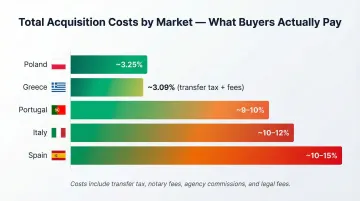
Transaction costs in Europe range from 3.25% in Poland to upwards of 15% in high-tax Spanish regions. Getting that number wrong at the start distorts every yield figure that follows — and by extension, every comparison between markets.
Conclusion
European real estate in 2025 offers recovering valuations, structural supply-demand imbalances, and currency-driven entry advantages for dollar-based investors—but only in the right markets and with the right entry strategy.
The markets with the strongest durable cases share common traits: constrained supply, rising rents, accessible legal frameworks, and proven foreign buyer demand. Position around those fundamentals, and the timing question takes care of itself.
For American investors looking to access fundamentally strong European markets—particularly Portugal—Alori International Holdings provides vetted opportunities, in-country legal guidance, and defined exit frameworks built on local market expertise. Reach out at info@aloriinternationalholdings.com.
Frequently Asked Questions
Can US citizens buy real estate in Europe?
Yes, US citizens can purchase property in the vast majority of European countries with no ownership restrictions. Each country requires a local tax identification number (NIE in Spain, NIF in Portugal, AFM in Greece), and some jurisdictions like Denmark and Switzerland have additional requirements for non-residents.
What is the outlook for 2026 in European real estate?
Most indicators point upward: stabilizing valuations, ECB rate easing, recovering transaction volumes, and sustained demand from foreign buyers. Residential properties and prime locations are expected to lead performance as European markets normalize after the 2022–2023 correction.
Which European country has the highest rental yield in 2025?
Markets like Romania (Bucharest ~8.67%), Italy (Florence ~7.84%), and Latvia (Riga ~7.59%) offer top gross yield figures. However, net yield after taxes and costs will be significantly lower and varies significantly by country—investors should model net returns rather than relying on gross yield alone.
What are the typical transaction costs when buying property in Europe?
Transfer taxes, notary fees, agency commissions, and legal fees typically add 5%–15% on top of the purchase price depending on the country. Poland offers the lowest costs at ~3.25%, while Spain and Italy can reach 10%–15% in total acquisition costs.
Is now a good time for Americans to invest in European real estate?
Post-correction pricing, ECB rate cuts, and a weaker US dollar making euro-denominated assets more accessible all point toward favorable entry conditions in 2025. That said, market selection and due diligence remain critical—look for markets with strong rental demand and structural supply gaps, not just headline price discounts.
Do I need to be a resident of a country to buy property there?
No, residency is not required to purchase property in most European countries. Some countries offer residency through property investment (for example, Greece's Golden Visa program, though entry thresholds have increased), and buyers should confirm country-specific rules around non-resident ownership and rental income taxation.