

Introduction
Henley & Partners recorded a 1,000% increase in U.S. client inquiries since 2019 — Americans now make up 23% of all investment migration applications globally. The driver isn't tourism. U.S. buyers are diversifying wealth across borders, hedging domestic market exposure, and accessing lifestyle and residency options that simply don't exist at home.
Americans can legally purchase property in most European countries without citizenship or prior residency. Rules, costs, and restrictions vary significantly by market — and those differences directly affect your returns, tax exposure, and long-term flexibility.
This guide breaks down the best European markets for American buyers — covering ownership rules, all-in transaction costs, and how to match each country to your specific objective, whether that's rental yield, capital appreciation, lifestyle, or a residency pathway.
TL;DR:
- Americans can buy in Portugal, Spain, Italy, France, Greece, and Croatia — a few markets require government approval
- Property ownership alone doesn't extend your stay beyond the 90-day Schengen limit
- Transaction costs add 5–15% on top of purchase price, depending on the country
- Greece's Golden Visa is still active (€400,000–€800,000 minimum); Spain's program ended April 2025
- U.S. tax obligations — FBAR, foreign income reporting — apply no matter where you buy
Can Americans Legally Buy Property in Europe?
There is no pan-European law blocking American buyers. Each country sets its own rules. Most EU nations—Portugal, Spain, Italy, France, Greece, and Croatia—allow Americans to purchase property freely without citizenship or residency requirements. These markets offer transparent legal frameworks and established foreign buyer infrastructure.
Some countries impose restrictions. Hungary, Poland, Denmark, and Malta require prior government approval before Americans can buy. Liechtenstein goes furthest, requiring both a residency permit and three years of active residency before any purchase is permitted. Rules can change with bilateral agreements, so engaging local legal counsel before committing is essential.
Countries by Purchase Accessibility
Unrestricted Access — France, Italy, Spain, Greece, Portugal, Ireland:
- No special permits required; purchase process mirrors domestic buyers
Conditional or Restricted:
- Malta: Requires Acquisition of Immovable Property (AIP) permit unless buying in Special Designated Areas
- Croatia: Requires reciprocity agreement and consent from Minister of Justice
- Hungary, Poland, Denmark: Government approval required
- Liechtenstein: Residency permit and three years of residency mandatory
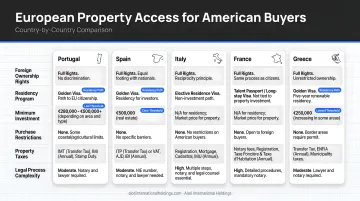
Even in unrestricted markets, one misconception trips up many buyers: property ownership does not grant residency or extend stays beyond the Schengen 90-day-per-180-day rule. Ownership and residency are separate legal tracks, each requiring its own application and approval.
U.S. tax obligations follow American buyers abroad regardless of where they purchase. Two filings apply to most foreign property holders:
- FBAR (FinCEN Form 114): Required when foreign bank accounts exceed $10,000 aggregate value
- FATCA (IRS Form 8938): Required for foreign assets exceeding $50,000 for unmarried individuals
Before committing capital, consult a U.S. tax professional who specializes in expat or foreign property transactions.
Best European Countries for American Property Buyers
The best country depends on your primary goal: rental yield, capital appreciation, lifestyle quality, or residency pathway. Budget and tolerance for bureaucratic complexity also matter. The five markets below represent the most accessible and compelling opportunities for Americans in 2025–2026.
Portugal
Portugal consistently ranks as the top destination for American buyers. The environment is English-friendly, rental markets in the Algarve and Lisbon remain strong, and the purchase process is straightforward with no restrictions for non-EU buyers. Although Portugal's Golden Visa real estate route ended in October 2023, alternative investment pathways remain.
Market Fundamentals:
- Lisbon median asking prices: €5,914 per square meter
- Algarve median prices: €2,922 per square meter
- Gross rental yields in Lisbon: 3.82%
- Emerging neighborhoods like Beato show 32.3% annual price growth
Emerging neighborhoods like Alcântara in Lisbon and inland Algarve offer stronger entry prices and higher capital appreciation potential than the prime tourist zones. For Americans seeking curated, lower-risk entry into Portugal with vetted legal structures, firms like Alori International Holdings focus specifically on this market.
Residency Alternatives: While real estate no longer qualifies for the Golden Visa, €500,000 investment in qualifying Portuguese investment funds or €250,000 in cultural heritage preservation provides alternative residency routes.
Spain
Spain offers variety: Barcelona's urban sophistication, Madrid's professional depth, and Costa del Sol's coastal lifestyle. Short-term rental income potential in tourist zones remains strong, expat infrastructure is established, and the legal framework is transparent.
Critical 2025 Update: Spain's Golden Visa program ended April 3, 2025 (Organic Law 1/2025). Residency-by-investment through real estate is no longer available.
Transaction Cost Reality: Property Transfer Tax (ITP) varies dramatically by region:
- Madrid: 6%
- Catalonia and Valencia: 10%
- Plus notary and legal fees totaling 10–15% all-in
Rental Performance:
Tax Consideration for Americans: Those yields come with a caveat. Spain's wealth tax (Patrimonio) applies to global assets above certain thresholds, potentially affecting high-net-worth American buyers more than expected. Work with a bilingual Spanish tax advisor before committing.
Italy
Italy delivers dual appeal: premium urban assets in Milan with strong professional rental demand versus rural lifestyle properties in Tuscany, Puglia, and Umbria at significantly lower price points.
Americans can buy freely after obtaining a Codice Fiscale (tax ID). The purchase process runs in two stages: the Compromesso (preliminary contract with deposit) and the Rogito (final deed executed by notary).
Market Pricing:
Southern regions like Puglia have drawn rising interest from American buyers attracted by value pricing and lifestyle appeal. Older properties often carry significant restoration costs — budget for a structural survey before signing any preliminary agreement.
Tax Obligation: Non-residents pay IMU (municipal property tax) of 0.46%–1.06% without the "prima casa" main residence exemption. This is self-assessed via Modello F24 — owners must proactively pay rather than wait for a bill.
Greece
Greece offers the highest value-for-money Mediterranean market still available to Americans. Price-per-square-meter remains lower than Spain, France, or Italy, with a strong recovery trajectory post-debt crisis.
Golden Visa Tiers (Updated September 2024): Greece raised minimum thresholds:
- €800,000 in prime zones (Athens, Mykonos, Santorini, Thessaloniki)
- €400,000 in other regions
- €250,000 exception for commercial-to-residential conversions or listed building restoration
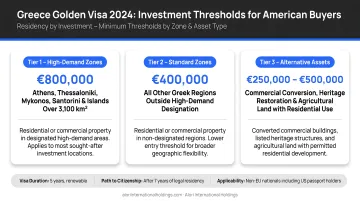
The Golden Visa grants a Schengen residency permit. Athens and Crete offer strong rental yields; islands like Santorini and Mykonos command premium lifestyle prices.
Important Warning: Greek bureaucracy requires careful navigation. Use an independent local lawyer to verify titles at the Land Registry before committing — property title irregularities occur more frequently than in Northern European markets.
Buyers also pay a 3.09% real estate transfer tax (FMA) on top of legal and notary fees.
Other Markets Worth Considering
Greece rounds out the core five — but several other European markets offer legitimate opportunities for specific buyer profiles.
France: No Golden Visa, but Americans can buy freely. Dordogne and Provence offer value compared to Paris. Notary and registration fees total 7–8% for older properties. Paris commands €9,570 per square meter.
Croatia: EU member since 2013, adopted the Euro in 2023. Americans face few restrictions. Transfer tax: 3%. Dubrovnik area averages €3,381 per square meter — lower than Greek islands.
Ireland: English-speaking, friendly property laws, strong Dublin rental market. However, median dwelling price: €345,000 — higher than many Continental alternatives.
How to Match the Right European Market to Your Investment Goal
American buyers typically fall into three archetypes: (1) yield investors seeking rental income, (2) appreciation investors targeting capital gains, and (3) lifestyle buyers wanting a second home or retirement base. Most blend two goals, but identifying the primary one determines the right market.
Market-to-Goal Mapping
Rental Yield Focus:
- Greece (Athens, Crete)
- Portugal (Algarve)
- Spain (Barcelona: 7.40% yield)
Capital Appreciation Focus:
- Portugal (Lisbon emerging districts: Beato +32.3% annually)
- Croatia (lower entry prices, EU growth trajectory)
Lifestyle/Second Home Focus:
- Italy (Tuscany, Puglia)
- France (Dordogne, Provence)
- Spain (Costa del Sol)
Residency Pathway:
- Greece (Golden Visa: €400,000–€800,000)
- Portugal (investment fund route: €500,000)
Emerging Market Opportunities
The four categories above cover established EU markets — but compelling opportunities exist outside them. Georgia (South Caucasus, Council of Europe member) is one example: entry prices run well below Western European averages, rental yields are strong, and few institutional buyers have moved in yet. Firms like Alori International Holdings have built portfolios here alongside Portugal precisely because structural demand, not price momentum, drives the thesis.
Critical Caution: Chasing the cheapest market without understanding demand fundamentals, infrastructure quality, and exit liquidity is a common mistake. Disciplined entry points and structural demand matter more than headline prices.
The Real Cost of Buying Property in Europe as an American
The purchase price is only the starting point. Americans must budget for multiple cost layers that vary significantly by country.
Transaction Cost Breakdown
Every European transaction layers several costs on top of the purchase price:
- Transfer taxes or stamp duty (varies widely by country)
- Notary and legal fees (typically 1–3%)
- Real estate agent commissions (2–6%)
- Currency conversion costs (USD to EUR)
Total Transaction Costs by Country:
| Country | Total Add-On | Key Components |
|---|---|---|
| Portugal | 8–10% | IMT transfer tax (tiered), notary, legal |
| Spain | 10–15% | ITP 6–10% (region-dependent), notary €600–€1,200, legal 1–2% |
| Italy | 10–12% | Registry tax, notary, legal |
| Greece | 10% | 3.09% FMA, legal, agent fees |
| Croatia | 5–7% | 3% transfer tax, agent 2–4%, legal ~1% |
| France | 7–8% | Notary/registration fees 7–8% |
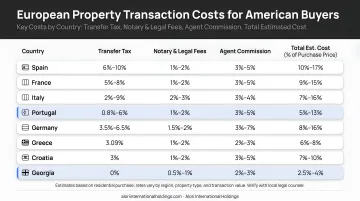
Ongoing Annual Costs
Americans often underestimate recurring expenses:
- Annual property taxes (IMI in Portugal, IBI in Spain, IMU in Italy)
- Property management fees (15–25% of rental income for short-term rentals)
- Insurance
- Income tax on rental earnings
Build these into your yield model before committing — what looks like a 6% gross return can compress to 3–4% net once taxes, management, and insurance are accounted for.
Currency Risk & Opportunity
Currency fluctuation significantly affects your all-in cost. Between April 2025 and April 2026, the EUR/USD exchange rate fluctuated between 1.0950 and 1.1974 — a ~9% swing that can add or erase tens of thousands of dollars on a $300K purchase.
Strategic Implications:
- A strengthening euro increases effective property value in dollar terms (tailwind)
- But also increases carrying costs denominated in euros (headwind)
- Use specialist transfer platforms (not traditional banks) to reduce conversion spreads
- Consider currency hedging tools for large purchases
Understanding the full cost picture — transaction, ongoing, and currency — is what separates investors who achieve their target returns from those who don't. Country selection, covered next, is where these numbers start to diverge sharply.
Residency, Golden Visas, and the 90-Day Rule
Property ownership does not bypass Schengen travel limits. U.S. citizens can stay a maximum of 90 days within any 180-day period across the Schengen Area. Owning property does not extend this.
To spend more time, you must apply for a long-stay visa or residency permit in the specific country where you own property.
Active Residency-by-Investment Programs (2025–2026)
Greece Golden Visa:
- €400,000 minimum (most regions)
- €800,000 in prime zones (Athens, Mykonos, Santorini, Thessaloniki)
- €250,000 exception for commercial conversions/heritage restoration
- Grants Schengen residency permit
Malta: Citizenship-by-investment program remains active through a structured contribution and real estate or rental pathway; thresholds differ by application tier
Portugal: Real estate no longer qualifies, but alternative routes include:
- €500,000 in qualifying investment funds
- €250,000 in cultural heritage preservation
- Citizenship eligibility after 5 years of legal residency
Spain: Golden Visa abolished April 3, 2025—no longer available
Residency Benefits
The programs above do more than extend your time in Europe. Residency in one EU country grants freedom of movement across the Schengen Area, letting Americans live, travel, and work without the 90-day clock running. In most EU countries, residency held for 5–10 years opens a direct pathway to citizenship.
How to Buy European Property as an American: Key Steps
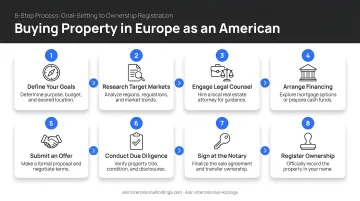
The buying process follows a similar sequence across most European countries, though timelines vary significantly by market:
- Define goal and budget including all-in costs (purchase + transaction fees + ongoing)
- Research target country's rules and engage a local English-speaking lawyer before any commitment
- Obtain tax ID number in target country (required nearly everywhere: NIF in Portugal, Codice Fiscale in Italy, NIE in Spain)
- Find reputable local agent through verified referrals or established networks
- Make offer and negotiate terms, price, and conditions
- Sign preliminary agreement and pay deposit (typically 10%)
- Conduct due diligence including surveys, title verification, and legal review
- Complete final deed with notary (where required) and register ownership
Timelines:
- Croatia: Few weeks
- Italy, Greece: Several months
- Spain, Portugal: 2–4 months typical
Two Non-Negotiable Professionals
Never skip these:
Independent local lawyer (not recommended by seller or agent)
- Verifies title, identifies hidden liabilities, and handles registration
- Reviews all contracts before you sign anything
U.S.-based international tax advisor
- Structures ownership to minimize U.S. tax exposure
- Ensures IRS compliance, including FBAR and FATCA reporting obligations
Americans who skip one or both typically discover the problem at closing — or after. Alori works with a vetted network of in-country legal and transaction professionals, so investors don't have to assemble this team from scratch in an unfamiliar market.
Financing Considerations
Most European banks mortgage to non-residents at lower loan-to-value ratios (50–70%) with additional documentation requirements. Many American buyers opt for all-cash purchases to avoid that complexity entirely. Either way, confirm your financing approach before you start evaluating specific properties — it directly affects what price range and markets make sense.
Frequently Asked Questions
Can Americans buy property in any European country?
Most European countries allow Americans to purchase freely—Portugal, Spain, Italy, France, Greece, and Croatia impose no special restrictions. However, Hungary, Poland, and Denmark require government approval, while Liechtenstein requires residency. Rules shift frequently, so verifying current country-specific requirements before proceeding—and retaining local legal counsel—is critical.
Does buying property in Europe give Americans residency?
Property ownership alone does not grant residency or extend stay rights beyond the 90-day Schengen limit. Some countries—including Greece, Malta, and Portugal—offer Golden Visa or residency-by-investment programs where real estate can qualify, but property purchase and residency remain separate legal processes.
What taxes do Americans owe when buying property in Europe?
Buyers typically pay local transfer taxes, stamp duties, and notary fees at purchase, totaling 5–15% depending on the country. Americans must also report foreign rental income and capital gains to the IRS—and file FBAR if foreign bank accounts exceed $10,000. A dual-qualified tax advisor is strongly recommended.
Which European country is easiest for Americans to buy property in?
Portugal, France, and Croatia are the most straightforward options for Americans—no special permissions required, clear legal processes, and established expat-buyer infrastructure. Portugal has the strongest track record of welcoming foreign buyers, with wide English-language professional support.
Do you need a European bank account to buy property in Europe?
Most countries don't require a local bank account, but having one simplifies ongoing management—especially for paying taxes, utility bills, and rental income. Opening one as a non-resident is possible but requires documentation and varies by country.
How does the 90-day rule affect Americans who own property in Europe?
American property owners in the Schengen Area remain bound by the 90-out-of-180-day limit for stays without a visa. To stay longer, they must obtain a long-stay visa or residency permit in their country of ownership—a separate process from the property purchase itself.