

Introduction
Global real estate markets faced unprecedented volatility through 2025, yet Portugal continues to attract record foreign capital. While inflation uncertainty and geopolitical tensions drove investors out of speculative markets, Portugal's fundamentals remained resilient. The country posted consistent GDP growth, welcomed over 1.5 million foreign residents, and saw median house prices climb to €2,111/m² in Q3 2025, marking a 16.1% year-on-year increase.
For American investors seeking international diversification, Portugal offers what few markets can: transparent legal frameworks, open capital flows, strong rental yields, and a decade-long price appreciation story built on structural demand rather than speculation.
This guide covers exactly what you need to act in 2026 — where the best opportunities are, what returns look like across property types and regions, and the true all-in costs and steps required to execute a purchase from the United States.
TLDR: Key Takeaways
- Portugal's national median house price hit €2,111/m² in Q3 2025, up 16.1% year-on-year—2026 data shows continued momentum
- Rental yields range from 5–10% depending on location and strategy, with tourism-driven coastal markets outperforming urban centers
- Americans face zero ownership restrictions—foreign buyers have identical property rights to Portuguese citizens
- Budget 9–11% above purchase price for total transaction costs (taxes, legal fees, notarial charges)
- Alori International Holdings curates vetted Portugal opportunities for American investors, with defined exit strategies and in-country legal networks
Why Portugal's Real Estate Market Stands Out in 2026
Consistent Economic Momentum Underpins Property Demand
Portugal's GDP grew steadily through 2025, and PwC's Emerging Trends in Real Estate Europe 2026 report confirms Lisbon ranks 11th among European cities for investment prospects, praised for "liveability, vibrancy, and quality of life." Consistent GDP expansion signals sustained employment growth, rising disposable incomes, and expanding demand for residential property — exactly what long-term investors need to see. Economic momentum doesn't just stabilize prices; it supports rent growth and tenant quality across both residential and short-term rental markets.
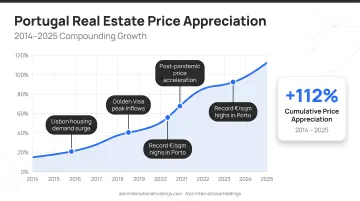
A Decade of Compounding Capital Growth
Portugal's price appreciation is structural, not speculative. From a 2014 baseline around €1,100/m², the national median climbed to €2,111/m² by Q3 2025 — compound annual growth well above eurozone averages.
That trajectory reflects genuine demand from foreign buyers, limited supply in desirable urban and coastal areas, and Portugal's emergence as a lifestyle destination within the EU. For American investors, this track record demonstrates capital preservation and inflation resistance across multiple economic cycles.
Structural Supply-Demand Imbalance Supports Price Pressure
Portugal's population expanded with over 1.5 million foreign nationals now residing in the country, yet new construction has lagged demand. Bureaucratic planning inefficiencies — highlighted in PwC's 2025 report, which noted Lisbon's "inefficient planning system" — mean new housing supply cannot keep pace with incoming residents and investor demand. Constrained supply in prime urban and coastal locations creates upward price pressure into 2026 and beyond, particularly in Lisbon, Porto, and the Algarve.
EU Membership Delivers Stability and Transparency
Portugal's position within the European Union gives American investors a framework that frontier markets simply cannot match. PwC identifies rule-of-law stability as essential for long-term capital deployment — and Portugal delivers on every measure:
- Political stability with consistent, transparent governance
- Regulatory frameworks aligned with EU standards and investor protections
- Open capital flows that allow straightforward entry, income repatriation, and exit
- Rule of law enforced through an independent judiciary
Where legal ambiguity and political risk define emerging markets, Portugal offers the legal predictability investors need to commit capital and plan exits with confidence.
Foreign Buyer Premium Signals International Confidence
Foreign buyers paid approximately 38.7% more per square metre than domestic buyers in Q3 2025, according to INE (Portuguese National Statistics Institute) data. That premium is a signal, not a warning. International investors recognize value, liquidity, and upside that justify paying above domestic pricing — reflecting broad confidence in Portugal's long-term trajectory and the rental, appreciation, and lifestyle returns the market consistently delivers.
Top Investment Regions in Portugal: Where to Put Your Capital
Lisbon Metropolitan Area: Premium Capital Appreciation Play
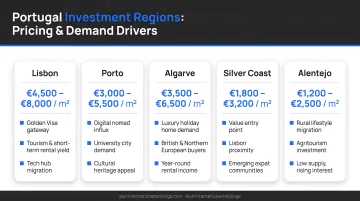
Lisbon commands Portugal's highest prices, with median values exceeding €3,500/m² in prime districts. Santo António, Parque das Nações, and Campo de Ourique show consistent performance driven by executive tenant demand, expat communities, and limited new supply. For investors targeting long-term capital appreciation and upscale short-term rentals, Lisbon delivers — expect lower initial yields (5–7%) offset by stronger appreciation over 5–10 year hold periods.
Greater Porto: Accessible High-Growth Alternative
Porto offers a compelling value proposition: median pricing around €2,200–€2,800/m², strong year-on-year growth (often in double digits), and a diversifying economy anchored by technology startups and international companies. Porto's appeal extends beyond tourism—its growing tech ecosystem drives genuine residential demand, differentiating it from purely seasonal markets. Investors can access quality properties at lower entry points than Lisbon while capturing similar or better yields (6–10%) and solid appreciation potential.
The Algarve: Tourism-Anchored Yield Market
The Algarve—particularly the Golden Triangle (Quinta do Lago, Vale do Lobo, Vilamoura)—is Portugal's premier short-term rental market. Median prices range from €2,800–€4,500/m² depending on proximity to beaches and golf courses. Top-performing municipalities include Loulé and Lagos, where occupancy rates regularly exceed 70% during peak seasons.
Yield-focused investors comfortable with operational complexity and municipal Alojamento Local licensing will find this market attractive. Gross yields run 7–10% with moderate long-term appreciation.
Emerging Secondary Markets: Value with Upside
Beyond Portugal's established hotspots, regions like Baixo Alentejo, Terras de Trás-os-Montes, and the Silver Coast offer compelling value for disciplined investors. Terras de Trás-os-Montes reported 34.3% annual growth in Q3 2025 — a signal of rapid appreciation driven by lifestyle migration and genuine affordability.
These markets reward local intelligence. Off-market access, verified project pipelines, and in-country relationships separate well-positioned investments from overpriced tourist-area purchases. Alori International Holdings maintains local networks in these regions, curating legally verified opportunities with defined rental and exit strategies.
Quick Yield & Pricing Comparison:
| Region | Median Price (€/m²) | Gross Yield Range | Primary Driver |
|---|---|---|---|
| Lisbon | €3,500+ | 5–7% | Capital appreciation, expat demand |
| Porto | €2,200–€2,800 | 6–10% | Tech economy, residential growth |
| Algarve | €2,800–€4,500 | 7–10% | Short-term tourism rentals |
| Secondary Markets | Below €2,000 (varies) | 8–12%+ | Lifestyle migration, early entry |
Rental Yields and ROI Potential Across Property Types
Long-Term Rentals: Structural Demand, Steady Income
Long-term rental yields in Lisbon and Porto range from 5–7%, supported by rising rents driven by housing affordability constraints and an expanding foreign resident population. National median rental values reached approximately €8.50/m² in Q1 2025, up nearly 12% year-on-year. Structural undersupply and continued immigration sustain this income stream. Long-term leases offer stable, predictable cash flow with lower operational complexity than short-term rentals—ideal for investors prioritizing passive income over yield maximization.
Short-Term Tourist Rentals: Higher Yield, Higher Complexity
Properties licensed under Portugal's Alojamento Local (AL) regime can command gross yields of 5–8% in Lisbon and 6–10% in Porto, with Algarve coastal properties reaching 8–10% during peak seasons. Occupancy rates in high-tourism areas frequently exceed 70% from May through September. The higher yield comes with real operational demands — cleaning, maintenance, guest management, and ongoing regulatory monitoring at the municipal level. Some Lisbon and Porto districts have restricted new AL licenses, so investors must verify licensing status before purchase.
Capital Appreciation: The Compounding ROI Layer
For American investors, total return must account for both rental income and price appreciation. Portuguese real estate appreciated approximately 90% over the past decade (2014–2024), delivering compound annual returns of roughly 6–7% before rental income. When appreciation stacks on top of rental yield, total annual returns in Portugal's stronger markets have historically exceeded 12–15% — while providing currency diversification away from USD-denominated assets.
Risk Considerations for American Investors
Three risk factors every American investor should address before committing capital:
- Currency exposure: USD/EUR swings affect both your purchase price and converted rental income. Most investors treat this as diversification rather than a problem to hedge — but it should be a deliberate choice, not an afterthought.
- Tax reporting obligations: Foreign bank accounts over $10,000 require FBAR disclosure; broader foreign financial assets fall under FATCA. Directly held real estate is generally not PFIC-reportable (unlike foreign funds), but confirm the specifics with a U.S. tax advisor.
- Exit planning: Define your exit scenario before you buy — foreign buyer resale, local market sale, or a 10-year hold. Investors who skip this step are the ones who end up selling at the wrong time.
The True Cost of Buying: Taxes, Fees, and Entry Budgets
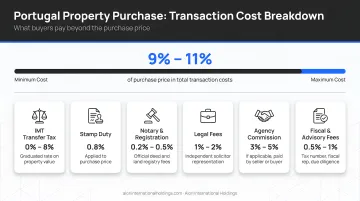
Beyond the headline price, Portugal's transaction costs typically add 9–11% to your total entry outlay. Knowing these figures upfront prevents surprises at the notary table.
One-Time Purchase Costs: Budget 9–11% Above Purchase Price
One-time costs at closing typically include:
- Property Transfer Tax (IMT): Sliding scale from 0–7.5% based on property value and intended use. Residential properties under €92,407 are exempt; the rate reaches 7.5% on amounts above €1,000,000.
- Stamp Duty: 0.8% of purchase price for most residential transactions (range: 0.4–0.8%).
- Legal and Notarial Fees: Roughly 2.5%, covering lawyer fees, notary charges, and property registration.
Illustrative Example:
- Purchase Price: €400,000
- IMT (estimated 6%): €24,000
- Stamp Duty (0.8%): €3,200
- Legal/Notarial (2.5%): €10,000
- Total Transaction Costs: €37,200 (9.3%)
Ongoing Ownership Costs
| Cost | Details |
|---|---|
| Annual Property Tax (IMI) | 0.3–0.8% of cadastral value. On a €400,000 property with a €300,000 cadastral value, expect €900–€2,400/year. |
| AIMI Municipal Wealth Tax | Applies to cadastral values above €600,000. Rate is 0.7% for individuals on the value exceeding that threshold, paid annually. |
| Condominium/Maintenance Fees | €50–€300/month depending on property type and building amenities. |
| Rental Income Tax | 25% flat rate for non-residents. If you establish residency, progressive rates of 14–48% apply depending on total income — which may be higher or lower than the flat rate depending on your bracket. |
Matching Budget to Market Entry Points
€140,000–€280,000 (~$150,000–$300,000):
- Secondary cities (Coimbra, Braga)
- Emerging regions (Silver Coast, inland Algarve)
- Studio to 2-bedroom apartments in Porto suburbs
- Off-plan developments in growth markets
€280,000–€560,000 (~$300,000–$600,000):
- 2-bedroom apartments in Lisbon suburbs (Parque das Nações, Benfica)
- 3-bedroom properties in central Porto
- Coastal Algarve apartments (Lagos, Albufeira)
- Entry-level villas in secondary Algarve locations
How to Buy Property in Portugal as a Foreign Investor
Legal Prerequisites: Complete Before Contracting
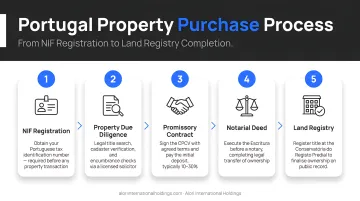
Portuguese Tax Identification Number (NIF): Mandatory for all property buyers. Obtain through Portuguese consulates in the U.S. or via a Portuguese fiscal representative (typically your lawyer). Processing takes 1–2 weeks.
Portuguese Bank Account: Required to pay purchase costs, taxes, and utilities. Non-residents can open accounts remotely with some banks, though in-person visits expedite approval. Bring your passport, proof of address, and NIF.
Legal Representative: Mandatory for non-residents and strongly advisable for all foreign buyers. Your lawyer (advogado) verifies title, conducts due diligence, drafts contracts, and represents you at the notarial deed signing.
Key Transaction Milestones
Promissory Contract (CPCV): Signed after price negotiation, this legally binding contract commits both parties to the sale. Buyers typically deposit 10–30% of the purchase price, which is forfeited if you withdraw or refunded double if the seller backs out.
Due Diligence Period: Your lawyer verifies clean title, checks for debts (unpaid property taxes, condominium fees), confirms zoning and licensing, and ensures no legal encumbrances. This process takes 2–6 weeks.
Notarial Deed (Escritura): Final signing occurs before a notary, transferring legal ownership. Both parties (or their representatives) must attend. You pay the remaining purchase price, IMT, stamp duty, and notarial fees at this stage.
Property Registration: Once signed, your lawyer files the deed with the Land Registry Office (Conservatória do Registo Predial), officially recording ownership. Registration typically completes within 1–2 weeks.
Total Timeline: 2–4 months from offer to final deed, depending on property complexity and financing.
Why Execution Quality Matters as Much as Property Selection
Buying in Portugal without in-market expertise exposes foreign investors to real execution risks:
- Mispriced offers due to unfamiliarity with local comparables
- Legal gaps from incomplete due diligence on title or licensing
- Currency transfer timing errors that delay or complicate closing
- Vendor negotiations handled without local context
Alori International Holdings works with American investors at each of these stages, combining local legal oversight with pricing analysis and defined exit planning so buyers can move confidently without needing to be on the ground.
Frequently Asked Questions
Is it good to invest in real estate in Portugal?
Yes, for long-term, income-seeking investors. Portugal delivers decade-long price appreciation (€1,100/m² in 2014 to €2,111/m² in Q3 2025), strong rental yields (5–10% depending on location), political and economic stability within the EU, and transparent legal frameworks that protect foreign capital.
Can Americans buy property in Portugal?
Absolutely. Americans face no restrictions on foreign ownership and have identical property rights to Portuguese citizens. You need a NIF tax number, a Portuguese bank account, and a local legal representative—all obtainable within weeks before signing contracts.
What rental yield can I expect from a Portugal investment property?
Long-term rental yields in Lisbon and Porto average 5–7%, while short-term tourist rentals in high-demand coastal areas (Algarve, Cascais) deliver 7–10%. Coastal tourism properties outperform urban long-term rentals on gross yield, though they require more active management and licensing.
What taxes do I pay when buying property in Portugal?
Expect IMT transfer tax (0–7.5% on a sliding scale), Stamp Duty (0.4–0.8%), and legal/notarial fees (approximately 2.5%). Total transaction costs typically add 9–11% on top of the purchase price, so budget accordingly from the outset.
What is the minimum amount needed to invest in Portuguese real estate?
There's no legal minimum for foreign buyers. Entry-level properties in secondary cities start under €200,000, while prime Lisbon and Algarve investment-grade assets typically start from €300,000–€500,000.
How long does it take to complete a property purchase in Portugal?
The full process from offer to notarial deed typically takes 2–4 months. The promissory contract (CPCV) locks in price and terms early, while due diligence and title verification occur before final completion at the notary's office.