

Introduction
Where should you put capital in Portugal heading into 2026? That question looks different today than it did three years ago. With real estate removed from the Golden Visa pathway in late 2023, the speculative froth has cooled. What remains is a market driven by fundamentals — structural housing shortages, sustained foreign demand, and entry prices well below comparable Western European destinations.
For disciplined investors, this reset creates a stronger entry point than the overheated peaks of 2021–2023.
American buyers are leading that charge. The number of U.S. residents in Portugal surged 36% year-over-year to 19,258 in 2024, while premium transaction values from American buyers jumped 82%. These are investors pursuing portfolio diversification, capital preservation outside USD-denominated assets, and stable rental income — in a market that pairs EU legal stability with pricing that most Western European capitals left behind a decade ago.
Key Takeaways
- Portugal offers EU legal stability, affordable pricing relative to Western Europe, and tourism-driven rental demand
- The Golden Visa real estate route ended in 2023, shifting focus from residency plays to genuine investment fundamentals
- Top 2026 markets: Lisbon, Porto, Algarve, Cascais, Comporta, and the Silver Coast — each with distinct yield, appreciation, and liquidity profiles
- Entry prices range from €150,000 in emerging coastal markets to €1M+ in prime Lisbon and Cascais; rental yields run 4–7%
- Getting pricing, legal structure, and exit strategy right from the start separates strong returns from costly mistakes
Portugal Real Estate in 2026: Why the Fundamentals Still Hold
The Post-Golden Visa Reset
The October 2023 "Mais Habitação" law eliminated real estate as a qualifying route for Portugal's Golden Visa, ending a decade-long incentive that channeled billions into residential property. Speculative demand cooled as a result — yet Portugal's House Price Index (HPI) still surged 17.6% in 2025, with transaction volumes up 8.6% to 169,812 dwellings.
Portugal's market hasn't needed visa-driven capital to stay healthy. Investors entering in 2026 benefit from clearer pricing no longer inflated by residency premiums.
Structural Demand Drivers That Persist
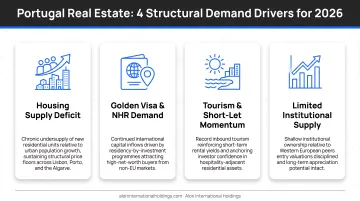
Several factors continue supporting Portuguese real estate independent of visa incentives:
- Tourism hit 32.5 million guests and 82.1 million overnight stays in 2025, with monthly tourism exports exceeding €4.3 billion — sustaining consistent demand for short-term rentals and hospitality-adjacent properties
- Foreign residents reached 1.54 million by end-2024, driving long-term rental demand in urban centers and coastal lifestyle markets
- Only 41,851 dwellings were licensed and 28,494 completed in 2024 against 156,325 total transactions — a persistent supply gap that underpins pricing
- Portugal ranked 7th globally in the 2024/2025 Global Peace Index, a consistent draw for international families and retirees seeking stable jurisdictions
Investor-Friendly Fundamentals
Portugal maintains key structural advantages for foreign buyers:
- No restrictions on foreign ownership — U.S. citizens can purchase in personal name or legal entity
- Low property taxes (IMI) — typically 0.3–0.45% annually in major municipalities
- Transparent legal framework — properties registered through Conservatória do Registo Predial with full title protection
- NHR tax regime — The Non-Habitual Resident program was revoked for new entrants in 2024, replaced by the IFICI program (restricted to scientific and tech professionals). Investors who registered before December 31, 2023 retain their NHR benefits for the full 10-year term.
Best Places to Invest in Portugal Real Estate in 2026
The locations below were selected on investment merit: rental yield potential, capital appreciation outlook, liquidity, and structural demand. Lifestyle appeal is not the filter here — fundamentals are.
Lisbon: The Capital's Regeneration Zones
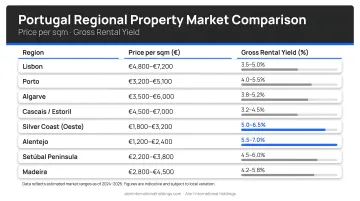
Lisbon remains Portugal's most liquid real estate market, where demand from multinationals, international families, and digital nomads stays consistent year-round. Prime central districts like Príncipe Real (€6,827/m²) and Avenida da Liberdade (€7,765/m²) offer capital preservation and the highest resale liquidity in Portugal. Emerging regeneration zones like Marvila (>€6,000/m²) and Beato (€4,917/m²) provide higher upside at lower entry points.
Lisbon suits investors prioritizing long-term capital preservation and exit liquidity over maximum yield. Rental yields tend to be lower than Porto — averaging 3.5–4.34% for long-term rentals — but the resale market is significantly more active.
| Category | Details |
|---|---|
| Typical Entry Price Range | €4,917–€7,765/m² (€350K–€800K+ total for typical apartments) |
| Gross Rental Yield | 3.5–4.34% (long-term rentals) |
| Best Investor Profile | Capital preservation investors, international families, buyers seeking high resale liquidity |
Porto: Higher Yields, Lower Entry, Rising Demand
Porto delivers the strongest yield-to-entry ratio of any major Portuguese city. Rental yields run 4–5% against a median entry price of €3,908/m², and a rapidly growing tech, startup, and creative economy draws younger professionals and remote workers who sustain rental demand through market cycles.
Up-and-coming districts like Bonfim (€3,674/m²) and Campanhã (€3,311/m²) benefit from urban renewal and transport upgrades. Porto appeals to investors willing to accept slightly lower liquidity in exchange for better yield and entry pricing. The city's startup ecosystem saw a 51% increase in total VC funding between 2024 and 2025, signaling structural economic growth beyond tourism.
| Category | Details |
|---|---|
| Typical Entry Price Range | €3,311–€3,908/m² (€200K–€400K+ total for typical apartments) |
| Gross Rental Yield | 4.0–5.0% |
| Best Investor Profile | Yield-focused investors, mid-range budget buyers (approx. $150K–$400K USD), long-term rental strategies |
The Algarve: Resort Income and Retiree Demand
The Algarve is Portugal's most established holiday rental market. Towns like Vilamoura (€4,731/m²), Lagos (€4,545/m²), and Albufeira (€3,927/m²) generate strong short-term rental income driven by year-round golf tourism, beach demand, and a large English-speaking expat community — making it particularly accessible for American buyers.
Entry prices in prime resort areas run higher than emerging markets, and Alojamento Local (AL) short-term rental licensing is under tightening regulatory scrutiny.
Decree-Law 76/2024 revoked the national suspension on new AL licenses, returning regulatory authority to individual municipalities. Investors must conduct municipal-level due diligence on licensing frameworks before committing capital.
| Category | Details |
|---|---|
| Typical Entry Price Range | €3,927–€4,731/m² (€250K–€500K+ total) |
| Gross Rental Yield | 4.0–6.0% (varies by proximity to coast and seasonality) |
| Best Investor Profile | Retirees, second-home buyers, short-term rental income investors, buyers targeting U.K./Northern European tourist demand |
Cascais and the Estoril Coast: Resilient Premium Market
Thirty minutes from Lisbon, Cascais draws high-net-worth families, international schools, and North American expats who want coastal living without sacrificing urban connectivity. That demand consistency — not yield — is the investment thesis here, making it one of Portugal's most attractive buy-and-hold markets.
Average asking prices sit at €5,561/m², with prime historic and waterfront areas commanding €7,260–€11,000/m². Cascais has shown exceptional appreciation — 8.6% annually through 2024 — and historically lower price volatility than speculative markets. Yields are lower than Porto or the Algarve, but long-term appreciation and demand stability form the primary investment case.
| Category | Details |
|---|---|
| Typical Entry Price Range | €5,561–€11,000/m² (€400K–€1M+ total) |
| Gross Rental Yield | 3.0–4.0% (lower yields; appreciation and stability are primary drivers) |
| Best Investor Profile | High-net-worth buyers (approx. $400K–$1M+ USD), lifestyle investors, North American expat community buyers |
Comporta and the Alentejo Coast: The Luxury Appreciation Play
South of Lisbon, Comporta is Portugal's fastest-appreciating luxury market. Low-density eco-villas integrated into pine forests and rice fields, combined with strict zoning that limits supply, have made it a magnet for global UHNW buyers who can't find comparable scarcity elsewhere in Western Europe.
Prime property prices in Comporta surged 19.4% over the past five years, driven by extreme scarcity and rising international demand. Prices range from €6,800–€10,700/m², with exclusive new beachfront villas commanding upwards of €15,000/m².
Comporta remains illiquid compared to Lisbon or Porto: fewer comparable sales, longer hold periods, and a thinner buyer pool at exit. This suits patient capital with a 5–10+ year horizon. Rental yield is secondary; the investment thesis is pure appreciation in an emerging luxury destination with constrained supply.
| Category | Details |
|---|---|
| Typical Entry Price Range | €6,800–€15,000/m² (€500K–€2M+ total) |
| Gross Rental Yield | 2.0–4.0% (rental yield is secondary to capital appreciation) |
| Best Investor Profile | UHNW buyers, long-horizon investors, eco-luxury positioning, buyers seeking early-mover premium market exposure |
The Silver Coast: Value Coastal Exposure with Growth Upside
For investors who want coastal Portugal at a fraction of Algarve or Cascais pricing, the Silver Coast is the clearest value play in 2026. Stretching from Ericeira north to Nazaré and Óbidos Lagoon, entry prices come in well below the premium markets: Nazaré averages €3,262/m², Ericeira €3,355/m², and Foz do Arelho €3,414/m².
Improving infrastructure and a growing international community of surfers, digital nomads, and early-stage investors drive emerging demand. Ericeira holds Europe's only World Surfing Reserve designation, while Nazaré's global brand recognition from big-wave surfing generates consistent tourism demand. Proximity to Lisbon (45–60 minutes) adds practical value for dual-use (rental + personal use) buyers.
| Category | Details |
|---|---|
| Typical Entry Price Range | €3,262–€3,414/m² (€150K–€350K total) |
| Gross Rental Yield | 4.0–6.0% (with upside potential as infrastructure improves) |
| Best Investor Profile | Mid-range budget investors (approx. $150K–$350K USD), early-stage value buyers, surf/lifestyle-driven demand, dual-use buyers |
What American Investors Need to Know Before Buying in Portugal
Legal and Tax Framework
Portugal imposes no restrictions on foreign property ownership. U.S. citizens can purchase in their personal name or through a legal entity, though a Portuguese fiscal number (NIF) is required as a first step.
Critical U.S. Tax Obligations:
- FBAR (FinCEN Form 114): Required if aggregate foreign financial accounts exceed $10,000 at any point during the year
- FATCA (Form 8938): Direct real estate held personally is not a specified foreign financial asset — no Form 8938 required. If held through a foreign entity (corporation or trust), that interest must be reported
- Rental Income: Foreign rental income must be reported to the IRS on Schedule E. You can generally claim taxes paid to Portugal as a Foreign Tax Credit using Form 1116 under the US-Portugal tax treaty
Cross-border tax structures add complexity — specialist advice before you buy is worth the cost.
Transaction Costs
Beyond the purchase price, budget for these closing costs:
- IMT (property transfer tax): 0–8%, applied on progressive brackets by value
- Stamp duty: ~0.8% of the purchase price
- Notary, registration, legal, and fiscal representation fees vary by transaction
Total transaction costs typically add 7–10% to the purchase price — a figure that catches many first-time foreign buyers off guard.
Currency Risk
Purchases are denominated in EUR, which directly affects what American buyers actually pay. The average exchange rate moved from 1.0820 USD/EUR in 2024 to 1.1306 USD/EUR in 2025 — a Euro that's getting more expensive for dollar-denominated buyers.
Two approaches investors commonly use to manage this exposure:
- Currency hedging tools offered through international FX brokers
- Specialist transfer services that lock in rates ahead of closing
How to Evaluate a Portugal Real Estate Investment
The most common mistake investors make is choosing a location based on personal appeal or a single trend ("everyone is buying in Lisbon") rather than evaluating structural demand indicators. The right framework examines:
- Rental demand consistency: Tourism volumes, expat growth, student populations
- Comparable transaction data: Recent sales, price per sqm trends, time-on-market
- Demographic and infrastructure trends: Population growth, transport upgrades, tech ecosystem development
- Regulatory environment: Short-term rental licensing (AL), municipal planning approvals
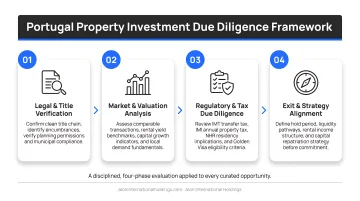
Proper due diligence on legal title — including caderneta predial, certidão de teor, and certificado energético — plus pending condominium charges or municipal infractions, is essential before any purchase. Skipping these checks has derailed otherwise sound deals. Buying without proper legal representation remains one of the most frequent and costly mistakes foreign investors make in Portugal.
That legal complexity is precisely where most individual buyers run into trouble. Alori International Holdings addresses this directly — combining macroeconomic data analysis, local in-market intelligence, and pre-vetted legal structures for each opportunity. Investors gain access to off-market deals with verified exit strategies, which substantially reduces the due diligence burden that solo buyers face when navigating Portugal's property market.
Conclusion
Portugal in 2026 offers a rare combination of market maturity, structural demand, and accessible entry prices for international investors. The removal of speculative Golden Visa capital has clarified pricing and revealed which markets stand on genuine fundamentals. The strongest opportunities are going to investors who prioritize rental demand depth, legal clarity, and realistic exit liquidity — not those chasing headline narratives.
Treat Portugal real estate as a long-term capital decision, not a short-term trade. The investors who perform best tend to share three habits:
- Matching location to specific yield, lifestyle, or residency objectives
- Entering at disciplined price points rather than chasing recent appreciation
- Working with partners who combine global investment context with local execution knowledge
If you're evaluating Portugal for your portfolio, Alori International Holdings works with investors on a selective basis to identify positions aligned with long-term capital objectives. Reach out at info@aloriinternationalholdings.com to start the conversation.
Frequently Asked Questions
Can Americans buy property in Portugal?
Yes. U.S. citizens face no restrictions on property ownership in Portugal and can purchase in their personal name or through a legal entity. The first step is obtaining a Portuguese fiscal number (NIF). Work with a cross-border tax advisor — U.S. reporting obligations (FBAR, FATCA) apply to foreign property and accounts.
Is Portugal real estate a good investment in 2026?
Portugal remains fundamentally sound for long-term investors due to strong tourism demand, undersupply of quality housing, EU legal stability, and competitive pricing versus comparable Western European markets. However, short-term appreciation is less predictable than it was in 2020–2022.
What happened to Portugal's Golden Visa program for real estate?
Portugal removed real estate from the Golden Visa's qualifying investment routes in late 2023 as part of housing reforms. The program still exists, but now requires investment in qualifying funds, research, cultural projects, or job creation rather than property purchases.
What rental yields can I expect from Portuguese investment properties?
Rental yields vary significantly by location and strategy. Expect 4–5% in prime Lisbon, 5–7% in Porto, and potentially higher in the Algarve for short-term holiday lets, though seasonality and AL licensing regulations affect net returns.
What are the total costs of buying property in Portugal as a foreigner?
Budget for IMT (0–8%), stamp duty (~0.8%), notary/registration fees, and legal representation. Total transaction costs typically add 7–10% above the purchase price. Legal fees alone often run €2,000–€5,000, and many buyers are caught off guard by IMT on properties above €1 million.
Which area in Portugal has the best capital appreciation potential in 2026?
Comporta/Alentejo Coast leads for luxury appreciation upside (19.4% over five years). For mid-market investors, Lisbon regeneration zones (Marvila, Beato) and the Silver Coast offer the strongest near-to-medium term growth case based on infrastructure development and emerging demand.