

Introduction
Portugal posted a 17.2% year-on-year house price increase in Q2 2025 — the highest in the EU — and foreign investor demand is still climbing heading into 2026. Interest that once concentrated in Lisbon's premium neighborhoods has since spread to Porto's regenerating industrial districts, the Algarve's coastal towns, and Madeira's year-round island market.
With so many regions showing movement, the harder decision is where to enter — and what you're optimizing for. Capital appreciation, rental yield, and lifestyle migration each point to different markets, entry prices, and risk profiles. Getting that alignment right is what separates a strong position from an expensive one.
This guide breaks down the best-performing Portuguese markets for 2026 using price trends, yield data, supply constraints, and investor demand — with a focus on what matters most to international buyers entering the €150K–€600K range.
Key Takeaways
- Portugal has outperformed most of Europe for five straight years — limited supply, strong tourism, and steady foreign capital explain why
- Lisbon and Porto remain the most liquid and internationally recognized markets, but emerging cities like Braga deliver stronger relative value
- Cascais, the Algarve, and Funchal offer competitive rental yields backed by year-round tourism demand
- American investors are increasingly active in markets with established expat infrastructure and defined exit paths
- Strategy drives location: rental yield, capital appreciation, and lifestyle migration each point to different cities
Why Portugal Still Makes Sense for Investors in 2026
Portugal leads the EU in house price growth despite rising interest rates. According to Eurostat data from October 2025, Portugal recorded a 17.2% year-on-year house price increase in Q2 2025 — far outpacing the EU average of 5.4%. This isn't a short-term spike. It's a structural imbalance driven by chronic undersupply, population migration into urban centers, and record tourism numbers.
The Supply Shortage Driving Prices
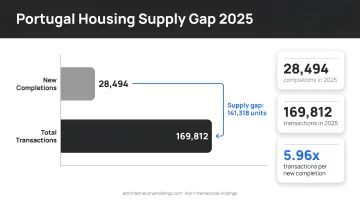
In 2024, Portugal saw only 28,494 dwelling completions, a modest 6.8% increase from the prior year. Meanwhile, 169,812 housing transactions closed in 2025, illustrating a massive gap between demand and available inventory. Tourism continues to underpin this demand, with 32.5 million guests and 82.1 million overnight stays in 2025, generating €29.1 billion in revenue.
Non-EU Investor Advantages
Portugal remains one of the most accessible European markets for American buyers:
- Foreign ownership rights available to all nationalities without restrictions
- Straightforward transaction process with transparent legal frameworks
- Euro-denominated asset exposure for investors seeking currency diversification beyond the dollar
Golden Visa & NHR Tax Changes
The October 2023 Mais Habitação reform restructured Portugal's investment landscape in two key ways:
- Golden Visa: Real estate purchases no longer qualify. The most accessible remaining route is a €500,000 investment in a CMVM-regulated, non-real-estate fund with a minimum 5-year maturity and 60% allocation to Portuguese commercial companies.
- Tax residency: The legacy Non-Habitual Resident (NHR) regime was replaced by IFICI ("NHR 2.0"). IFICI offers a 20% flat tax on eligible employment income and exemptions on foreign-source income, but is strictly limited to high-value professions, R&D roles, and startup employees.
Visa incentives have narrowed, but Portugal's investment case hasn't changed. Investors continue to target the market for diversification, lifestyle, and long-term capital preservation — the residency pathway is a bonus, not the thesis.
Best Places to Invest in Portugal in 2026
These markets were selected based on price growth trajectory, rental yield data, supply-demand imbalance, infrastructure investment, and relevance to international buyers in the €150K–€600K range — rather than brand recognition or tourism popularity.
Lisbon
Lisbon is Portugal's most liquid and internationally recognized real estate market. It attracts sustained demand from tech workers, short-term rental tourism, and high-net-worth foreign buyers. New supply in central neighborhoods stays constrained, driving consistent price premiums relative to the rest of Portugal.
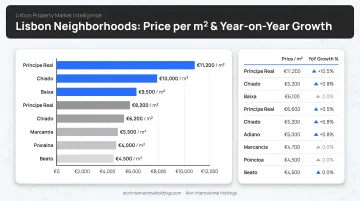
In Q1 2025, the median price of properties purchased by foreign buyers in Greater Lisbon was 52.5% higher than those purchased by domestic buyers. Central Lisbon neighborhoods now command premium pricing:
- Chiado: €8,018/m² (+12.1% YoY)
- Baixa: €7,222/m² (+10.0% YoY)
- Parque das Nações: €6,671/m² (+15.9% YoY)
Median rents for new leases in Lisbon reached €16.00/m² in Q1 2025 (+5.1% YoY), but gross rental yields average just 3.79% — the lowest in Portugal.
| Metric | Data |
|---|---|
| Avg. Price Range (€/m²) | €6,671–€8,018 (central neighborhoods) |
| Estimated Gross Rental Yield | 3.79% |
| Best Investor Profile | Capital preservation and premium short-term rental investors with higher entry budgets |
Takeaway: Lisbon is a capital preservation and lifestyle market, not a yield play. Buyers entering at these price points are paying for liquidity, brand recognition, and turnkey positioning — not income.
Porto
Porto offers the most balanced market in Portugal for 2026 — strong transaction volume, measured price growth, and growing international recognition. The Financial Times' fDi Intelligence report awarded Porto the FDI Strategy prize among large European cities in 2025, highlighting its tech startup ecosystem and digital business hubs.
Porto's median transaction price reached €3,186/m² in the 12 months ending September 2025, with 8.4% year-on-year growth. Diversity of buyer types ranges from historic townhouse investors to riverfront apartment purchasers.
Key neighborhoods include:
- Cedofeita: €5,625/m² (+8.6% YoY) — Prime central
- Baixa: €5,186/m² (-0.3% YoY) — Historic core
- Bonfim: €3,674/m² (+2.6% YoY) — Transitional/creative district
Transitional neighborhoods like Bonfim and Paranhos offer entry points under €3,700/m² and gross yields up to 6.5% for studios.
| Metric | Data |
|---|---|
| Avg. Price Range (€/m²) | €3,096–€5,625 (central and transitional neighborhoods) |
| Year-on-Year Price Growth | 8.4% |
| Best Investor Profile | Investors seeking balanced capital growth and rental income at a mid-range entry point |
Takeaway: Porto delivers attainable entry prices, strong rental demand from expats and remote workers, and visible urban regeneration — structural drivers that support long-term fundamentals rather than short-term momentum.
Cascais
Cascais is Portugal's premier coastal luxury corridor: 30 minutes from Lisbon, with a distinct character shaped by international schools, marinas, golf courses, and a large established expat community. It draws a disproportionately high share of American and British buyers.
Despite a slight deceleration in Q2 2025, Cascais maintains absolute premium pricing. The municipality's median transaction price was €4,713/m² in Q3 2025, but asking prices in March 2026 averaged €7,042/m².
Rental yields hold up well for a luxury market. Global Property Guide reports Cascais 1-bedroom apartments yield 3.69%, while 2-bedrooms yield 4.06%.
| Metric | Data |
|---|---|
| Avg. Entry Price (apartments) | €4,713–€7,042/m² |
| Gross Rental Yield | 3.69%–4.11% (depending on property size) |
| Best Investor Profile | Lifestyle-aligned investors, high-net-worth buyers, and those targeting the luxury short-term rental segment |
Takeaway: Cascais rewards investors who treat lifestyle infrastructure as a financial asset. The established expat base, year-round population, and premium rental ceiling differentiate it from purely seasonal coastal markets.
Braga
Braga is northern Portugal's fastest-rising market, with three structural demand drivers working simultaneously: tech-sector job growth, university-driven rental demand from the University of Minho's 20,566 enrolled students, and infrastructure investment that is steadily closing the connectivity gap with Porto.
In Q3 2025, Braga's median transaction price was €2,090/m² — a €1,096/m² discount compared to Porto's €3,186/m². Yet Braga recorded 22.7% year-on-year price growth, well ahead of the national average.
The city licensed 1,062 new dwellings in 2024, making it one of the top district capitals for new housing investment. The municipal agency InvestBraga has supported 305 startups, cementing Braga's status as a northern tech hub.
| Metric | Data |
|---|---|
| Avg. Price Range (€/m²) | €2,090/m² (significantly below Porto's €3,186/m²) |
| Rental Demand Driver | University of Minho enrollment (20,566 students) + growing tech sector employment |
| Best Investor Profile | Value-oriented investors targeting higher yield over capital appreciation, especially in the student rental segment |
Takeaway: Braga offers significantly lower entry prices than Lisbon or Porto, consistent occupancy driven by student and young professional tenants, and a historic center drawing increasing tourism attention.
The Algarve (Albufeira & Carvoeiro)
The Algarve is Portugal's most tourism-dependent investment market, where short-term rental income is the primary value driver. The region recorded 20.82 million overnight stays and 5.34 million guests in 2024, sustaining strong property values. The Algarve's median transaction price reached €3,203/m² in Q3 2025 (+16.6% YoY).
Albufeira draws mass-market volume, while Carvoeiro offers boutique positioning with tighter supply:
- Albufeira: T2 (2-bedroom) asking prices generally start from €220,000
- Carvoeiro (Lagoa): T2 asking prices generally start from €275,000
Faro district average gross yields are 4.23%, but high seasonal occupancy can translate to stronger returns on the right property type.
| Metric | Data |
|---|---|
| Avg. Price Range | €220,000 (Albufeira T2) – €275,000 (Carvoeiro T2) |
| Avg. Gross Rental Yield (seasonal) | 4.23% (Faro district average) |
| Best Investor Profile | Investors prioritizing short-term rental income, seasonal appreciation, and lifestyle use; less suited for long-term residential yield strategies |
Regulatory Note: Decree-Law 76/2024 (October 2024) revived the short-term rental (AL) market by making licenses permanent and transferable again, but granted municipalities power to create "containment areas." Investors must verify hyper-local zoning before purchasing for STR purposes.
Funchal, Madeira
Funchal occupies a distinctive position within the Portuguese investment landscape: an island capital with year-round mild climate, growing expat and digital nomad infrastructure, and property values that hold below mainland equivalents despite consistent appreciation.
Funchal's median transaction price reached €3,346/m² in Q3 2025 (+15.0% YoY). Asking prices in March 2026 averaged €3,993/m². The broader Madeira region saw a 14.6% YoY price increase in December 2025.
Madeira successfully decoupled from purely seasonal tourism, driven by digital nomad infrastructure like the Ponta do Sol Nomad Village and expanded flight connectivity. The region saw 12.8 million overnight stays in 2025, an 8.4% YoY increase.
| Metric | Data |
|---|---|
| Avg. Price Range (€/m²) | €3,346–€3,993/m² (significantly below Lisbon's €6,671–€8,018/m²) |
| Year-on-Year Price Growth | 15.0% (Q3 2025) |
| Best Investor Profile | Lifestyle-migration investors, retirees, and those seeking a lower-entry island market with stable year-round rental demand |
Takeaway: Funchal's case rests on year-round occupancy, below-mainland pricing, and 15% annual appreciation — a combination that makes it a credible diversification position within a Portugal-focused portfolio, not just a lifestyle purchase.
How We Selected These Markets
Market selection was built on structural demand indicators — not momentum or headlines. The evaluation framework examined:
- Supply-demand imbalance
- Price growth consistency over 3–5 years
- Rental yield sustainability
- Infrastructure investment pipelines
- Entry-point relevance for international buyers in the €150K–€600K range
Each criterion was chosen specifically because it maps to mistakes that consistently erode returns for international buyers. Understanding the framework means understanding what to watch out for.
Common Mistakes Investors Make
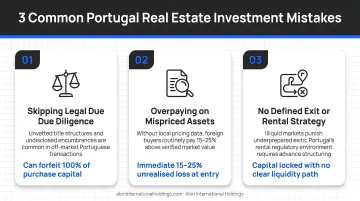
- Defaulting to brand familiarity over yield data — Lisbon carries name recognition, but gross yields average around 3.79%. Porto's transitional neighborhoods can reach 6.5%, and Braga's student demand drives higher relative returns. Familiarity is not a strategy.
- Underestimating transaction costs — IMT property transfer tax, annual IMI (0.3–0.45% of cadastral value), and AL licensing requirements vary by municipality and directly affect net returns and STR eligibility.
- Skipping exit planning — Liquidity differs sharply by market. Lisbon and Porto offer deep buyer pools; secondary markets like Braga require longer hold periods for optimal exits.
Alori's Approach
Alori International Holdings pairs macroeconomic analysis with in-country professionals who know local regulations, municipality-level licensing rules, and transaction realities. The goal is matching each investor's specific objective — capital preservation, yield optimization, or long-term appreciation — with the market structure most likely to deliver it.
Conclusion
Portugal's property market enters 2026 with durable fundamentals — supply constraints, sustained international demand, improving infrastructure across secondary cities, and a tourism sector that continues to underpin rental income across coastal and urban markets.
The "best" market depends entirely on investor objectives:
- Capital appreciation: Lisbon and Porto
- Rental yield: The Algarve and Braga
- Lifestyle alignment: Cascais or Funchal
A well-structured portfolio often benefits from combining more than one.
That's where local intelligence and disciplined deal selection make the difference. Ready to explore Portugal investment opportunities? Alori International Holdings provides access to curated, off-market properties with verified legal structures and clear exit strategies built in. Reach out at info@aloriinternationalholdings.com or visit our website to get started.
Frequently Asked Questions
Where is the best place to invest in real estate in Portugal?
The best location depends on your investment goals. Lisbon and Porto offer capital appreciation and liquidity, the Algarve delivers short-term rental yield, and Braga or Funchal provide value-oriented entry points with emerging demand.
Is investing in Portugal a good idea?
Portugal offers strong fundamentals for 2026 — it leads the EU in house price growth at 17.2% year-over-year as of Q2 2025. For American investors, it also provides a transparent legal framework for non-EU buyers and a meaningful hedge against dollar-denominated asset concentration.
Where do Americans buy houses in Portugal?
American buyers concentrate in Lisbon (particularly upscale neighborhoods and riverfront areas), Cascais (for the expat community and lifestyle infrastructure), and the Algarve (for holiday homes and short-term rental income), with Porto and Funchal drawing increased attention from younger buyers and digital nomads.
What entry costs should American investors expect in Portugal?
Entry points vary widely by market. Lisbon and Porto apartments typically start around €250,000–€400,000 in established neighborhoods. The Algarve ranges from €200,000 for smaller units to €1M+ for coastal villas. Emerging markets like Braga offer the most accessible entry, with quality apartments available from €150,000–€220,000.
How much money do I need to invest in Portugal to get citizenship?
Portugal's Golden Visa no longer qualifies through direct residential property purchase. The primary route is a €500,000 investment in a CMVM-regulated investment fund (minimum 5-year maturity). Citizenship eligibility requires a qualifying residency period — now 10 years under recent legislation (7 years for citizens of Portuguese-speaking countries).