
Porto's real estate market presents a compelling paradox: while the city's international profile grows steadily—bolstered by UNESCO heritage status, a thriving €7.5 billion tech ecosystem, and surging tourism—property prices remain 20-50% below comparable Western European hubs. With average prices around €3,940/m² compared to Lisbon's €5,914/m², Barcelona's €4,989/m², and Amsterdam's €7,963/m², Porto offers one of the most accessible entry points in the EU property market today.
This guide is designed for American investors and internationally-minded buyers seeking to diversify into a stable, EU-regulated market with strong tourism fundamentals, consistent rental income potential, and controlled long-term appreciation. We'll cover the investment case, current market data, best neighborhoods, rental return strategies, and the step-by-step process for foreign buyers navigating Porto's property landscape.
Key Takeaways
- Porto's residential property averages €3,940/m²—well below Lisbon and most Western European capitals—with steady appreciation underway
- Rental yields range from 4.0% to 6.5% depending on neighborhood, driven by consistent tourist and expat demand
- Foreign buyers hold the same ownership rights as Portuguese citizens; a NIF number and local bank account are the only entry requirements
- Foz do Douro and Cedofeita anchor capital appreciation plays; Bonfim, Paranhos, and Vila Nova de Gaia deliver stronger rental yields
- Porto is where Lisbon was a decade ago—prices are still accessible, but the window is narrowing
Why Porto Is a High-Conviction Real Estate Market
Porto's investment case rests on structural demand drivers—not cyclical tailwinds. As Portugal's second-largest city, Porto anchors a metropolitan region of 1.8 million people and a €7.5 billion tech and startup ecosystem that expanded 48% between 2020 and 2024.
The city supports 706 registered startups and scaleups employing roughly 17,500 professionals, alongside eight active unicorns including Sword Health, Talkdesk, and Feedzai.
The University of Porto alone enrolls over 35,800 students, creating recession-resistant rental demand year-round. This is complemented by UNESCO World Heritage designation for Porto's Historic Centre, Luiz I Bridge, and Monastery of Serra do Pilar—a 51-hectare protected zone that attracts consistent international tourism and ensures architectural scarcity value.
Infrastructure Tailwinds: High-Speed Rail Cuts Lisbon Travel to 75 Minutes
The €3 billion Porto-Lisbon High-Speed Rail represents Porto's most significant infrastructure catalyst. Construction on the 71-kilometer Porto-Oiã section began in 2026 under a 30-year concession, with completion targeted for 2030. Once operational, the HSL will reduce travel time from roughly 3 hours to 1 hour 15 minutes, serving an estimated 10 million passengers annually and meaningfully increasing Porto's appeal to remote workers and business travelers based in Lisbon.
Two metro expansions are also reshaping intra-city connectivity:
- Linha Rosa (Pink Line): Connects São Bento to Casa da Música; operations expected early 2027
- Linha Rubi (Ruby Line): Links Casa da Música to Santo Ovídio in Vila Nova de Gaia via a new Douro River crossing, repositioning Gaia as a primary transit hub
Comparative European Affordability
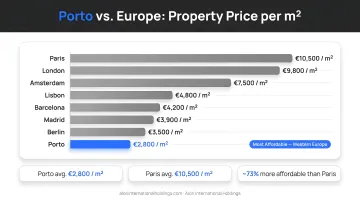
Porto's price per square meter offers substantial arbitrage compared to peer European cities:
| City | Average Price per m² |
|---|---|
| Amsterdam | €7,963 |
| Lisbon | €5,914 |
| Barcelona | €4,989 |
| Porto | €3,940 |
Porto trades at a 20-33% discount to comparable European markets. For American investors seeking diversification away from USD-denominated assets, that gap—paired with Portugal's EU membership, stable governance, and consistent openness to foreign capital—represents a low-risk entry environment that's difficult to replicate elsewhere in Western Europe.
What distinguishes Porto from other undervalued European cities is the convergence of these factors at the same time: population density, tech sector growth, infrastructure investment, and price accessibility—all pointing in the same direction.
Porto Real Estate Market: Current Prices and Trends
As of early 2026, Porto's average residential price stands at €3,940/m², representing a modest 1.4% year-on-year increase. The market splits clearly by property type: apartments command a premium at €4,837/m², while houses average €3,536/m² — a gap that shapes which investment strategy makes sense for each buyer profile.
What's Driving Controlled Growth
Several factors support Porto's measured appreciation trajectory:
- Euribor stabilization around 2% (3-month at 2.13%, 12-month at 2.86%) improving mortgage accessibility for domestic buyers
- Construir Portugal program reducing VAT to 6% on new construction up to €648,000, stimulating developer supply
- Consistent international buyer demand from Western European and American investors
- Supply constraints in premium neighborhoods where historic building stock limits new development
Rental Market Fundamentals
Porto's rental market shows strong yields with neighborhood-specific variation. Average rents across the city break down as follows:
- Baixa and Cedofeita: €22/m² (highest in city)
- Historic Center: €21/m²
- Bonfim and Paranhos: €16–18/m² (balanced yield zones)
- Vila Nova de Gaia: €14/m² (emerging value area)
The rental market saw modest correction after sharp prior-year increases — current entry yields compare well against recent highs, which feeds directly into the price trajectory projected for the next 6–12 months.
6-12 Month Price Forecast
Property consultancies project continued appreciation. Tagus Property forecasts 4.1% growth pushing the city average to €4,100/m², while JLL anticipates consolidation with structural scarcity continuing to pressure prices upward. Key catalysts include:
- High-speed rail progress connecting Porto to Lisbon and Spain
- Metro network extensions opening new residential catchment areas
- Continued inflows of international companies and remote workers
- Sustained tourist volume supporting short-term rental demand
Risk Factors to Monitor
Three risk factors warrant close attention before committing capital:
- Alojamento Local (AL) regulations: Short-term rental rules are tightening, with new license restrictions already in place across the Historic Center and Foz do Douro
- **IMT reform for non-residents**: A proposed flat 7.5% transfer tax on high-value transactions could materially affect acquisition costs for foreign buyers
- Premium zone saturation: Supply scarcity in top neighborhoods props up prices but limits liquidity — exit timelines may extend in slower cycles
Best Neighborhoods to Invest in Porto
Porto's neighborhoods segment into three distinct investment profiles: premium wealth preservation zones, balanced yield-and-value areas, and emerging high-yield neighborhoods. Your investment goals should dictate which profile fits.
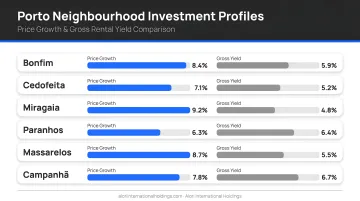
| Neighborhood | Price per m² | YoY Growth | Market Profile |
|---|---|---|---|
| Cedofeita | €5,625 | +8.6% | Premium urban residential |
| Historic Center/Ribeira | €5,324 | -1.4% | Tourist and heritage core |
| Foz do Douro/Lordelo do Ouro | €4,785 | +14.5% | Luxury coastal lifestyle |
| Boavista | €4,194 | +8.6% | Business and executive hub |
| Bonfim | €3,700 | +4.0% | Trendy mid-range professionals |
| Paranhos | €3,545 | +2.4% | Student and hospital district |
| Vila Nova de Gaia | €2,817 | +6.3% | High-value emerging suburb |
Premium and Lifestyle Neighborhoods
Foz do Douro and Lordelo do Ouro command Porto's highest prestige as coastal zones offering Atlantic and Douro River views. At €4,785/m² with +14.5% annual growth, these neighborhoods attract affluent international buyers seeking premium lifestyle properties. Properties here typically yield 4.0-4.5% on long-term rentals but carry high resale liquidity and capital appreciation security. Expect entry points from €400,000 for apartments to €1 million+ for waterfront villas.
Cedofeita and Boavista (€4,194-€5,625/m², +8.6% growth) represent premium urban positioning with exceptional short-term rental appeal. Proximity to cultural amenities, restaurants, and metro access creates consistent demand from business travelers and remote workers. Short-term rental yields in Cedofeita typically run 5.5–6.5%, outperforming long-term returns by a meaningful margin.
Balanced and Emerging Neighborhoods
Bonfim (€3,700/m², 5.8% gross yield) offers excellent balance of entry price and rental return. This trendy neighborhood east of the city center attracts young professionals and digital nomads with renovated buildings, street art culture, and improving infrastructure. Studio apartments here generate 6.2% gross yields while maintaining appreciation potential.
Paranhos (€3,545/m², 5.2% yield) benefits directly from University of Porto's 35,800 student population plus hospital district employment. Studio apartments achieve 6.4% gross yields—Porto's highest—with structural, recession-proof demand. Entry points start around €150,000 for studios, €250,000 for two-bedroom units.
Vila Nova de Gaia is Porto's best value entry point at €2,817/m² (+6.3% growth). Situated across the Douro River, Gaia offers skyline views, port wine cellars, and accelerating infrastructure investment. Yields around 5.4% suit most entry budgets in this market.
The High-Speed Rail station at Santo Ovídio and Ruby metro line integration are set to transform connectivity — making this particularly relevant for investors in the €150K–€400K range.
Historic Center and Ribeira
The Historic Center and Ribeira command €5,186-€5,324/m² with yields around 4.6%. UNESCO-listed architecture creates scarcity value and consistent tourist demand. Renovation projects offer significant value appreciation potential post-restoration, though buyers should note that short-term rental regulations are most actively enforced here, with new AL licenses severely restricted.
Rental Yields and Investment Strategies
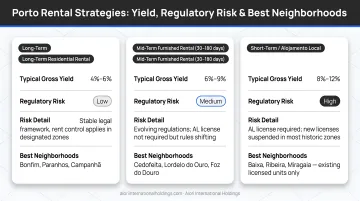
Porto's rental market supports three distinct strategies, each with different yield profiles, management intensity, and regulatory exposure:
| Strategy | Gross Yield Range | Best Neighborhoods | Regulatory Risk |
|---|---|---|---|
| Short-term (Airbnb/AL) | 5.5–8.0% | Ribeira, Cedofeita | High (AL restrictions) |
| Mid-term (1–6 months) | 5.0–7.0% | Bonfim, Boavista | Low |
| Long-term residential | 4.0–6.5% | Paranhos, Vila Nova de Gaia | Minimal |
Neighborhood-Specific Yield Analysis
| Neighborhood | Property Type | Gross Yield | Net Yield | Target Tenant |
|---|---|---|---|---|
| Paranhos | Studio | 6.4% | 5.1% | Students & hospital staff |
| Campanhã | Studio | 6.3% | 4.9% | Budget renters near transit |
| Bonfim | Studio | 6.2% | 4.8% | Young professionals |
| Cedofeita | Studio | 6.0% | 4.7% | Remote workers & students |
| Historic Centre | 1-Bed | 5.1% | 3.8% | Expats & professionals |
| Foz do Douro | 3-Bed Villa | 3.7% | 2.5% | Wealthy families |
Luxury purchases in Foz do Douro are primarily capital appreciation plays — price growth, not rental income — netting just 2.5% after taxes and maintenance. Investors seeking cash flow should target smaller units (T0/T1 studios and one-bedrooms) in Paranhos or Bonfim.
The Mid-Term Rental Opportunity
Mid-term rentals (1–6 months) have become a standout strategy, driven by Porto's growing digital nomad population. The city welcomed 24,100 digital nomads in 2024, a 163% surge since 2015. This demographic drives demand for turnkey, furnished apartments with flexible lease terms.
Mid-term rentals balance short-term yield with tenant stability while carrying significantly lower regulatory risk than Alojamento Local platforms facing ongoing restrictions. Investors can capture higher per-month revenues from expats and remote workers without the management intensity of nightly turnover. There's also no compliance burden from AL licensing in restricted zones.
Porto's tourism fundamentals reinforce this demand. The city recorded 6.27 million overnight stays in 2024 — a 36.9% increase versus 2019 — and peak seasons now extend well beyond summer. Cultural events, wine tourism, and year-round city-break traffic keep demand steady, which translates directly into lower vacancy risk for mid-term rental holders.
Buying Property in Porto as a Foreign Investor: Process, Taxes, and Costs
Step-by-Step Buying Process
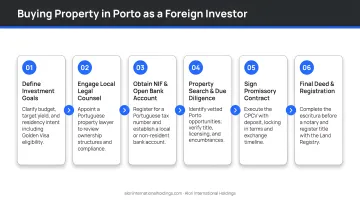
1. Obtain a Portuguese NIF (Tax Identification Number)
Non-EU residents require a fiscal representative in Portugal. The process can be completed remotely via power of attorney granted to a Portuguese resident or lawyer.
2. Open a Portuguese bank account
Required for utility payments, property taxes, and transaction settlement. Most banks require in-person account opening, though some accommodate remote applications with proper documentation.
3. Secure financing if needed
Non-residents can typically access 60–70% LTV from Portuguese banks, requiring a 30–40% cash down payment. Alternatives include a home equity line of credit (HELOC), developer payment plans, or all-cash purchases.
4. Find property through licensed agent
Work with licensed real estate professionals who understand local market nuances and can verify property legal status.
5. Sign Promissory Contract (CPCV)
Initial binding agreement with 10–30% deposit securing the property during the due diligence period.
6. Complete Final Deed (Escritura)
Notarized transaction transferring legal title, with registration at the Conservatória do Registo Predial providing full ownership protection.
Taxes and Transaction Costs
Once the deed is signed, the true cost of acquisition becomes clear. Budget 9–11% above the purchase price for taxes and fees — a €300,000 property typically requires €27,000–€33,000 in additional funds at closing.
Purchase-Side Costs
| Cost | Rate | Notes |
|---|---|---|
| IMT (Property Transfer Tax) | 0–10% | Marginal rates from 1% (up to €106,346) to 8% (up to €660,982) for secondary/holiday homes. 2026 proposals may introduce a flat 7.5% for non-residents. |
| Stamp Duty | 0.8% | Applied to purchase price or VPT (tax valuation), whichever is higher |
| Legal/Notarial Fees | ~2.5% | Covers legal representation, notary, and registration |
Annual Holding Costs
| Tax | Rate | Threshold |
|---|---|---|
| IMI (Municipal Property Tax) | 0.3–0.45% of cadastral value | Porto's 2026 rate: 0.324% |
| AIMI (Wealth Tax) | 0.7% above €600,000 (individuals) | €1.2M threshold for married couples; corporate-owned residential properties: 0.4% with no exemption |
Capital Gains Tax:
Non-residents face the same rules as residents: 50% of capital gain is taxable, aggregated with worldwide income and taxed at Portugal's progressive rates (14.5% to 48%). This represents a significant change from the previous flat 28% rate following European Court of Justice rulings.
Alori International Holdings: Reducing Transaction Risk for American Buyers
Alori International Holdings provides American investors with access to curated, vetted Porto opportunities with verified legal structures and defined exit strategies. For buyers unfamiliar with Portuguese property law, that means practical support across local expertise networks, developer due diligence, and deal vetting focused on regulatory compliance and clean ownership structures. Alori operates as an independent advisor — not a transaction executor — which keeps its incentives aligned with the investor, not the deal.
Frequently Asked Questions
Is Porto a good place to invest in real estate?
Yes. Porto offers strong investment fundamentals with affordable entry relative to Western Europe (€3,940/m² vs. €5,914/m² in Lisbon), rental yields of 4–6.5%, consistent tourism and expat demand, and controlled appreciation supported by €3 billion in high-speed rail infrastructure and EU stability.
Can foreigners buy property in Porto?
Foreigners have identical property ownership rights as Portuguese citizens, with no restrictions on non-resident purchases. Key requirements are a NIF (tax identification number) and Portuguese bank account, both obtainable with professional assistance, including remotely.
What are the best neighborhoods in Porto for real estate investment?
It depends on your yield vs. appreciation priority. Premium areas (Foz do Douro, Cedofeita) offer capital security at 4.0–4.5% yields; balanced neighborhoods (Bonfim, Paranhos) hit 5.2–5.8%; and emerging Vila Nova de Gaia delivers the strongest value-to-growth ratio at 5.4% yields and €2,817/m².
What rental yields can investors expect in Porto?
Gross yields range from 4.0–4.6% in premium neighborhoods (Foz do Douro, Cedofeita), 5.0–5.8% in balanced areas (Bonfim, Paranhos), and up to 6.4% in emerging neighborhoods (Vila Nova de Gaia, Campanhã). Short-term rentals can push gross yields higher, but management fees and licensing costs typically reduce net returns by 1.5–2.5 percentage points.
What taxes do foreign buyers pay when purchasing property in Porto?
Total acquisition costs — covering IMT (0–10%, with a proposed 7.5% flat rate for non-residents), Stamp Duty (0.8%), and legal fees (~2.5%) — typically add 9–11% to the purchase price. Ongoing costs include annual IMI property tax (0.3–0.45%) and an AIMI wealth tax of 0.7% on portfolios exceeding €600,000.
How does Porto compare to Lisbon for real estate investment?
Porto's average €3,940/m² represents roughly a 33% discount to Lisbon's €5,914/m². Rental yields in Porto tend to be higher (4.0–6.5% vs. Lisbon's 3.5–5.0%), and the city is often compared to where Lisbon was a decade ago — with more price upside remaining, backed by a €3 billion rail project, rising expat inflows, and a tourism market that continues to outpace projections.