

Introduction
Portugal has become one of Europe's most structurally sound markets for vacation home investment — combining lifestyle appeal with strong financial returns. For American investors, the case is clear: a stable Western European democracy with transparent property laws, consistent tourism demand, and entry prices that remain significantly below comparable markets in France, Spain, or Italy.
Yet most US investors face real uncertainty when approaching the market. How do foreign purchase processes work? What do returns actually look like, and can you secure financing overseas? How do you avoid regulatory pitfalls like short-term rental restrictions?
This guide answers each of those questions directly — covering where to buy, what it costs, how Americans navigate the purchase process, and how to protect returns over the long term.
Why Portugal Is a High-Conviction Market for Vacation Home Investment
Tourism and Economic Fundamentals
Portugal's vacation rental market rests on measurable structural demand. The country welcomed 29.0 million international arrivals in 2024, representing 9.3% growth year-over-year. Tourism now contributes 11.9% to Portugal's GDP, with the IMF forecasting 2.1% GDP growth for 2026.
That consistent inbound demand is what drives both rental income and long-term property appreciation — making the fundamentals here data-backed rather than sentiment-driven.
Competitive Entry Pricing
Portugal maintains a significant affordability advantage relative to Western European peers:
| Country | Avg Price per Sqm | Data Type |
|---|---|---|
| Portugal | €2,025 | Median Bank Appraisal (Oct 2025) |
| Spain | €2,517 | Asking Price (Q3 2025) |
For American investors targeting the $150,000–$600,000 range, this price differential translates into superior purchasing power. A $300,000 budget secures a 2-bedroom Algarve apartment, a Lisbon studio, or a Porto townhouse — entry points that would be significantly constrained in comparable French or Italian markets.
Capital Appreciation Track Record
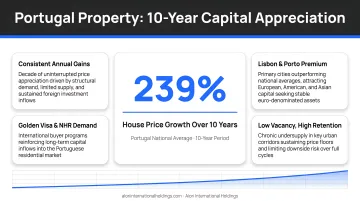
Portugal's House Price Index surged 17.6% in 2025, driven by persistent supply-demand imbalances. Existing dwellings appreciated 18.9%, outpacing new construction at 14.2%. Over a 10-year period, Lisbon nominal house prices have grown 239.91%, reflecting sustained international buyer demand and capital appreciation potential.
Why Americans Specifically Choose Portugal
Beyond pricing, Portugal offers practical advantages for US investors:
- No foreign ownership restrictions — Americans can freely purchase property without special permits
- English widely spoken — particularly in Lisbon, Porto, and the Algarve's international communities
- Political stability — established democracy with transparent legal frameworks
- Strong expat community — active American and international resident networks already in place
- Hybrid investment model — many buyers use the property 2-3 months annually and rent the remainder, generating income while building equity
For investors who want exposure to international real estate without the opacity of emerging markets, Portugal checks the structural boxes that matter: demand visibility, legal clarity, and a pricing floor that still has room to move.
Best Regions to Buy a Portugal Vacation Home
Location determines everything in Portuguese real estate — property price, rental yield, short-term licensing access, and capital appreciation potential. Here's how the major regions compare.
The Algarve
The Algarve represents Portugal's premier vacation rental market, offering the strongest combination of yield and regulatory clarity. With 300+ days of annual sunshine and consistent international tourist demand, the region delivered median transaction prices of €3,203/sqm in Q3 2025, with gross rental yields averaging 6.4% regionally.
Key hotspots within the Algarve:
- Vilamoura — Luxury marina, golf courses, and resort infrastructure; ideal for premium short-term rentals
- Albufeira — High-volume tourism hub with strong rental demand across all property types
- Lagos — Historic coastal town attracting families and digital nomads; balanced rental and lifestyle appeal
- Portimão — Emerging market with lower entry prices and growing international interest
The Algarve also holds a meaningful regulatory edge: it remains largely unaffected by the Mais Habitação law's short-term rental restrictions that have tightened AL licensing in Lisbon and Porto. Alojamento Local registration stays more accessible here for investors targeting seasonal income.
Lisbon and Greater Lisbon
Lisbon commands Portugal's highest property prices at €5,000/sqm median transaction value, reflecting premium urban positioning and strong long-term capital appreciation. Gross rental yields average 3.82%, lower than the Algarve but supported by year-round corporate and executive tenant demand.
The Mais Habitação law has, however, severely restricted new AL licensing within Lisbon proper — municipal containment zones ban new registrations where AL-to-permanent-housing ratios exceed 10%.
For vacation rental investors, Greater Lisbon is the practical workaround. Cascais (€4,713/sqm, 4.06% yields), Sintra, and the Setúbal Peninsula offer better regulatory flexibility while maintaining proximity to Lisbon's employment and tourism infrastructure — the upside of the capital without the licensing constraints.
Porto
Porto offers a balanced investment proposition: lower entry prices than Lisbon (€3,186/sqm median transaction) with moderate gross rental yields around 4.02%. The city attracts strong tourism and digital nomad demand, supporting both short-term and medium-term rental strategies.
Porto's city center faces the same Mais Habitação AL licensing restrictions as Lisbon — specific containment areas (Vitória, São Nicolau, Sé) ban new licenses. Investors focused on vacation rentals should target Porto's metro area, where regulatory flexibility remains intact.
Emerging Regions: Silver Coast and Alentejo
The Silver Coast (Oeste) and Alentejo offer lower entry points with emerging investment potential:
- Silver Coast — Coastal towns like Caldas da Rainha averaging €2,285/sqm asking prices
- Alentejo — Interior rural markets like Beja at €1,573/sqm
These regions face no Mais Habitação AL restrictions, making short-term rental licensing straightforward. Tourist interest is growing, particularly for authentic Portuguese experiences and rural retreats. The trade-off is clear: lower entry prices create room for capital appreciation as these markets mature, but current rental volumes and nightly rates run well below the Algarve or Lisbon.
The Financial Picture: Property Prices, Rental Yields, and Ownership Costs
Regional Price and Yield Benchmarks
| Region/Municipality | Median Price/Sqm | Gross Rental Yield | Property Type Access ($150K-$600K) |
|---|---|---|---|
| Algarve (Region) | €3,203 | ~6.4% avg | 2-3 bedroom apartments, smaller villas |
| Faro (Algarve) | €3,549 | 7.06% (studios) | Studio to 2-bedroom units |
| Lisbon (City) | €5,000 | 3.82% | Studio to 1-bedroom apartments |
| Cascais (Lisbon Metro) | €4,713 | 4.06% (2-bed) | 1-2 bedroom apartments |
| Porto (City) | €3,186 | 4.02% | 1-2 bedroom apartments, townhouses |
The Algarve delivers the highest gross yields, particularly for smaller units (studios and 1-bedrooms). Lisbon commands premium pricing with lower yields but stronger capital appreciation potential. Porto sits between the two — solid yields without Lisbon's premium price floor.
Yield clarity: Gross yields represent annual rental income divided by property price before expenses. Net yields subtract property management fees (15-25% of rental revenue), annual IMI tax (0.3-0.8%), insurance, and condominium fees where applicable. Net yields typically run 2-3 percentage points below gross figures.
One-Time Purchase Costs Beyond Property Price
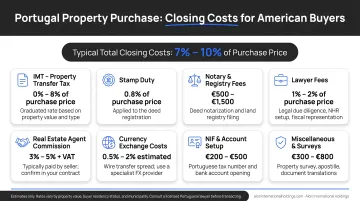
American buyers should budget 6-10% of the purchase price for closing costs:
Property Transfer Tax (IMT) — Progressive rate structure for vacation/secondary homes:
- Up to €106,346: 1%
- €106,346-€145,470: 2%
- €145,470-€198,347: 5%
- €198,347-€330,539: 7%
- €330,539-€633,931: 8%
- €633,931-€1,150,853: Flat 6%
- Over €1,150,853: Flat 7.5%
Stamp Duty (Imposto de Selo): Flat 0.8% on property acquisition
Notary and registration fees: Typically 1-2% combined
Legal/attorney fees: 1-2% for due diligence, contract review, and representation
Example: On a €300,000 Algarve apartment, expect approximately €18,000-€30,000 in total closing costs.
Ongoing Ownership Costs
| Cost Item | Typical Range | Notes |
|---|---|---|
| Annual Municipal Property Tax (IMI) | 0.3–0.8% of assessed value | Paid annually |
| Property insurance | €300–€800/year | Varies by property type and location |
| Condominium fees | €50–€200/month | Applies to managed apartment buildings |
| Property management fees | 15–25% of rental revenue | Essential for absentee US owners |
| Rental income tax (long-term) | 25% flat rate on net income | Category F, non-resident rate |
| Rental income tax (short-term) | 35% of gross revenue taxable | Simplified regime applies |
Taken together, these costs typically reduce gross yields by 2-3 percentage points — which is why running net return projections before committing is essential.
Financing Options for Non-Resident Americans
Portuguese banks offer mortgages to non-residents, typically at 60-70% loan-to-value (LTV) ratios. This requires substantial down payments of 30-40% minimum.
Requirements for US buyers:
- Portuguese Tax Identification Number (NIF)
- Income documentation acceptable to Portuguese lenders
- Credit reference report (Experian or equivalent)
- Last three months' bank statements
- Recent payslips or employer reference
- Last year's income tax declaration
Many American investors choose cash purchases to simplify transactions and avoid cross-border financing complexity. Those who prefer to preserve liquidity have several alternatives:
- US home equity (HELOC): Borrow against existing US property at domestic rates
- Developer payment plans: Often 0% interest over 24-48 months on new developments
- Seller financing: Negotiated directly with the vendor, typically on a case-by-case basis
How US Citizens Can Buy a Vacation Home in Portugal: Step-by-Step
US citizens can freely buy property in Portugal — there are no restrictions on foreign ownership. The process is legally straightforward but benefits significantly from professional guidance given language barriers and unfamiliarity with Portuguese notarial systems.
Working with a firm like Alori International Holdings reduces legal and transaction risk for American buyers navigating an unfamiliar market. Local professionals verify title structures through Portugal's property registry (Conservatória do Registo Predial), assess developer track records, and ensure documentation meets both Portuguese and US tax compliance requirements.
The Purchase Process
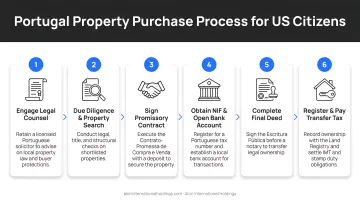
Step 1: Obtain a Portuguese Tax Number (NIF)
Required for all property transactions. American buyers can obtain a NIF through a local tax office in Portugal or by granting power of attorney to a Portuguese legal representative who can secure it on your behalf.
Step 2: Open a Portuguese Bank Account
Practical for handling property transactions, paying taxes, and managing utilities. Most banks require your NIF and passport for account opening.
Step 3: Engage a Portuguese Property Lawyer
Independent legal representation is essential for due diligence, contract review, title verification, and protecting your interests. Portuguese lawyers typically charge 1-2% of the purchase price.
Step 4: Sign the Promissory Contract (CPCV)
This preliminary contract commits both parties to the sale. Buyers typically deposit 10-30% of the purchase price at this stage. It also establishes the completion timeline agreed upon by both parties.
Step 5: Execute the Final Deed (Escritura Pública)
The final deed is signed before a Portuguese notary, with the balance of the purchase price transferred. Title officially transfers at this point.
Step 6: Register the Property
Your lawyer registers the property at the Land Registry and Tax Office, ensuring legal ownership and establishing your tax obligations.
Physical presence not required: American buyers can grant power of attorney to a Portuguese legal representative to act on their behalf throughout the entire process, from NIF acquisition to final deed signing.
Golden Visa Status (Important Clarification)
As of October 2023, the Portuguese government discontinued the real estate investment route under the Golden Visa program. US buyers purchasing vacation homes for investment or personal use cannot currently obtain residency through property purchase.
Alternative residency pathways remain available:
- D7 Visa — For passive income holders (requires minimum €920/month documented income in 2024)
- D2 Visa — For entrepreneurs establishing businesses in Portugal
- Investment fund routes — Golden Visa remains available through qualifying fund investments
The real estate Golden Visa route remains a common misconception among American buyers, so it's worth confirming current program status before factoring residency into your investment decision.
Maximizing Your Return: Rental Strategy and Property Management
Alojamento Local (AL) Licensing Requirements
All properties rented short-term in Portugal (under 30 consecutive days) must be registered with local authorities and hold an AL license. Registration is completed via the Balcão do Empreendedor portal, generating a Registo Nacional de Alojamento Local (RNAL) number.
Licensing status by region:
- Lisbon and Porto city centers: Severely restricted under the Mais Habitação law; new licenses banned in containment zones where AL density exceeds municipal thresholds
- Algarve: Broadly available; municipalities may introduce local density quotas but no regional blanket ban exists
- Silver Coast and Alentejo: Open; no significant licensing restrictions
Tax and compliance obligations:
- AL income is treated as business income (Category B)
- Under the simplified regime, 35% of gross rental income is taxable profit
- AL operations subject to 6% VAT in mainland Portugal (exemption threshold €15,000 annually)
- Non-compliance risks significant fines and license revocation
Verify AL licensing status and municipal regulations before purchasing if short-term rental income is critical to your investment thesis. Once licensing is confirmed, the next step is building a rental strategy that works across the full calendar year.
Strategic Rental Approach
Successful investors combine multiple rental strategies to maximize annual income:
Peak-season short-term rentals (May–October): Capture maximum yield through nightly rentals on Airbnb, Booking.com, and Vrbo during high-demand summer months. Professional photography, competitive dynamic pricing, and strong guest reviews directly impact occupancy rates.
Off-peak medium/long-term rentals (October–April): Sustain year-round income through 1-6 month rentals to digital nomads, corporate tenants, or seasonal residents. This reduces vacancy during low-demand winter months.
Platform distribution: List across multiple platforms simultaneously to maximize visibility and booking potential. Direct booking websites can reduce platform commission fees (typically 3-15% per reservation).
Firms like Alori offer defined rental strategies and exit planning as part of their curated approach, giving US investors managing properties remotely a clear framework built on actual occupancy data and documented market benchmarks.
Property Management for Absentee Owners
For US investors unable to be on the ground, professional property management is a necessary operating cost, not an afterthought. Portuguese property management companies handle:
- Guest communication and booking management
- Cleaning and turnover between guests
- Maintenance and emergency repairs
- Compliance with AL tax and reporting obligations
- Pricing optimization and calendar management
Typical management fees: 15-25% of rental revenue
This cost must be factored into net return calculations. Management quality directly impacts guest reviews, occupancy rates, and long-term property condition — all of which affect both rental income and resale value.
Key Risks to Understand Before You Invest
Regulatory Risk
The Mais Habitação law created significant uncertainty for short-term rental operators in Lisbon and Porto. Regulations can evolve, and municipalities may introduce additional restrictions or density quotas even in currently open markets like the Algarve.
Mitigation: Choose locations with regulatory stability (the Algarve, Silver Coast, Alentejo), monitor local policy developments, and structure investments to support both short-term and long-term rental strategies. Properties that can pivot between rental types maintain flexibility regardless of regulatory changes.
Currency Risk
US investors receive rental income in euros and hold assets denominated in euros. USD/EUR exchange rate fluctuations directly affect dollar-denominated returns. A weakening euro reduces the dollar value of rental income and property appreciation when repatriated.
Mitigation:
- Factor currency exposure into return modeling before committing capital
- Consider euro-denominated holdings to offset future euro expenses (travel, retirement abroad)
- Dollar-cost averaging over multiple years reduces exchange rate timing risk
Seasonal Income Volatility
The Algarve and most coastal markets experience high seasonality. Nightly rates and occupancy rates drop October–April. Investors relying exclusively on summer rental income face cash flow gaps during off-season months.
Mitigation:
- Stress-test returns against off-peak scenarios, modeling 60–70% annual occupancy rather than 90%+
- Blend short-term summer rentals with medium-term winter tenancies to smooth cash flow
- Prioritize properties with year-round appeal — proximity to services and good infrastructure cuts seasonal exposure
Risk Management Framework
The right infrastructure makes these risks manageable:
- Disciplined entry — Verified pricing in markets with structural, not speculative, demand drivers
- Legal due diligence — Independent legal counsel, clean title verification, and full regulatory review before closing
- On-the-ground professionals — Local managers and advisors who track regulatory shifts before they affect your returns
The investors who get hurt in Portugal are typically those who bought on momentum, skipped legal review, or modeled peak-season occupancy as a baseline. Each of those mistakes is avoidable with the right preparation.
Frequently Asked Questions
Can a US citizen buy a house in Portugal?
Yes, US citizens can freely purchase property in Portugal with no ownership restrictions. A Portuguese Tax Identification Number (NIF) is required, and the process is straightforward with proper legal representation.
What are the taxes involved in buying a vacation home in Portugal?
Main taxes include Property Transfer Tax (IMT, up to 8% for vacation homes), Stamp Duty (0.8%), and annual Municipal Property Tax (IMI, 0.3–0.8%). Rental income is taxed at 25% for non-residents on long-term leases; short-term rentals are taxed on 35% of gross revenue under the simplified regime.
What rental yields can I expect from a Portugal vacation home?
Gross rental yields typically range from 4–7%, with the Algarve leading at 6.5–7.0% and Lisbon Metro averaging 3.8–4.0% for smaller units. Net yields run 2–3 percentage points lower after expenses.
Is the Portugal Golden Visa still available for real estate buyers?
No, the real estate investment route under the Golden Visa program was discontinued in October 2023. Other investment routes (qualifying funds) and residency visas (D7, D2) remain available for Americans seeking Portuguese residency.
What is the Alojamento Local license and do I need one to rent my property?
An Alojamento Local (AL) license is required for any property rented short-term (under 30 consecutive days) in Portugal. Licensing is generally available outside of Lisbon and Porto city centers, where the Mais Habitação law has imposed significant restrictions.
Do I need to be in Portugal to complete the purchase?
No, physical presence is not required. US buyers can grant power of attorney to a Portuguese lawyer or legal representative to act on their behalf throughout the entire purchase process, from NIF acquisition to final deed signing.