

Introduction
Few real estate markets offer Georgia's tax profile. U.S. property owners face average annual property taxes of 1.81%; UK buyers pay up to 17% in stamp duty and surcharges. Georgia caps property taxes at just 1% of market value—with full exemptions for most middle-income households. Add zero transfer taxes, a flat 5% rental income tax, and complete capital gains exemptions after two years, and the cost structure becomes difficult to match globally.
This guide covers who pays property tax, how it's calculated, key deadlines, and how capital gains and rental income taxes complete the picture for investors.
Quick Summary: Georgia Property Tax at a Glance
- Households earning under GEL 40,000 annually are exempt from property tax on buildings (land tax still applies)
- Tax rates range from 0.05% to 1% based on household income and property location
- Foreign and non-resident owners follow the same rules as residents, though income calculations differ
- Annual deadlines: declaration by November 1, payment by November 15
- Land tax is calculated separately and applies regardless of income level
Who Is Subject to Property Tax in Georgia?
Georgian law imposes annual property tax on individuals (natural persons) who own taxable assets and whose total household income in the previous year exceeded GEL 40,000 (roughly $14,800 USD at current rates). Those earning below this threshold are exempt from property tax on buildings and other assets—but not on land.
Taxable property includes:
- Residential and commercial real estate, including unfinished construction
- Passenger vehicles, yachts, helicopters, and airplanes
- For those engaged in economic activity: fixed assets and uninstalled equipment
- Property received from non-residents under lease agreements
Ownership triggers the obligation regardless of whether the property is occupied, vacant, or rented out — title determines liability, not usage.
What Counts as "Household Income"?
Georgian tax law defines household income broadly. It includes the owner's worldwide income plus the income of all household members: spouse, minor children, and co-habitating close family members (parents, siblings, grandparents, grandchildren). You cannot isolate your personal income alone — the entire household's combined earnings count toward the GEL 40,000 threshold.
Residents vs. Non-Residents: Key Distinctions
How income is counted toward the GEL 40,000 threshold depends on your residency status:
| Status | Income Counted Toward Threshold |
|---|---|
| Georgia tax resident | Worldwide income |
| Non-resident Georgian citizen | Georgian-sourced income only |
| Non-resident foreign national | Worldwide income |
For non-resident foreign owners, meeting these obligations does not require being present in Georgia. You can file through the Revenue Service online portal or authorize a local representative via power of attorney. Georgian citizens and temporary residence holders can even complete notarization remotely through the Notary Chamber of Georgia's Skype-based service.
How Is Property Tax Calculated in Georgia?
Georgia's property tax system is straightforward by international standards — and remarkably low by American ones. Two variables drive what you owe:
- Total annual household income (prior tax year)
- Property location/municipality (local authorities set rates within statutory bounds)
Tax is calculated on the market value of the property as of December 31 of the prior tax year. The Revenue Service may reassess that value during audits if it exceeds book value.
Income Brackets and Applicable Rates
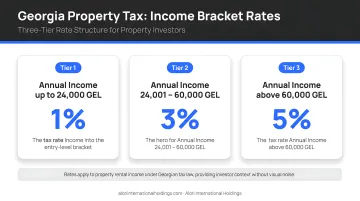
| Household Income (Prior Year) | Property Tax Rate |
|---|---|
| Below GEL 40,000 | 0% (Exempt on buildings) |
| GEL 40,000 to GEL 100,000 | 0.05% to 0.2% of market value |
| Above GEL 100,000 | 0.8% to 1% of market value |
Example:
An individual with household income of GEL 120,000 owning a Tbilisi apartment with a market value of GEL 300,000 would pay between GEL 2,400 and GEL 3,000 annually. For context, a comparable property in the U.S. would typically carry $5,400+ in annual property taxes — making Georgia's effective rate roughly 80% lower for high-income bracket owners.
Special Rule: Small Business Status (SBS)
Individual Entrepreneurs with Small Business Status (SBS) benefit from a unique calculation: only 25% of their taxable income under the 1% SBS regime counts toward the household income threshold.
Worked example:
- SBS income: GEL 100,000
- Income counted toward threshold: GEL 25,000 (25% of GEL 100,000)
- That puts total counted income below the GEL 40,000 threshold — meaning full exemption from property tax
Corporate Property Tax
Legal entities (companies) are taxed differently: up to 1% annually on the average net book value of fixed assets, investment property, uninstalled equipment, and unfinished construction. For assets acquired before 2005, multipliers apply:
- Acquired before 2000: 3x multiplier
- Acquired 2000–2004: 2x multiplier
- Acquired in 2004: 1.5x multiplier
These multipliers reflect the historical undervaluation of older assets on Georgian balance sheets. For investors acquiring new property today, they're generally not a factor — corporate holdings will simply be taxed on current net book value at up to 1% annually.
Land Tax in Georgia: A Separate but Important Obligation
Land tax in Georgia is completely separate from building/asset property tax. It applies to all landowners and users regardless of household income level—the GEL 40,000 exemption threshold does not apply to land.
How land tax is calculated:
| Land Type | Base Rate | Municipal Adjustment |
|---|---|---|
| Non-Agricultural Land | GEL 0.24 per square meter/year | Territorial coefficient up to 150% (1.5x) |
| Agricultural Land (Arable/Homestead) | GEL 50–100 per hectare (Tbilisi: GEL 100/ha) | Adjusted up to 150% |
| Agricultural Land (Pasture/Grassland) | GEL 1.5–20 per hectare | Adjusted up to 150% |
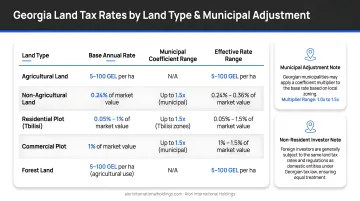
For foreign investors purchasing land plots for development, land tax represents a minimal annual holding cost—but investors should still factor it into their underwriting before committing capital.
Related Taxes Every Property Investor in Georgia Should Know
Beyond annual property tax, Georgia's other real estate-related taxes are notably favorable compared to Western markets, making the overall tax cost of Georgian real estate ownership among the lowest in Europe.
Capital Gains Tax on Property Sales
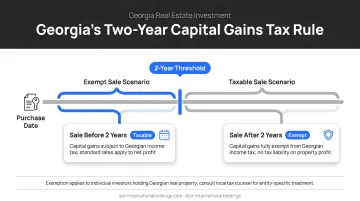
Georgia applies a two-year capital gains rule:
- Properties held more than two years: Capital gain is 100% tax-exempt
- Properties sold within two years: 5% capital gains tax on the gain (selling price minus original cost), rather than the standard 20% personal income tax rate
For U.S. investors, the contrast is sharp: federal capital gains rates run up to 20% (plus applicable state taxes), even on primary residences that exceed Section 121 exclusion limits. Holding Georgian property beyond the two-year mark eliminates that burden entirely.
Rental Income Tax
Rental income from Georgian residential property is taxed at a flat 5% rate on gross income—significantly lower than the standard 20% personal income tax. This 5% rate applies to both long-term leases and short-term rentals (e.g., Airbnb).
Additional advantages:
- Rental income from property located outside Georgia is not taxable in Georgia
- Capital gains from the sale of foreign property are also not taxable in Georgia
For investors holding assets across multiple countries, this separation keeps Georgian income reporting straightforward. Note that U.S. investors still carry FATCA reporting obligations on foreign accounts and property income — Georgian tax rates are favorable, but they don't eliminate U.S. disclosure requirements. Working with an advisor who understands both jurisdictions is worth the investment.
No Transfer or Stamp Taxes
Georgia imposes **no transfer taxes** and no stamp taxes on property transactions—a significant cost advantage compared to most European markets where transfer taxes can reach 3–10% of property value, or the UK where stamp duty and surcharges can exceed 12% for additional properties.
Filing Deadlines and Compliance for Foreign Owners
Annual property tax calendar:
- November 1: Declaration deadline (for the prior tax year)
- November 15: Payment deadline
Example: Property purchased in 2024 → first filing due November 2025.
Filing process:
Declarations are submitted through Georgia's Revenue Service electronic portal. The system is fully digitized, meaning non-resident foreign owners can comply remotely without being physically present in Georgia. Alternatively, owners can grant a power of attorney to a local representative.
Consequences of non-compliance:
- Late filing: 5% penalty (if under 2 months late) or 10% penalty (if over 2 months late) of assessed tax
- Late payment: 0.05% daily penalty interest on outstanding liability
These penalties compound quickly — and non-residents carry a higher risk of triggering them, since the Georgian Revenue Service communicates exclusively through digital channels. Missing a notice is easy when you're managing a property from abroad. Setting calendar reminders for both deadlines, or engaging a local representative, is the most reliable way to stay compliant without surprises.
Frequently Asked Questions
Is there property tax in Tbilisi, Georgia?
Yes, property tax applies in Tbilisi. The city falls under municipal jurisdiction, with local authorities setting specific rates within the national statutory range of 0.05% to 1%, based on the owner's household income and property value.
How much are property taxes in Tbilisi, Georgia?
Tax rates follow the national income-based tiers: exempt if household income is below GEL 40,000; 0.05%–0.2% for incomes between GEL 40,000 and GEL 100,000; 0.8%–1% for incomes above GEL 100,000. The exact rate within each band is set by Tbilisi municipality.
Do foreigners and non-residents have to pay property tax in Georgia?
Yes, foreign property owners are subject to the same property tax rules as Georgian residents. Non-resident foreign nationals count their worldwide income toward the GEL 40,000 threshold and can comply remotely via the Revenue Service portal or through an authorized local representative.
What is the property tax deadline in Georgia?
The annual property tax declaration must be filed by November 1, with payment due by November 15 of the year following the relevant tax year. Late filing results in fines and interest charges.
Is there capital gains tax when selling property in Georgia?
Properties held for more than two years are sold tax-free. Properties sold within two years attract a 5% capital gains tax on the net gain, compared to Georgia's standard 20% income tax rate.
Is land tax the same as property tax in Georgia?
No, land tax is a separate obligation. It applies to all landowners regardless of household income (unlike building property tax, which carries a GEL 40,000 income threshold) and is calculated based on land size, type, and location rather than market value.