

Introduction
American investors face a complex challenge: domestic real estate markets are expensive, increasingly correlated, and offer compressed returns in many metropolitan areas. Rising property taxes, higher interest rates, and regional price corrections create concentrated risk for portfolios anchored solely in U.S. assets. This dynamic has pushed capital-conscious investors toward international real estate as a structural diversification move — a deliberate hedge against domestic overexposure, not a speculative bet.
Georgia (the country, situated at the crossroads of Eastern Europe and Western Asia) is often overlooked by American investors, yet it consistently surfaces in high-conviction international market analyses. The numbers behind that reputation are hard to dismiss.
Georgia recorded real GDP growth of 9.7% in 2024, welcomed 7.8 million international visitors in 2025, and secured a $6.5 billion institutional development commitment from Eagle Hills. These are structural demand signals — not marketing narratives.
This article breaks down the concrete investment advantages of Georgian real estate in measurable terms: entry prices, tax efficiency, rental yields, and exit strategies backed by data.
Key Takeaways
- Georgian property prices in Tbilisi ($1,152/sqm) and Batumi ($1,234/sqm) remain 50-75% below comparable European markets
- 0% property purchase tax, 0% capital gains tax on residential sales held over two years, and annual property tax capped at 1%
- Tourist arrivals reached 7.8 million in 2025, driving short-term rental demand and gross yields of 7-10%
- Eagle Hills' $6.5 billion development commitment validates long-term institutional confidence in Batumi and Tbilisi
- American investors in the $150,000–$400,000 range can access these fundamentals through a transparent legal framework with in-market professional guidance
What Is Investing in Georgian Real Estate?
Georgian real estate investment means purchasing residential, hospitality-linked, or commercial property in Georgia to generate rental income, capital appreciation, or both—typically structured around key urban centers like Tbilisi, Batumi, and emerging resort markets.
The most relevant property categories for international investors include:
- Managed hotel complex apartments — income-generating units operated under hospitality brands
- Short-term rental units in high-traffic tourism corridors
- Residential apartments in high-demand urban districts with strong long-term tenant bases
Foreign nationals face no legal restrictions on purchasing apartments or residential property—agricultural land is the only category with ownership limitations.
Georgia's investment case rests on structural fundamentals, not speculative momentum. The core drivers are consistent: low entry costs, rising demand, favorable regulation, and growing international visibility.
The country ranked 7th globally in the World Bank's 2019 Ease of Doing Business report and maintains a transparent, digitized property registration system with completion times of just 1–4 days.
Key Advantages of Investing in Georgian Real Estate
The three advantages below are grounded in operational and financial outcomes investors can measure—not abstract potential.
Affordable Entry Prices with Strong Appreciation Potential
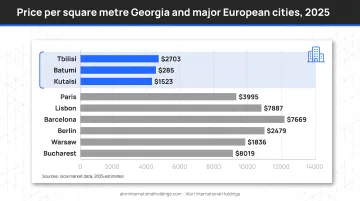
Georgian real estate remains materially underpriced compared to equivalent assets in Western Europe, Southeast Asia, and even neighbouring regional markets. Investors can build a meaningful position at the $100,000–$400,000 price point—roughly half what comparable properties cost in Lisbon, Warsaw, or Dubrovnik.
Price-Per-Square-Metre Comparison (2025-2026):
| City | Price Per Sqm | Year |
|---|---|---|
| Tbilisi, Georgia | $1,152 | 2025 |
| Batumi, Georgia | $1,234 | 2025 |
| Lisbon, Portugal | ~$5,200 | 2026 |
| Dubrovnik, Croatia | ~$3,792 | 2024 |
| Warsaw, Poland | ~$3,876 | 2026 |
| Bucharest, Romania | ~$2,581 | 2025 |
Appreciation is driven by real demand factors:
- Urbanisation: 61% of Georgia's population lives in urban areas, with one-third concentrated in Tbilisi
- Expat and digital nomad inflows: 205,857 immigrants recorded in 2023, with over 800 digital nomad visas approved through the "Remotely from Georgia" programme
- Institutional validation: Eagle Hills' $6.5 billion term sheet for Tbilisi Waterfront and Batumi's Gonio Yachts & Marina raises baseline property values for surrounding areas
In markets where institutional capital is just beginning to arrive, early-entry private investors historically capture the strongest appreciation curves. Tbilisi averaged 8.7% year-over-year price growth in Q1-Q2 2025, while Batumi recorded 6.4%—both outpacing most European markets. Lower acquisition cost also means a wider buyer pool upon resale, which improves liquidity.
Investors entering before major infrastructure projects complete—or before a market is fully priced into international awareness—benefit most. Georgia currently sits at that inflection point.
Investor-Friendly Tax and Legal Framework
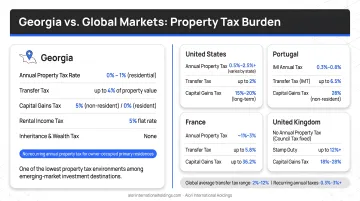
Georgia's regulatory environment is structured to attract foreign capital. The tax framework delivers three major advantages:
- 0% tax on property purchase (no stamp duty or transfer tax)
- Annual ownership tax of 0.05%–1% of assessed value (based on family income)
- 0% capital gains tax on residential property sold after two years of ownership (5% if sold within two years)
Global Property Tax Comparison:
| Country | Purchase Tax | Annual Property Tax |
|---|---|---|
| Georgia | 0% | 0.05%–1% |
| Portugal | Variable IMT + Stamp Duty | 0.3%–0.45% |
| Spain | 7% (Andalucia) | Municipal-dependent |
| United States | State/County-dependent | 1.88% (NJ/IL average) |
In practice, investors retain more of their rental yield, face minimal holding costs, and can exit cleanly. A $200,000 property in Georgia incurs roughly $100–$2,000 annual tax versus $3,760 in New Jersey or $600–$900 in Portugal—a material difference that compounds over a 5-10 year hold.
The legal process is equally efficient. Property registration through Georgia's National Agency of Public Registry takes 1-4 days with fees of 50-200 GEL ($18-$73). Transactions are transparent, digitised, and fast, reducing legal exposure and friction.
Georgia scored 50/100 on Transparency International's 2024 Corruption Perceptions Index, ranking 56 out of 182 countries. For investors comparing net-of-tax returns across international markets, Georgia's framework outperforms most European alternatives at the same gross yield level.
Tourism-Driven Rental Demand and High Yield Potential
Georgia's tourism sector has grown consistently, with Batumi and Tbilisi serving as primary demand anchors. In 2025, Georgia recorded 7.8 million international arrivals—a 5.9% increase year-over-year. For well-positioned properties, that growth feeds directly into occupancy rates and rental yields.
Rental market structure:
- Batumi: Short-term rental demand peaks seasonally but extends year-round due to conference and business travel
- Tbilisi: Consistent demand from expatriates, digital nomads, and business travellers
- Ski resorts (Gudauri): Seasonal winter demand adds a third layer
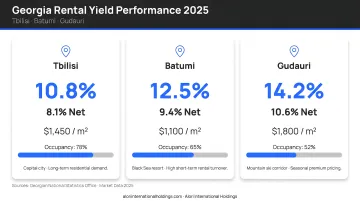
Documented yield data:
- Batumi managed apartments: Average gross rental yields of 7.4% in 2025 (down from 8.8% in 2024 due to supply adjustments)
- Tbilisi residential: Rental yield of 9.1% as of February 2025
- Batumi upper-upscale branded hotels: Q1-Q2 2025 occupancy of 65.7% with $99 average daily rate (ADR)
Global hotel brands have validated destination quality with recent commitments:
- Marriott opened Paragraph Freedom Square in Tbilisi (November 2023)
- Radisson opened Radisson RED Tbilisi (August 2023)
- Wyndham signed Wyndham Grand Batumi Gonio for 2026 completion
These anchors support private rental investment nearby by raising service standards and attracting higher-spending travellers. Investors prioritising income-generating assets over pure capital appreciation will find the rental yield profile of managed or well-located Georgian properties among the most competitive in the European and Caucasus region.
What Happens When Investors Overlook Georgia
Markets at Georgia's stage of development—early institutional interest, rising but not yet peak prices, improving infrastructure—have a limited window before the early-entry premium disappears.
Investors who entered Tbilisi or Batumi pre-2021 have already captured substantial appreciation. Batumi's weighted average price per square metre rose from $1,015 in 2018 to $1,234 in Q1-Q2 2025—a 21.6% increase. Tbilisi's average rose from $857 in 2018 to $1,152 in Q1-Q2 2025—a 34.4% increase. Those who delayed are now buying at higher price points with compressed upside.
Delaying entry is one cost. Two others are harder to recover from:
- Undiversified domestic concentration: Investors holding all real estate exposure in the U.S. face correlated risk — rising interest rates, regional corrections, and regulatory changes that hit all holdings at once. Georgia's demand cycle runs on regional tourism, expat migration, and international capital flows, not U.S. credit conditions.
- Executing without local knowledge: Unvetted developers, opaque pricing, and unclear exit structures can erase the cost advantage of a low-entry market. The difference between informed and uninformed entry shows up most sharply here — in due diligence quality, legal compliance, and whether a defined exit strategy exists before capital is committed.
How to Get the Most Value from Georgian Real Estate Investment
The highest-conviction investments in Georgia combine three factors:
- Location in a high-demand corridor (Batumi seafront, central Tbilisi, resort proximity)
- Property type suited to the dominant rental use case (furnished short-term units or managed hotel apartments)
- A clear exit strategy defined at acquisition—not after
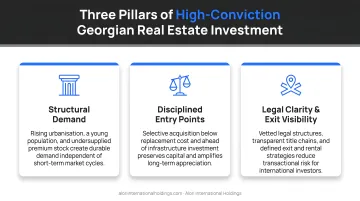
Georgian real estate works best when investors approach it as a long-term hold rather than a short-term flip. Appreciation compounds when held through development cycles, and rental income stabilizes as the market matures. Properties held over two years benefit from 0% capital gains tax—a significant incentive to align with longer time horizons.
American investors face specific friction points in Georgia—legal structures, currency exposure, management logistics, and pricing verification. Working with a firm that combines global investment strategy with in-country execution addresses each of these directly. Alori International Holdings covers the Georgia market through:
- Developer vetting and construction timeline verification
- Legal due diligence and transaction structure review
- Accurate local pricing benchmarks through professional networks
- Exit strategy planning built into the acquisition process
This removes the execution gaps that erode returns in cross-border transactions—and positions investors to capture what Georgia's market actually offers rather than what it appears to offer from a distance.
Conclusion
Georgia real estate offers a rare combination of low entry cost, income-generating yield, favorable regulation, and structural demand growth—and it remains accessible for American investors before the market reaches full international pricing. With property prices 50–75% below comparable European markets, 0% purchase tax, 0% long-term capital gains tax, and documented rental yields of 7–10%, the fundamentals are measurable and the numbers hold up under scrutiny.
The advantages compound when acted on with discipline. Tax efficiency, appreciation potential, and rental income are all highest for investors who enter early, select the right asset type, and manage the position with local expertise. Execution quality matters as much as market selection.
Georgia is at the stage where institutional capital is moving in, infrastructure is expanding, and early-entry investors can still capture the strongest returns. That window is open now—not indefinitely.
Frequently Asked Questions
Is Georgia a good place to invest in real estate?
Yes. Georgia ranks as a high-conviction international real estate market due to its low entry prices ($1,152-$1,234/sqm), 0% purchase tax, 0% long-term capital gains tax, strong rental demand in Batumi and Tbilisi (7-10% yields), and consistent economic growth (9.7% GDP growth in 2024) attracting institutional investment like Eagle Hills' $6.5 billion commitment.
Can foreigners legally buy property in Georgia?
Yes. Georgian law permits foreign nationals to purchase residential property with no restrictions; the only limitation applies to agricultural land. Property registration takes 1-4 days and costs 50-200 GEL, making the process faster and cheaper than nearly any comparable international market.
What rental yields can investors expect in Georgia?
Yields vary by segment and location. Managed hotel-apartment complexes in Batumi deliver gross yields of 7.4% annually as of 2025, while standard residential rentals in Tbilisi offer 9.1% returns. Both figures benefit from Georgia's 5% flat income tax on rental earnings, keeping net returns strong.
What are the property taxes for real estate investors in Georgia?
Georgia imposes no purchase tax (0% stamp duty), annual ownership tax of 0.05%-1% depending on assessed value and family income, and a 5% profit tax on residential sales within two years. Properties held over two years are exempt from capital gains tax, placing the overall tax burden well below rates in most Western European markets.
Is $10,000 enough to invest in real estate?
Direct property ownership in Georgia typically requires higher capital, with entry-level units starting around $50,000-$80,000 in secondary markets. However, $10,000 can serve as a deposit or initial equity contribution in certain off-plan or developer-financed arrangements.
What is the 2% rule for investment property?
The 2% rule suggests a rental property should generate monthly rent equal to at least 2% of its purchase price to be cash-flow positive. While this benchmark is challenging to meet in U.S. markets, Georgia's low purchase prices (starting under $100,000) and 7-10% annual rental yields make it more achievable here than in most developed markets.