

Introduction
Georgia has attracted $6.98 billion in cumulative FDI between 2021 and 2024 while posting a 9.7% real GDP growth rate in 2024 — among the highest in the region. The numbers reflect a structural shift: global capital is repositioning toward markets that combine low costs, open policy, and real economic momentum.
For American investors, the appeal goes beyond headline growth. Georgia's framework is built around investor protection from the ground up:
- Zero tax on reinvested profits — modeled on Estonia's territorial tax system, meaning retained earnings compound untaxed
- Strategic geography — positioned at the crossroads of Europe and Asia, with free trade access to both
- US-Georgia Bilateral Investment Treaty — protects American capital and permits full profit repatriation
This article breaks down the concrete, data-backed reasons why Georgia rewards long-term investors — particularly those seeking real asset diversification outside the US without the capital requirements or premium valuations of Western Europe.
Key Takeaways
- Georgia ranks 35th globally for economic freedom, with zero tax on reinvested profits and no capital gains tax on property held over two years
- Its location along the Middle Corridor drives infrastructure investment, including the Baku-Tbilisi-Kars railway upgrade to 5 million tons annually and the Anaklia Deep Sea Port launching in 2029
- Tbilisi real estate averages $1,385/sqm with 8.9% gross rental yields; premium districts posted 20%+ price growth year-on-year in early 2025
- Property registration takes four days (one day expedited), company formation one day, and profit repatriation faces no restrictions under the 1994 US-Georgia BIT
- American investors gain treaty-backed legal protections, sub-$1,400/sqm entry pricing, and yields that outperform most Western European markets
What Makes Georgia a High-Conviction Investment Market
Georgia is a small, structurally open economy at the crossroads of Europe and Central Asia. Since the early 2000s, it has undergone consistent reform backed by measurable results: the Heritage Foundation Index of Economic Freedom ranks it 35th globally, while the Fraser Institute's Economic Freedom of the World report places it 25th.
The investment case rests on durable, structural fundamentals:
- Zero tax on retained corporate profits under an Estonian-style model
- Expanding trade connectivity through Middle Corridor infrastructure investment
- 7.4 million international visitor arrivals in 2024, driving rental demand
- Foreign ownership of urban property permitted, with one-day expedited title registration
For American investors specifically, Georgia offers the US-Georgia Bilateral Investment Treaty, signed in 1994 and effective in 1997. The treaty guarantees:
- National treatment on par with domestic investors
- Free transfer of funds and full profit repatriation without delay
- Binding investor-state dispute resolution through ICSID or UNCITRAL arbitration
Key Reasons to Invest in Georgia
The reasons below rest on structural advantages with measurable implications for investor returns, risk management, and long-term capital growth. Each is grounded in official data, not promotional claims.
One of the World's Most Competitive Tax Regimes
Since January 1, 2017, Georgia has operated an Estonian-style Corporate Income Tax (CIT) model. Retained and reinvested profits are taxed at 0%. A flat 15% CIT applies only when profits are distributed as dividends or treated as deemed distributions (non-business expenses, free-of-charge distributions, and over-limit representation expenses).
How the tax structure works:
- Retained profits: 0% CIT on earnings reinvested in the business or held within the entity
- Distributed profits: 15% flat rate when dividends are paid to shareholders
- 0% capital gains tax on residential property sales for individuals holding the asset more than two years
- No inheritance, gift, or wealth tax: Property transferred to Class I and II heirs (spouses, children, parents, siblings) is fully exempt regardless of value
- Minimal property tax: 0.05%–1% of market value, applicable only when family income exceeds GEL 40,000 annually
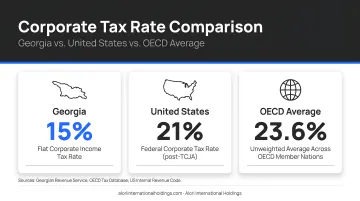
Georgia's Heritage Foundation Tax Burden Score stands at 87.8 out of 100 in 2026. To illustrate the gap in tax efficiency:
| Jurisdiction | Statutory Corporate Tax Rate | Note |
|---|---|---|
| Georgia | 15% (only on distributions) | 0% on reinvested earnings |
| United States | 21% (Federal) | Reduced under the TCJA |
| OECD Average | 23.58% | Global statutory rate (2025) |
Free Industrial Zones (FIZ) further eliminate taxes for qualifying businesses. Under the Law of Georgia on Free Industrial Zones, FIZ enterprises in zones like Poti and Kutaisi benefit from:
- 0% Profit Tax on zone-generated profits
- 0% Property Tax on zone-located assets
- 0% VAT on goods brought into the zone and intra-zone transactions
Why this matters for investors:
The 0% reinvestment tax directly accelerates compounding for investors who hold and grow assets in-country rather than extracting profits annually. Over a 5–10 year holding period, that efficiency compounds in ways that materially change total returns for American investors using Georgia as a diversification vehicle.
Real estate investors benefit most directly: no capital gains tax on property sales means retaining the full upside on appreciation. Add minimal property tax and zero inheritance tax for family transfers, and Georgia ranks among the most tax-efficient real estate markets globally.
When this advantage matters most:
Investors with multi-year horizons who prioritize capital accumulation over annual income extraction gain the most here. The zero-tax structure on retained capital lets real estate portfolios appreciate, refinance, and expand without distribution tax drag — a structural edge that widens progressively against higher-tax Western markets.
A Strategic Location Driving Trade and Economic Growth
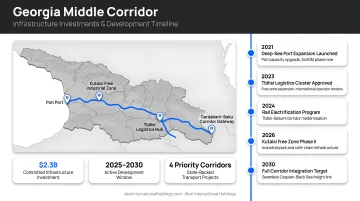
Georgia sits at the intersection of Europe and Asia along the modern Silk Road, making it a critical transit and logistics corridor. The government has deliberately invested in infrastructure to capitalize on this position, with measurable results already visible.
Infrastructure developments backing this position:
Baku-Tbilisi-Kars (BTK) Railway: Following modernisation works completed in 2024, the BTK railway's capacity expanded from 1 million tons to 5 million tons annually. This tripling of capacity positions Georgia as a core transit route for East-West freight flows.
Anaklia Deep Sea Port: In August 2024, the Belgian firm Jan De Nul was awarded the tender for marine infrastructure design and dredging. Phase 1 is planned to add 600,000 TEU of capacity, with the first vessels expected by 2029. This deep-water port will enable Georgia to handle larger container vessels and compete directly with regional hubs.
Poti Sea Port Expansion: APM Terminals is pursuing a $200 million expansion to add a deep-water terminal capable of handling 13.5-metre draft vessels, boosting capacity by 400,000 TEU to over 1 million TEU total.
Belt and Road Initiative (BRI): In 2023, China and Georgia established a Strategic Partnership, with the joint statement explicitly welcoming the BRI and noting the signing of a Bilateral Cooperation Plan to develop the Middle Corridor.
Why this matters for investors:
Infrastructure investment is a leading indicator of sustained economic growth and rising property values, particularly in logistics hubs and gateway cities. The World Bank's 2024 report on the Middle Trade and Transport Corridor projects that Middle Corridor freight volumes could triple by 2030 with proper investments — a trajectory Georgia is positioned to capture.
The $6.98 billion in cumulative FDI from 2021–2024 shows that global capital is already moving in. Growing business activity drives demand for residential and commercial property, supporting both rental yields and long-term capital appreciation in cities like Tbilisi and Batumi.
When this advantage matters most:
For investors with a 5+ year horizon, the timing is relevant. Infrastructure development in emerging markets tends to accelerate property value gains once key projects reach full operational capacity. Entering before Anaklia Port or the expanded BTK railway come fully online means lower entry pricing — and capturing the full appreciation cycle as economic activity builds around them.
Affordable Real Estate with Strong Growth and Rental Fundamentals
Georgia's property market — particularly in Tbilisi and Batumi — offers low entry prices relative to comparable cities in Southern Europe, strong rental demand driven by booming tourism, and meaningful capital appreciation potential as the market matures.
How Georgia's real estate market works for foreign investors:
- Foreigners can freely purchase urban and commercial property (agricultural land is restricted to Georgian citizens)
- Property registration takes four working days standard, with one-day expedited service available
- The US-Georgia BIT provides investment protections and guarantees profit repatriation
Current property prices and affordability:
| City / District | Average Price per Sqm (USD) | Market Segment |
|---|---|---|
| Tbilisi - Mtatsminda | $2,471 | Premium flats |
| Tbilisi - Vake | $2,146 | Premium flats |
| Tbilisi - Saburtalo | $1,568 | Mid-tier flats |
| Tbilisi - City Average | $1,385 | Primary market |
| Batumi - City Average | $1,821 | Primary market (turnkey) |
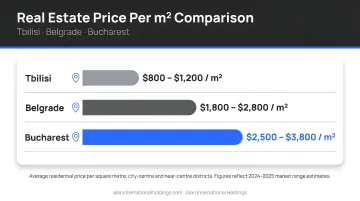
Comparison with peer European markets:
- Tbilisi: ~$1,385/sqm (January 2026)
- Belgrade, Serbia: €2,517/sqm ($2,940/sqm) (Q3 2025)
- Bucharest, Romania: €2,500/sqm ($2,927/sqm) (December 2025)
This affordability gap is significant: Georgia offers entry points 50–60% below comparable Eastern European cities while delivering similar or superior rental yields and stronger GDP growth.
Tourism growth driving rental demand:
Georgia's tourism sector has expanded rapidly, with international visitor arrivals reaching 7.4 million in 2024, up from 5.42 million in 2022. Travel receipts reached $4.12 billion in 2024, directly feeding occupancy rates and rental returns.
Tbilisi's average gross rental yield stood at 8.9% in early 2026, while Batumi recorded 8.8% in 2024. Premium districts in Tbilisi like Mtatsminda and Vake saw 20%+ year-on-year price growth in early 2025, demonstrating that capital appreciation is accelerating in sought-after areas.
Property price appreciation during construction:
Primary market prices in Tbilisi increased by 11.6% year-on-year in 2024, showing that properties purchased during construction have historically appreciated significantly by completion. Investors who identify the right early-stage developments — before completion drives the final price adjustment — capture the full appreciation cycle.
Key performance indicators (KPIs) investors should track:
- Gross rental yield: Tbilisi year-round demand vs. Batumi seasonal peaks
- Occupancy rates: Batumi's summer tourism season vs. Tbilisi's business/expat stability
- Price per square metre: Track relative to Belgrade, Bucharest, and other peer markets
- GEL/USD exchange rate stability: Monitor currency risk for dollar-based investors
When this advantage matters most:
The $100,000–$600,000 investment range goes significantly further in Georgia than in Western European markets at comparable quality levels. That gap is likely to compress as international attention grows and prices adjust to reflect improving fundamentals — making entry timing a meaningful part of the return equation.
What Investors Lose by Overlooking Georgia
Investors who concentrate entirely in domestic US assets miss exposure to markets where structural growth, tax efficiency, and entry-point timing create outsized return potential. The specific risks of overlooking Georgia include:
- Correlated currency and regulatory risk — US dollar exposure, domestic inflation cycles, and interest rate policy move together. Georgia offers currency diversification and growth independent of US economic conditions.
- Missing early-entry appreciation — Markets that attract sustained international attention reprice over time. Entering before Anaklia Port reaches operational capacity and before Western European capital flows accelerate means capturing the full appreciation cycle, not the tail end of it.
- No hedge against US property stagnation — Georgia's 9.7% GDP growth and infrastructure-driven expansion offer a growth profile that US real estate, after decades of appreciation, cannot replicate.
The window at current valuations and favorable conditions — low entry prices, strong FDI momentum, pre-completion infrastructure upside — is not permanent. Markets with sustained GDP growth, rising FDI, and accelerating infrastructure investment reprice once institutional capital arrives. That repricing is already underway in Georgia.
How to Enter the Georgian Market the Right Way
Georgia's investor-friendly framework removes many typical barriers: one-day business registration, one-day expedited property registration, no restrictions on profit repatriation, and the US-Georgia BIT providing legal protections for American investors. But successful investing still requires local market knowledge.
Understanding the Market
Investors need to know which neighborhoods are appreciating, which projects are legally sound, and what exit strategies are realistic. The most common mistakes foreign investors make include:
- Entering without verified legal structures and clear title verification
- Overpaying in tourist-heavy markets without understanding rental seasonality
- Failing to plan exit strategies before purchase — liquidity, tenant demand, and resale timelines
- Ignoring currency risk and local tax compliance requirements
All of these can be avoided with proper due diligence and in-market expertise.
Alori International Holdings' Approach
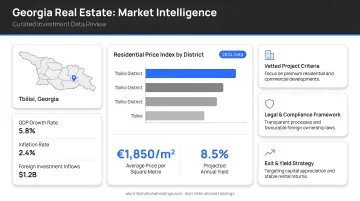
Alori International Holdings applies a high-conviction, data-driven approach to the Georgian market, vetting projects for legal structure, pricing accuracy, rental potential, and defined exit pathways. The company provides American investors with curated access to Georgia's real estate opportunities, using local intelligence to invest with confidence.
Through transaction coordination, legal due diligence support, and market intelligence, Alori connects global investment strategy with in-country execution. The result: reduced legal and transaction risk, accurate pricing insights, and clear exit and rental strategies that independent investors would struggle to access.
Conclusion
Georgia's investment case rests on a durable combination of structural advantages: one of the world's most competitive tax systems (0% on reinvested profits, 0% capital gains on property held over two years), a strategically positioned and infrastructure-backed economy, and a real estate market that offers entry pricing well below where the fundamentals point.
These advantages compound when entered with discipline — and that compounding depends on timing. Tbilisi's current fundamentals make that case clearly:
- $1,385/sqm average pricing — still early relative to comparable regional capitals
- 8.9% gross rental yields — among the highest in Europe and Central Asia
- 9.7% GDP growth — one of the fastest-expanding economies globally
- $6.98 billion in cumulative FDI — signaling that institutional capital is already moving
The window to enter ahead of wider discovery is narrowing, not widening.
For American investors seeking diversification beyond domestic markets, Georgia delivers legal protections under the US-Georgia BIT, full profit repatriation, and a tax-efficient structure that rewards long-term capital growth. The market is measurable, legally sound, and supported by macro tailwinds that remain firmly intact.
Frequently Asked Questions
Why invest in Georgia?
Georgia offers zero tax on reinvested profits under its Estonian-style model, ranks 35th globally for economic freedom, and attracted $6.98 billion in FDI from 2021–2024. Tbilisi real estate delivers 8.9% gross rental yields at comparatively low entry costs, with a favorable tax structure that most Western markets cannot match.
Can Americans buy property in Georgia?
Yes. US citizens can freely purchase urban and commercial real estate in Georgia, though agricultural land is restricted to Georgian citizens. The US-Georgia Bilateral Investment Treaty (1994) provides legal protections for American investors, including full profit repatriation and access to international arbitration for dispute resolution.
What taxes do foreign investors pay on real estate in Georgia?
Georgia levies 0% capital gains tax on property held more than two years, no inheritance or wealth tax, and minimal annual property tax (0.05%–1% of market value, triggered only when family income exceeds GEL 40,000). Few markets outside the Gulf region offer a comparable tax profile for foreign investors.
What are the best cities for real estate investment in Georgia?
Tbilisi averages $1,385/sqm with 8.9% gross rental yields, underpinned by year-round business and expat demand. Batumi averages $1,821/sqm, driven by Black Sea tourism and strong short-term rental performance. Tbilisi suits investors prioritizing stability; Batumi suits those targeting seasonal income.
What is the average rental yield on real estate in Georgia?
Tbilisi's average gross rental yield stood at 8.9% in early 2026, while Batumi recorded 8.8% in 2024. Yields vary significantly by location, property type, and management quality — premium districts and professionally managed properties can deliver higher returns, while secondary locations may underperform.
Is Georgia a safe and legally stable country to invest in?
Georgia ranks 21st globally on the Numbeo Safety Index 2026 with a high safety score of 73.8, and 1st in Eastern Europe and Central Asia on the World Justice Project Rule of Law Index (52nd globally). Georgia is a full member of ICSID, providing international arbitration frameworks that protect foreign investor rights.