Understanding Foreign Property Rights in Georgia
Yes, foreigners can legally buy property in Georgia with very few restrictions. Unlike many countries that impose complex ownership rules, residency requirements, or punitive taxes on foreign buyers, Georgia operates a transparent, digitized framework that puts international investors on equal footing with Georgian citizens.
This guide is written for American investors looking to diversify into a high-growth, low-cost-of-entry market beyond traditional Western real estate. Georgia's appeal comes down to a few hard-to-ignore advantages:
- Zero property purchase tax for foreign buyers
- Rapid title registration — typically completed within days
- Residency eligibility through a single qualifying property transaction
- No restrictions on foreign ownership of most property types
Few markets combine legal accessibility with this level of upside potential.
TLDR: Key Facts for Foreign Buyers
- Foreigners can purchase apartments, homes, and commercial property with no citizenship or residency requirements
- Agricultural land is restricted, but 49-year leases and corporate ownership structures are available
- Registration completes in 1–4 business days through Georgia's Public Registry
- Zero property purchase tax; capital gains tax drops to 0% after two years of ownership
- Effective March 2026, the minimum property investment for Georgian residency rises to $150,000 (up from $100,000)
What Foreigners Can (and Cannot) Own in Georgia
Permitted Property Types
Foreign nationals hold identical ownership rights to Georgian citizens across most property types. Article 183 of the Civil Code of Georgia grants foreigners the right to acquire and own immovable property through written transactions registered in the Public Registry — with full title protections enforced through Georgian courts.
Eligible property categories include:
- Apartments and residential houses
- Commercial buildings and office spaces
- Retail and mixed-use properties
- Non-agricultural land plots
The Agricultural Land Restriction
Under Georgia's Organic Law on Agricultural Land Ownership, non-Georgian citizens cannot directly purchase agricultural land. This restriction applies to both foreign individuals and foreign-registered legal entities. The only exception for direct ownership is inheritance—foreign nationals who inherit agricultural land may retain ownership.
Foreigners can, however, lease state-owned agricultural land for up to 49 years — providing long-term access without ownership. The lease structure supports agricultural development and income generation while the underlying land title stays with the Georgian state or a qualifying entity.
The LLC Workaround
Foreign investors can access agricultural land indirectly through a Georgian-registered company if a Georgian national holds at least 51% of shares and maintains "decisive influence" (meaning majority control over key decisions). A foreign-majority company may also own agricultural land through a specific investment plan approved by the Government of Georgia.
Either route works — but both require qualified legal counsel to structure correctly from the start.
How to Buy Property in Georgia as a Foreigner: Step-by-Step
Step 1: Property Search and Selection
Buyers can search listings independently through online portals or work with local agents and international investment firms like Alori International Holdings, which curates vetted projects across select markets. District selection significantly impacts rental yield and resale potential. Tbilisi neighborhoods like Vake and Mtatsminda offer premium lifestyle positioning and strong expat demand, while districts like Saburtalo and Gldani provide more affordable entry points with solid fundamentals. Batumi's coastal markets attract tourism-driven rental demand, particularly for branded residences and resort apartments.
Step 2: Due Diligence
Due diligence in Georgia involves checking the Public Registry extract for encumbrances: liens, debts, legal disputes, or ownership history irregularities. Buyers should also review cadastral maps (official boundary surveys) to confirm property boundaries and verify the property's legal status: residential, commercial, or construction-ready.
This step is critical for foreign buyers unfamiliar with local norms. Engaging a Georgian lawyer or working with a firm that has in-country expertise ensures title verification, developer track record assessment, and compliance with municipal regulations. Georgia's digitized registry reduces fraud risk, but independent verification remains essential.
Step 3: Preliminary Agreement and Payment
With due diligence complete and terms confirmed, both parties sign a preliminary purchase agreement. Payment methods include bank transfer (most common), cash, developer installment plans (often 0% interest for 24–48 months on off-plan projects), and in some cases cryptocurrency. If either party does not speak Georgian, a notary is required under the Law of Georgia on Notaries (Article 6), which mandates participation of a certified interpreter for legal transactions.
Step 4: Registration with the Public Registry
Once the preliminary agreement is signed, the purchase contract is submitted to Georgia's National Agency of Public Registry (NAPR). Registration fees are among the lowest of any developed property market:
| Processing Speed | NAPR Fee (GEL) | USD Equivalent (April 2026) |
|---|---|---|
| 4 Working Days | 150 GEL | ~$56 |
| 1 Working Day | 270 GEL | ~$100 |
| Same Day | 350 GEL | ~$130 |
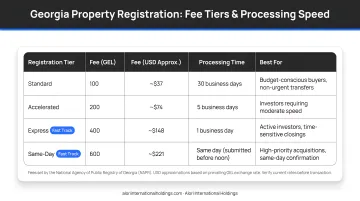
Registration typically completes in 1–4 business days, after which the buyer receives full legal title.
Georgia's registry infrastructure also stands out globally: in 2016, the country partnered with Bitfury to anchor property records to the Bitcoin blockchain, creating tamper-resistant ownership records. For investors coming from markets with weaker registry systems, this is a meaningful structural advantage.
Step 5: Remote Purchasing Option
Buyers do not need to be physically present in Georgia to complete a purchase. A power of attorney (POA) allows a local lawyer or representative to act on their behalf throughout the transaction. Note that as of October 20, 2023, transactions based on foreign-issued POAs require mandatory local notarization in Georgia. The contract must be drafted by a Georgian notary, in addition to standard apostille and certified translation requirements.
For American investors managing deals from abroad, this remote capability matters. Working with a firm like Alori International Holdings reduces legal risk by handling notary requirements, registry submissions, and coordination with local professionals from the start.
Taxes and Costs of Buying Property in Georgia
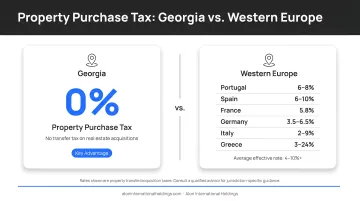
Purchase Tax: 0%
Georgia levies no property purchase tax, transfer tax, or stamp duty on buyers. This stands in stark contrast to Western European markets: the UK charges up to 12% Stamp Duty Land Tax plus a 2% foreign buyer surcharge; Spain imposes 6–11% transfer tax depending on region; Portugal charges up to 7.5% IMT plus 0.8% stamp duty. Georgia's 0% entry cost provides immediate capital efficiency and liquidity advantage.
Rental Income Tax
Georgia taxes residential rental income at a flat 5% — provided owners register for the preferential rate and forgo deductions. Commercial property rentals fall under standard personal income tax at 20%. Both rates sit well below comparable regimes in Western Europe, where rental income commonly attracts 20–45% depending on jurisdiction.
Capital Gains Tax: The Two-Year Rule
A 20% capital gains tax applies if the property is sold within two years of purchase. After two years, capital gains tax drops to 0%. For investors targeting Georgia's rising urban markets, the two-year threshold aligns naturally with typical appreciation cycles in Tbilisi and Batumi.
Property Tax
Georgia calculates annual property tax based on property value and the owner's global income, with rates ranging from 0.05% to 1% of market value. For non-resident individuals with incomes over 100,000 GEL, rates typically fall between 0.8% and 1%. This remains significantly lower than most European property tax regimes.
Transaction and Ancillary Costs
Buyers should budget for:
- Agent commissions run 1–3%, often negotiable or absorbed by the seller
- Notary fees range from 100–200 GEL for basic translations up to 600+ GEL for complex contracts under current POA rules
- Translation services typically cost 100–300 GEL depending on document volume
- Legal representation runs $500–$2,000 USD depending on transaction complexity (fees are commonly quoted in USD by international legal firms)
Residency by Investment: The $150,000 Path
The March 2026 Threshold Increase
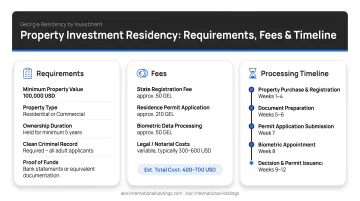
Effective March 1, 2026, Georgia raised the minimum real estate investment required for a short-term residence permit from $100,000 to $150,000 USD (equivalent in GEL). The property must be non-agricultural, and the valuation must be established by a certified assessor accredited by the Georgian Unified National Accreditation Body—not merely the purchase contract price.
What Georgian Residency Provides
Georgian residency grants the right to reside in Georgia long-term, open local bank accounts, and operate legally within the country. It does not automatically confer a path to citizenship; naturalization requires 10 years of continuous lawful residence (or 5 years under simplified procedures) and passing Georgian language and history examinations. A separate 5-year "Investment Residence Permit" is available for a $300,000 USD investment.
The permit is administered by the Public Service Development Agency (SDA) under the Ministry of Justice:
- Processing time: 30 days standard, 10 days expedited
- Fees: 300 GEL (standard) or 600 GEL (expedited)
- Duration: Issued for one year, renewable annually while ownership is maintained
A Strategic Hedge for American Investors
For American investors, Georgian residency offers a concrete secondary benefit beyond the property itself: a legal foothold in a foreign country with minimal tax burden, a low cost of living (approximately $1,030 monthly for a single person in Tbilisi), and geographic position between Europe and Asia.
Why Georgia Stands Out for American Investors
Low Entry Price Point with Strong Yield Potential
Georgia's property prices are significantly lower than comparable European markets. As of Q1 2026, Tbilisi district prices demonstrate compelling value:
| District | Average Price per Sqm | Comparison |
|---|---|---|
| Mtatsminda (premium) | $2,471–$3,178 | 60% below Berlin city center (~$7,900) |
| Vake (premium) | $2,146–$2,798 | 62% below Lisbon city center (~$7,200) |
| Saburtalo (mid-tier) | $1,568–$1,628 | 75% below Barcelona city center (~$6,500) |
| Gldani (budget) | $1,050–$1,333 | 85% below Western European equivalents |
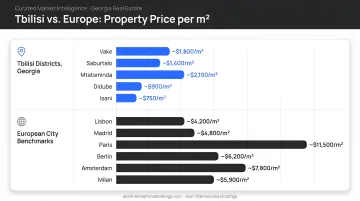
Even Tbilisi's most expensive premium districts cost less than half the price per square meter of central Berlin, Lisbon, or Barcelona. This affordability translates to accessible entry points for middle and upper-middle-class American investors targeting $150,000–$600,000 property acquisitions.
Rental yields average 7.4% across Georgia, with Tbilisi yields ranging from 5.5% in premium Vake to over 8.8% in Didi Digomi. Batumi offers strong yields averaging 7.3%, driven by tourism demand and branded residence management programs.
Transparent and Fast Legal System
Georgia ranked 7th globally in the World Bank's final Doing Business 2020 report, recognized for regulatory efficiency and investor protection. The country's digitized Public Registry — which pioneered blockchain-based land registration in 2016 — creates secure, tamper-resistant ownership records that reduce the fraud risk found in other emerging markets.
Combined with 1–4 business day registration timelines and zero transfer taxes, this makes Georgia one of the more accessible entry points for international capital anywhere in the world.
Tourism and Rental Demand Fundamentals
Georgia welcomed 7.4 million international non-resident travelers in 2024, a 4.2% year-over-year increase. This tourism growth supports short-term rental demand in Tbilisi and Batumi, particularly for professionally managed branded residences and resort apartments. Georgia's GDP grew 7.5% in 2023 — a growth rate that directly supports occupancy rates, rental pricing, and long-term asset values.
Portfolio Diversification and Low Correlation to US Markets
Georgia runs on a different economic clock than the US. Its currency (the Georgian Lari), demand drivers, and growth cycle are largely independent of Federal Reserve policy or S&P 500 sentiment — which is precisely what makes it useful for reducing domestic portfolio concentration risk. Unlike mature Western European markets that often move in correlation with US economic trends, Georgia's frontier market dynamics are driven by regional tourism, Black Sea trade flows, and post-Soviet economic integration patterns. For American investors seeking exposure that doesn't mirror their existing holdings, these structural drivers — tourism, regional trade, and independent monetary policy — are the point.

Frequently Asked Questions
Can foreigners get a mortgage in Georgia?
Yes, major commercial banks like TBC Bank and Bank of Georgia offer mortgages to non-residents. The National Bank of Georgia caps LTV at 70% for USD/EUR loans and 90% for GEL loans, with rates ranging from 6.4% to 12.1%. Most foreign buyers still transact in cash due to documentation requirements and the relatively high rate environment.
How much money do you need to live in Tbilisi?
A single person in Tbilisi typically spends around $1,030/month, including $550–$700 for a centrally located 1-bedroom apartment. Tbilisi ranks among the most affordable capital cities in Europe and Eurasia for expatriates.
Can foreigners own agricultural land in Georgia?
No, foreigners generally cannot purchase agricultural land directly. However, they may lease it for up to 49 years, inherit it under specific conditions, or access it through a Georgian-majority-owned legal entity (51%+ Georgian ownership) or through a government-approved investment plan.
What taxes do foreign property owners pay in Georgia?
Foreign property owners pay no purchase tax, a 5% rental income tax on residential property (20% on commercial), and a 20% capital gains tax if sold within two years (zero after two years). Annual property tax ranges from 0.05% to 1% of property value based on the owner's global income.
Do I need to be physically present in Georgia to buy property?
No. Buyers can complete the entire transaction remotely via power of attorney granted to a local legal representative. Note that as of October 2023, foreign-issued POAs must be locally notarized in Georgia, in addition to standard apostille and translation requirements.
Can buying property in Georgia lead to residency?
Yes, a property purchase of $150,000 or more (based on certified appraisal) qualifies a foreign buyer for a Georgian residence permit. The permit is issued annually and renews as long as ownership is maintained — a straightforward path to residency for international investors.