
Introduction
For American investors looking for a low-cost, low-friction offshore foothold, Georgia stands out on three specific terms: a 5% flat tax on rental income, zero capital gains tax after two years of ownership, and no physical presence requirement to maintain residency. You can hold the permit, own the asset, and never book a flight to Tbilisi.
That combination — favorable tax treatment plus a fully remote-eligible residency — is rare at the $150,000 investment level. Most comparable programs either require extended stays or come attached to significantly higher minimum thresholds.
One threshold change is now in effect. As of March 1, 2026, Georgia raised its minimum real estate investment threshold from $100,000 to $150,000 — a 50% increase that reshapes the entry calculus for new applicants and changes how investors should think about property selection.
This article breaks down the two residency routes available through Georgian real estate, explains the 2026 regulatory changes, evaluates investment fundamentals beyond the residency benefit, and identifies the key risks investors must navigate before application.
TL;DR: Key Takeaways
- The $150,000 short-term permit renews annually and leads to permanent residency after 10 years
- The $300,000 Investment Residence Permit runs 5 years and qualifies for permanent residency after 5 years
- The $150,000 threshold took effect March 1, 2026; existing permit holders who maintain ownership are grandfathered under old rules
- No minimum stay requirement to maintain the property-based residence permit
- Tax advantages include 5% rental income tax, 0% capital gains after two years, and no inheritance tax
- Spouse and minor children qualify under a single investment, no additional property purchase needed
Two Pathways to Georgia Residency Through Real Estate Investment
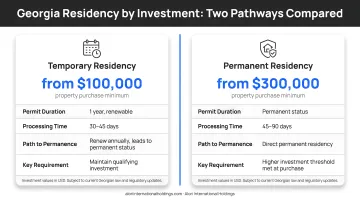
Pathway 1 — The Short-Term Residence Permit ($150,000+ Property)
This permit is issued to foreign nationals who own non-agricultural real estate in Georgia with a certified market value exceeding $150,000 USD (or GEL equivalent), as stipulated in Georgia's amended immigration law effective March 2026. The threshold applies to total holdings—multiple properties can be combined to reach the minimum.
Permit structure:
- Initially issued as a one-year renewable permit
- After 10 consecutive years of maintaining the permit, investors become eligible for permanent residency
- Family members (spouse and dependent minor children) qualify under the same investment with no separate purchase required
Critical distinctions to understand:
The valuation is based on certified market appraisal, not purchase price. This appraisal must be conducted by an assessor accredited by Georgia's LEPL Unified National Body of Accreditation (Georgian Accreditation Centre). Properties purchased for $150,000 but appraised at $135,000 will not qualify. This appraisal gap is the most common application failure point.
The property must remain in the investor's ownership for the permit to stay valid. Selling the qualifying asset immediately voids residency eligibility.
Pathway 2 — The Investment Residence Permit ($300,000+)
This route requires a minimum investment of $300,000 USD in Georgian real estate or qualifying business assets. It grants a 5-year temporary residence permit immediately for the investor and immediate family, making it considerably faster than the short-term permit route. Investors can apply for permanent residency after 5 years rather than 10, cutting the timeline in half — a meaningful advantage for those planning long-term residency or business operations in Georgia.
For investors choosing the business route rather than real estate, Georgian law mandates annual turnover thresholds:
- Year 1: Minimum $50,000 equivalent in GEL
- Year 2: Minimum $100,000 equivalent in GEL
- Years 3-5: Minimum $120,000 equivalent in GEL annually
Pure real estate investments under the $300,000 threshold are exempt from these turnover obligations, which makes the property route the cleaner path for most individual investors.
What Changed in 2026: Georgia's Updated Investment Threshold
The Legislative Context
In June 2025, Georgia's Parliament passed Law No. 670, amending the Law on the Legal Status of Aliens and Stateless Persons. The new $150,000 threshold took effect March 1, 2026, marking the second major increase in the program's history (previously raised from $35,000 to $100,000 in 2019).
What Triggered the Change
Georgian authorities cited a significant gap between the number of foreign nationals entering the country and those formally registered as labor migrants or residents. This prompted broader immigration reform, including stricter work permit rules alongside the higher investment threshold.
Transition Rules for Existing Investors
Current permit holders who obtained residency at the $100,000 threshold may continue renewing their permits without re-appraisal, provided they maintain ownership of the qualifying property. The $150,000 rule applies to new applications only—grandfathered investors are protected under the previous framework.
Work Permit Requirements Introduced in 2026
The threshold increase wasn't the only change. Simultaneous reforms introduced mandatory work permit requirements for foreign nationals, also effective March 1, 2026. The rules differ significantly depending on which permit tier you hold:
- Standard $150,000 permit holders: Residence rights only — a separate work permit is required for any employment or business activity
- $300,000 Investment Residence Permit holders: explicitly exempt — meaning they can operate a business or take employment in Georgia without obtaining an additional permit
The threshold increase wasn't the only change. Simultaneous reforms introduced mandatory work permit requirements for foreign nationals, also effective March 1, 2026. A property-based residence permit does not automatically grant the right to work or conduct business in Georgia under the new rules.
The rules differ significantly depending on which permit tier you hold:
- Standard $150,000 permit holders: Residence rights only — a separate work permit is required for any employment or business activity
- $300,000 Investment Residence Permit holders: Explicitly exempt — meaning they can operate a business or take employment in Georgia without obtaining an additional permit
For entrepreneurs relocating with active business interests, the higher-tier permit eliminates a meaningful administrative hurdle that the standard permit does not.
Why Georgia Real Estate Makes Sense Beyond the Residency Benefit
The Investment Case: Market Fundamentals
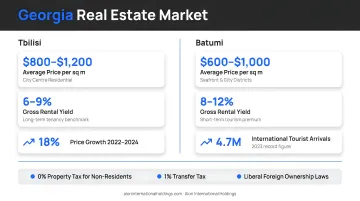
Georgia's property market—particularly in Tbilisi and Batumi—offers a rare combination of low entry prices relative to European capitals, growing tourism infrastructure, and strong rental demand. According to market data from Cushman & Wakefield, Tbilisi's average property price reached $1,152 per square meter in 2025, with year-over-year price growth of 8.7%. Batumi showed similar strength at $1,234 per square meter and 6.4% annual appreciation.
Rental yields remain attractive: Tbilisi delivers approximately 7.53% gross rental yields, while Batumi offers 7.31%. These yields are supported by robust tourism recovery—Georgia welcomed 7.8 million international visitors in 2025, a 5.9% increase year-over-year.
Tax Environment: A Structural Advantage
Georgia's tax framework is one of the most investor-friendly in the region:
- Rental income: Taxed at just 5% for residential properties, significantly below Western European and US rates
- Capital gains: Completely exempt after two years of ownership, allowing tax-free appreciation on properly timed exits
- Inheritance tax: None — Georgia levies no wealth or inheritance taxes
This tax structure means rental income can offset the cost of maintaining residency — provided investors select properties with strong rental fundamentals.
The Dual-Use Investment Structure
Unlike traditional immigration programs that represent pure cost, a qualifying Georgian property generates active rental income while securing legal residency. For American investors purchasing properties in the $150,000–$300,000 range, this dual benefit means residency costs are offset by rental returns over the holding period.
Alori International Holdings specializes in identifying qualifying properties with vetted legal structures and defined rental strategies. The focus is on curated opportunities in Georgia's strongest markets — Tbilisi's premium districts (Vake, Saburtalo, Vera) and Batumi's coastal developments. This approach helps investors avoid common pitfalls, including:
- Off-plan delivery risk on pre-construction purchases
- Incorrect property classification that disqualifies residency eligibility
- Appraisal shortfalls that undermine the $100,000 threshold
Geopolitical Risk Context
Georgia's EU visa-free access for ordinary passport holders remains intact. On March 5, 2026, the European Commission suspended visa-free travel for Georgian diplomatic and official passport holders due to concerns over democratic backsliding — a restriction that does not currently apply to regular passports. The Commission noted, however, that the suspension could expand if underlying issues go unresolved.
Georgian residency functions as a regional base and diversification tool — not a guaranteed gateway to broader European access.
Eligibility Requirements and the Application Process
Who Qualifies
Any foreign national can apply — Georgian law imposes no nationality restrictions. To qualify, applicants must meet all of the following:
- Meet the minimum property investment threshold
- Hold valid legal status in Georgia at the time of application
- Submit compliant documentation
- Own non-agricultural immovable property (agricultural land does not qualify)
Required Documentation
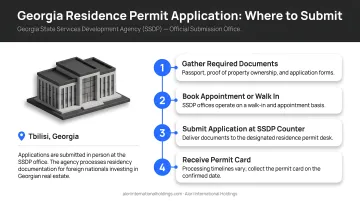
For a real estate-based application, submit the following to the State Services Development Agency (SDA):
- Approved application form
- Copy of passport
- Proof of legal stay in Georgia
- Property ownership documents (extract from the Public Registry)
- Certified appraisal report from a GAC-accredited assessor
- Digital photograph (3x4)
- Proof of state fee payment
- Written recommendations (from a Georgian Government member or three Georgian citizens with business authority)
- Relationship-confirming documents for any included family members (marriage or birth certificates)
Processing Timeline and Fees
The SDA charges a flat state fee, with processing speed determining the cost:
| Processing Time | Fee |
|---|---|
| 30 calendar days | 300 GEL (~$110) |
| 20 calendar days | 450 GEL (~$165) |
| 10 calendar days | 600 GEL (~$220) |
Documentation errors are the most common cause of delays or rejections. If your application is rejected, you can reapply once the issues are corrected — but processing fees are non-refundable, so a clean first submission matters.
Key Risks and Considerations for Foreign Investors
Property Appraisal and Classification Risk
The most common application failure point is submitting a non-compliant appraisal or purchasing a property type that does not qualify. Investors must verify appraiser accreditation before relying on any valuation for residency purposes. Under Georgian law, agricultural land ownership is strictly prohibited for foreign nationals, making property classification verification essential.
Off-Plan and Completion Risk
Buyers pursuing pre-construction or off-plan developments must ensure legal ownership is formally transferred and fully registered before submitting a residency application. Delays in developer delivery can cause investors to miss their intended application window—a timing risk that grows more acute as the March 2026 threshold increase approaches.
Value Maintenance Obligation
Securing the residency permit is only half the equation—maintaining it requires the portfolio's certified market value to stay above the qualifying threshold at each renewal. Key considerations include:
- Investors holding smaller Batumi units near the $150,000 floor face the most appraisal exposure and should account for this in their planning
- Purchasing at a 10–15% cushion above the threshold provides meaningful buffer against market-driven valuation dips
- Annual price volatility in secondary markets is real; build that variance into your acquisition math from the start
Frequently Asked Questions
What is the investor visa for Georgia?
Georgia offers two main investor residency routes: the $150,000+ property-based permit (renewable annually, permanent residency path after 10 years) and the $300,000 Investment Residence Permit (5-year term, permanent residency after 5 years). Both pathways include immediate family members.
What is the 183 day rule in Georgia?
The 183-day rule relates to tax residency, not legal residency. Spending more than 183 days per year in Georgia makes an individual a Georgian tax resident, which is separate from the property-based residence permit. However, foreign-source income is legally exempt from Georgian taxation even for tax residents.
What are the new rules for Georgia 2026?
Two major changes took effect March 1, 2026:
- The real estate residency threshold increased from $100,000 to $150,000
- A residence permit alone no longer grants the right to work or run a business — a separate work permit is now required (except for $300,000 Investment Residence Permit holders)
Can foreigners own property in Georgia?
Yes. Foreign nationals can freely purchase and own non-agricultural real estate in Georgia with the same ownership rights as Georgian citizens. Agricultural land ownership is restricted for foreign nationals under Georgian law.
How long does it take to get a Georgian residence permit through real estate?
Processing times range from 10 to 30 calendar days depending on the fee tier chosen. The timeline begins after all documentation—including the certified property appraisal—is fully submitted. Submitting complete documentation upfront avoids most delays.
Does a Georgia residence permit allow me to work there?
Since March 1, 2026, a property-based residence permit no longer grants the right to work or conduct business in Georgia. A separate Right to Labour Activity work permit is now required — unless you hold the $300,000 Investment Residence Permit, which includes work rights.