

Introduction
American buyers purchased more Portuguese property in 2023 than in any prior year on record — and the drivers are straightforward. Portugal imposes zero restrictions on foreign ownership, offers strong rental demand in its main cities, and has delivered consistent price appreciation even through broader European market softness. For US investors looking beyond domestic real estate, few markets combine political stability, EU access, and genuine affordability the way Portugal does.
That appeal is well-founded — but the buying process stops many Americans before they start. Portugal's legal system works differently from US real estate closing processes, taxes like IMT and AIMI require advance planning, and there's a persistent misconception that property ownership automatically grants residency rights. This guide breaks down each element clearly, so you can move forward with confidence.
Key Takeaways
- Foreigners — including Americans — can buy Portuguese property with the same ownership rights as locals; the only prerequisite is a Portuguese tax number (NIF)
- Budget 7–10% above purchase price for IMT, stamp duty, legal fees, and registration charges
- Property ownership does not grant residency; longer stays require a separate visa such as the D7 or D8
- US buyers face FBAR and FATCA reporting obligations along with Portuguese tax requirements
- The purchase follows a fixed legal sequence: NIF, promissory contract, due diligence, final deed, and registration
Why Portugal in 2026: The Investment and Lifestyle Case
Sustained Market Fundamentals and Price Performance
Portugal's property market continues to show consistent fundamentals. As of early 2025, Portugal's national average property price exceeded €1,900 per square meter, with year-over-year price growth averaging 8–10% in prime urban markets like Lisbon and Porto. This performance sits comfortably between Spain's slower appreciation trajectory and the Netherlands' overheated valuations, making Portugal a balanced option for Americans weighing Western European alternatives.
Macroeconomic stability supports durable demand:
- EU membership and euro-zone currency stability eliminate exchange rate risk within the eurozone and provide regulatory transparency
- Growing tech and expat sector drives sustained rental demand in Lisbon, Porto, and coastal hubs
- Consistent inbound foreign capital from Western Europe and North America creates multi-cycle buyer depth
These fundamentals support risk-adjusted returns rather than speculative cycles. Alori International Holdings focuses on Portugal because its case rests on macroeconomic data, demographic tailwinds, and capital flow trends — not short-term price momentum.
Regional Rental Yield Potential
Rental yields vary significantly by location, and understanding these ranges helps investors calibrate expectations:
- Lisbon: 4–6% gross yields, driven by corporate relocation and expat demand
- Porto: 5–7% gross yields, benefiting from lower entry prices and strong tourism
- Algarve: 6–9% gross yields, supported by year-round tourism and short-term rental demand
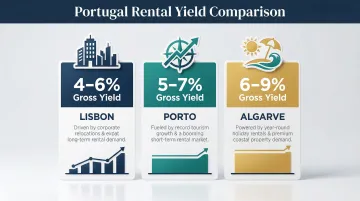
Portugal's large expat community and consistent international visitor arrivals protect against vacancy risk. Unlike seasonal markets dependent on one revenue stream, Portuguese cities benefit from both long-term professional tenants and short-term holiday renters.
Lifestyle Fundamentals That Attract Structural Demand
Portugal's quality-of-life metrics translate directly into durable buyer demand. Key draws for international buyers include:
- Safety: Consistently ranks among Europe's lowest violent crime rates
- Cost of living: 30–40% lower than major US coastal cities like New York or Los Angeles
- Infrastructure: Healthcare and digital connectivity that outperform most emerging markets
- Climate: Over 300 days of sun annually, particularly along the Algarve and Lisbon coast
Together, these factors attract a self-reinforcing wave of buyers that supports long-term price floors.
Alori International Holdings evaluates each Portuguese opportunity against macroeconomic indicators, demographic trends, capital flows, and regulatory frameworks before presenting it to investors. The goal is straightforward: ensure every project has a clear structural reason to perform, not just a compelling headline yield.
What Foreigners Need Before They Can Buy
Portuguese Tax Number (NIF)
The NIF (Número de Identificação Fiscal) is mandatory for every property transaction in Portugal. Non-residents can obtain one through a local tax office in person or by appointing a legal representative to complete the process remotely. Many buyers engage a Portuguese lawyer to serve as their fiscal representative, which allows NIF registration before arriving in Portugal.
Portuguese Bank Account
While not a legal prerequisite, a Portuguese bank account is strongly recommended for handling deposits, tax payments, and utility transfers. Non-residents typically require a fiscal representative to open an account. Factor in currency conversion costs when budgeting — USD to EUR conversion spreads and wire transfer fees can add 1–2% to total transaction costs.
Independent Portuguese Lawyer (Advogado)
Engaging a Portuguese lawyer is essential for foreign buyers. Unlike agents, who typically represent the seller, your lawyer acts solely in your interest — and Portuguese law provides no automatic buyer protections to substitute for that relationship.
Your lawyer handles the critical verification work that protects your investment:
- Confirms ownership title through the Land Registry (Certidão de Registo Predial)
- Identifies any outstanding debts, mortgages, or liens attached to the property
- Reviews all contracts in Portuguese before you sign
- Conducts full due diligence in place of title insurance, which Portugal does not offer
Without this layer of legal review, hidden encumbrances or misrepresented ownership can transfer directly to the buyer.
How to Buy Property in Portugal as a Foreigner: Step by Step
The Portuguese buying process is a structured, legally defined sequence. Foreign buyers who skip or rush steps — especially due diligence — are where most costly mistakes originate, often after the deposit is already committed.
Step 1: Define Your Budget and Investment Goals
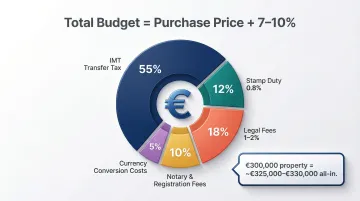
Decide upfront whether the purchase is for personal use, rental income, long-term capital appreciation, or a combination. This determines the optimal location, property type, and financing structure. Reserve a 7–10% cost buffer above the listed price to cover:
- IMT (transfer tax)
- Stamp duty (0.8%)
- Legal fees (1–2%)
- Notary and registration fees
- Currency conversion costs
Step 2: Research Locations and Property Types
Primary regional options for foreign buyers:
- Lisbon: Urban appreciation, strong rental demand, corporate tenant base
- Porto: Growth market, lower entry point, cultural appeal
- Algarve: Coastal lifestyle, holiday rental yields, international airport access
- Silver Coast and inland areas: Value-oriented buyers, emerging infrastructure development
Match your investor profile (income vs. appreciation focus) to the region's strengths.
Step 3: Obtain Your NIF and Engage a Lawyer
Complete these two tasks simultaneously before making any offer: get your NIF (tax identification number) and retain a Portuguese property lawyer. Your lawyer can serve as fiscal representative to obtain the NIF remotely and will review every subsequent document in the process. Handled remotely, this step typically takes 1–2 weeks.
Step 4: Make an Offer and Sign the Promissory Contract (CPCV)
The Contrato de Promessa de Compra e Venda (CPCV) is a legally binding agreement that locks in the purchase price, terms, and timeline. You'll typically pay a deposit of around 10% of the purchase price at signing.
Critical terms:
- If the buyer withdraws without legal cause, the deposit is forfeited
- If the seller withdraws, they must return double the deposit
- The CPCV sets the timeline for final deed signing (usually 30–90 days)
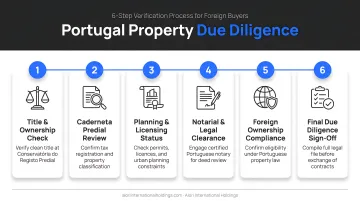
Step 5: Conduct Due Diligence
Your lawyer verifies:
- Land registry documents: Certidão de Registo Predial (legal ownership) and Caderneta Predial (tax status and VPT)
- No outstanding debts or mortgages attached to the property
- Valid building permits and licenses (Licença de Utilização for habitation)
- Energy performance certificate (mandatory for all property sales)
For older properties, hire a certified surveyor to conduct structural checks. Recent updates to Portuguese criminal law have strengthened protections against unlawful occupation, but buyers must still verify vacant possession before closing.
Step 6: Sign the Final Deed and Register
The Escritura Pública de Compra e Venda is the final deed signed before a notary. At this point:
- The remaining balance is paid
- Ownership is legally transferred
- IMT and stamp duty must be paid before the deed is signed
After signing, you register the property with the Portuguese Land Registry (Conservatória do Registo Predial) to formally complete the transaction.
The government's "Casa Pronta" service consolidates taxes, deed signing, and registration into a single appointment — eliminating multiple separate filings and reducing total closing time.
Taxes and Total Costs to Budget For
IMT (Property Transfer Tax)
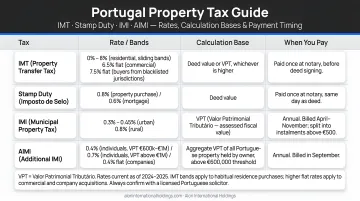
IMT (Imposto Municipal sobre Transmissões Onerosas de Imóveis) applies on a progressive scale from 0% to 8% depending on property value and type (residential, rural, or commercial). It must be paid before the final deed is signed and cannot be deferred.
Example: A €300,000 residential property in Lisbon typically incurs €8,000–€10,000 in IMT.
Stamp Duty (Imposto de Selo)
A flat 0.8% applied to the purchase price, paid alongside IMT. Stamp duty also applies to mortgage agreements at a separate rate.
IMI (Annual Municipal Property Tax)
IMI (Imposto Municipal sobre Imóveis) is the annual municipal property tax calculated on the government-assessed value (VPT), not the market price. Rates typically range from:
- Urban properties: 0.3–0.5%
- Rural properties: Up to 0.8%
The VPT is generally well below market price — a property purchased at €300,000 might carry a VPT of €150,000–€180,000, keeping annual IMI between €450 and €900 in most urban cases.
AIMI (Additional Property Tax for Higher-Value Holdings)
AIMI (Adicional ao IMI) is a wealth-style surcharge applied when an individual owner's combined VPT across all Portuguese properties exceeds €600,000. The rate is 0.7% on the amount above that threshold, rising to 1% above €1,000,000. Investors building a multi-property portfolio should factor this into their total holding cost projections.
| Tax | Rate | Basis | When Paid |
|---|---|---|---|
| IMT | 0%–8% (progressive) | Purchase price | Before deed signing |
| Stamp Duty | 0.8% flat | Purchase price | Before deed signing |
| IMI | 0.3%–0.8% annually | VPT (assessed value) | Annual |
| AIMI | 0.7%–1% annually | Combined VPT above €600,000 | Annual |
Beyond these Portuguese taxes, American buyers carry a second layer of reporting requirements back home.
US Tax Obligations for American Buyers
American buyers must:
- Report foreign bank accounts under FBAR rules if balances exceed $10,000 at any point during the year
- Declare rental income from Portuguese property on their US federal tax return
- Understand the US–Portugal tax treaty to reduce double taxation on rental income and capital gains
Work with a US expat tax specialist and a Portuguese fiscal representative before closing — the two advisory roles cover different obligations and neither substitutes for the other.
Common Pitfalls and Misconceptions for Foreign Buyers
Due Diligence Failures
The most consequential mistakes occur when buyers skip legal title checks or rely solely on estate agent assurances. Without independent legal review, buyers can inherit hidden debts, illegal extensions, or disputed ownership. A title check should cover at minimum:
- Land registry status: Confirm the seller holds clean, unencumbered title
- Planning permissions: Verify all structures are legally approved and registered
- Outstanding charges: Check for unpaid municipal taxes or mortgages attached to the property
Hiring an independent lawyer for this review is the single most effective risk mitigation step.
Cost Underestimation
Many buyers budget only for the listed price and are caught off guard by additional costs. Example: A €300,000 purchase can realistically cost €325,000–€330,000 all-in when you include:
- IMT: €8,000–€10,000
- Stamp duty: €2,400
- Legal fees: €3,000–€6,000
- Registration and notary fees: €1,000–€2,000
Request a full cost breakdown from your legal and advisory team before signing any preliminary contract. Surprises at closing are almost always the result of incomplete budgeting at the start.
Location Selection Based on Aesthetics, Not Data
Foreign buyers often choose locations based on tourism experience rather than rental demand data, transport links, or long-term development plans. Investors should validate an area's rental yield history and infrastructure trajectory before committing. Ask:
- What is the average vacancy rate over the past 3 years?
- Are there planned metro or highway extensions?
- What is the regulatory environment for short-term rentals?
A location that performs well as a tourist destination doesn't automatically perform well as a rental investment — the data behind each market tells a different story.
Residency and Visas: What Property Ownership Gets You
Property Ownership Does Not Grant Residency
Owning property in Portugal does not automatically confer residency rights. Non-EU citizens, including Americans, are still limited to 90 days in any 180-day period under Schengen rules without a visa. You'll need to apply for a separate residence permit for any longer stays.
D7 and D8 Visa Pathways
D7 — Passive Income/Retirement Visa
- Requires proof of stable passive income: rental yields, dividends, or pensions
- Owning property strengthens the application by demonstrating accommodation and financial ties to Portugal
- Typical income requirement: €820–€1,000 per month
D8 — Digital Nomad Visa
- For remote workers earning income from outside Portugal
- Property ownership demonstrates accommodation stability and commitment to the country
- Income requirement: Typically 4x the Portuguese minimum wage (approximately €3,280/month)
Both pathways grant legal residence. After five years, you may become eligible for Portuguese citizenship — one of the more compelling long-term benefits for investors who plan to build ties here.
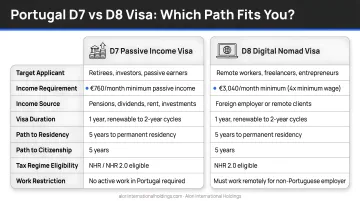
Neither visa requires a property purchase, but owning removes one of the most common application hurdles: proving stable accommodation.
Golden Visa Update
Portugal ended the Golden Visa's direct property purchase route in October 2023. For investors focused specifically on residency-by-investment, the program still offers pathways through:
- Investment fund contributions (€500,000 minimum in qualifying CMVM-regulated funds)
- Job creation (10+ full-time positions)
- Cultural or scientific contributions
Frequently Asked Questions
Can an American citizen buy a house in Portugal?
Yes, American citizens can buy property in Portugal with no special restrictions. The process is identical to that for any other foreign national — the primary requirements are a Portuguese NIF and a local Portuguese bank account for most transactions.
How long can you stay in Portugal if you buy a property?
Property ownership alone does not extend stay rights. Non-EU citizens including Americans are limited to 90 days in any 180-day period under Schengen rules unless they obtain a separate residence visa such as the D7 or D8.
What are the total costs of buying property in Portugal as a foreigner?
Buyers should budget an additional 7–10% on top of the purchase price to cover IMT (transfer tax), stamp duty (0.8%), notary and registration fees, and legal fees (typically 1–2%) — plus ongoing annual IMI property tax.
Do I need a lawyer to buy property in Portugal as a foreigner?
While legally optional, hiring an independent Portuguese lawyer (advogado) is strongly recommended for foreign buyers to verify title, identify debts, review contracts in Portuguese, and protect against the most common transaction risks.
Does buying property in Portugal affect my US taxes?
US citizens must report Portuguese rental income on their federal return and may have FBAR obligations for foreign bank accounts. Consulting a US expat tax specialist is recommended to navigate the US–Portugal tax treaty and avoid double taxation.
Can buying property in Portugal lead to residency or citizenship?
Property ownership supports but does not guarantee residency. It can strengthen a D7 or D8 visa application, and after five years of legal residence, applicants may become eligible for Portuguese citizenship through a separate application process.
Alori International Holdings helps American investors identify and acquire property in Portugal — with on-the-ground market knowledge, legal due diligence support, and a focus on long-term capital growth over speculative returns. For more information, contact info@aloriinternationalholdings.com.