
Introduction
European luxury real estate is drawing serious capital — and the reasons go beyond prestige addresses. As interest rate pressure and inflation reshape global investment flows, Europe continues to attract international buyers at pace, from prime urban corridors to Mediterranean coastal estates.
Traditional hubs like London, Paris, and Milan continue to hold their ground. Meanwhile, Southern European markets — particularly Portugal, Spain, and Greece — are pulling in growing investor attention through lifestyle appeal, favorable entry pricing, and structural demand that shows no sign of softening.
For American investors, this market demands more than surface-level awareness. Currency dynamics, regulatory frameworks, and shifting demand patterns create genuine complexity alongside genuine opportunity.
What drives value is also changing. Sustainability credentials, supply constraints, and lifestyle amenity quality have moved from nice-to-haves to primary price drivers. The next one to three years will be shaped by interest rate normalization, tightening supply, and the maturation of Golden Visa and residency program reforms across key markets.
Key Takeaways
- Prime European markets — especially London, Paris, and Lisbon — are holding value while secondary zones soften
- Portugal leads Southern Europe on price growth, fueled by lifestyle migration and sustained foreign demand
- Green building certifications now affect resale prices directly, not just buyer preference
- A strong USD gives American investors real purchasing power in euro-denominated markets right now
- Tightening supply and gradual rate cuts will push prime prices higher over the next 2–3 years
Established European Luxury Markets Hold Ground — But Selectively
Traditional luxury hubs—London, Paris, Zurich, Monaco, and Milan—continue to demonstrate price resilience, driven by persistent supply constraints, UHNW international demand, and their status as safe-haven assets in a volatile global environment. However, the defining characteristic across these markets is selective appreciation, not uniform growth.
Milan Leads European Prime Appreciation
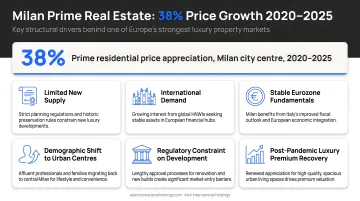
Milan has emerged as Europe's standout performer. Prime residential prices surged approximately 38% between 2020 and 2025, driven by Italy's €100,000 flat-tax regime for new residents and infrastructure investment tied to the 2026 Winter Olympics. The Scalo Romana Olympic Village regeneration project is transforming entire districts, particularly in areas like Brera and Porta Nuova, where international buyers are securing properties ahead of anticipated post-Olympic demand.
London Offers Contrarian Value
While Milan surges, London presents a different opportunity. Prime Central London prices remain 29.5% below their 2014 peak in areas like Knightsbridge and Belgravia. For USD-denominated cash buyers, this represents a rare value play in one of the world's most liquid luxury markets. The combination of established legal transparency, institutional-grade ownership protections, and below-peak pricing creates conditions favoring long-term wealth preservation strategies.
Prime Central Zones Widen the Gap
Across established hubs, prime central zones are widening the premium gap over secondary locations within the same cities. Key micro-locations illustrate just how concentrated this divergence has become:
- Paris 6th and 8th arrondissements continue to command premiums over the broader city
- London's Mayfair holds its position despite wider market softness
- 17 of Europe's 20 key luxury streets now have vacancy rates below 5%, with six at 0% — confirming extreme scarcity at the most desirable micro-locations
That scarcity is precisely what defines these markets as fortress assets: valued for liquidity, legal transparency, and capital preservation rather than speculative upside. With average price-per-sqm across prime districts diverging sharply by sub-location, entry point and precise location now determine outcome more than broad city-level timing.
Lifestyle Migration and Southern European Markets Drive New Growth
Southern European markets—led by Portugal, Spain, and Greece—are capturing an increasing share of both luxury and accessible-premium investment. This shift reflects lifestyle-driven buyers and tax-motivated high-net-worth individuals redirecting capital away from high-cost northern European cities.
Portugal Combines Growth, Infrastructure, and Accessibility
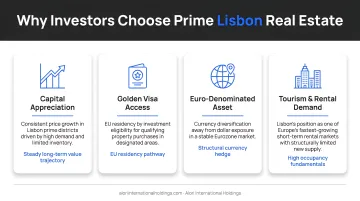
Lisbon's prime neighborhoods posted 5.3% price growth in 2024, outpacing several northern European capitals. That performance reflects a combination of improving infrastructure, favorable foreign buyer regulations, and sustained international demand.
Areas like Príncipe Real, Alcântara, and Lapa have been particularly consistent, drawing buyers attracted by:
- Lifestyle appeal — walkable neighborhoods, mild climate, and strong cultural infrastructure
- Tax incentives — Portugal's NHR (Non-Habitual Resident) regime continues to attract relocating high-net-worth individuals
- Relative affordability — prime Lisbon still prices well below comparable addresses in Paris, London, or Amsterdam
- Improving connectivity — infrastructure upgrades and growing direct flight routes from North America and the Gulf