

Introduction
More Americans than ever are looking to buy property in Europe—and it's easy to understand why. With US home prices surging and dollar volatility rising, investors are turning to international markets for diversification, better value, and inflation-resistant hard assets outside domestic exposure.
Europe isn't a single market. It's dozens of them—each with different legal frameworks, languages, and price points ranging from $80,000 to $2 million+. Without clear guidance, it's easy to pick the wrong one and watch your capital erode through hidden fees, poor rental demand, or murky legal structures.
This guide cuts through the noise. It identifies the five strongest European property markets for American investors in 2025–2026, chosen for legal accessibility, rental yield potential, transaction transparency, and long-term capital growth.
Key Takeaways
- Europe's best property markets for Americans are Portugal, Greece, Georgia, Italy (South/Puglia), and Croatia
- Entry prices range from $60,000 (Georgia, Southern Italy) to $400,000 (Portugal, Croatia)
- Americans can buy property outright in most European countries without citizenship or residency
- Strong markets share five traits: legal accessibility, rental yield potential, price-to-value ratio, residency pathways, and stability
- Prioritize markets with clear exit strategies and durable structural demand — not short-term price momentum
Why Buy Property in Europe Right Now?
The macroeconomic case for European real estate is compelling. According to recent Knight Frank research, international buyers accounted for over 15% of property transactions across key European markets in 2024, with American buyers representing one of the fastest-growing segments.
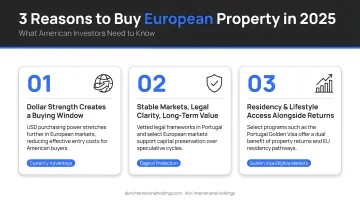
Three core reasons make the timing attractive:
- Currency dynamics: The USD/EUR exchange rate still favors American buyers, delivering purchasing power advantages of 8–12% compared to 2020 levels — discounting European property prices for American buyers without any negotiation required.
- Post-COVID tourism recovery: European tourism has rebounded strongly, with many coastal and urban markets surpassing 2019 visitor numbers. This drives rental demand, particularly for vacation properties in Portugal, Greece, and Croatia.
- Inflation-resistant hard assets: European real estate offers diversification beyond US market exposure. While Paris, Zurich, and London require deep pockets, a growing tier of accessible markets sits in the $150,000–$600,000 range — well within reach for mid-level investors.
Best Places to Buy Property in Europe
These destinations were selected for their combination of legal accessibility for American buyers, measurable rental demand, transparent transaction processes, and long-term capital growth potential—not just lifestyle appeal.
Portugal (Algarve & Lisbon Region)
Portugal ranks as one of Europe's most foreigner-friendly property markets. Americans face no restrictions on foreign ownership, and the process is straightforward: obtain a NIF tax number, work with a licensed notary, and complete transactions through a mature system with strong buyer protections.
While the Golden Visa no longer applies to real estate purchases, the Non-Habitual Resident (NHR) tax regime and low annual property taxes (IMI) continue to attract international buyers. Transaction costs typically run 7-8% of the sale price, covering stamp duty, notary fees, and registration.
Investment case: Portugal delivers stable tourism-driven rental income combined with capital appreciation potential. The Algarve attracts consistent seasonal demand, while Lisbon offers year-round rental opportunities from both expats and tourists. Average property prices range from €150,000–€350,000 for a 2-bedroom apartment in suburban Algarve or Lisbon areas, with gross rental yields typically between 4.5–6%.
Alori International Holdings operates in Portugal with in-market expertise, offering access to vetted opportunities and defined exit strategies for international investors in the $150,000–$400,000 range.
| Metric | Details |
|---|---|
| Entry Price Range | €150,000–€350,000 ($160,000–$375,000) |
| Rental Yield | 4.5–6% gross annually |
| Residency Pathway | Investment fund route (€500,000+) for Golden Visa; NHR tax scheme for new residents |
Greece (Athens & Crete)
Greece offers accessible entry for American buyers. Foreigners purchase freely after obtaining a Greek tax number (AFM), hiring a local lawyer, and working with a notary—a process typically taking 2–3 months.
The Golden Visa remains active with a €250,000 threshold in select lower-demand zones and €500,000 in major urban areas—one of the last active real estate-linked residency programs in Europe.
Investment case: Greece rebounded from its debt crisis with prices in many areas still reflecting below-peak valuations. Average prices range from €150,000–€300,000 for a 2-bedroom apartment in Athens or Crete. Coastal and island properties benefit from strong tourism-driven short-term rental demand, with gross rental yields typically between 5–7% (higher for Airbnb-eligible coastal properties reaching 7–9%).
| Metric | Details |
|---|---|
| Entry Price Range | €150,000–€300,000 ($160,000–$320,000) |
| Rental Yield | 5–7% gross annually (7–9% for coastal short-term rentals) |
| Residency Pathway | Active Golden Visa: €250,000 (select zones) or €500,000 (Athens, Thessaloniki, Mykonos, Santorini) |
Georgia (Tbilisi & Batumi)
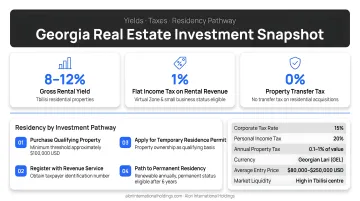
Georgia combines some of Europe's lowest entry prices with a genuinely simple transaction process. All nationalities can purchase residential and commercial property with no restrictions (agricultural land excluded). Title transfer completes in as little as one business day. Legal and registration fees typically run under 1% of purchase price—a fraction of what buyers pay in Western Europe.
A $100,000 real estate investment qualifies for a renewable one-year residence permit, though this threshold rises to $150,000 effective March 1, 2026.
Investment case: Georgia's value and tax efficiency stand apart from any other market in this guide. Average property prices in Tbilisi and Batumi range from $1,152–$1,395 per square meter — roughly $60,000–$150,000 for modern 1–2 bedroom apartments. According to Cushman & Wakefield's 2025 Georgia market report, Batumi coastal properties deliver gross rental yields of 8.8–11.2%.
The tax structure reinforces the return profile:
- Flat 5% rental income tax
- Zero capital gains tax after two years of ownership
- Zero annual property tax
Demand drivers are structural, not speculative. Georgia recorded 2.8 million international visitors in H1 2025 (up 5% year-over-year), Black Sea coastal development continues to expand Batumi's supply and visitor base, and a young, urbanizing population underpins Tbilisi's residential market.
Alori International Holdings operates in Georgia with direct in-market expertise, offering curated opportunities in Tbilisi and Batumi with vetted legal structures and defined exit strategies.
| Metric | Details |
|---|---|
| Entry Price Range | $60,000–$150,000 |
| Rental Yield | 8.6% Tbilisi; 8.8–11.2% Batumi coastal zone |
| Residency Pathway | $100,000 property investment qualifies for 1-year renewable residence permit (rises to $150,000 March 1, 2026); permanent residency after 5 years continuous stay |
Italy – Puglia & Southern Italy
Southern Italy offers dramatically lower entry points than the North. Foreigners buy without restrictions after obtaining a codice fiscale (tax code) and completing notary-executed final deeds. While Tuscany and Milan command premium prices, Puglia, Calabria, and Sicily deliver high lifestyle and short-term rental appeal driven by surging tourism to the "heel of the boot."
Average property prices in Puglia (Lecce, Ostuni, Alberobello areas) range from €80,000–€220,000 for 2–3 bedroom properties. Transaction costs run approximately 7–10%.
The €1 home scheme continues in approximately 20 towns across Sicily and other regions, but comes with mandatory renovation obligations (estimated €50,000–€80,000) and residency requirements. For pure investors, move-in-ready properties at €80,000–€200,000 offer stronger ROI with less risk. Gross rental yields typically range from 5–7%, with short-term rental premiums in tourist hotspots.
| Metric | Details |
|---|---|
| Entry Price Range | €80,000–€220,000 ($85,000–$235,000) |
| Rental Yield | 5–7% gross annually (higher for short-term tourist rentals) |
| Residency Pathway | No property-linked residency program; Italy's Elective Residency Visa available for financially independent applicants (proof of passive income required) |
Croatia (Dalmatian Coast & Dubrovnik)
Croatia became an EU member in 2013 and joined the Eurozone in 2023. American buyers face no purchase restrictions and can own property with full title. The buying process involves a preliminary contract, government pre-emption check, and notary-executed final deed—typically 2–3 months.
Croatia's Dalmatian Coast offers comparable Mediterranean lifestyle to Italy and Greece, but entry prices run roughly €50,000–€100,000 lower than equivalent coastal properties in those markets.
Investment case: Average property prices in Split, Hvar, and Dubrovnik range from €200,000–€400,000 for 2-bedroom apartments. Tourism to Croatia has grown substantially since EU accession, driving strong short-term rental demand with gross rental yields of 5–8% in high-demand coastal areas.
Transaction costs are approximately 3% (transfer tax)—among the lowest in Europe, improving overall investment returns.
| Metric | Details |
|---|---|
| Entry Price Range | €200,000–€400,000 ($215,000–$430,000) |
| Rental Yield | 5–8% gross annually in coastal areas |
| Residency Pathway | No direct investment-linked residency; Digital Nomad Visa available; standard EU long-stay options apply |
How We Selected These Destinations
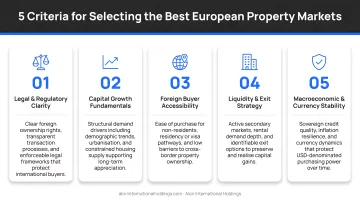
Each destination was assessed against five criteria:
- Legal accessibility for non-EU/American buyers
- Average entry price within the $100,000–$600,000 range
- Gross rental yield potential supported by documented tourism or migration demand
- Transaction cost transparency and clear title processes
- Availability of residency or tax incentive pathways
Markets driven by speculative momentum or with opaque legal structures were excluded.
Why Certain Markets Were Excluded
Popular but overpriced markets like Paris, Zurich, and London fall outside the target price range. Markets with heavy foreign ownership restrictions or unpredictable regulatory environments — such as Turkey with recent currency volatility — were excluded.
The goal is durable investment decisions across market cycles, not short-term gains.
Structural Demand Over Surface-Level Appeal
Those exclusions reflect the same logic as the positive screen: fundamentals matter more than headlines. Tourism infrastructure, demographic tailwinds, urban migration trends, and capital flow data were weighted more heavily than lifestyle rankings or media coverage. Georgia's 5% year-over-year tourism growth and Batumi's 65.7% hotel occupancy rates, for example, demonstrate measurable demand — not just narrative appeal.
Key Considerations for American Buyers
Legal Basics
Americans can purchase property in nearly every European country, but the process requires a few country-specific steps:
- A local tax identification number (NIF in Portugal, AFM in Greece, codice fiscale in Italy)
- A local bank account in some cases
- A licensed local attorney to handle due diligence—title searches, zoning compliance, and lien checks
Critical mistake: Relying solely on seller's agents is one of the most common and costly errors. Independent legal representation protects your interests.
Financial Considerations for US Citizens
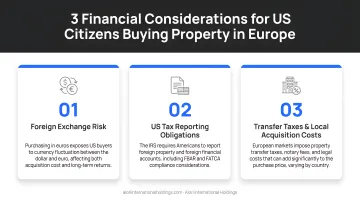
Three financial realities shape how Americans approach European property:
- Tax reporting: FBAR and FATCA obligations apply to foreign bank accounts and assets above set thresholds. Rental income is taxable to the IRS regardless of where it's earned.
- Mortgage terms: Non-residents typically face 30–40% down payment requirements, versus 10–20% domestically. Cash purchases are more common at this price range.
- Currency exposure: The dollar has strengthened roughly 10–12% against the euro over the past five years, effectively discounting European prices for American buyers — but USD/EUR moves in both directions and should be factored into your projected returns.
Rental and Exit Strategy
Short-term rental rules differ sharply by city. Lisbon and Barcelona have tightened licensing requirements — permits are harder to obtain and in some districts no longer available. Coastal and resort markets offer more favorable conditions than major city centers. Verify local regulations before purchasing for short-term income, not after closing.
Capital gains tax treatment varies:
- Georgia: Zero capital gains tax after two years of ownership
- Greece: Favorable treatment for primary residences
- Portugal, Italy, Croatia: Standard capital gains rates apply (15-26% depending on jurisdiction and holding period)
Know your exit before you buy — the holding period, intended use, and target buyer or rental market should all inform which structure and jurisdiction makes the most sense for your investment.
Conclusion
Europe's best property markets for American investors in 2025-2026 offer a rare combination of legal clarity, accessible entry prices, and long-term capital growth potential—but the key is selectivity. Chasing the cheapest market or the most media-covered destination without understanding local fundamentals is the surest path to underperformance.
Portugal leads for legal simplicity and lifestyle appeal. Greece offers value with an active Golden Visa. Georgia delivers exceptional yields with ultra-low taxes. Southern Italy provides Mediterranean charm at accessible prices. Croatia combines Eurozone stability with low transaction costs.
Knowing where to invest is only half the equation. Executing the purchase—navigating foreign legal systems, verifying title, structuring exit options—is where most investors stall or make costly mistakes.
Alori International Holdings works with investors entering Portugal and Georgia through vetted opportunities with verified legal structures, in-country execution support, and defined exit strategies built in from the start. Contact info@aloriinternationalholdings.com to explore current opportunities.
Frequently Asked Questions
Which European country is the cheapest to buy property?
Georgia and Bulgaria offer the lowest-cost entry points, with apartments available from $50,000–$100,000, followed by Southern Italy and parts of Greece. However, "cheapest" doesn't mean best value—factor in transaction costs, rental demand, and legal clarity.
What is the best country to buy property in Europe?
There's no single best country. Portugal leads for legal simplicity and lifestyle; Greece for value and an active Golden Visa; Georgia for lowest taxes and fastest transactions; Croatia for Eurozone stability with low transfer taxes. The best fit depends on your budget, goals, and investment horizon.
What is the best European country to buy rental property?
Batumi, Georgia and Greece deliver the highest gross rental yields—6–9% in Greece and up to 11% in Batumi's coastal zones. Portugal and Croatia offer stable, tourism-driven income, though short-term rental regulations in major cities are tightening. Coastal and resort markets generally offer more favorable conditions.
Where can a US citizen buy property in Europe?
US citizens can purchase property freely in most European countries including Portugal, Greece, Italy, Croatia, Georgia, and Bulgaria. No EU citizenship or residency is required. A local tax ID number and licensed attorney are the standard procedural requirements.
Are $1 homes in Italy still available?
Yes, roughly 20 towns across Sicily and other regions still offer the scheme. It requires mandatory renovation within a set timeframe (estimated $50,000–$80,000+) and, in some cases, local residency obligations—making move-in-ready Southern Italy properties at $80,000–$150,000 a lower-risk alternative for most investors.
What should Americans know about taxes when buying property in Europe?
Americans must report foreign bank accounts (FBAR) and assets meeting FATCA thresholds, and rental income earned abroad is still taxable to the IRS. Some countries reduce the local burden—Georgia's flat 5% rate and Portugal's NHR scheme are notable examples—but US obligations apply regardless. A cross-border tax advisor is essential before purchasing.