Introduction: Lisbon's Luxury Property Market Is Outperforming the World—Here's What Investors Need to Know
Lisbon's luxury residential market posted 4.4% growth in 2025 and is projected to grow 4–5.9% in 2026 according to Savills' Prime Residential World Cities report. This places the Portuguese capital among only five global cities expected to exceed 4% appreciation, alongside Seoul, Tokyo, Madrid, and Cape Town.
While traditional prime markets like New York, London, and Paris are projected at sub-2% growth, Lisbon is outperforming the global average of 1.3% by more than 3 percentage points. For internationally minded investors—particularly American buyers watching US luxury markets stagnate—this represents a standout diversification opportunity.
What's driving this gap isn't speculation — it's a combination of constrained supply, sustained foreign demand, and a regulatory environment that still welcomes outside capital. The details matter, and they favor investors who move with data rather than momentum.
TLDR: Key Takeaways at a Glance
- Lisbon luxury property grew 4.4% in 2025; 2026 forecasts of 4–5.9% growth run nearly four times the global prime market average
- Prime neighborhoods like Chiado and Príncipe Real command €8,000–12,000/m² (EUR-denominated); the wider metro averages €5,829/m²
- Chronic supply constraints driven by geography and heritage preservation sustain long-term price appreciation
- NHR 2.0 still offers meaningful tax advantages for qualifying professionals, even as the Golden Visa residential pathway closed in October 2023
- Branded residences are emerging as a major 2026 trend for lifestyle-oriented international buyers
Lisbon's Luxury Market Performance: By the Numbers
Lisbon significantly outpaced the global prime residential market in 2025. According to Savills' World Cities Prime Residential Index, the city achieved 4.4% capital value growth—more than three times the 1.3% global average. For 2026, Savills forecasts Lisbon will maintain this momentum with projected growth between 4% and 5.9%.
Current price benchmarks reflect this strength:
- Ultra-prime areas like Chiado and Príncipe Real command €8,000–12,000/m² for fully renovated properties
- Broader central Lisbon luxury neighborhoods average over €6,100/m²
- The wider metropolitan area averages approximately €5,829/m²
After rapid expansion in 2023-2024, the market is showing stabilization with more selective buyers and fewer speculative transactions. This reflects a maturing prime segment built on genuine fundamentals, not a momentum-driven run that's losing steam.
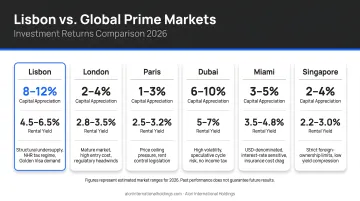
Rental performance tells the same story. Lisbon ranks among the fastest-rising luxury rental markets globally, with gross yields in prime segments running 3.5%–4.8% annually. Add projected capital appreciation of 4–5.9%, and total returns approach 8–12%. That compares favorably to the sub-2% appreciation forecasts for established markets like New York or London.
Supply pipeline considerations:
The Lisbon City Council approved the Matinha project in December 2024—a €2 billion development adding approximately 2,000 new homes in the eastern riverside district of Marvila. However, this peripheral location means the project is unlikely to ease supply-demand pressure in heritage-restricted central zones like Chiado or Baixa, where scarcity remains the dominant price driver.
What's Driving Demand in Lisbon's Prime Segment
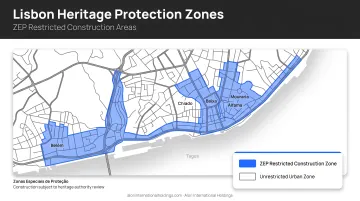
Structural scarcity underpins Lisbon's sustained price appreciation. The city is geographically bounded by the Tagus River and the Atlantic Ocean, with strict heritage preservation laws prohibiting new construction in coveted central neighborhoods.
Zonas Especiais de Proteção (ZEP) regulations extend 50 meters from classified properties, requiring prior authorization from cultural heritage authorities for any construction or alteration. This makes areas like Chiado, Lapa, and Baixa structurally scarce — and appreciation in these neighborhoods consistently outpaces broader market averages.
International Buyer Demand Stays Elevated
Foreign buyers accounted for 24% of transactions and 32% of total transaction value in Lisbon — a figure that reflects sustained cross-border appetite rather than a post-pandemic spike.