

Introduction
Portugal has moved to the front of Europe's vacation rental markets, offering American investors a rare combination of strong tourism fundamentals, accessible entry pricing relative to Western European peers, and rental yields reaching 5–10% annually. The appeal isn't momentum-driven — it's structural. The country recorded 19.7 million foreign guests in 2025, a 1.9% year-over-year increase, with US arrivals climbing 3.2% to 2.4 million visitors.
For investors looking to diversify beyond domestic US real estate, Portugal delivers on three fronts: macroeconomic stability, transparent property ownership laws, and a short-term rental ecosystem generating consistent income across coastal and urban markets.
This guide covers the essentials: where to buy, what yields to expect, how Portugal's evolving regulatory landscape (including the Mais Habitação law) affects licensing, and what the purchase process looks like for US-based buyers. Whether you're eyeing the Algarve coast or a Lisbon city-break apartment, understanding the fundamentals — pricing, taxation, and operational structure — will help you make informed entry decisions.
TLDR:
- Portugal welcomed 19.7M foreign guests in 2025; US visitors hit 2.4M, up 3.2% YoY
- National median property price: €3,107/sqm (March 2026), competitive vs. France (€6,140/sqm)
- Algarve short-term rentals generate median annual revenue of €30,000 at 75% occupancy
- New AL licenses suspended in Lisbon/Porto cores; Algarve, Madeira, and interior regions remain open
- Non-resident rental income taxed at flat 28%; US-Portugal tax treaty applies
Why Portugal Stands Out as a Vacation Rental Market
Portugal's position as a vacation rental market is built on structural demand — tourism growth, favorable entry pricing, and macroeconomic stability — not speculative momentum. For American investors, the fundamentals align across multiple fronts.
Tourism Demand: Durable and Growing
Portugal's tourism sector continues to grow steadily. In 2025, the country recorded 19.7 million foreign guests (up 1.9% year-over-year), with total guest counts reaching 32.5 million.
The numbers are particularly relevant for American investors: US arrivals grew to 2.4 million in 2025, a 3.2% YoY increase, generating 3.1 million overnight stays (+8.0% YoY). This sustained North American demand supports year-round occupancy rates — the foundation of stable rental income.
Entry Pricing Advantage
While Portugal's property market has appreciated significantly—with the national median asking price reaching €3,107 per square meter in March 2026 (up 12.0% YoY)—it remains highly competitive compared to major European hubs. Spain's national average sits at €2,709/sqm, but prime French markets like Ile-de-France command €6,140/sqm, nearly double Portugal's rate. Within Portugal:
- Lisbon City: €6,082/sqm
- Porto City: €4,085/sqm
- Algarve Region: €3,988/sqm
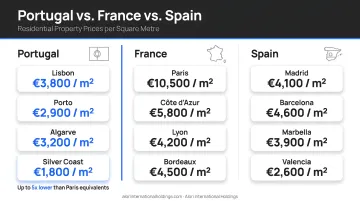
For American investors leveraging a strong US dollar against the euro, these entry points offer meaningful upside compared to equivalent Mediterranean or Atlantic coastal markets. A $500,000 budget can secure premium coastal villas or centrally located urban apartments that would cost significantly more in comparable French, Italian, or Spanish destinations.
Macroeconomic and Political Stability
Portugal ranks 7th globally in the 2025 Global Peace Index, reflecting low crime, political stability, and a safe investment environment. Real GDP growth reached 2.1% in 2024, demonstrating steady economic momentum. Critically, Portugal imposes **no restrictions on foreign property ownership**—non-resident Americans can purchase freely without nationality-based barriers, requiring only a Portuguese tax number (NIF) and legal representation.
The USD/EUR Dynamic
As of April 14, 2026, the euro traded at $1.1793, within a historical range that has fluctuated between $0.9549 and $1.1980 over the past 36 months. For US investors, this creates both opportunity and risk. When the dollar strengthens, acquisition costs drop in USD terms; when the euro strengthens, rental income and property equity translate into higher dollar values upon repatriation or sale.
Many advisors position euro-denominated real estate as a natural hedge within internationally diversified portfolios, offsetting concentration in dollar-denominated US assets. Alori International Holdings uses exactly this macro lens — analyzing currency dynamics alongside tourism trends, demographic flows, and infrastructure development — to identify markets like Portugal before price appreciation becomes fully priced in.
Top Locations for Vacation Rental Investment in Portugal
Location determines licensing viability, rental yield, seasonality, and guest profile. Choosing the right market within Portugal matters as much as choosing Portugal itself. Here are the primary regions American investors target for vacation rental opportunities.
The Algarve
The Algarve remains Portugal's premier vacation rental market, combining coastal proximity, championship golf infrastructure, and 300+ days of annual sunshine that extend the rental season beyond traditional summer peaks. Properties here achieve among the highest rental yields in the country:
- Faro/Algarve median annual revenue: €30,000, with 75% occupancy and €107 average daily rate (Feb 2025–Jan 2026)
- Lagos median annual revenue: €25,000–€27,000 (est.), with 51.5% occupancy and €180 ADR
These figures reflect strong international demand, particularly from UK, Irish, and North American guests seeking beach access, golf tourism, and villa-style accommodations.
Property Types and Price Ranges:
- Villas with private pools (€400K–€1M+) dominate the high-end rental segment, especially in the Golden Triangle (Quinta do Lago, Vale do Lobo, Vilamoura). T4 villas in Guia list around €840,000; T3 properties in Albufeira around €590,000.
- Coastal apartments (€200K–€350K) offer lower entry points for investors targeting professional management and summer season cash flow. T2 apartments in Vilamoura start around €399,000.
Year-round occupancy potential drives the Algarve's investment case — peak summer rates offset winter softness, and golf tourism extends the shoulder season into spring and autumn.
Lisbon and the Greater Lisbon Area
Lisbon delivers high nightly rates and year-round occupancy driven by business travel, city-break tourism, and digital nomad demand. The city commands Portugal's highest acquisition costs at €6,082/sqm (March 2026).
Emerging neighborhoods offer a relative entry advantage: Parque das Nações sits at €6,665/sqm while Marvila recorded a €6,014/sqm transaction median in Q3 2024 — both with strong appreciation trajectories and lower saturation than the historic center.
Regulatory Impact
Lisbon implemented absolute containment zones under the Mais Habitação law, suspending new AL (Alojamento Local) licenses in historic parishes where short-term rentals exceed 10% of permanent housing. These include Santa Maria Maior, Misericórdia, and Santo António. However, the Greater Lisbon Metropolitan Area—including Cascais, Sintra, and Setúbal—remains accessible for new AL registrations, offering suburban alternatives with strong rental demand from families and beach-focused travelers.
Porto and Emerging Regions
Porto attracted 7.4 million tourists in 2024, supporting strong short-term rental performance. The city's median annual STR revenue reached €26,000 with 78% occupancy and €90 ADR (Feb 2025–Jan 2026). Porto's UNESCO heritage district and Foz do Douro waterfront draw international guests year-round. Like Lisbon, however, the historic center and Bonfim neighborhoods face AL licensing suspensions as of late 2024.
Price Benchmarks:
Porto City median asking price reached €4,085/sqm (March 2026), representing a middle ground between Lisbon's premium pricing and interior/coastal markets.
Interior and Emerging Alternatives
Those restrictions have pushed investor attention toward markets outside the major cities. The most active alternatives include:
- Silver Coast (Nazaré, Óbidos): Unrestricted AL licensing, rising eco-tourism and surf tourism demand
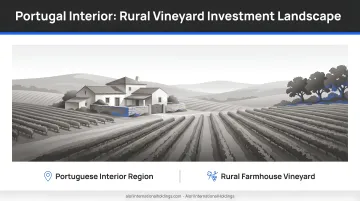
- Alentejo: Rural farmhouses, vineyards, and agri-tourism properties exempt from AL containment zones
- Douro Valley: UNESCO World Heritage wine region attracting experience-driven travelers
These regions benefit from explicit exemptions under Portaria n.º 208/2017, which defines interior territories as exempt from national AL suspension measures. They offer lower entry costs, higher gross yields (due to reduced competition), and access to sustainable/nature-focused tourism demographics. For investors weighing location against licensing risk, these markets combine regulatory clarity with structurally undersupplied rental inventory — a useful foundation before evaluating the licensing process itself.
Understanding Rental Yields and Return Potential
Gross rental yields alone don't tell the full story. Net yields—after operating costs, taxes, and fees—determine actual cash-on-cash returns. Here's how to model returns realistically.
Expected Gross Rental Yields by Region
- Algarve: Faro ranks in the top 23% nationally for STR yield, with properties achieving 4–7% gross yields depending on location and property type
- Porto: Porto ranks in the top 41% nationally, with similar 4–7% ranges
- Lisbon Metro: Year-round business travel and tourism support consistent occupancy, though higher acquisition costs compress gross yields relative to coastal markets
These ranges assume dynamic pricing strategies that capture peak summer rates while offering discounts during off-season months. Active pricing management makes a measurable difference. Raising rates during August's 85% occupancy peaks and pulling back during January's 42% trough is what separates average annual revenue from optimized returns.
From Gross to Net Yield: Key Cost Items
To calculate net yield, subtract these operating costs from gross rental income:
| Cost Item | Range/Rate | Notes |
|---|---|---|
| Property Management Fees | 15%–30% of rental revenue | Professional management companies handle guest communications, cleaning, maintenance, and check-ins |
| Platform Commissions | Airbnb: 3% host fee; Booking.com: 10–25% (avg 15%) | Varies by platform and booking structure |
| IMI Property Tax | 0.3%–0.45% (urban); 0.8% (rural) | Annual municipal property tax based on assessed value |
| AL Registration Fee | Free via Balcão do Empreendedor (municipalities may charge local fees) | Initial registration is free; some municipalities impose annual renewal fees |
| Insurance | Variable | Mandatory civil liability insurance required for AL properties |
| Maintenance & Utilities | Variable | Ongoing repairs, utility costs during vacancies, and capital improvements |
Example Net Yield Calculation:
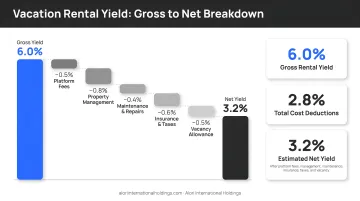
A €300,000 Algarve apartment generating €18,000 gross annual rental income (6% gross yield):
- Property management (25%): -€4,500
- Platform commissions (15%): -€2,700
- IMI (0.4%): -€1,200
- Insurance, maintenance, utilities: -€2,000
Net income: €7,600 = 2.5% net yield
That 6% gross yield becomes 2.5% net — less than half. Model blended annual occupancy (not peak-season rates) and build in conservative expense assumptions from the start. The difference between a well-modeled deal and a disappointing one is almost always in the costs, not the headline yield.
Capital Appreciation: The Secondary Return Driver
Portugal's House Price Index (IPHab) increased 17.6% year-over-year in 2025, with transaction values rising 23.4%. Appreciation at this pace won't hold at the same rate across every cycle, but long-term capital growth combined with rental income accounts for total return — and Portugal's structural demand drivers remain intact. Markets with limited coastal supply (Algarve beachfront) or infrastructure-driven demand (Lisbon Metro expansion) tend to appreciate faster over multi-year hold periods.
That appreciation potential cuts both ways, though. Overpaying into a rising market compresses yield on day one and limits exit gains later. Disciplined entry pricing — buying below peak valuations or in emerging markets before broad price discovery — is what protects long-term total returns.
Licensing, Regulations, and the Mais Habitação Law
Portugal's short-term rental market operates under a licensing framework that has evolved significantly in response to housing affordability pressures. Understanding these regulations is critical before purchasing.
The Alojamento Local (AL) License Requirement
All properties rented for under 30 consecutive days must register with the local câmara (municipal council) and obtain an AL license. The process involves:
- Registration via Balcão Único Eletrónico (Portal do Cidadão): Mandatory prior communication submitted online
- Municipal Review Period: Municipalities have 60 days (90 days in containment zones) to oppose the registration
- Standards Compliance: Properties must meet health, fire safety, and habitability standards; mandatory civil liability insurance required
- RNAL (National Registry): Once approved, the property receives a registration number listed on the national AL database
Mais Habitação Law and DL 76/2024 Updates
In October 2023, Portugal passed Lei n.º 56/2023 (Mais Habitação/More Housing), aiming to address housing shortages by restricting short-term rentals in high-demand urban areas. Decree-Law 76/2024 (effective November 2024) revoked the national suspension of new AL licenses and the 5-year expiry rule, shifting regulatory power to municipalities.
Key Impacts:
- Municipal Containment Zones: Local councils can now define containment areas and restrict new licenses. Lisbon and Porto implemented absolute containment zones in historic cores where AL units exceed 10% of permanent housing stock.
- License Transferability: Generally, AL licenses transfer upon property sale—except in Lisbon's absolute containment zones, where licenses expire upon transfer, preventing new buyers from operating short-term rentals.
- Exempt Regions: Interior territories (defined by Portaria n.º 208/2017), Algarve, Madeira, and Azores remain open for new AL registrations.
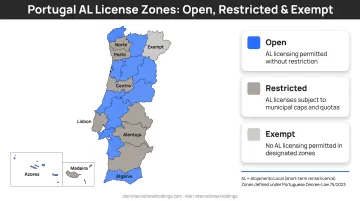
For American investors: Verify AL license status before purchasing in Lisbon or Porto city centers. Properties with existing licenses can continue operating, but new buyers in containment zones may be unable to obtain licenses. Greater Lisbon suburbs (Cascais, Sintra) and coastal or interior regions offer far fewer restrictions and remain the most straightforward entry points for new investors.
Rental Income Taxation for Non-Residents
Non-resident landlords pay a flat 28% withholding tax on net Portuguese rental income (Category F under the CIRS tax code). Key tax considerations for US investors:
- 28% flat rate: Applies to all net rental income earned by non-resident foreign property owners under Category F of the CIRS tax code
- US-Portugal Tax Treaty: The double taxation treaty lets US investors claim foreign tax credits on their US returns for Portuguese taxes already paid, reducing double taxation
- IFICI/NHR 2.0 (introduced 2024/2025): Offers a 20% flat rate on qualifying employment and self-employment income for professionals who relocate to Portugal — it does not apply to rental income, so it's only relevant if you plan to establish Portuguese tax residency alongside your investment
The Buying Process for American Investors
Purchasing Portuguese property as a non-resident involves several administrative steps, but the process is straightforward with professional guidance.
Essential Legal and Administrative Steps
1. Obtain a Portuguese NIF (Número de Identificação Fiscal)
The NIF is Portugal's tax identification number, required for all property transactions. Americans must appoint a fiscal representative in Portugal — a requirement for all non-EU buyers. The process takes 7–10 working days and can be handled remotely via a Power of Attorney, so you don't need to travel to Portugal to get started.
2. Open a Portuguese Bank Account
Required for paying property deposits, transaction costs, and ongoing expenses (utilities, property tax, management fees). Most banks accept account applications from non-residents with a valid NIF and proof of identity.
3. Hire a Licensed Portuguese Property Lawyer (Advogado)
Your lawyer handles due diligence and verifies that the property is transaction-ready. Key checks include:
- Title, debts, and existing liens
- Construction and habitation permits
- AL (short-term rental) registration status and transferability
Transaction Sequence and Timeline
1. Promissory Contract (CPCV — Contrato Promessa de Compra e Venda)
The buyer and seller sign a promissory contract outlining the purchase terms, price, and timeline. The buyer typically pays a 10% deposit at this stage. The CPCV legally binds both parties to the transaction, with penalties for non-performance.
2. Due Diligence Period
The buyer's lawyer conducts title searches, verifies permits, confirms tax compliance, and ensures the property meets all legal requirements. Due diligence typically takes 30–60 days.
3. Final Deed (Escritura Pública)
Signed before a notary, the Escritura Pública transfers legal ownership. The buyer pays the remaining purchase price plus all transaction costs.
Total Timeline: The full process typically takes 2–4 months from initial offer to final deed.
Buyer Transaction Costs
| Cost Item | Rate/Amount | Notes |
|---|---|---|
| IMT (Transfer Tax) | Progressive rates up to 7.5% for properties over €1,150,853 | Lower rates apply to properties under €550,000; exemptions available for primary residences under certain conditions |
| Stamp Duty | 0.8% on acquisition value | Applied to the purchase price |
| Notary & Registry Fees | Casa Pronta service: €375 (single registry act) or €700 (with bank financing) | Covers notary fees and land registry registration |
| Legal Fees | Variable (typically 1%–2% of purchase price) | Depends on complexity and attorney rates |
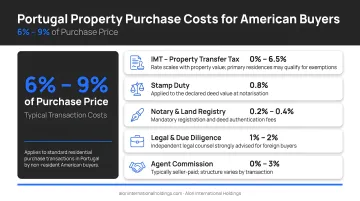
Total buyer costs typically range from 6–9% of the purchase price.
Structured Entry for US-Based Investors
For buyers who can't be on the ground in Portugal, Alori International Holdings provides a structured path through the process — vetted properties with verified legal standing, in-market professionals handling transaction coordination, and defined exit strategies built in from the start. It's the difference between navigating an unfamiliar foreign market alone and working with a team that's already done it.
Key Risks to Know Before You Invest
Portuguese vacation rentals offer genuine upside — but five specific risks can erode returns if left unaddressed. Here's what to evaluate before committing capital.
Regulatory Risk
The shift of AL licensing authority to municipalities under DL 76/2024 means local councils can rapidly implement or alter containment zones. Lisbon and Porto have already demonstrated this by suspending new licenses in historic cores. Future municipal elections or housing policy shifts could expand restrictions to currently unrestricted areas or impose additional fees and compliance requirements. Investors should verify current AL license status, understand transferability rules, and factor regulatory risk into hold-period planning.
Seasonal Demand Concentration
Algarve properties face significant seasonality: August occupancy hits 85%, but January drops to 42%. This creates uneven cash flow throughout the year. Investors relying on peak-season projections to model annual returns may overestimate net income. Diversifying across Lisbon (year-round business travel) and Algarve (seasonal tourism) or targeting shoulder-season demographics (retirees, remote workers) can smooth occupancy volatility.
Currency Risk
The EUR/USD exchange rate has fluctuated between $0.9549 and $1.1980 over the past 36 months. For US investors receiving rental income in euros, unfavorable exchange rate movements can reduce dollar-equivalent returns. Property appreciation in euros may also be offset by euro depreciation against the dollar upon exit.
Euro-denominated real estate can function as a natural hedge within a diversified portfolio — but currency volatility adds a layer of risk absent from domestic US investments.
Overpaying in a Hot Market
With national prices rising 17.6% in 2025 and transaction values up 23.4%, investors entering at peak valuations face compressed gross yields and limited appreciation upside. If rental rates fail to keep pace with acquisition costs, net yields deteriorate. Stress-test returns at conservative occupancy assumptions (60%–70% annual occupancy rather than 80%+) and model flat or declining appreciation scenarios to ensure the investment works under downside conditions.
Management and Operational Risk
Owning a vacation rental from the US requires a reliable local property management partner. Poor management leads to guest complaints, negative reviews, license compliance failures, and property deterioration. Vetting management companies before purchase — not after — is critical. Evaluate each candidate on:
- Verified track record in the target market
- Fee structures relative to delivered occupancy rates
- Maintenance protocols and response times
- Guest communication standards and review scores
A 30% management fee that delivers 90% occupancy and 4.8-star reviews is far superior to a 15% fee that results in 60% occupancy and 3.9-star ratings.
Frequently Asked Questions
Is Airbnb profitable in Portugal?
Yes, Airbnb can be profitable in Portugal—particularly in the Algarve and Lisbon/Porto areas. Profitability depends heavily on location, property type, occupancy rate, and net costs after management fees, taxes, and licensing. Gross yields of 4–7% are commonly cited, but net yields after all expenses typically fall 2–4 percentage points lower.
Where is the best place to buy a rental property in Portugal?
The Algarve leads on tourist demand, coastal appeal, and rental yields. Lisbon Metro, Porto, the Silver Coast, and Alentejo are gaining ground as alternatives. The right choice depends on your budget, yield goals, and tolerance for licensing restrictions.
Can Americans buy property in Portugal?
Yes, there are no restrictions on foreign property ownership in Portugal. Americans can purchase freely; the key requirements are a Portuguese NIF (tax number) and legal representation. The process is generally straightforward with professional guidance.
What licenses are required to operate a vacation rental in Portugal?
Any property rented short-term (under 30 days) must have an Alojamento Local (AL) license from the local municipality. New licenses are suspended in some urban zones—Lisbon and Porto historic cores—under the Mais Habitação law. Verify AL license availability before purchasing in those areas.
What taxes apply to rental income from a Portuguese vacation property?
Non-resident foreign owners pay a 28% flat withholding tax on Portuguese rental income. US investors should also account for US tax reporting obligations and whether Portugal's IFICI/NHR 2.0 scheme applies to their situation.
Is buying a vacation rental in Portugal a good long-term investment?
Portugal's consistent tourism demand, decade-long price appreciation, and accessible entry prices relative to comparable markets make it a sound long-term hold. Evaluate total return—yield plus appreciation—against realistic net costs, and model returns under conservative occupancy and exchange rate assumptions rather than relying on headline gross yields.