

Introduction
Portugal's luxury villa market has emerged as a focal point for American capital seeking stable, high-performing assets outside domestic markets. Despite the 2023 closure of the Golden Visa real estate route and the end of the Non-Habitual Resident (NHR) tax regime, foreign investment in Portuguese property reached a record €3.9 billion in 2025—a 10.4% year-on-year increase that captured 45.9% of all foreign direct investment into the country. For context, American buyer transaction volume has tripled since 2019, demonstrating that Portugal's fundamentals now drive demand independently of tax incentives.
Those fundamentals are real: structural tourism demand, constrained coastal supply, stable governance, and entry pricing that remains competitive against comparable European markets. But strong fundamentals don't eliminate execution risk. Buying from abroad without a structured approach is where costly missteps happen.
This guide covers where to invest, what returns to expect, how the buying process works, and which risks require active management — a practical framework for international investors entering Portugal's luxury villa market.
TLDR: Key Takeaways
- Portugal's luxury villa market delivers 5–8% gross rental yields in prime locations, supported by one of Europe's most robust tourism sectors
- The Algarve Golden Triangle, Lisbon, and Cascais offer the deepest liquidity and strongest appreciation potential, each with distinct risk/return profiles
- IMI property tax runs 0.3–0.45% of cadastral value annually, but total transaction costs reach 8–10% including IMT, stamp duty, and legal fees
- The Golden Visa real estate route closed in late 2023 and NHR ended January 2024 — investment thesis must stand on fundamentals alone
- Legal title, Alojamento Local licensing, and exit strategy require thorough due diligence before any overseas purchase
Why Portugal Is a High-Conviction Market for Luxury Villa Investment
Portugal's luxury villa market stands on structural, long-term demand anchors that outlast policy cycles. The country ranked 7th globally in the 2025 Global Peace Index, operates within the EU framework with zero restrictions on foreign property ownership, and offers over 3,000 hours of sunshine annually in the Algarve. These are embedded structural advantages — not cyclical draws — and they translate directly into durable, compounding demand. Three forces make this particularly compelling for investors right now.
Supply Constraints Create Structural Price Support
Coastal development land in Portugal is tightly regulated and geographically finite. Unlike markets where supply can expand to meet demand, prime Algarve and Lisbon coastal zones face hard physical and regulatory limits. This scarcity supports price floors and long-term appreciation potential. Quinta do Lago, for example, averaged €12,793–€14,000/m² in 2025, with severe inventory shortages pushing premium properties even higher.
International Demand Underpins Liquidity
Foreign buyers accounted for 20.1% of all home transactions in the Algarve in 2025, representing 31.3% of the region's total property value. In prime Golden Triangle locations, foreign buyer share exceeds 80%. UK, German, French, and increasingly American buyers drive this sustained appetite — a buyer pool wide enough to ensure real resale liquidity when investors seek exits.
The American Investor Case
For US-based investors, the appeal is structural: EUR-priced real estate in a stable EU market reduces USD concentration risk, generates income in hard currency, and provides a second-home lifestyle option in one asset. According to a 2024 Coldwell Banker Global Luxury report, 40% of high-net-worth Americans plan to purchase property abroad within the next year, with Portugal ranking among the most desirable destinations — even after the Golden Visa real estate pathway closed.
Relative Value vs. European Coastal Markets
| Market | Location | Prime Price per m² |
|---|---|---|
| French Riviera | Saint-Jean-Cap-Ferrat | €35,000–€80,000 |
| French Riviera | Cannes (La Croisette) | €15,000–€30,000 |
| Spain | Marbella | €5,400 |
| Portugal | Central Algarve Luxury | €6,250 |
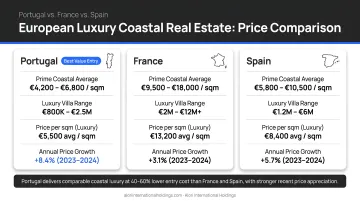
Portugal's entry prices run 60–80% below the French Riviera while delivering comparable lifestyle, climate, and infrastructure — a value gap that supports both capital appreciation and rental income generation over time.
Best Locations to Buy Luxury Villas in Portugal
Portugal's luxury villa market concentrates in three broad zones: the southern Algarve coast, the Lisbon metro area (including Cascais), and emerging markets like Alentejo and Porto. Each delivers distinct investor profiles, price ranges, and return dynamics.
The Algarve: The Golden Triangle and Beyond
The Golden Triangle—Quinta do Lago, Vale do Lobo, and Vilamoura—represents Portugal's most established and liquid luxury market. These resorts anchor Europe's premier golf destination, with 40+ championship courses, marina access, and proven international buyer demand.
Price Benchmarks (2025):
| Municipality/Resort | Prime Price per m² | Foreign Buyer Share |
|---|---|---|
| Quinta do Lago | €12,793–€14,000+ | >80% |
| Vale do Lobo | €9,171–€9,640 | >80% |
| Vilamoura | €3,814–€5,965 | 50% |
Vilamoura averaged €5,672/m² in 2025, offering relative value within the Triangle driven by new marina infrastructure and improving amenities. For investors with medium-term horizons, flanking markets deliver stronger upside: Lagos (€4,200–€6,303/m²) recorded the Algarve's highest price increase in 2023, while Tavira (€2,641–€3,947/m²) saw double-digit annual growth with 92% foreign buyer penetration.
Lisbon, Cascais, and the Silver Coast
Lisbon neighborhoods—Chiado (€8,389/m²), Príncipe Real (€7,445/m²), and Lapa (€7,095/m²)—command the highest price-per-square-meter nationally. Cascais reached €6,758/m² in March 2026, representing 7% year-on-year growth. Prime Quinta da Marinha properties range from €4,500 to €9,000/m².
These markets attract buyers prioritizing year-round livability: international school access, airport proximity, and established expat communities. The investment thesis here is capital appreciation, not rental yield — a meaningfully different risk profile than Algarve vacation properties.
Luxury residential values in Lisbon rose 4.4% in 2025, with Cascais averaging 6% annual appreciation over the past five years.
Emerging Luxury Markets: Alentejo and Porto
Comporta and Melides (Alentejo coast) represent Portugal's fastest-appreciating luxury micro-markets. Buyers and analysts draw comparisons to early-stage Hamptons — ultra-high-net-worth demand for seclusion over amenity density. Average prices surged to €9,000/m² in 2024, a 28.5% year-on-year increase. Supply is tightly constrained by strict planning rules, which supports premium pricing and scarcity-driven appreciation.
Porto offers a distinct profile within Portugal's luxury landscape:
- Entry prices from €4,883/m² city-wide, rising to €9,500–€12,000/m² in Foz do Douro
- Short-term rental demand anchored in cultural tourism rather than sun-and-golf seasonality
- A growing tech-sector expat community supporting year-round residential demand
- Foz do Douro recorded 14.5% growth in 2025/2026, among Portugal's strongest submarkets
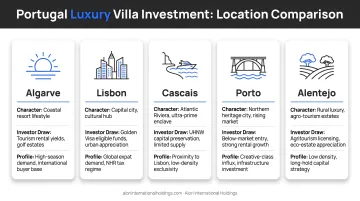
For investors building a Portugal-focused portfolio, Porto's lower entry point and demand structure complement rather than duplicate the Algarve or Lisbon positions.
Rental Yields and Return Potential for Luxury Villas
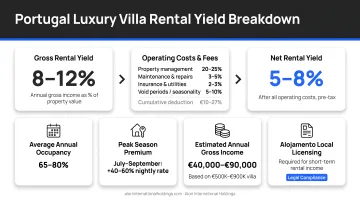
Gross rental yields in prime Algarve locations typically range from 5% to 8% for well-managed short-term rentals, with premium holiday villas achieving the upper end. For context, average European prime net initial yields sit at 4.0% in Spain, 3.9% in the UK, and 4.5% in France, putting Portugal's gross yields ahead of most comparable markets.
Understanding Net vs. Gross Yield:
Gross yields don't account for management fees (typically 15–25% of revenue), maintenance, utilities, and annual IMI property tax (0.3–0.45% of cadastral value). Net yields after these deductions typically fall to 3–5% for most luxury villas, though premium properties with strong occupancy can exceed this range.
Alojamento Local (AL) Licensing
Short-term villa rentals in Portugal require an Alojamento Local (AL) license—registration, safety compliance, and insurance. Recent regulatory tightening has created municipal-level restrictions: Lisbon cancelled 6,765 inactive AL licenses in February 2026, and many central parishes enforce "absolute containment" zones where new registrations are prohibited. Investors must confirm AL availability before purchase or factor in long-term rental yield scenarios (~4–5% gross) as a baseline.
Occupancy Dynamics
The Algarve's tourism season has lengthened significantly. Annual occupancy rates average 61% nationally, reaching 70–75% for top Algarve holiday rentals. The region's seasonality rate dropped to 40.9% in 2024(the lowest since 2010), pointing to genuine year-round demand driven by golf tourism, digital nomads, and expat population growth.
Hypothetical €1M Villa Income Example:
- Nightly rate (peak): €500–€800
- Nightly rate (shoulder): €300–€500
- Annual occupancy: 70%
- Gross annual revenue: €100,000–€140,000
- Gross yield: 10–14% (best-case scenario for top-performing premium villas; typical range is 5–8%)
- Net yield after management/costs: 6–9%
Capital Appreciation and Exit Strategy
Vilamoura and nearby Golden Triangle areas recorded a 12% increase in housing prices in 2023. In well-chosen locations with a strong rental track record, resale to international buyers is the primary exit path. This gives Portugal villa investments meaningful liquidity that purely local markets can't match.
Alori International Holdings structures each investment with a defined exit strategy and vetted legal framework from the start, so investors enter with a clear resale pathway rather than working one out after the fact.
Understanding Costs, Taxes, and the Buying Process
Portugal's Key Taxes and Transaction Costs
One-Time Purchase Costs:
| Tax Type | Rate | Notes |
|---|---|---|
| IMT (Transfer Tax) | 7.5% | Applies to properties above €1,150,853 |
| Stamp Duty (Purchase) | 0.8% | Applied to higher of purchase price or tax value |
| Legal & Notary Fees | ~1–2% | Independent lawyer recommended |
Buyers in Portugal do not pay realtor commission (seller pays ~5%). For a €1M villa, total transaction costs typically land around 8–10%.
Ongoing Ownership Costs:
- IMI (annual property tax): 0.3–0.45% of cadastral value, which runs below market value — so effective annual tax rates stay well below market-rate calculations
- Rental income tax for non-residents: 28% flat rate. Under the simplified AL regime, only 35% of gross rental income is treated as taxable profit, with 65% assumed as deductions — resulting in an effective rate of approximately 9.8% on gross rental revenue.
What No Longer Applies:
Two programs that previously attracted foreign buyers have since closed or changed:
- NHR tax regime ended for new applicants from January 2024, replaced by the Tax Incentive for Scientific Research and Innovation (IFICI), which targets qualified workers rather than passive investors
- Golden Visa real estate route closed in late 2023; fund investments (€500,000 minimum) and capital transfers remain as alternative qualifying routes
Portugal's investment fundamentals — limited premium supply, sustained foreign demand, and strong rental yields in key markets — remain intact regardless of residency incentives.
With the cost and regulatory picture in place, the mechanics of completing a purchase follow a consistent sequence.
The Purchase Process: Key Steps
The standard buying process for foreign nationals follows this timeline:
- NIF (tax number) registration → Portuguese bank account opening
- Promissory Contract (CPCV) with 10% deposit
- Due diligence period (legal title verification, AL license check, mortgage/lien clearance)
- Final deed (Escritura) at notary
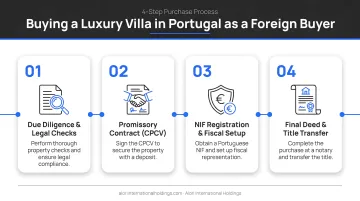
The process typically takes 2–4 months for clean transactions. Engaging an independent Portuguese lawyer (not the agent's lawyer) and verifying property title and land registry before signing is essential — not optional.
Key Risks and Due Diligence for Luxury Villa Buyers
Primary Risks International Buyers Face
- Unclear title or outstanding debt — mortgage charges, tax liens, or unresolved ownership disputes
- Illegal construction — additions or modifications that cannot be regularized after the fact
- AL license restrictions — municipal-level constraints that may be imposed after purchase
- Currency risk — USD/EUR fluctuation that directly affects return calculations
Mandatory Due Diligence Documents:
- Tax record (caderneta predial) — issued by Autoridade Tributária, confirming VPT (tax value), property size, and registered usage
- Land registry extract (certidão permanente) — from Instituto dos Registos e do Notariado, proving current ownership and revealing any encumbrances (valid 6 months)
- Habitation license (licença de utilização) — issued by the municipality, verifying the property is legally registered for residential use
Management Dependency Risk
Luxury villa returns correlate directly with property management quality. Absentee owners relying on underperforming managers see occupancy rates and nightly pricing erode over time. Establish property management agreements with clearly defined KPIs, occupancy reporting, and termination clauses before closing.
For overseas investors, this is where transaction-stage due diligence matters most. Firms like Alori International Holdings integrate in-country professionals who vet properties for legal compliance and operational readiness before the deal closes — reducing the risk of inheriting a management problem alongside the asset.
Regulatory Environment
Portugal introduced AL license restrictions in high-density areas (Lisbon, some Algarve municipalities). Decree-Law 76/2024 (effective November 2024) returned AL control to municipalities, allowing "containment areas" where new registrations are prohibited. For luxury villa buyers counting on short-term rental income, this makes pre-purchase licensing verification non-negotiable — confirm both the property's current AL status and the municipality's active policy before projecting any rental yield.
Frequently Asked Questions
Can Americans buy luxury villas in Portugal?
Yes. Portugal imposes no restrictions on foreign property ownership, including for American citizens. Americans need a Portuguese NIF (tax number) and a local bank account to complete purchases, but the process is fully accessible to non-EU buyers.
What are the typical rental yields for luxury villas in Portugal?
Gross rental yields in prime Algarve locations typically range from 5% to 8% for well-managed short-term rentals, with net yields after management and costs closer to 3–5%. Lisbon and Cascais yields tend to be lower but are offset by stronger long-term capital appreciation.
How much does a luxury villa in Portugal cost?
Algarve luxury villas in the Golden Triangle range from roughly €1M to €5M+, with prime Vilamoura properties averaging around €5,672/m². Lisbon and Cascais neighborhoods command €7,000–€8,000/m² in top areas. Entry-level luxury in emerging markets like Alentejo can start lower.
Is Portugal's real estate market still a good investment in 2025?
Yes. The end of NHR and the Golden Visa property route removed tax-driven demand, but core fundamentals held firm — foreign buyer FDI reached €3.9 billion in 2025, prime coastal supply remains constrained, and tourism continues to grow. Investors buying on structural demand rather than incentive programs are well-positioned.
What taxes do I pay when buying a luxury villa in Portugal?
Purchase taxes include IMT (approximately 7.5% for high-value properties) and stamp duty at 0.8%, plus legal and notary fees. Annual holding costs run IMI at 0.3–0.45% of cadastral value. Non-resident rental income is taxed at a flat 28%.
What is the best area to buy a luxury villa in Portugal for investment?
The Algarve's Golden Triangle (Quinta do Lago, Vale do Lobo, Vilamoura) offers the deepest liquidity and strongest short-term rental yields. Lisbon and Cascais favor capital appreciation and long-term residential demand. Emerging markets like Comporta in Alentejo offer higher upside but lower liquidity—choose based on your investment horizon and risk tolerance.