

Introduction
Lisbon's real estate market entered 2025 with three converging tailwinds: record tourism arrivals reaching 88.3 million overnight stays in 2024, rising rents, and structurally constrained supply in the historic center. For investors seeking durable diversification beyond domestic markets, the underlying case is solid.
Yet opportunity requires precision, not just enthusiasm. New short-term rental restrictions have frozen licensing in most of Lisbon's historic core. Tax structures have evolved following the 2023 removal of the property-linked Golden Visa route. Neighborhood-level variation means the difference between 3% and 5%+ gross yields, even within a few kilometers.
This guide breaks down where yields hold up, which neighborhoods still offer entry points, and what the regulatory shifts actually mean for your returns. Investors who succeed here in 2025 come in with data and local expertise, not momentum.
Key Takeaways
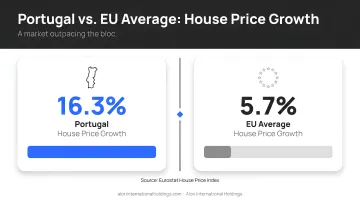
- Portugal's residential prices rose 16.3% year-on-year in Q1 2025, outpacing the EU average of 5.7%
- Lisbon's average transaction price surpassed €5,000/m² for the first time in 2025, but growth is stabilizing rather than reversing
- Rental demand is rising across tourist, digital nomad, and long-term residential leases, driven by record tourism and expat migration
- Gross yields range from roughly 3.8% in premium central zones to over 5% in residential neighborhoods like Estrela and Graça
- Foreign buyers face no ownership restrictions, but short-term rental licensing, tax structures, and exit planning require local expertise
Why Lisbon Is a High-Conviction Market for 2025
Lisbon's investment case rests on macroeconomic stability, structural demand drivers, and supply constraints that continue to underpin values even as appreciation moderates from pandemic-era highs. Each factor reinforces the others — together, they form a durable thesis rather than a momentum play.
Economic Backdrop: The European Commission's Autumn 2025 forecast projects Portugal's real GDP growth at 1.9% for 2025 and 2.2% for 2026. This stable growth trajectory, combined with EU recovery fund investment flowing into infrastructure and housing initiatives, provides supportive conditions for real estate values.
Tourism Demand: Portugal's tourism sector reached record highs in 2024, with 34.0 million guests and 88.3 million overnight stays across all tourist accommodation. Non-resident arrivals grew 9.3% year-on-year to 29.0 million, and Lisbon captures an outsized share — directly sustaining both short-term rental income potential and long-term resale values through consistent visitor flow.
Structural Supply Constraint: Central Lisbon faces limited land availability, heritage preservation rules that restrict new construction in historic neighborhoods, and slow permitting processes. This scarcity keeps upward pressure on prices and rents even when demand growth softens — new inventory in prime urban locations simply cannot materialize fast enough to close the gap.
Currency Positioning for US Investors: The USD/EUR exchange rate fluctuated between 1.15 and 1.17 in mid-2025, representing favorable positioning for dollar-denominated buyers. When the dollar strengthens relative to the euro, American investors effectively receive a discount on entry prices — a factor that amplifies entry-price advantages when timing acquisitions.
European Outperformance: Portugal's House Price Index increased 16.3% year-on-year in Q1 2025, dramatically outpacing the EU average of 5.7%. That gap reflects genuine fundamentals: strong demand from both domestic and international buyers running up against hard supply limits, not speculative momentum.
Key Market Trend: Prices Are Stabilizing at Elevated Levels
After the sharp appreciation surge between 2020–2023, Lisbon's market has entered a stabilization phase characterized by moderate growth rather than correction or reversal.
Lisbon's average transaction price surpassed €5,000/m² for the first time in 2025, reaching €5,207/m² according to Confidencial Imobiliário. Premium central neighborhoods command significantly higher rates — Chiado averages around €8,018/m², while Estrela and Lapa hover near €6,900–€7,000/m². Growth is real, but the double-digit pace from the pandemic years has given way to something steadier.
Even after Portugal removed the property-linked Golden Visa route in October 2023, international buyer interest has held firm. In H1 2024, foreigners invested €464 million in 800 residential properties in Lisbon's Urban Rehabilitation Area, with Americans representing 13% of foreign buyers alongside French (15%) and Brazilians (13%). That sustained cross-border capital flow continues to support prices — no residency incentive required.
For investors entering in 2025, this dynamic requires a strategic adjustment. The window for outsized short-term capital gains has narrowed. The investment case now rests on a different foundation:
- Steady long-term appreciation rather than momentum-driven gains
- Rental yield as a consistent income component
- Portfolio diversification into a liquid, euro-denominated market
- Inflation-resistant asset exposure with a 5+ year horizon
Key Market Trend: Rental Demand Is Surging and Diversifying
Lisbon's rental market in 2025 is fueled by three distinct demand pools, each with different yield profiles and regulatory treatment.
Three Demand Pools:
- Short-term tourists: Record arrivals drive platform-based demand through Airbnb and similar services, delivering the highest gross yields but facing the strictest regulatory constraints
- Mid-term digital nomads and remote workers: Portugal's D8 Digital Nomad Visa continues to attract this cohort, with 5,259 new residence permits granted for independent professional activity in 2024, creating demand for 3–12 month leases
- Long-term residents: Students, expats, and local professionals face severe housing scarcity, generating stable demand for annual leases with lower regulatory risk
Lisbon's median rental value for new lease agreements reached €16.00/m² in Q1 2025, up 5.1% year-on-year — a direct result of the ongoing supply-demand gap that shows no sign of closing.
Gross rental yields in Lisbon average 3.82% as of Q4 2025, with meaningful variation by unit type and a solid standing among European capitals:
| Property Type | Gross Yield |
|---|---|
| Studio | 3.94% |
| 1-bedroom | 4.34% |
| 2-bedroom | 3.76% |
| 3-bedroom | 3.81% |
| City | Gross Yield |
|---|---|
| Barcelona | 7.40% |
| Paris | 4.65% |
| Lisbon | 3.82% |
| Berlin | 3.88% |
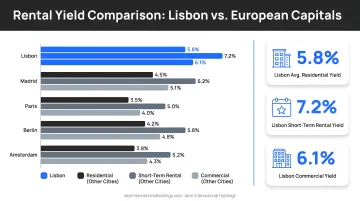
For American investors focused on passive income, the mid-to-long-term rental segment is the clearest entry point. It carries less regulatory risk than short-term AL licensing, more predictable cash flow than vacation lets, and direct exposure to the growing wave of relocating professionals — all without the hands-on management demands that cross-border ownership typically makes impractical.
Key Market Trend: Neighborhood Selection Is the New Alpha
Lisbon is not one market but many. Neighborhood selection has become the most important variable determining yield, regulatory freedom, and resale liquidity in 2025.
Central premium pricing—such as Chiado at roughly €8,018/m² with yields near 3.8%—may not pencil out for income-focused investors. Residential neighborhoods offer better entry price-to-yield trade-offs while maintaining strong fundamentals.
Graça and Alfama
Both neighborhoods carry high lifestyle and tourism appeal. Graça averages around €6,161/m² with yields approaching 5%, while Alfama-Sé sits at approximately €6,318/m².
Critical regulatory constraint: Neither can issue new short-term rental (AL) licenses due to official containment zone designation. The 2025 municipal regulation establishes "Absolute Containment" zones where AL registrations exceed 10% of permanent housing—zero new licenses allowed. Transmission of existing licenses now results in expiration.
Investors in these neighborhoods should target long-term residential or mid-term digital nomad rentals and factor this restriction into underwriting. The tourism appeal remains, but monetization must flow through permitted rental channels.
Estrela and Lapa
These family-oriented, centrally located neighborhoods have seen significant price appreciation—Estrela averages €6,917/m² and Lapa €7,036/m²—but still offer yields in the 3.5–5%+ range for well-positioned units.
These neighborhoods fall outside the strictest containment zones, making AL licensing more viable than in historic tourist areas. Verification at the property level is essential before purchase, as licensing status can vary street by street based on local AL density.
The combination of central location, residential character, and rental flexibility makes Estrela and Lapa worth examining for investors who want optionality in their rental strategy.
Beyond central neighborhoods, two distinct options emerge for investors who prioritize growth or lower entry costs.
Parque das Nações and Outer Districts
Parque das Nações stands out as a modern, infrastructure-rich district with strong price momentum. Asking prices reached €6,665/m² in March 2026, a 13.0% year-on-year increase that peaked at 19.4% in October 2025. The neighborhood appeals to young professionals and corporate tenants, with transaction volumes growing over 40% in 2025.
For investors targeting lower entry points (roughly €130,000–€370,000), Lisbon's periphery offers meaningful alternatives:
- Amadora — €3,673/m²; strong metro connectivity, growing residential demand
- Setúbal — €3,293/m²; coastal access, appealing to longer-term tenants
- Montijo — €2,710/m²; lowest entry price, but expect longer resale timelines and a narrower tenant pool
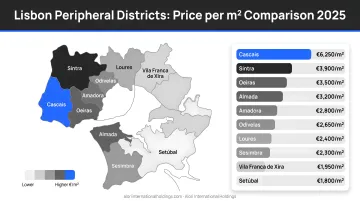
Each peripheral market trades some resale liquidity for yield upside—a trade-off worth quantifying before committing capital.
What American Investors Need to Know Before Buying in Lisbon
Legal and Administrative Requirements
Portugal imposes no nationality restrictions on property ownership, making this a fully accessible market for US citizens. Basic requirements include:
- NIF tax number (Número de Identificação Fiscal)
- Portuguese bank account
- Proof of funds
- Licensed local solicitor (strongly recommended for due diligence and contract management)
Tax Structure
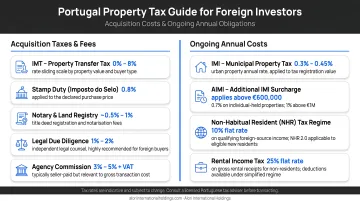
Acquisition costs:
- IMT (transfer tax): Progressive rates up to 8% for secondary/rental properties, with the first €104,261 exempt for primary residences
- Stamp Duty: 0.8% of transaction value
- IMI (annual municipal tax): 0.3% minimum rate for urban properties in Lisbon
Ongoing tax considerations:
- Rental income for non-residents is taxed at 25% (reduced from 28% in 2023)
- The NHR regime was replaced by IFICI in 2024, offering a 20% flat rate on employment income for highly qualified professionals
- US investors must consult advisors familiar with the US-Portugal tax treaty and FBAR/PFIC reporting obligations
Short-Term Rental Licensing Landscape
New AL licenses in Lisbon's designated containment zones (covering most historic central neighborhoods) are effectively frozen. Investors can still obtain licenses in non-restricted zones, through full building ownership, or via qualifying urban rehabilitation projects.
Critical due diligence: Investors must verify AL status at the property level before committing. Licensing rules vary neighborhood by neighborhood based on current AL density ratios.
Navigating the Market with Professional Support
That regulatory complexity is why most American buyers work with advisors who already understand the local licensing landscape. Alori International Holdings focuses specifically on this market — connecting US investors with vetted opportunities, verified legal structures, and clear exit strategies without requiring boots on the ground.
Financing and Exit Strategy
Mortgage financing is available to non-residents, typically requiring 20–30% down payment from Portuguese banks. As of mid-2025, Euribor rates hovered near 2% across short and medium maturities. Many American investors purchase in cash or use home-country financing.
Critical planning step: Define your exit strategy before purchase. Will you pursue resale after appreciation, mid-term rental income, or eventual lifestyle migration? Each pathway requires different property characteristics, neighborhood selection, and legal structuring.
Frequently Asked Questions
What is the property market outlook for 2025 in Portugal?
Portugal's property market remains on an upward trajectory in 2025, with prices rising at a more moderate pace than the 2022–2023 surge. Lisbon continues to lead national values, with the outlook favoring stable appreciation and strong rental demand rather than speculative gains.
Can Americans freely buy property in Lisbon?
Yes, Portugal imposes no nationality restrictions on property ownership. Americans need a Portuguese NIF tax number, a local bank account, and proof of funds. Hiring a local lawyer to handle due diligence and contract steps is strongly advised.
What rental yields can investors realistically expect in Lisbon?
Gross yields in Lisbon generally range from around 3.8% in premium central zones like Chiado to over 5% in residential neighborhoods like Estrela or Graça, depending on property type, location, and rental strategy.
Which Lisbon neighborhoods offer the best investment returns in 2025?
Estrela, Lapa, and Graça offer strong returns relative to purchase price for income-focused investors, while Parque das Nações stands out for capital appreciation. Prioritize yield-focused neighborhoods for rental income; Parque das Nações if long-term value growth is the primary goal.
Is Airbnb-style short-term rental still viable in Lisbon?
New AL licenses are restricted or frozen across most of Lisbon's historic center under official containment zone rules. Short-term rental remains possible in non-restricted zones or through urban rehabilitation pathways — but verify licensing status before committing to any purchase.
Does buying property in Lisbon qualify for the Golden Visa?
As of October 2023, the real estate route for the Portuguese Golden Visa was discontinued. Investors seeking residency through investment must now use qualifying investment fund routes (€500,000 minimum) or other approved pathways, not direct property purchase.