

Introduction
Gross rental yields in Portugal range from 5% in Lisbon to close to 10% in peak-season Algarve markets — well above what most US domestic markets are delivering as entry prices surge and yields compress at home.
Portugal is a politically stable EU member with strong tourism fundamentals, growing expat demand, and clear property ownership rights for foreign buyers. That combination makes it one of the more defensible international yield plays available to American investors right now.
But not every Portuguese city performs equally. Entry prices, rental strategies, and local demand fundamentals vary sharply by location. This guide maps the best cities using real yield data, so you can identify where to deploy capital for reliable income today and meaningful appreciation over time.
Key Takeaways
- Portugal gross rental yields range from 5% in Lisbon to 10–12% in Algarve resort towns — well above most European averages
- Porto and Braga are the standout balanced plays: lower entry prices than Lisbon with comparable or higher yields (6–7.5%)
- Short-term rentals boost returns in coastal cities, but AL license restrictions in Lisbon and Porto require careful navigation
- National prices are up 11–19% YoY by segment, supporting both rental yield and capital appreciation
- Porto, Braga, and Coimbra offer accessible USD entry points from ~$150,000 to $500,000 (approximate EUR equivalents)
Why Portugal's Rental Market Stands Out in 2025
Portugal's rental market is powered by structural demand rather than speculative momentum. The country's tourism sector reached record highs in 2025, with monthly tourism exports exceeding €4.3 billion, fueling sustained demand for hospitality, short-term rentals, and lifestyle real estate. This tourism strength translates directly into rental income sustainability for property investors.
The Supply-Demand Imbalance
Housing supply in Portugal's major cities hasn't kept pace with demand. Rising mortgage volumes and rent growth nationwide point to structural undersupply — not a temporary spike. In Lisbon alone, vacancy rates remain well below the European average, creating durable conditions for rental income across investment cycles.
Portugal's Competitive Advantages
Compared to other EU markets, Portugal offers:
- Lower cost per sqm than Spain or France in comparable urban centers
- Higher average yields than the EU average (approximately 4.6% nationally versus 3-4% EU-wide)
- No inheritance tax on Portuguese real estate assets
- Residency pathways through D7 visas, Digital Nomad Visas, and investment fund routes that continue attracting expat and digital nomad tenant demand
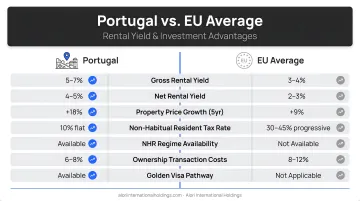
For American investors, this combination — yield premium, lower entry costs, and built-in tenant demand from expats and nomads — is difficult to find elsewhere in Western Europe.
Best Cities in Portugal for Rental Yields in 2025
Cities were evaluated on gross rental yield range, average purchase price per sqm, depth of rental demand, rental strategy flexibility, and current market momentum.
Lisbon
Portugal's capital is its most liquid real estate market — with deep tenant demand from professionals, expats, and students across income levels. The city recorded 7.4 million hotel overnight stays in H1 2025, underscoring the tourism volume that drives short-term interest.
Ongoing urban regeneration in neighborhoods like Intendente and Marvila adds upside potential beyond current yields. The primary yield strategy here is long-term letting — AL license containment zones now block new short-term rental permits in key districts, so investors without an existing license or full building ownership should plan accordingly.
| Metric | Details |
|---|---|
| Gross Rental Yield | 4.1%–6% (Historic Centre vs. outlying zones) |
| Average Price per sqm | €5,000–€6,300 in central areas |
| Best Property Type & Strategy | T1/T2 apartments for long-term professional or expat rentals; short-term viable only with existing AL license or full building ownership |
Porto offers comparable or higher yields at meaningfully lower entry prices — making it the natural next step for investors weighing cash-on-cash returns.
Porto
Porto has built a credible tech and startup ecosystem alongside a large Erasmus and university student population. Cruise and airport traffic grew 5% year-over-year by July 2025, and entry prices remain well below Lisbon.
For investors focused on cash-on-cash returns, Porto is the stronger entry point: lower acquisition costs with yields at or above Lisbon's. Rental growth in new properties reached approximately 10% in H1 2025, with the Historic Centre commanding the highest rents. The same AL license containment rules apply in Porto as in Lisbon, so long-term letting is the default strategy.
| Metric | Details |
|---|---|
| Gross Rental Yield | 5.5%–7% depending on location and tenant type |
| Average Price per sqm | €3,500–€3,860 |
| Best Property Type & Strategy | T1/T2 apartments near universities or city center for student and professional long-term lets; some short-term opportunity in non-restricted zones |
For investors willing to move further from the major metros, Braga offers the sharpest yields in the country — with a fraction of the entry cost.
Braga
Braga has emerged as one of Europe's faster-growing tech and innovation hubs, with a large University of Minho student base anchoring year-round rental demand. Property prices sit well below Lisbon and Porto.
Yields of 7–7.5% combined with purchase prices in the €2,000–€2,500/sqm range produce the strongest yield-on-cost numbers of any major Portuguese city. Tenant demand is stable and predictable — students and young professionals provide consistent occupancy without the seasonal swings that affect coastal markets.
| Metric | Details |
|---|---|
| Gross Rental Yield | 7%–7.5% |
| Average Price per sqm | €2,000–€2,500 |
| Best Property Type & Strategy | Compact apartments near University of Minho for long-term student and young professional rentals; buy-and-hold profile |
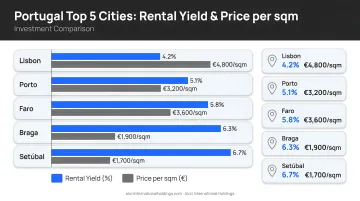
The Algarve operates on an entirely different model — seasonal short-term rentals, resort-grade inventory, and some of the highest gross yields in the country.
Faro and the Algarve
The Algarve draws consistent international tourist demand from UK, German, and North American visitors across resort towns including Lagos, Vilamoura, Albufeira, and Tavira. Over 10 hotel openings are planned through 2028, signaling continued institutional confidence in the region's tourism infrastructure.
Short-term rental yields reach 8–10%+ during peak summer season, making this the highest gross yield environment in Portugal. A hybrid strategy works well here — peak-season short-term lets supplemented by long-term tenants (retirees and lifestyle buyers) during quieter months. The Golden Triangle (Quinta do Lago, Vale do Lobo) commands €5,000+/sqm but delivers strong gross returns on luxury inventory, and AL licenses remain more accessible outside the major containment zones.
| Metric | Details |
|---|---|
| Gross Rental Yield | 6%–10%+ depending on resort location, property type, and season |
| Average Price per sqm | €3,000–€5,000+ (lower in inland towns, premium in Golden Triangle) |
| Best Property Type & Strategy | Villas with pools or sea views for peak-season short-term holiday rentals; AL licenses more accessible outside containment zones; hybrid short/long-term strategy recommended |
For investors who prioritize simplicity and predictability over peak yields, Coimbra offers a quieter but durable buy-and-hold case.
Coimbra
The University of Coimbra — one of the oldest in Europe, founded in 1290 — enrolls over 30,000 students annually, creating a structural, year-round rental base that doesn't depend on tourism cycles or tech sector growth.
Yields of 5.5–6% at entry prices of €1,800–€2,200/sqm make Coimbra one of Portugal's most accessible markets by capital requirement. The rental market is also among the least exposed to regulatory and seasonal volatility — no AL license battles, no off-season vacancy risk, no luxury pricing pressure.
| Metric | Details |
|---|---|
| Gross Rental Yield | 5.5%–6% |
| Average Price per sqm | €1,800–€2,200 |
| Best Property Type & Strategy | T1/T2 apartments near the University of Coimbra for student and academic long-term lets; ideal for investors seeking minimal management complexity |
Short-Term vs. Long-Term Rentals: Which Delivers Better Returns in Portugal?
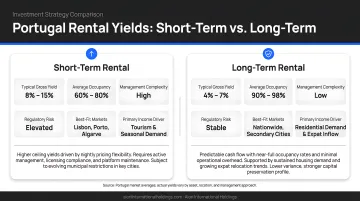
Choosing between short-term Alojamento Local (AL) rentals and long-term leases shapes both your return profile and your operational workload. The two models trade off yield potential against predictability in distinct ways:
Short-term (AL) rentals:
- Higher gross yields in coastal and tourist-heavy cities
- Subject to licensing restrictions in Lisbon and Porto containment zones
- Require active management or a property manager
- Carry seasonal income risk
Long-term rentals:
- Lower but more predictable cash flow
- Minimal operational overhead
- No licensing complexity
- Easier to manage remotely
The Yield Spread Reality
National long-term gross yields average approximately 4.6%, while optimized short-term holiday rentals in the Algarve can achieve 5% to 8%, reaching 10%+ during peak summer months. In Lisbon, short-term yields average 5.2% compared to 4.1% for long-term rentals.
The Hybrid Strategy
A hybrid approach is gaining traction among active investors: AL license operation during summer peak months combined with 6-month furnished mid-term leases targeting digital nomads and relocators during off-peak periods. This works best in the Algarve and non-restricted Porto/Lisbon neighborhoods.
Mid-term rentals (1–6 month leases) offer a useful workaround for licensing constraints. Classified under the Portuguese Civil Code as "arrendamento para fins especiais transitórios" (leases for special transitional purposes), these bypass AL licensing requirements entirely while capturing digital nomad and corporate demand.
Regulatory Landscape
AL license reform under the "Mais Habitação" program tightened new permit issuance in high-demand zones. However, Decree-Law 76/2024 (effective November 2024) reversed the most restrictive elements — AL licenses are once again permanent and transferable nationwide, shifting regulatory power back to individual municipalities. Before committing to a short-term strategy, verify the current municipal zoning rules (PDM) for your target city. This landscape is still evolving.
What to Look for When Evaluating Portugal Rental Yield Potential
Three fundamentals separate durable yield from speculative return:
1. Structural Tenant Demand
Focus on student, professional, or tourist populations driven by institutional factors rather than trend-dependent demand. University cities (Coimbra, Braga), tech hubs (Porto), and established resort destinations (Algarve) offer demand anchored by education, employment, and tourism infrastructure.
2. Entry Price Discipline
Buy below or at fair value per sqm relative to achievable rents — don't chase appreciation momentum. Compare your target purchase price against local rental comps to ensure the yield calculation is grounded in reality, not optimistic projections.
3. Exit Liquidity
Choose markets with sufficient buyer depth to exit at or above entry cost after a 5–10 year hold. Lisbon, Porto, and established Algarve resort towns offer far greater liquidity than emerging markets with limited transaction history.
Legal Due Diligence Essentials
Portugal-specific legal diligence is non-negotiable:
- Verify AL licensing status before purchase if short-term rental is your strategy
- Confirm urban rehabilitation zone (ARU) eligibility for tax benefits (reduced 5% VAT, IMI exemptions)
- Understand IMT transfer tax and annual IMI property tax obligations
- Ensure title is clean with no encumbrances or legal disputes
- Retain local legal counsel — foreign buyers navigating Portugal's legal framework independently face real execution risk

Each of these steps requires local knowledge that's difficult to replicate remotely. For American investors, that gap is where deals go wrong — missed licensing restrictions, mispriced assets, or title issues that surface post-close. Alori International Holdings addresses this directly through vetted in-country professional networks and access to off-market opportunities, giving investors the legal grounding and deal access that independent remote research rarely provides.
Conclusion
Portugal's rental yield market in 2025 rewards investors who match city selection to their investment profile. Lisbon and Porto offer balanced capital growth and steady income. Braga and Coimbra deliver higher yields at lower entry points. The Algarve maximizes peak-season income. Investors who ignore local regulation and actual demand drivers tend to find out why those things matter only after they've committed capital.
That points to what headline yield figures consistently leave out. A complete picture means evaluating:
- Total return — yield plus capital appreciation trajectory
- Entry price relative to replacement cost
- Regulatory durability of your intended rental strategy
The cities generating the most durable returns in 2025 share one trait: genuine housing demand that predates the current investment cycle and won't evaporate when sentiment shifts.
For investors looking to move on Portugal's property market with grounded analysis and local execution, explore Alori International Holdings' curated Portugal investment opportunities at aloriinternationalholdings.com.
Frequently Asked Questions
What is the average rental yield in Portugal in 2025?
Gross rental yields vary by city and rental type, ranging from approximately 4–6% in central Lisbon for long-term rentals to 7–10%+ in Algarve resort markets during peak season. Porto and Braga offer strong mid-range yields of 6–7.5% with lower entry prices.
What is the property market outlook for Portugal in 2025?
Portugal's market outlook remains strong, driven by GDP growth, persistent housing supply shortages, and sustained international buyer demand. Price growth is moderating from 2022–2023 peaks, with total commercial real estate investment on track to exceed €2.5 billion in 2025.
Which city in Portugal has the highest rental yield?
Faro/Algarve is the top short-term yield market (up to 9–10%+ in peak season), while Braga is the top long-term yield market (approximately 7–7.5%). "Highest yield" should be weighed against entry price, seasonality, and regulatory context.
Is short-term or long-term rental more profitable in Portugal?
Short-term rentals offer higher gross returns but face AL licensing restrictions in Lisbon and Porto, active management demands, and seasonal income risk. Long-term rentals deliver more predictable, regulation-stable cash flow. A hybrid strategy is gaining traction among experienced investors.
Can foreigners buy and rent out property in Portugal?
Yes, there are no restrictions on foreign property ownership. Rental income is taxable in Portugal at a flat 28% rate for non-residents. Obtaining a NIF (tax identification number) and retaining local legal counsel are essential first steps for foreign buyers.