Introduction
For American real estate investors hunting beyond saturated domestic markets, Georgia (the country) has emerged as one of 2025's strongest-performing international investment destinations. The nation's GDP grew by 7.5% in 2023, consistently outpacing regional averages, while its business-friendly regulatory framework ranks among the most accessible in Eurasia. Georgia's digital property registry ensures transparent ownership registration, and foreign investors enjoy the same ownership rights as locals—no restrictions, no quotas.
Those fundamentals make a strong case for Georgia — but knowing where to invest is a different question entirely. Many investors recognize the country's potential yet struggle to match specific cities to their goals.
Is Tbilisi better for stable rental yield? Does Batumi's beach market justify the hype? Where do appreciation plays make sense versus short-term tourist income? This guide breaks down Georgia's top investment locations city by city, mapping each to specific investor profiles, price ranges, and rental strategies.
Key Takeaways
- Property tax capped at 1%, zero capital gains tax, and 0% tax on reinvested profits make Georgia structurally attractive for long-term investors
- Tbilisi offers the strongest year-round tenant demand, entry points from $100,000–$200,000, and rental yields of 6–12%
- Batumi works for short-term tourism rentals, but oversupply and winter seasonality make location selection critical
- Gudauri and Bakuriani target niche ski-resort buyers; Kutaisi is the lowest entry point with long-term appreciation potential
- Match your city to your strategy — yield, capital growth, or lifestyle-and-residency — before committing capital
Why Georgia Is One of the Best Emerging Markets to Invest In (2025 Context)
Georgia's economic trajectory stands out in Eastern Europe. The country achieved 7.5% GDP growth in 2023, attracting $2.1 billion in foreign direct investment between 2021 and 2024. Its ranking on the World Bank Business Ready Index consistently places it among the top 20 globally for ease of doing business, ahead of many EU member states.
Tax Advantages That Create Structural Investment Appeal
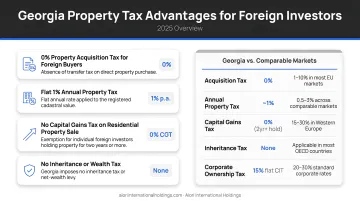
- Corporate income tax applies only to distributed profits at 15%—retained earnings are tax-free
- Property tax capped at 1% of assessed value
- Zero capital gains tax on property sales
- No inheritance or wealth taxes
- Rental income taxed at just 5% for individuals
Trade Access and Free Industrial Zones
Georgia maintains preferential trade access through its Deep and Comprehensive Free Trade Agreement (DCFTA) with the EU, plus bilateral agreements with China, UK, Turkey, and CIS countries.
Free Industrial Zones in Poti, Kutaisi, and Tbilisi extend this further, offering businesses 100% relief on corporate profit tax, VAT, property tax, and import duties.
Political Context and Risk Calibration
The "Agents Law" controversy and uncertainty around EU accession timelines have created short-term uncertainty in investor sentiment since 2023. However, the legal framework protecting foreign property ownership remains unchanged — property rights are digitally registered, transparent, and enforceable.
For investors with multi-year horizons, the core drivers — GDP growth, infrastructure spending, and tourism expansion — remain on track despite the political uncertainty.
Best Places to Invest in Georgia in 2025
Most first-time investors in Georgia either win or lose based on one decision: choosing the right location. Each city serves a different investor profile, and mismatches between your capital structure and the local market dynamics lead to underperformance or illiquidity.
The six markets covered below span Georgia's full investment spectrum — from the capital's diversified rental economy to niche ski resorts and an emerging Free Zone city:
- Tbilisi — capital city, broadest investor appeal
- Batumi — Black Sea coastal tourism market
- Gudauri — ski resort niche
- Kutaisi — emerging market entry point
- Bakuriani & Borjomi — wellness and mountain resort zone
Tbilisi – Georgia's Capital and Primary Investment Hub
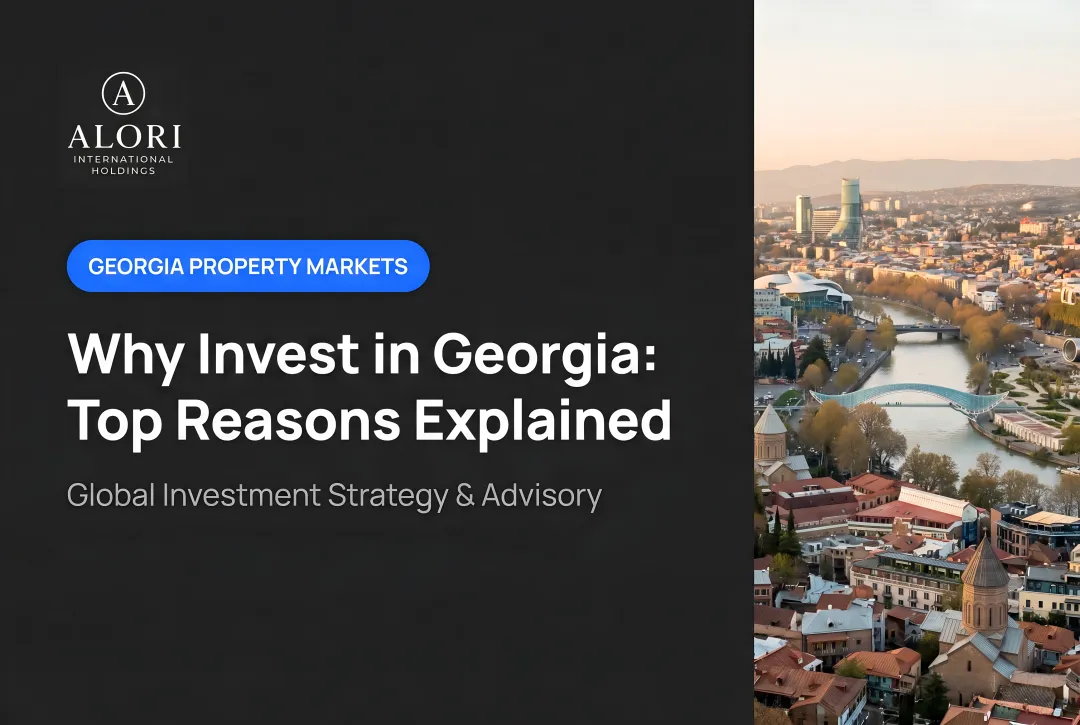
Tbilisi is Georgia's economic, political, and cultural center, home to roughly 1.2 million people — nearly half the country's population. With approximately 75% of all tourists passing through the capital, Tbilisi offers the most resilient, all-weather real estate market in the country.
Three distinct districts serve different investment objectives:
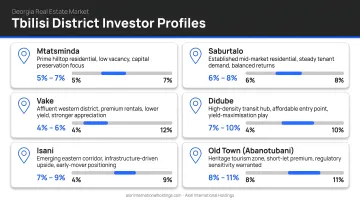
- Vake: Premium lifestyle district attracting diplomat and expat long-term rentals, with established infrastructure and proximity to international schools
- Mtatsminda and Old Tbilisi: High-yield short-term rental zones where proximity to tourist sites drives Airbnb occupancy above 70% year-round
- Chughureti and Marjanishvili: Emerging gentrification plays — prices run 30–40% below Vake, but infrastructure investment is accelerating
Prices in Tbilisi still sit well below comparable European capital cities. Where $150,000 might buy a studio in Lisbon's periphery, the same budget secures a renovated two-bedroom apartment in central Tbilisi's tourist core.
| Metric | Details |
|---|---|
| Price Range (USD) | $70,000–$300,000 depending on district; most foreign investor sweet spots in the $100,000–$200,000 range |
| Rental Yield Profile | Long-term yields: 5–9%; short-term (Airbnb) yields in tourist-core districts: 10–12% |
| Best Investor Profile | Yield-focused investors, short-term rental operators, lifestyle buyers, long-term appreciation plays |
Batumi – Black Sea Coastal Tourism Market
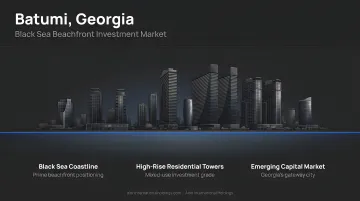
Batumi is Georgia's second city and primary beach destination on the Black Sea. Nearly all foreign real estate investment here targets short-term tourist rentals, including hotel-managed apartment programs where operators handle bookings and maintenance in exchange for revenue share.
Over the past decade, Batumi experienced a construction boom that added thousands of units to the market — and the oversupply risk is both real and measurable. Competition for tourist renters compressed yields significantly. Investors who bought inland budget units often face winter vacancy rates exceeding 60%, with blended annual yields falling below 4%.
Location selection within Batumi matters more than in any other Georgian market. Focus on seafront or premium developments within 500 meters of the beach. These properties maintain occupancy during peak summer months and command rental premiums year-round. Batumi's seasonality pattern is pronounced — July and August generate 50–60% of annual rental income, while November through March show minimal tourist activity.
| Metric | Details |
|---|---|
| Price Range (USD) | Seafront and premium units: $80,000–$200,000; inland budget units: $40,000–$70,000 |
| Rental Yield Profile | Short-term yields are season-dependent; peak summer occupancy can be strong, but annual blended yields often underperform Tbilisi due to winter vacancy |
| Best Investor Profile | Investors targeting summer tourism rental income with realistic occupancy models and awareness of seasonality risk |
Gudauri – The Ski Resort Niche
Gudauri is Georgia's largest ski resort, located approximately 1.5 hours north of Tbilisi at 2,200 meters elevation. The resort draws both domestic and international winter tourists, with brand hotel developments including Radisson now operating on-site — a sign that institutional hotel brands see long-term viability in the resort.
The limitations here are structural, not incidental. Gudauri is heavily seasonal — activity concentrates from January through April, and off-season occupancy drops close to zero. Properties near ski lifts command the strongest yields, but that supply is limited.
Long-term hold strategies work best here. As Georgia's winter tourism infrastructure develops and ski resort connectivity improves, proximity to core resort infrastructure should drive appreciation. Investors seeking year-round cash flow, however, will find Gudauri a poor fit.
| Metric | Details |
|---|---|
| Price Range (USD) | Properties near ski infrastructure: $60,000–$150,000 |
| Rental Yield Profile | High seasonal yields during winter months; very low off-season occupancy — annual blended yield depends heavily on ski-lift proximity |
| Best Investor Profile | Niche winter-tourism investors, lifestyle buyers who ski, or those with a long-term hold thesis on resort infrastructure appreciation |
Kutaisi – Emerging Market Entry Point
Kutaisi is Georgia's third-largest city and home to the Kutaisi Free Economic Zone, which offers 100% tax exemption on corporate profit, property tax, VAT, and import duties for businesses operating within the zone. Government investment in infrastructure — including Kutaisi International Airport, which handled 1.72 million passengers in 2024 — signals long-term development intent.
Tourist demand in Kutaisi is transitional — most visitors stay one night as a stopover between Tbilisi and Batumi. Residential rental demand from locals runs lower than in Georgia's two primary cities, and rental yields reflect this.
According to Cushman & Wakefield, Kutaisi's average residential price reached $834 per square meter in early 2025, with new 50-square-meter apartments available for approximately $45,000.
Kutaisi suits investors with a long-term appreciation thesis, provided they're comfortable with:
- Lower immediate rental yields (3–5% annually)
- 5–10 year hold periods
- Higher uncertainty around exit liquidity
The Free Zone activity and airport connectivity provide fundamental support, but this is not a cash-flow-first market.
| Metric | Details |
|---|---|
| Price Range (USD) | $40,000–$90,000 (among the most affordable Georgian city property) |
| Rental Yield Profile | Lower absolute yields than Tbilisi; returns primarily driven by future capital appreciation rather than current income |
| Best Investor Profile | Budget entry-point investors, those with 5–10 year appreciation horizons, or investors interested in Free Zone business exposure alongside residential property |
Bakuriani & Borjomi – Wellness and Mountain Resort Zone
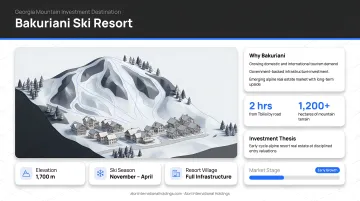
Bakuriani (Georgia's second-largest ski resort, 2.5 hours from Tbilisi) and neighboring Borjomi (known for its spa heritage and mineral water) together form a wellness and mountain tourism corridor. This zone attracts both winter sports visitors and year-round health tourism travelers.
The key distinction from Gudauri is seasonality. Borjomi's spa heritage and hiking appeal generate demand outside the winter ski window, reducing the vacancy risk that makes pure ski resorts difficult to underwrite. That said, this remains a niche market — occupancy fundamentals are strongest for properties near resort infrastructure: ski lifts, spa facilities, and established hiking access.
| Metric | Details |
|---|---|
| Price Range (USD) | $40,000–$120,000; lower than Gudauri for comparable property types |
| Rental Yield Profile | More seasonally balanced than pure ski resorts due to wellness tourism year-round, but still below Tbilisi's income stability |
| Best Investor Profile | Lifestyle investors, wellness tourism operators, or those seeking lower-cost entry into Georgia's growing domestic tourism market |
How We Chose These Investment Locations
The selection criteria prioritize structural demand drivers over short-term momentum. These are the factors that separate durable investment markets from speculative ones:
Core evaluation criteria:
- Year-round tenant or visitor demand (not just seasonal spikes)
- Supply/demand balance (avoiding oversupplied markets)
- Macro infrastructure backing (airports, transport corridors, free zones)
- Legal and transactional clarity for foreign buyers
Most first-time investors choose based on headline price or developer marketing claims — skipping the research that actually matters:
- Seasonality and occupancy patterns
- Local demand profile (tourist vs. residential)
- Yield reality vs. projection
- Legal title integrity on specific properties
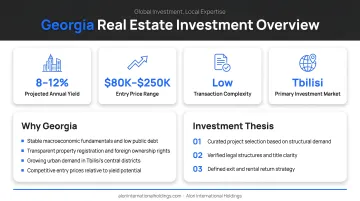
At Alori International Holdings, we apply this framework to identify and curate Georgian real estate opportunities for international investors. Our approach combines macroeconomic data analysis, demographic trends, and foreign investment patterns with in-country professionals who understand local regulations and transaction processes.
Every opportunity we present includes vetted legal structures and defined exit strategies built in from the start — because sound execution is what converts market potential into actual returns.
Conclusion
Georgia's 2025 real estate market offers genuine opportunity across multiple cities, each serving a different investor profile. The decision that matters most isn't which city ranks highest on a generic list — it's matching location to your specific goals: yield versus appreciation, lifestyle versus pure financial return, short-term rental versus long-term residential hold.
Accessing Georgia's upside with confidence requires more than choosing Tbilisi over Batumi or identifying a price range. Three fundamentals determine whether an investment holds up over time:
- Verified legal structures — ownership titles, foreign buyer rights, and transaction integrity
- Accurate pricing data — drawn from real market transactions, not developer projections
- A defined exit strategy — one that accounts for liquidity conditions in each local market
Alori International Holdings identifies and vets Georgia property opportunities with verified legal structures, on-the-ground pricing intelligence, and clear exit strategies built in from the start. If you're ready to explore Georgian real estate aligned with your capital structure and timeline, contact our team at info@aloriinternationalholdings.com.
Frequently Asked Questions
What to invest in Georgia?
Real estate—particularly in Tbilisi and Batumi—remains the most accessible and well-understood investment vehicle for foreign investors. The IT sector also offers tax incentives for qualified businesses, and Free Industrial Zones provide exemptions for manufacturing and logistics operations.
Can foreigners buy property in Georgia?
Yes. Georgia permits full foreign ownership of most real estate with no restrictions. Property registration is straightforward and can be completed quickly through the digital registry. Legal due diligence on title and building age is still essential before purchasing.
Is Tbilisi or Batumi better for real estate investment?
Tbilisi offers stronger year-round demand, lower seasonality risk, and a wider range of viable strategies — from long-term residential to short-term tourist rentals to commercial. Batumi suits investors targeting summer tourism, but oversupply in certain submarkets means unit selection matters. Seafront properties consistently outperform inland alternatives.
What rental yields can investors expect in Georgia?
Long-term residential in Tbilisi typically yields 5–9%, while short-term tourist rentals in Old Tbilisi or peak-season Batumi can reach 10–12%. Stress-test these figures against real occupancy rates, not developer projections.
What taxes apply to foreign property owners in Georgia?
Property tax is capped at 1% of assessed value. There is no capital gains tax on property sales. Rental income is taxed at 5% for individuals. Georgia also imposes no inheritance or wealth tax — a combination that places it among the lowest tax burdens for property investors in Europe or its neighboring regions.
What are the biggest risks of investing in Georgia?
Political uncertainty around EU accession, oversupply in certain Batumi submarkets, legal title issues on older buildings, and currency risk if rental income is earned in Georgian Lari (GEL). Each of these risks can be addressed through proper due diligence, local legal counsel, and deal structures vetted for compliance and exit clarity.