Introduction
In the U.S., property taxes drain around 1.8% of private capital stock every year. On a $500,000 property, that's $5,000–$10,000 in recurrent taxes annually — not once, but for every year you hold the asset.
Europe offers a different structure entirely. Several jurisdictions levy zero annual property tax, shifting the cost model from recurring wealth drain to one-time entry fees. This guide covers five countries where no annual property tax applies — Malta, Monaco, Liechtenstein, Andorra, and Georgia — and breaks down what investors need to know about total holding costs before committing capital.
For long-horizon investors, that distinction matters. You pay to enter the market once — then hold without annual levies compounding against your equity.
Key Takeaways
- Malta and Liechtenstein are the only two European countries with 0.000% recurrent property taxes per Tax Foundation data
- Monaco, Andorra, and Georgia effectively impose no annual property tax for most foreign investors, with narrow exceptions
- Even zero-tax countries charge one-time purchase taxes, rental income taxes, and may restrict foreign ownership
- Georgia pairs zero property tax with low entry costs, strong rental yields, and open foreign ownership rules — accessible to mid-level investors in the $100K–$600K range
What "No Property Tax" Actually Means: Setting the Right Expectations
When we say "no property tax," we mean no recurring annual tax on owned residential property—not the absence of all real estate-related costs.
The OECD classifies taxes into distinct categories:
- Category 4100: Recurrent taxes on immovable property (annual, ongoing)
- Category 4400: Taxes on financial and capital transactions (one-time, at purchase)
This distinction matters enormously for investors. A country charging 5% stamp duty once is fundamentally different from one charging 1% of property value every year.
Example: For a €400,000 property held 10 years:
| Tax Structure | Total Cost Over 10 Years |
|---|---|
| One-time 5% stamp duty | €20,000 |
| Annual 1% property tax | €40,000 (€4,000 × 10 years) |
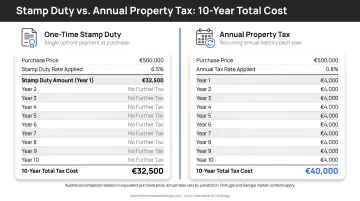
Zero annual tax countries front-load costs at purchase, then impose no recurring levy. Over a decade, that difference compounds into meaningful equity preservation.
European Countries With No Annual Property Tax
Malta
Tax Status: 0.000% annual property tax (Tax Foundation verified)
Malta is the only EU member state with zero recurrent property tax, combining tax efficiency with EU market access and strong governance frameworks.
Transaction Costs:
- 5% stamp duty on purchase (reduced for first-time buyers on the first €200,000)
- 15% flat tax on rental income
- 0% capital gains tax on primary residence held 3+ years; 5–8% on investment properties
Foreign Ownership Rules: Non-EU buyers need an Acquisition of Immovable Property (AIP) permit to purchase property outside Special Designated Areas (SDAs). AIP permits restrict ownership to one property and prohibit renting. Purchasing within SDAs removes these restrictions entirely, allowing unrestricted buying and leasing.
Residency Pathway: The Malta Permanent Residence Programme (MPRP) requires a minimum €375,000 property purchase (2025 threshold), granting indefinite EU residency and Schengen access.
Why Malta Stands Out: Malta offers zero annual property tax alongside EU membership, English as an official language, and established legal frameworks. For American investors, that combination means no recurring tax drag on a property held inside the EU's single market.
Monaco
Tax Status: Zero annual property tax, zero income tax (non-French nationals), zero capital gains tax
Monaco eliminates virtually every recurring tax category—but the barrier to entry is price, not paperwork.
Transaction Costs:
- 4.5% registration duty + 1.5% notary fees (6% total) for individuals
- 10% registration duty for opaque offshore entities
- 1% annual levy on rent if leasing the property
In 2025, Monaco's average price per square meter reached €57,569, with the Larvotto district exceeding €71,000/sqm. This makes Monaco inaccessible for most investors outside the top 1%.
Who Monaco Is For: Monaco suits ultra-high-net-worth buyers whose primary goal is total tax elimination and wealth preservation. Investors focused on yield or capital growth will find better fundamentals elsewhere.
Liechtenstein
Tax Status: 0.000% annual property tax (Tax Foundation verified)
Liechtenstein matches Malta's zero-tax status but is effectively closed to foreign investors.
Transaction Costs:
- 3–3.5% transfer tax on purchase
- Rental income taxed up to 24% (including municipal surcharges)
Foreign Ownership Restrictions: Non-residents face heavy restrictions under the Grundverkehrsgesetz (Land Transfer Act). Generally, foreigners must reside in Liechtenstein for at least three years and obtain government permission to purchase property—making it inaccessible for most foreign buyers.
Andorra
Tax Status: No national property tax; symbolic municipal levy ("foc i lloc") of €24–€48 annually for residents
Andorra offers zero national property tax but introduced new foreign investment levies in 2025.
Transaction Costs:
- 4% transfer tax (ITP) split between government (1%) and parish (3%)
- Rental income taxed at 10% flat rate for non-residents
- Capital gains tax tapers to 0% after 10 years of ownership
Foreign Ownership Restrictions: Non-residents are generally limited to owning one property without special permission. The 2025 Omnibus Law introduced a progressive Foreign Investment Tax (IEI) of 3–10%, but investors receive a 90% reduction if dedicating the property to affordable rental housing for at least 10 years.
Strategic Consideration: Andorra's combination of low tax, lifestyle appeal, and restrictive foreign ownership makes it niche—suitable for investors seeking lifestyle residency, not passive portfolio diversification.
Georgia
Tax Status: Effectively zero annual property tax for foreign investors
Georgia offers the most accessible zero-tax entry point in Europe, combining low cost, open ownership, and strong yield fundamentals.
How the Tax Works: Households earning below approximately $12,500 annually are fully exempt from property tax. Higher-income owners pay up to 1% of property value. For most foreign investors who don't register local income, this means zero annual property tax.
Transaction Costs:
- No transfer tax—only nominal registration fees
- 0% capital gains tax after two years of ownership
- 5% flat income tax on rental earnings
Foreign Ownership: Open ownership for residential and commercial properties (excluding agricultural land). No permits, no quotas, no restrictions.
Market Metrics:
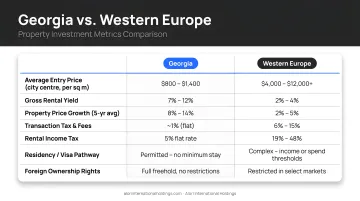
- Tbilisi average price: $1,312–$1,325 per sqm (early 2025)
- Gross rental yields: 8.6–9% annually
- Residency threshold: $100,000 property investment qualifies for permanent residency
Comparison to Western Europe: Tbilisi pricing is a fraction of Lisbon (€5,914/sqm median) or Athens (post-crisis highs). For the $150,000–$600,000 investor bracket, Georgia offers the lowest-friction entry point among European no-tax markets.
Alori International Holdings sources investment opportunities directly in the Georgian market, providing verified legal structures, developer-level off-market access, and clearly defined exit strategies. For investors entering Georgia for the first time, that in-country presence significantly reduces transaction risk.
European Countries With Low Property Tax Worth Considering
Not all investors prioritize zero tax. For some, low-tax EU markets with strong rental demand and residency pathways deliver superior total returns.
Croatia
From January 2025, Croatia introduced a tax of €0.60–€8 per sqm annually — but only on holiday homes. Primary residences and long-term rentals remain exempt.
This is both a market update and a cautionary note: even historically no-tax countries can change their rules without warning.
Portugal
Municipal Property Tax (IMI) averages 0.3–0.45% annually — well below the U.S. average of 1.8%. Key investor considerations include:
- Tax rate: 0.3–0.45% of cadastral value per year, one of the lowest holding costs in Western Europe
- Rental fundamentals: Strong tourism-driven demand in Lisbon, Porto, and the Algarve supports consistent rental yield
- Tax residency: Portugal's NHR regime was revoked in 2023 and replaced by the IFICI regime, targeted at scientific and innovation roles
Portugal's combination of low annual tax and an established legal framework makes it a consistent focus for investors seeking durable international exposure.
Greece
Greece taxes property at a fixed fee of €2–€16 per sqm — not percentage-based — making annual costs predictable regardless of market appreciation. Key residency thresholds after the 2024 Golden Visa update:
- €800,000 minimum in prime areas (Athens, Mykonos, Santorini, Thessaloniki)
- €400,000 minimum in most other regions
- €250,000 exception for converting commercial properties to residential use
Bulgaria
Municipal tax ranges from 0.01–0.45% of assessed value — among the lowest in Europe. Bulgaria suits investors prioritizing minimal holding costs over residency pathways.
When Low Tax Outperforms No Tax
Portugal and Greece offer something Georgia and Montenegro cannot: EU residency pathways, deep legal infrastructure, and tourism-driven rental demand in established markets. For investors weighing total return rather than tax elimination alone, these factors often outweigh the marginal annual cost difference.
The Other Costs: What You Still Pay Even in No-Tax Countries
Zero annual property tax does not mean zero cost — four expense categories still shape your true holding costs:
1. Transfer Taxes or Stamp Duty (One-Time)
Typically 2–7.5% in European no-tax markets. These front-load costs at purchase but are paid once.
2. Rental Income Tax
If the property generates income, most countries tax rental earnings. Malta charges 15% flat; Georgia charges 5% flat; Portugal taxes rental income as personal income.
3. Capital Gains Tax on Sale
Varies widely. Georgia exempts gains after two years; Malta exempts primary residences held 3+ years; others charge up to 33%.
4. Municipal Fees or Service Charges
Ongoing utility, maintenance, or community fees exist even in zero-tax jurisdictions.
5. Foreign Ownership Restrictions
- Liechtenstein: Heavily restricted for non-residents
- Malta: Requires AIP permits outside SDAs
- Andorra: Limits foreigners to one property
- Georgia: Open ownership (except agricultural land)
- Monaco: No restrictions
The countries with the lightest tax burden often compensate through higher transfer costs or tighter ownership rules. Running the full numbers — not just the annual rate — is what separates a well-structured acquisition from a costly surprise.
How to Match the Right European Market to Your Investment Goals
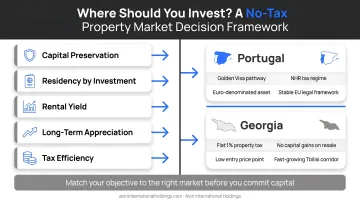
There is no single "best" no-tax market. The right choice depends on your objectives.
Decision Framework:
| Goal | Recommended Market | Why |
|---|---|---|
| EU residency + no annual tax | Malta | Only no-tax EU member; MPRP offers Schengen access |
| Ultra-prime wealth preservation + total privacy | Monaco | Zero tax on income, capital gains, and property; but €57,569/sqm pricing |
| Low entry cost + zero effective tax + strong yield | Georgia | Open ownership, $1,312/sqm pricing, 8.6–9% yields, no capital gains after 2 years |
| Lifestyle + low (not zero) tax + residency pathway | Portugal or Greece | EU access, established legal frameworks, tourism-driven rental demand |
True Cost of Ownership: 10-Year Comparison
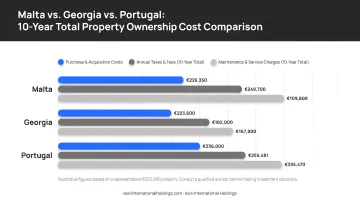
The table below compares total holding costs for a hypothetical $300,000 property held over 10 years — purchase costs, annual taxes, and rental income tax combined:
Malta:
- Purchase: $15,000 (5% stamp duty)
- Annual tax: $0
- Rental income tax (assuming $15,000/year gross): $22,500 (15% × $15,000 × 10 years)
- Total 10-year cost: $37,500
Georgia:
- Purchase: ~$500 (nominal registration fees)
- Annual tax: $0
- Rental income tax (assuming $24,000/year gross): $12,000 (5% × $24,000 × 10 years)
- Total 10-year cost: $12,500
Portugal:
- Purchase: $21,000 (7% IMT + stamp duty estimate)
- Annual tax: $1,200/year × 10 = $12,000 (0.4% IMI average)
- Rental income tax (assuming $15,000/year gross, taxed at 28%): $42,000
- Total 10-year cost: $75,000
Georgia delivers the lowest total cost and highest net yield for mid-level investors. Malta offers EU access at moderate cost. Portugal trades higher taxes for EU residency pathways and the stability of a mature market.
For American investors in the $150,000–$600,000 range, Georgia offers the lowest barrier to entry: minimal purchase costs, open foreign ownership, no capital gains tax after two years, and rental yields above 8%. Alori International Holdings works specifically in Georgia and Portugal, giving investors curated, vetted opportunities in both markets — a zero-tax, high-yield emerging market and a low-tax, EU-access mature market — backed by local execution and in-market due diligence.
Frequently Asked Questions
Where in Europe is there no property tax?
Malta, Monaco, Liechtenstein, Andorra, and Georgia (with income thresholds) are the only European jurisdictions with zero or near-zero annual property tax. Croatia abolished its general property tax but reintroduced a holiday-home levy in 2025.
Which European countries have low property taxes?
Portugal (0.3–0.45% IMI), Greece (€2–€16/m² fixed fee), and Bulgaria (0.01–0.45%) offer low property taxes well below the U.S. average of approximately 1.8% of private capital stock.
Which country has the lowest taxes in Europe overall?
Malta and Liechtenstein are the only confirmed 0.000% annual property tax jurisdictions, According to Tax Foundation data, Malta and Liechtenstein are the only confirmed 0.000% annual property tax jurisdictions in Europe. For overall tax burden—income, corporate, and property combined—Andorra, Monaco, and Georgia rank among the lightest regimes.
Does Portugal have property tax?
Yes, Portugal's IMI (Imposto Municipal sobre Imóveis) applies at roughly 0.3–0.45% of taxable property value. That's well below most EU averages and the U.S. benchmark of approximately 1.8%.
Is the annual property tax the only cost of owning property in Europe?
No. Even in zero-tax jurisdictions, ownership carries other costs buyers should plan for:
- One-time purchase taxes (typically 2–7.5% of property value)
- Rental income tax if leasing the property
- Capital gains tax on eventual sale
- Annual municipal fees and maintenance levies
"No property tax" refers only to the recurring annual levy—not the full cost of ownership.