

Introduction
American investors are increasingly looking to Europe not just for lifestyle, but as a deliberate strategic move: EU mobility access, asset diversification, and legal residency through a qualifying property investment.
Several European countries allow non-EU citizens, including Americans, to obtain legal residency in exchange for a minimum real estate investment — a program commonly known as a Golden Visa.
This guide covers which countries offer these programs, how the process works, what to weigh when comparing markets, and which misconceptions to clear up before committing capital.
Key Takeaways
- Greece, Cyprus, Malta, and Hungary currently offer residency by property investment — Portugal shifted to fund-based routes only
- Investment minimums run from roughly €220,000 to €800,000 depending on the country and property location
- Residency permits don't automatically lead to EU citizenship; most programs require 7–10+ years before you're eligible to apply
- U.S. citizens can legally buy property in Europe but must account for U.S. tax reporting obligations on foreign assets
- Direct property ownership bypasses FBAR and FATCA reporting; fund-based routes trigger both
What Is Property-Based European Residency?
Residency by investment is a legal immigration status granted by a host country in exchange for a qualifying economic contribution — specifically, real estate. It gives the holder the right to live, travel, and in some cases work in that country. This is not a tourist visa or a temporary work permit. It's a formal immigration pathway.
Key legal distinctions:
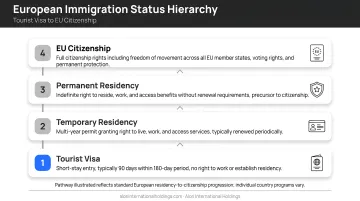
- Tourist visa: Limits you to 90 days per 180 across the Schengen zone — no right to reside long-term
- Temporary residence permit: Renewable legal status for extended stays; where most Golden Visa programs begin
- Permanent residency: Granted after several years of continuous legal status, with fewer renewal requirements
- Citizenship: Full rights, including an EU passport — typically available after 7–10+ years of continuous residency
For American investors, the Golden Visa takes this a step further by bundling residency rights with broader European access.
A Golden Visa offers:
- Schengen zone travel access — 90 days in any 180-day period across 27+ countries
- The right to reside in the issuing country
- Family inclusion for spouses, dependent children, and in some programs, parents
- A long-term pathway to an EU passport after fulfilling residency requirements
Which European Countries Offer Residency by Buying Property?
Greece
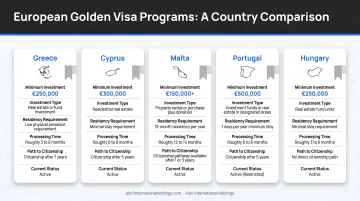
Greece's Golden Visa program features tiered investment thresholds based on property location and type. As of 2024, the minimum investment is €250,000 for most regions, but prime locations including Attica, Mykonos, Santorini, Thessaloniki, and other urban centers require €800,000. The program allows rental income on qualifying properties and does not require physical residency to maintain the permit.
Greece permits direct purchase of residential property—villas, apartments, or commercial real estate—and the residency permit is renewable every five years as long as the investment is maintained.
Cyprus and Malta
Cyprus offers the Cyprus Permanent Residence Program with a minimum investment of €300,000 for new residential or commercial property. Unlike Greece, Cyprus grants permanent residency from the outset rather than a renewable temporary permit. Applicants must prove minimum annual income from foreign sources (€30,000 plus €5,000 per dependent) and cannot be employed in Cyprus. The path to citizenship requires extended residency and naturalization after 7+ years.
Malta provides two distinct pathways. The Global Residence Programme offers temporary residency status with a flat-rate tax regime requiring either property purchase (minimum €275,000 in southern Malta or Gozo, or €350,000 elsewhere) or rental (minimum €9,600 or €10,500 annual rent). The Malta Permanent Residence Programme requires real estate purchase or rental plus a €68,000 government contribution, €2,000 charitable donation, and proof of assets exceeding €500,000. Malta also offers a separate, faster citizenship-by-investment pathway distinct from property-based residency.
Portugal and Hungary
Portugal underwent a significant program change in 2023. Direct residential property purchase in most of Portugal no longer qualifies for the Golden Visa. What qualifies now is narrower:
- €500,000 qualifying investment funds (the primary route)
- Property in low-density interior regions, the Azores, or Madeira
- Buying a Lisbon apartment or Algarve villa does not qualify for residency
Americans evaluating Portugal need to understand this distinction clearly before committing capital.
For investors seeking both residency and Portuguese real estate, firms like Alori International Holdings assist clients in pursuing these as separate strategies: fund-based Golden Visa investments for residency, combined with direct real estate purchases in prime markets for financial returns and rental income.
Hungary launched the Guest Investor Program in 2024, requiring investment in Hungarian real estate investment funds with a minimum threshold of approximately €250,000. This is a newer option with a shorter track record than Greece or Cyprus.
Important: Spain's Golden Visa property route ended in April 2025. Outdated online information may still reference Spain—ignore it.
How the Process Works: Step by Step
The end-to-end timeline from due diligence to residency card issuance typically runs 3 to 9+ months. The exact length depends on the country you choose, current application volume, and how complete your documentation is at the time of submission.
Step 1: Eligibility Assessment and Program Selection
Americans should begin with a review of personal eligibility—clean legal record, source-of-funds documentation, financial qualifications—then select the program that aligns with investment size, lifestyle goals, tax situation, and long-term residency or citizenship objectives.
Key questions to answer:
- What is your total investment budget, including transaction costs?
- Do you want to live full-time in Europe or just have the option?
- Is citizenship a long-term goal, or is temporary residency sufficient?
- How will this impact your U.S. tax obligations?
Step 2: Property Search, Due Diligence, and Purchase
Before signing any agreement, legal due diligence is non-negotiable: verify the property title, check for encumbrances or zoning restrictions, and confirm the property qualifies under the specific program's rules.
In most European Golden Visa countries, Americans purchase with cash. Mortgages for non-residents are harder to access and rarely used for investment-residency purposes.
Due diligence checklist:
- Title verification and ownership history
- Encumbrances, liens, or legal disputes
- Property valuation and appraisal
- Zoning and regulatory compliance
- Developer track record (for new construction)
- Rental licensing (if generating income)
A local notary finalizes the transaction, and all documentation must be prepared in the local language with certified translations where required. The biggest risk at this stage is buying in a weak market just to qualify for a visa. Alori International Holdings addresses this directly, vetting properties in markets like Portugal for fundamentals, legal compliance, and long-term value before presenting them to investors.
Step 3: Residency Application and Document Submission
After purchase, the next phase involves assembling required documents: passport, proof of investment, clean background check, health insurance, and financial statements. Applicants must submit biometric data and file the residency application with the relevant government authority. In many countries, a licensed representative can handle the entire submission process on your behalf.
Most programs require these documents:
- Valid passport and passport photos
- Notarized property purchase agreement
- Bank statements proving investment funds
- Criminal background check (apostilled)
- Private health insurance policy
- Proof of accommodation in the country
- Biometric data (fingerprints, photo)
Processing times vary: Greece typically takes 2–4 months, Cyprus 2–3 months, Malta 4–6 months.
Key Factors to Consider When Choosing a Program
Investment Threshold vs. Total Cost of Entry
The headline property price is not the only cost. True all-in costs can exceed the minimum investment by 15–25%. Additional costs include:
- Government application fees (€2,000–€15,000 depending on country)
- Legal and notary fees (3–5% of property value)
- Property transfer tax or stamp duty (2–10% of purchase price)
- Health insurance (€500–€2,000 annually per person)
- Background checks and document certification (€500–€1,500)
- Ongoing residency renewal fees (€500–€2,000 every 1–5 years)
- Charitable donations (Malta only, €2,000+)
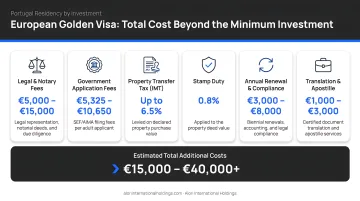
Budget at least 20% above the minimum investment threshold to cover total cost of entry.
Residency Requirements and Lifestyle Fit
Some programs require no minimum days spent in the country (Greece, Cyprus). Others have physical presence conditions or tax residency triggers. This matters for Americans who want the option—not the obligation—of living in Europe.
Americans must comply with U.S. tax reporting obligations regardless of where they live. Two key rules apply:
- FBAR (FinCEN Form 114): Required if foreign financial accounts exceed $10,000 at any point during the year
- FATCA (IRS Form 8938): Triggered when investing through funds rather than direct property ownership
Directly held foreign real estate is explicitly excluded from both FBAR and FATCA reporting — a meaningful compliance advantage for investors buying property outright.
Path to Citizenship and Long-Term Value
Investors focused on an eventual EU passport must understand the naturalization timeline and conditions for each country. Timelines vary significantly by country:
- Greece & Cyprus: 7+ years of continuous residency, plus language proficiency and integration tests
- Malta: Faster pathway via citizenship-by-investment (€690,000+ contribution), without the multi-year residency requirement
- Portugal: 5 years for permanent residency; 6–7 years for citizenship eligibility, with Portuguese language proficiency required
The property investment serves two purposes: it qualifies for residency and functions as a real asset that can generate income or appreciate over time. Rental yields in Greece and Portugal typically range from 5–10% annually in high-demand tourist markets.
Market Fundamentals and Exit Strategy
Choosing a program based solely on the lowest investment threshold is a common mistake. Evaluate the underlying real estate market — rental demand, price trajectory, legal frameworks for foreign ownership, and realistic exit liquidity.
Questions to ask:
- Is the local market experiencing oversupply or undersupply?
- What are tourism trends and international demand signals?
- How liquid is the secondary market for resale?
- Are there rental licensing restrictions or tax changes on the horizon?
Advisors who combine global investment strategy with local market knowledge help investors avoid buying in weak markets simply to qualify for a visa. Alori International Holdings, for example, evaluates regulatory frameworks, demographic trends, and capital flows before recommending any market — focusing on long-term value rather than short-term momentum.
Common Misconceptions About Buying Property for European Residency
Misconception 1 — "Any property purchase in Europe qualifies"
Golden Visa programs have strict qualifying criteria—specific property types, minimum values, geographic restrictions, and in some cases approved developer lists. Buying a €200,000 vacation apartment in the wrong location or country will not grant residency. For example, Portugal's 2023 law change means Lisbon and Algarve properties no longer qualify for Golden Visa purposes, even though they remain excellent real estate investments.
Misconception 2 — "Residency means I can live anywhere in the EU"
A residence permit issued by one EU country gives the holder the right to reside in that country and travel across the Schengen Area for up to 90 days per 180, but does not grant the right to live or work freely in other EU member states. That right comes only with EU citizenship. A Greek Golden Visa holder cannot relocate to Germany or France permanently without obtaining separate residency or work permits.
Misconception 3 — "This is a quick route to an EU passport"
Most European residency-by-investment programs require 7–10+ years of residency before citizenship eligibility. The exception is Malta's separate citizenship-by-investment pathway, which has its own distinct requirements (€690,000+ government contribution, plus property and donations). If your goal is an EU passport within 2–3 years, Golden Visa property routes will not get you there.
Frequently Asked Questions
Can I get permanent residency in Europe by buying property?
Yes, some countries offer permanent residency directly (Cyprus), while others grant a temporary residence permit first and require several years of residency before permanent status (Greece, Portugal). Conditions vary by program.
Which European countries offer residency by buying property?
Active programs as of 2025–2026: Greece, Cyprus, Malta, and Hungary. Portugal's program now requires €500,000 fund investments or property in low-density interior regions. Spain's property Golden Visa closed in April 2025.
Can a U.S. citizen buy property in Europe?
Yes, U.S. citizens can purchase property in most European countries, though some require government approval for non-EU buyers (Croatia, Hungary). Americans must also comply with U.S. reporting requirements on foreign assets if applicable.
What is the easiest European country to get residency?
Greece is frequently cited for its lower entry threshold (€250,000 in most regions) and straightforward program, while Cyprus offers permanent residency directly. "Easiest" ultimately depends on your budget, target timeline, and how quickly you need permanent status versus temporary residence.
Which European countries offer citizenship by buying property?
No European country offers citizenship directly through a property purchase alone. Property investment grants residency, and citizenship is available only after meeting multi-year residency and naturalization requirements. Malta has a faster but distinct citizenship-by-investment pathway.
What is the easiest European country to buy property in?
Greece and Portugal are generally considered accessible for foreign buyers with established legal processes. Some Central and Eastern European countries impose additional conditions on non-EU purchasers.
Final Takeaway: Buying property in Europe for residency is a multi-year commitment. Program selection, total cost structure, residency obligations, and exit strategy all need to align with your long-term goals — not just the entry threshold. Direct property ownership carries U.S. tax reporting implications, so working with advisors who combine global investment strategy with on-the-ground local knowledge is worth the effort before you commit capital.