

Introduction
European property markets have drawn sustained interest from American buyers over the past several years — driven by dollar strength, portfolio diversification, and the appeal of owning hard assets outside the US financial system. According to recent market data, foreign buyers drove significant price divergence between primary cities like Lisbon and Porto versus secondary markets in 2025.
Yet accessibility creates a critical trap: most buyers select countries based on lifestyle appeal — Mediterranean views and cultural charm — rather than investment fundamentals. This leads to poor returns, legal friction, or capital locked in illiquid markets where transaction costs devour projected gains.
This guide cuts through the noise. Each country is evaluated on legal clarity of ownership, realistic price trajectories, transaction cost discipline, and residency upside — criteria that determine actual returns, not just a good story over dinner in Lisbon.
Key Takeaways
- Most European countries legally permit foreigners to buy residential property without citizenship or residency requirements
- Portugal, Greece, Cyprus, Spain, and Georgia stand out for accessible ownership laws, clear transaction processes, and durable market fundamentals
- Transaction costs add 5–13% to purchase price—budget accordingly
- Property ownership doesn't grant automatic residency—visa and Golden Visa programs are separate applications with distinct requirements
- Local legal and advisory support in your target market significantly reduces transaction risk and pricing blind spots
What to Look for When Buying Property in Europe as a Foreigner
Legal Access Comes First
Verify whether non-EU, non-resident foreigners can purchase your target property type without permits, quotas, or nationality restrictions. Switzerland requires cantonal authorization under Lex Koller for non-resident buyers. Denmark mandates five consecutive years of residency or Ministry of Justice permission for non-EU nationals. Hungary requires government consent for non-EU property acquisition.
Agricultural and coastal restrictions also vary. Georgia prohibits foreigners from purchasing agricultural land entirely. Cyprus caps non-EU buyers at 4,000m² of land for dwellings.
Transaction Costs Matter More Than You Think
Full cost structure transparency determines whether an investment works financially. A 10–13% cost add-on versus 5–7% shifts your ROI meaningfully.
Standard transaction components:
- Transfer tax or VAT (new builds)
- Stamp duty on deed execution
- Notary and registry fees
- Legal fees (1–2% of purchase price)
- Agent commission (typically seller-paid, 2–5%)
Buyers bear almost all closing costs—taxes, notary, registry—while sellers absorb agent commissions and capital gains taxes.
Market Fundamentals Over Affordability
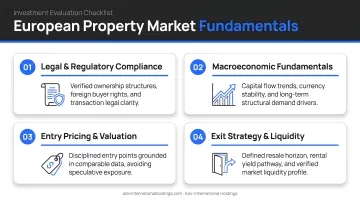
Low entry price means nothing without structural demand. Before committing to a market, evaluate these fundamentals:
- Rental yield: What income does the property generate relative to purchase price?
- Demand drivers: Tourism growth, demographic trends, employment migration
- Capital appreciation: Historical price trends and future growth outlook
- Market liquidity: Can you exit the asset efficiently when needed?
Legal Infrastructure Quality
Look for countries with reliable land registries, clear title verification processes, and enforceable property rights. Weak legal infrastructure exposes buyers to title disputes, undisclosed liens, and land they legally cannot build on.
Spain, Portugal, and Greece operate strict notary-based systems where a Notary Public acts as a state official to certify transactions and verify registry compliance — a meaningful layer of protection for foreign buyers.
Residency Incentives as Bonus, Not Driver
Property-linked residency programs can add real value for American buyers who want the flexibility of a second base or a path to European residency. That upside is worth understanding — but investment fundamentals need to hold up on their own first.
Best European Countries for Foreigners to Buy Property
The following five countries were selected based on foreign ownership accessibility, investment-grade market data, clear legal frameworks, and meaningful long-term capital upside—not just ease of purchase or passport benefits.
Portugal
Portugal offers one of Europe's most transparent and foreigner-friendly property markets: no ownership restrictions for foreign nationals, a notary-based transaction system with strong buyer protections, and well-developed real estate infrastructure serving international buyers.
Investment Case:
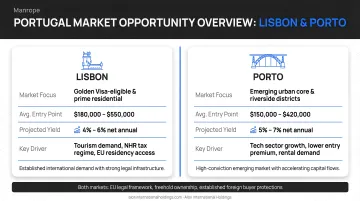
Lisbon averages €5,886/m² with gross rental yields around 3.79%, while Porto sits at €3,309/m² yielding 4.32% nationally. Secondary markets offer stronger fundamentals: the Setúbal Peninsula (Silver Coast proxy) averages €2,710/m² with 5.09% yields, and Alentejo Litoral trades at €2,128/m².
Lower-competition markets still offer entry points under €250,000 with strong rental demand driven by tourism and the growing digital nomad community. Alori International Holdings has direct market expertise in Portugal with curated opportunities, verified legal structures, and defined exit strategies for international buyers.
| Category | Details |
|---|---|
| Average Price Range | Lisbon: €5,886–€6,425/m²; Porto: €3,309–€3,844/m²; Silver Coast: €2,710/m²; Typical total price: €150K–€600K investment band |
| Transaction Costs | IMT transfer tax up to 7.5% (8% for non-primary residences between €324K–€648K); Stamp duty 0.8%; Notary/legal €500–€1,200; Total: 6–10% |
| Residency / Investment Highlight | NHR (Non-Habitual Resident) tax regime ended 2024; new IFICI offers 20% flat tax for 10 years (limited to R&D/tech sectors); Golden Visa via direct property purchase closed Oct 2023; €500K fund-based route remains active |
Greece
Greece stands out for full foreign ownership rights, an active property-linked Golden Visa program with tiered thresholds, and price-to-quality ratios that remain compelling versus Western European peers.
Investment Case:
Athens South (Riviera) averages €4,091–€4,125/m² with ~5.43% gross yields, while Athens Center trades at €2,439/m². Crete averages ~€2,105/m². Tourism-driven short-term rental markets in Crete, Peloponnese, and Thessaloniki offer dual-use investment potential.
Transaction process requires a Greek tax number (AFM), local bank account, and notary—typically 2–3 months to completion. Greece extended its 24% VAT suspension on new builds until December 31, 2026, meaning buyers pay only 3.09% transfer tax.
| Category | Details |
|---|---|
| Average Price Range | Athens South: €4,091–€4,125/m²; Athens Center: €2,439/m²; Crete: €2,105/m²; Typical 2-bed: €150K–€400K depending on location |
| Transaction Costs | Transfer tax (FMA) 3.09%; Notary fees 0.8–1.2% + 24% VAT; Legal fees 1–2% + 24% VAT; Total: 8–12% |
| Residency / Investment Highlight | Golden Visa thresholds: €800K in Athens/Thessaloniki/major islands (min. 120m²); €400K all other regions; €250K for commercial-to-residential conversions; renewable every 5 years; citizenship after 7 years continuous residence (183 days/year) |
Cyprus
Cyprus is a Euro-denominated EU market with straightforward foreign ownership rules. Non-EU buyers need Council of Ministers approval, but it's typically granted within 2–3 weeks — a minor procedural step, not a meaningful barrier. Low crime rates and a high-quality lifestyle make it a consistent draw for second-home buyers and full-time relocators.
Investment Case:
Limassol new apartments average €426,000 yielding 5.29%, Paphos averages €312,000 (4.25% yield), and Nicosia averages €190,000 (4.78% yield). National average sits around €2,518/m².
Cyprus abolished stamp duty effective January 1, 2026, significantly reducing transaction costs. A 5% reduced VAT rate applies to the first 130m² of primary residences (up to €350K value, max property size 190m²).
A €300,000+ purchase with five-year hold qualifies for Cyprus Permanent Residence—one of Europe's most accessible residency-by-investment thresholds.
| Category | Details |
|---|---|
| Average Price Range | Limassol: €426,000 avg; Paphos: €312,000 avg; Nicosia: €190,000 avg; €2,518/m² national average |
| Transaction Costs | Transfer fees: 3% up to €85K, 5% €85K–€170K, 8% over €170K (50% reduction if no VAT charged); VAT 19% standard or 5% reduced (first 130m² primary residence); Stamp duty abolished Jan 2026; Legal fees 1% or €2,000–€5,000; Total: 1.5–8% (resale) or 5–19% (new build) |
| Residency / Investment Highlight | Category 6.2 Permanent Residence: €300K+ new-build investment, 5-year hold, proof of €50K annual foreign income; visit Cyprus once every 2 years; EU healthcare/education access; citizenship eligible after 7 years legal residence |
Spain
Spain operates a mature, liquid real estate market with well-established legal protections for foreign buyers: no ownership restrictions, a clear NIE registration process, and strong buyer infrastructure across all major regions. Spain officially abolished its real estate Golden Visa effective April 3, 2025. That shifts Spain's appeal squarely onto investment and lifestyle fundamentals.
Investment Case:
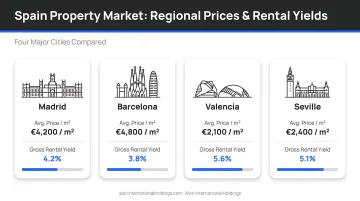
Regional price variation offers distinct investment profiles. Madrid averages €5,820/m² yielding 5.04%, Barcelona €5,176/m² (7.17% yield), Málaga €4,023/m² (4.65% yield), and Valencia coastal areas ~€2,460/m² (6.11% yield).
Rental demand is structurally strong in tourist coastal areas, but transaction costs (10–13%) rank among Europe's highest and must be factored into ROI calculations. Regional transfer tax (ITP) varies widely: Andalusia 7%, Madrid 6%, Valencia 9%, and Catalonia's progressive scale reaches 13% over €1.5M.
| Category | Details |
|---|---|
| Average Price Range | Madrid: €5,820/m²; Barcelona: €5,176/m²; Valencia Coast: €2,460/m²; Málaga: €4,023/m²; Total purchase range: €150K–€600K+ |
| Transaction Costs | ITP transfer tax 6–13% (highly regionalized); VAT on new builds 10% + 0.5–1.5% stamp duty (AJD); Notary ~€1,750; Registry ~€1,000; Legal fees 1% + VAT; Total: 10–12% |
| Residency / Investment Highlight | Golden Visa ended April 2025; property purchase no longer grants residency; Non-Lucrative Visa remains option for buyers planning to reside; Spain's value proposition: pure investment/lifestyle play with strong market liquidity |
Georgia
Georgia is one of Europe's lowest-friction markets for foreign buyers. All nationalities can purchase residential and commercial property with zero restrictions (agricultural land excluded). Title transfer can complete in a single day, and total legal and registration fees typically run under 1% of purchase price.
Investment Case:
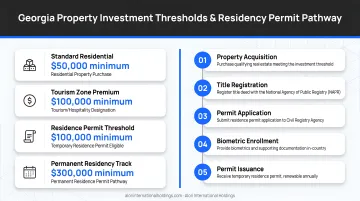
Tbilisi averages $1,200–$1,500/m² with gross rental yields of 7.2–7.5%. Batumi (Black Sea coastal hub) averages $1,865/m² yielding 7.4%. Entry-level studio apartments in Batumi start around $50,000.
A $100,000+ real estate investment qualifies for a one-year renewable residence permit (threshold increases to $150,000 effective March 1, 2026). Alori International Holdings operates directly in the Tbilisi and Batumi markets, providing investors with off-market access and data-grounded analysis on both micro-markets.
| Category | Details |
|---|---|
| Average Price Range | Tbilisi: $1,200–$1,500/m²; Batumi: $1,865/m²; Entry price: $50K–$150K (studios/1-beds); Investment range: $100K–$600K |
| Transaction Costs | Property transfer tax: 0%; Registration fees: 150–350 GEL (~$50–$130); Legal/translation fees optional; Total: <1% |
| Residency / Investment Highlight | $100K+ investment = 1-year renewable residence permit (increases to $150K threshold March 1, 2026); $300K investment = 5-year permit leading to permanent residency; 5% flat tax on rental income; 0% capital gains tax after 2-year hold; no inheritance or wealth tax |
Key Costs and Legal Considerations Foreign Buyers Overlook
Beyond the listed purchase price, foreign buyers must budget for transaction costs ranging from under 1% in Georgia to 13% in parts of Spain. That spread can quietly erase a year or two of projected returns if buyers don't account for it upfront.
Closing Cost Comparison:
| Country | Estimated Total Closing Costs | Primary Drivers |
|---|---|---|
| Georgia | <1% | 0% transfer tax; flat registration fees ($50–$130) |
| Cyprus | 1.5–8% (resale) / 5–19% (new) | Transfer fees (discounted 50%) OR VAT; stamp duty waived from 2026 |
| Portugal | 6–10% | Progressive IMT (up to 7.5%) + 0.8% stamp duty |
| Greece | 8–12% | 3.09% FMA + notary (1%) + legal (1–2%) |
| Spain | 10–12% | Regional ITP (6–13%) + notary/registry + legal (1%) |
Legal Due Diligence Layer
Every foreign buyer should verify three things before contracts are signed:
- Title status — search the land registry for liens, debts, or ownership disputes
- Building permits — confirm any construction or renovation was properly authorized
- Zoning compliance — particularly in Greece and Italy, where undisclosed encumbrances are common
Retain an independent local lawyer — not the seller's agent — to handle this. Notary-based systems in Spain, Portugal, and Greece certify transaction legality, but that's not the same as protecting your interests as a buyer. Only your own counsel does that.
Financing Realities for Non-Residents
Mortgages exist in Spain, Portugal, and Greece for non-residents but typically require:
- 30–40% down payments
- Local tax number registration
- Foreign income documentation
- Interest rates between 3.0–4.2%
For American investors in the $150K–$600K range, cash purchase remains the most common route — faster to close and far less documentation. See how non-resident mortgages work in Spain if financing is on the table.
Visas, Residency, and the 90/180-Day Rule
Understanding Schengen Limitations
The Schengen Area allows visa-exempt Americans a maximum of 90 days in any rolling 180-day period across the entire zone. Portugal, Spain, France, Italy, and Greece fall within Schengen. Property ownership does NOT extend this. Overstaying carries fines and potential travel bans. Cyprus is the exception here — it sits outside Schengen entirely, giving Americans a separate 90-day allowance that doesn't count against the Schengen quota.
For buyers planning longer stays, residency programs are the practical solution. Each country covered in this guide offers a route — the requirements and benefits vary considerably.
Residency Pathways in Featured Countries
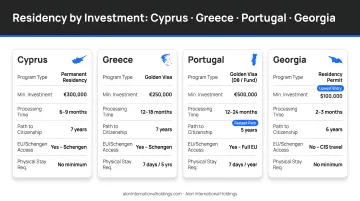
- Cyprus: €300K property + €50K annual foreign income = Permanent Residency; visit once every 2 years; citizenship after 7 years
- Greece: €250K–€800K Golden Visa (tiered by location); renewable every 5 years; citizenship after 7 years continuous residence (183 days/year)
- Portugal: Direct property Golden Visa closed Oct 2023; €500K fund-based route active; IFICI tax regime (20% flat tax, 10 years) limited to R&D/tech professionals
- Georgia: $100K+ property = 1-year renewable permit (increases to $150K March 1, 2026); $300K = 5-year permit leading to permanent residency
A note on US tax obligations: Buyers planning extended stays should work with an immigration attorney alongside a real estate advisor. Establishing tax residency abroad triggers FBAR and FATCA reporting requirements — compliance starts before you move, not after.
Conclusion
Europe's best property markets for foreign buyers combine legal clarity, transparent transaction processes, structural demand fundamentals, and meaningful residency optionality. Portugal, Greece, Cyprus, Spain, and Georgia each offer distinct value propositions within the $150K–$600K range American buyers are targeting.
The difference between a rewarding international property investment and a costly mistake comes down to three things: market selection discipline, in-country legal due diligence, and working with advisors who understand both global capital strategy and local execution. Buying in a country that simply sounds appealing is not a strategy.
Alori International Holdings takes a selective, data-driven approach to international real estate — with deep expertise in Portugal and Georgia, access to off-market opportunities, and local networks built to navigate each market with confidence. Reach out at info@aloriinternationalholdings.com to start a consultation.
Frequently Asked Questions
Which European country is best to buy property as a foreigner?
It depends on your goals (investment returns, lifestyle, residency). Portugal and Georgia lead for low transaction costs and strong fundamentals, while Greece and Cyprus offer active residency programs tied to property investment. Spain provides mature market liquidity but ended its Golden Visa in April 2025.
Which European countries allow Americans to buy property?
Most European countries allow Americans to buy residential property without restrictions or residency requirements. Notable exceptions include agricultural land restrictions in Eastern Europe and quota systems in Switzerland. Getting a local tax number (NIE, AFM, or NIF) is usually the first step.
What are the typical transaction costs when buying property in Europe?
Transaction costs (taxes, notary, legal fees) range from under 1% in Georgia to 10–13% in Spain. Greece averages 8–12%, Portugal 6–10%, and Cyprus 1.5–8% for resales or 5–19% for new builds. Always budget these on top of the asking price.
Do I need to live in the country to buy property in Europe?
None of the countries covered here require residency before purchase. Buyers can own property as non-residents. However, long-term stays beyond 90 days in Schengen countries require a separate visa or residency permit.
Is buying property in Europe a good investment for Americans?
For the right buyer—yes. Portfolio diversification, rental income in tourism-heavy markets, and inflation hedging are all real advantages. Returns depend heavily on market selection, entry price discipline, and how well the deal is structured on the ground rather than country popularity alone.
Can I get a mortgage as a foreign buyer in Europe?
Yes, mortgages for non-residents exist in Spain, Portugal, and Greece but typically require 30–40% down payments and proof of foreign income. Cash purchases are more common among foreign buyers and sidestep currency risk and documentation hurdles with foreign lenders.