
Introduction
In 2025, the promise that buying property in Europe unlocks a European passport has become more myth than reality. For decades, wealthy investors secured EU citizenship through real estate purchases with minimal residency requirements. A landmark Court of Justice of the European Union (CJEU) ruling in April 2025 declared such schemes illegal, closing the door on "golden passports" across the bloc.
Pathways still exist, though not the ones most American investors expect. A small number of EU countries continue to offer Golden Visa residency programs tied to real estate investment. These grant the legal right to live in a country and eventually apply for citizenship through standard naturalization — typically after 7–10 years of residence.
The distinction between a residency permit and actual citizenship shapes every financial and legal decision in this process. Knowing which you're pursuing determines where you invest, how much you commit, and how long you wait.
Key Takeaways
- Direct EU citizenship through real estate purchase alone ended in 2025 when the CJEU ruled against Malta's golden passport scheme
- Greece, Malta, Hungary, and Latvia still offer Golden Visa residency programs tied to real estate or fund investments, with naturalization possible after 7–10 years
- Minimum investment thresholds range from €250,000 (Greek conversion projects) to €800,000 (premium Greek zones)
- Residency permits take 3–9 months to process; citizenship adds 7–10 years of legal residence, language tests, and integration requirements on top
- Programs face ongoing EU scrutiny and may change: work with current legal expertise before committing
What "European Citizenship by Real Estate Investment" Actually Means in 2025
The original concept was simple and appealing: "golden passport" programs allowed wealthy investors to purchase EU citizenship directly through real estate and financial contributions, with no long-term residence required. These schemes effectively sold not just national citizenship but EU-wide rights—including freedom of movement across 27 member states.
The End of Golden Passports
On April 29, 2025, the CJEU ruled that Malta's citizenship-by-investment scheme was illegal, describing it as the "commercialisation of EU citizenship." The court determined that granting nationality in direct exchange for predetermined payments without a genuine link to the state violates EU law principles of sincere cooperation. Malta officially discontinued its Citizenship by Naturalisation for Exceptional Services (CES) program in July 2025, removing all legislative references.
For investors who had been exploring EU passport routes, the landscape has fundamentally shifted — but alternatives remain.
What Remains Open: Residency-by-Investment
Golden Visa programs—which grant residency permits rather than citizenship—remain legal, though under increasing scrutiny. The critical distinction:
- Closed: Direct citizenship via investment alone
- Available: Residency-by-investment programs that grant the right to live in a country and eventually apply for citizenship through standard naturalization after several years
What a Golden Visa Actually Gives You
A Golden Visa is not a passport. It is a legal residency status offering:
- Schengen travel access (90 days in any 180-day period across Schengen countries)
- The right to live and operate in the issuing country
- A long-term pathway to citizenship if residency and integration requirements are met
Residency does not automatically lead to citizenship. Most pathways require 7–10 years of legal residence, language proficiency tests, and proof of genuine connection to the country.
The Regulatory Trend
The direction of travel across Europe has been consistent — contraction, not expansion:
- Spain eliminated its real estate Golden Visa route effective April 3, 2025
- Ireland closed its program in February 2023
- Portugal removed property from eligible investments in October 2023, shifting to fund-based pathways
- Greece, Malta, Hungary, and Latvia currently maintain programs but remain under Brussels scrutiny
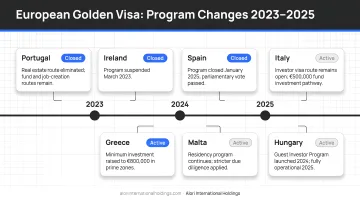
Any of these programs could change with little notice.
European Countries Still Offering Real Estate-Based Pathways
As of mid-2025, four countries retain property-linked residency programs with viable citizenship pathways: Greece, Malta, Hungary, and Latvia. Each has different thresholds, timelines, and requirements. Portugal's Golden Visa shifted entirely to fund-based investments and no longer qualifies as a real estate route.
Greece Golden Visa
Greece operates a tiered investment structure based on property type and location:
- €250,000: Conversion/restoration projects (commercial-to-residential conversions or historic building restorations) nationwide — conversion must be completed before applying
- €400,000: Most regions across Greece for properties of at least 120 sq.m.
- €800,000: High-demand zones including Athens, Thessaloniki, Santorini, Mykonos, and islands with populations exceeding 3,100
Greece requires no minimum stay to maintain residency — a practical advantage for investors who don't plan to relocate immediately.
One firm restriction: Golden Visa properties cannot be used for short-term rentals, such as Airbnb.
Citizenship becomes available after 7 years of legal residence. Applicants must demonstrate B1-level Greek language proficiency, knowledge of Greek history and culture, and genuine ties to the country. Approval is discretionary — not guaranteed.
Malta Permanent Residence Programme (MPRP)
The MPRP requires a combination of property commitment, government fees, and a charitable donation:
- Property purchase: €300,000 in the South of Malta or Gozo, or €350,000 in the rest of Malta
- OR property lease: €10,000 annually (South/Gozo) or €12,000 annually (Mainland)
- Government contribution: €28,000 (if purchasing) or €58,000 (if leasing)
- Administration fee: €40,000
- Charitable donation: €2,000 to a registered NGO
This grants lifetime permanent residence with Schengen access and no physical stay requirement.
Citizenship Route: Malta previously offered citizenship through its Naturalisation for Exceptional Services (CES) program, which required an additional €600,000–€750,000 contribution, a property commitment, and 12–36 months of residency. Following the April 2025 CJEU ruling, EU pressure forced Malta to discontinue the CES route entirely. The MPRP remains active as a permanent residency program only.
Hungary Golden Visa
Hungary's Guest Investor Program (launched 2024) requires:
- Minimum investment: €250,000 in approved real estate investment funds registered by the Hungarian National Bank — not direct property purchase
- Fund allocation: At least 40% of the fund's net asset value must be allocated to residential real estate in Hungary
- Holding period: Minimum 5 years
- Residency permit: 10-year renewable permit with full Schengen access
- Stay requirement: None
Hungary discontinued direct property purchases effective January 1, 2025, shifting to the fund-based structure above. The government is actively resisting EU pressure to close the program altogether.
Latvia Golden Visa
Latvia's program requires:
- Minimum investment: €250,000 in qualifying property
- Government fee: 5% of the property's purchase price
- Residency permit: 5-year renewable temporary residence permit
Citizenship is available after 10 years of full legal residence, with Latvian language proficiency required. At a decade-long timeline, this suits investors committed to long-term European integration rather than those seeking a faster passport route.
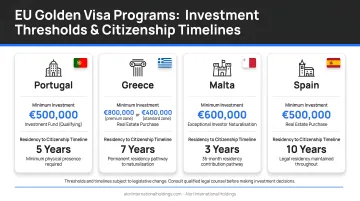
Quick Comparison: Four Active Programs
| Country | Min. Investment | Permit Length | Stay Required | Citizenship Timeline |
|---|---|---|---|---|
| Greece | €250,000–€800,000 | 5-year renewable | None | 7 years |
| Malta | €300,000–€350,000 (purchase) | Lifetime PR | None | Not available (CES discontinued) |
| Hungary | €250,000 (fund) | 10-year renewable | None | Not a primary pathway |
| Latvia | €250,000 | 5-year renewable | None | 10 years |
How the Process Works: From Property Purchase to Residency
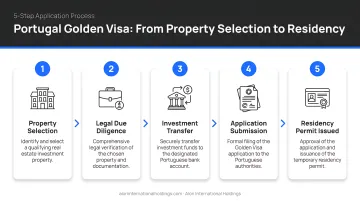
The end-to-end process involves:
- Selecting a qualifying country and property
- Conducting due diligence
- Completing the purchase
- Submitting the residency application
- Maintaining compliance through renewal cycles
Regardless of which country you choose, most programs share a baseline set of personal eligibility requirements:
- Clean criminal record
- Proof of legal source of funds
- Valid health insurance
- Demonstrated income or net worth thresholds (varies by country)
Step 1: Country Selection and Property Qualification
Not every property in a qualifying country automatically qualifies. Confirm that the specific transaction meets the program's eligibility criteria across these dimensions:
- Approved zones and regions
- Property type (residential, commercial, conversion)
- Minimum valuation thresholds
- Developer approval (where required)
- Investment structure (direct property vs. fund investment)
Step 2: Due Diligence, Document Preparation, and Legal Setup
This phase typically takes 30–60 days. Budget adequate time — rushing it increases the risk of errors that delay the residency application.
- Background checks on the investor
- Document collection (passport, financial records, criminal background)
- Translation and notarization of documents
- Engaging a licensed local lawyer
A qualified local attorney is non-negotiable here. They verify title structures, flag transaction irregularities, and ensure your purchase deed will satisfy the immigration authority's requirements.
Step 3: Property Purchase and Investment Completion
With due diligence complete, the transaction moves into formal execution:
- Signing preliminary contracts
- Opening a local bank account
- Transferring funds from verifiable legal sources
- Completing the notarized purchase deed
- Registering the property in the investor's name
Once the property is registered, you have the documentation needed to file your residency application.
Step 4: Residency Application and Renewal
After the property purchase, the immigration process follows a consistent sequence across most programs:
- Biometric data collection
- Submission to the relevant immigration authority
- Waiting period (see processing times below)
- Issuance of the residence permit card
Renewal Obligations: Track minimum stay requirements (if any) to preserve the citizenship pathway timeline. Most programs require holding the property for at least 5 years before sale.
Processing Times by Country:
- Hungary: 21 days (fastest)
- Latvia: 1–3 months
- Malta: 6–12 months
- Greece: 12–16 months (due to backlogs in high-demand areas)
Key Factors That Determine Success for American Investors
U.S. Tax Reporting Obligations
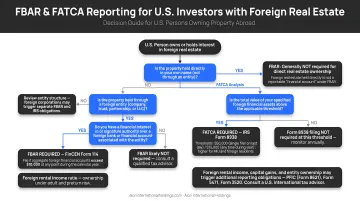
American investors must account for FBAR and FATCA reporting requirements:
Direct Property Ownership:
- Foreign real estate held directly (in the individual's name) is exempt from both FBAR and FATCA Form 8938 reporting
- FBAR (FinCEN 114): Required only if foreign financial accounts exceed $10,000 aggregate value
- FATCA (Form 8938): Required if specified foreign financial assets exceed $50,000 (single) or $100,000 (married filing jointly)
Foreign Entity Ownership:
- Holding property through a foreign corporation, partnership, or trust triggers complex IRS information returns:
- Form 5471: Required for 10%+ ownership in a foreign corporation
- Form 8865: Required for 10%+ interest in a controlled foreign partnership
- Form 3520: Required for foreign trust transactions or foreign gifts/bequests exceeding $100,000
Why Market Intelligence and Local Expertise Matter
The two highest-risk points for American buyers entering unfamiliar markets are overpaying due to inaccurate pricing intelligence and encountering legal or title issues due to unfamiliar transaction processes.
Alori International Holdings addresses both risks through two complementary capabilities:
- Quantitative market analysis — evaluating macroeconomic indicators, demographic trends, capital flows, regulatory frameworks, and historical asset performance to identify accurate entry points
- In-country legal and property expertise — navigating local regulations, verifying title structures, and assessing developer credibility before any capital is committed
Exit Strategy Alignment
Sound due diligence naturally extends to what happens at the end of the holding period. Most programs require holding the property for 5 years before sale, so investors should evaluate:
- Rental income potential during the holding period (typical yields: 5–12% annually depending on property type and location)
- Realistic resale market conditions
- Whether the investment thesis holds independent of the residency benefit
Properties should generate value through rental income or capital appreciation, not solely as a residency vehicle.
Common Misconceptions About Buying European Citizenship Through Real Estate
Misconception #1: Buying Expensive Property = Quick Citizenship
A qualifying property purchase gets you residency — not citizenship. Those are two very different legal statuses. In most EU countries, citizenship requires 7–10 additional years of legal residence, demonstrated language proficiency, and proof of integration. The property is the entry point, not the finish line.
Misconception #2: Golden Visa Programs Are Permanent and Stable
Several major programs (Spain, Ireland, Portugal property route) have closed in recent years. Hungary eliminated direct property purchases effective January 2025. Investors who assume program stability may be acting on outdated assumptions — and that's a costly mistake when timelines and capital are on the line.
Misconception #3: Golden Visa = EU-Wide Freedom of Movement
Even where Golden Visa programs remain open, it's worth understanding what they actually provide. Schengen travel access — available to most Golden Visa holders — is not the same as the right to live, work, or relocate freely across all EU member states. That requires full EU citizenship or a separate work permit in each country. A residency permit in Greece, for example, does not allow an investor to simply relocate to Germany.
Frequently Asked Questions
What European countries offer citizenship through real estate investment?
Direct citizenship through real estate alone is no longer available in the EU following the 2025 CJEU ruling. Greece, Malta, Latvia, and Hungary offer residency programs via real estate or fund investment that can lead to citizenship after 7–10 years of legal residence.
Which EU country is the easiest to get citizenship by real estate investment?
Greece is generally considered the most accessible entry point, with investment thresholds starting at €250,000 in select zones, a 7-year citizenship pathway, and no minimum stay requirement. That said, "easiest" depends on the investor's goals, budget, and willingness to establish genuine ties to the country.
How much do you need to invest in real estate in Europe to get citizenship?
Investment minimums range from €250,000 (Greece, select conversion zones; Latvia direct property) to €800,000 (Greece, premium zones). Malta's discontinued citizenship route required over €1.3 million total. These figures can change—verify current thresholds before proceeding.
Is EU citizenship by investment still legal after the 2025 CJEU ruling?
The CJEU ruling targeted direct citizenship-for-cash schemes (specifically Malta's golden passport). Residency-by-investment programs with a long-term naturalization pathway remain legal, though under increasing regulatory scrutiny across the EU.
Can Americans buy property in Europe to get residency or citizenship?
Yes, U.S. citizens are eligible for most European Golden Visa programs. Americans face additional reporting obligations (FBAR, FATCA) on foreign property and bank accounts and should consult a cross-border tax advisor before proceeding.
How long does it take to get citizenship through European real estate investment?
The residency permit itself typically takes 3–9 months after the property purchase. Citizenship then requires an additional 7 years (Greece) to 10 years (Latvia) of legal residence, plus language tests and integration requirements. Most investors should plan for a full timeline of 8–11 years from first investment to passport.