

Introduction
US coastal home prices have climbed more than 40% since 2020, yet rental yields in many of those same markets have compressed to 2–3%. Meanwhile, European markets like Portugal are generating net yields of 5–7% on properties priced well below comparable US vacation homes. For American investors caught between overvalued domestic assets and depreciating cash, that gap is difficult to ignore.
European property offers what most domestic markets no longer can: affordable entry points, income that covers carrying costs, and capital growth tied to structural demand rather than speculation.
The hesitation is understandable. European property sounds complicated, expensive, and reserved for ultra-wealthy elites. But that perception no longer reflects reality. Markets like Portugal offer well-located properties for $150,000–$600,000 — well below comparable US vacation homes — while delivering rental income that offsets ownership costs and capital growth supported by structural demand.
This article breaks down the financial case for buying a European holiday home now — covering post-pandemic pricing dynamics, the current USD-to-EUR advantage, rental demand trends, and what the buying process actually looks like for American investors.
Key Takeaways
- European holiday home prices have stabilized, creating buying conditions driven by fundamentals rather than speculation
- Portuguese properties deliver 5–12% annual rental yields backed by sustained tourism and expat demand
- Short-term rental income offsets property taxes, insurance, and management costs across key European markets
- A strong USD gives American buyers meaningful purchasing power in Portugal and other European markets right now
- Advisors who combine global strategy with in-country expertise reduce legal, pricing, and exit risk
What a European Holiday Home Investment Really Means Today
A European holiday home in 2025 is not a single-purpose asset. It functions at once as a lifestyle property (personal use), an income generator (short or long-term rental), and a capital appreciation vehicle. Which function dominates depends entirely on your goals.
For most American buyers in the $150,000–$600,000 range, the primary objective is wealth preservation combined with access to a higher quality of life — not speculative flipping. European markets reward this long-term mindset with stable regulatory frameworks, transparent ownership structures, and decades of consistent appreciation data behind them.
That long-term case holds even as recent headlines about foreign buyer restrictions, overtourism taxes, and rental crackdowns have rattled some investors. Well-chosen markets with stable regulatory environments — such as Portugal — remain fully accessible and welcoming to foreign investors. The key is avoiding saturated urban cores and focusing on emerging coastal regions where regulations support sustainable growth rather than imposing blanket freezes.
Key Reasons to Buy a European Holiday Home Now
The following advantages are grounded in market fundamentals, macroeconomic timing, and real-world ownership outcomes — not lifestyle fantasy or wishful thinking.
Strong Capital Appreciation in High-Demand Markets
Select European markets have demonstrated consistent long-term price growth supported by structural demand drivers: limited housing supply, international buyer interest, and in-migration trends.
EU-wide house prices increased 64.9% from 2015 to Q4 2025, with Portugal recording a massive 180% cumulative increase over the same period — the highest growth among Western European nations. In Q3 2025 alone, Portugal's House Price Index rose 17.7% year-over-year, while Spain recorded 11.3% annual growth.
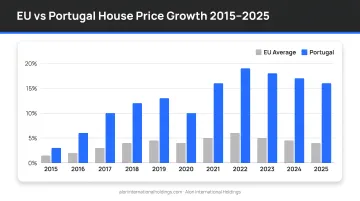
This appreciation reflects fundamentals, not speculation. Tourism demand remains exceptionally strong — Portugal's tourism exports surpassed €4.3 billion in monthly revenue in 2024, while Spain welcomed a record 93.8 million international tourists, including 4.26 million Americans.
Why this matters:
- Entry at stabilized price points in structurally demanded markets positions you for the next appreciation cycle
- Premium, accessible markets with international buyer demand hold value through economic cycles better than oversupplied areas
- American buyers entering now get realistic valuations, not peak momentum pricing
This dynamic is most relevant to buyers 5–15 years from potential retirement who want a capital asset that appreciates while generating interim income — and want exposure outside US domestic real estate cycles. That profile connects directly to the income question: whether the property can carry itself financially in the years before you use it full-time.
Real Rental Income That Can Offset Ownership Costs
Europe's short-term rental market has rebounded strongly post-pandemic. Travel demand — particularly from North American and Northern European visitors — is driving high occupancy in Mediterranean, Atlantic coast, and historic city markets.
A well-located holiday home, managed properly, can generate rental income during peak and shoulder seasons that offsets or eliminates ongoing ownership costs: property taxes, insurance, utilities, and management fees.
Current rental performance:
- Lisbon averages 67% occupancy with €143 average daily rates, generating approximately €24,000 annual revenue for active listings
- Portuguese luxury villas deliver 5–10% annual rental yields in tourist-driven markets
- Branded residences and resort apartments achieve 7–12% annual yields through professional management
Two viable ownership models exist: lifestyle-first owners who rent occasionally to cover costs, and income-first owners who structure use around maximizing rental yield. Both reduce the net cost of ownership substantially.
Critical regulatory context:
Portugal's regional licensing framework protects long-term rental income by preventing market oversaturation. Decree-Law 76/2024 decentralized licensing authority to municipalities, allowing them to establish "containment zones" where new licenses are restricted.
Lisbon's historic center has implemented absolute contention zones — licenses expire upon property sale — but the Algarve and emerging coastal markets remain open with standard compliance requirements. Buyers who understand this framework can target markets where rental income remains both legal and durable.

When this matters most: Buyers planning 4–12 weeks of personal use annually who want the property to carry itself financially the remainder of the time — a profile fitting most American second-home buyers.
Portfolio Diversification and USD Currency Advantage for American Buyers
For American investors, purchasing European real estate is simultaneously a geographic diversification play and a currency opportunity.
USD purchasing power remains strong. The 2025 annual average exchange rate sits at 1.1300 USD/EUR, highly competitive against the 10-year average of 1.1188. American buyers acquire Euro-denominated assets with built-in purchasing power advantages relative to local buyers.
Real assets in stable foreign markets provide a hedge against domestic inflation, USD devaluation cycles, and US equity market volatility — exposure that holding more US-denominated assets cannot address.
Why this matters:
- European real estate in markets like Portugal offers low correlation to US equities and bonds, reducing overall portfolio volatility
- Buying Euro-denominated assets with a strong USD creates favorable acquisition economics
- Geographic diversification reduces exposure to US domestic market risk, regulatory changes, and economic cycles
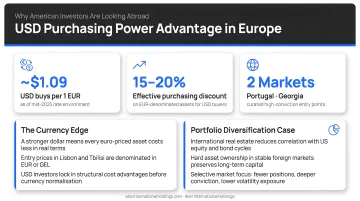
Alori International Holdings focuses on exactly this market entry challenge — vetting specific projects in Portugal for legal compliance, accurate pricing, and clear exit paths. The goal is removing the friction that typically prevents American buyers from moving from interest to execution.
When this matters most: High-net-worth and upper-middle-class American investors who already have significant US equity and domestic real estate exposure and are seeking genuinely diversified, inflation-resistant international holdings.
What Happens When You Delay the Decision
Hesitation compounds costs. Every year spent waiting in a steadily appreciating market means:
- Capital gains missed as prices rise
- Rental income forgone on a property you don't yet own
- A higher entry price when you finally decide to act
Post-pandemic stabilization periods in markets like Portugal don't last indefinitely. As interest rates normalize globally and more international buyers re-engage, demand will outpace constrained supply again. The ECB cut its deposit facility rate to 2.25% by April 2025, directly stimulating local mortgage demand and transaction volumes.
The transaction data confirms the momentum: Spanish sales rose 7% year-over-year in Q3 2025, while Portuguese transactions climbed 3.8% YoY. The window to buy ahead of that demand curve is narrowing.
There's also a currency risk American buyers rarely factor in. If the USD weakens against the EUR in coming years, the same Euro-denominated property costs more in dollar terms — without the price tag ever changing. Waiting is not a neutral position. It's a bet that everything stays in your favor.
Buyers who acted in 2020–2022 are already experiencing this effect. Markets have moved, and entry points have shifted upward.
How to Navigate Your European Holiday Home Purchase the Right Way
The most common source of regret among first-time international property buyers is not the market they chose but the process they followed.
Common mistakes include:
- Relying on local agents with conflicting incentives
- Skipping independent legal review
- Entering markets without understanding exit and rental strategies in advance
- Underestimating total transaction costs and ongoing ownership expenses
Each of these mistakes is avoidable with the right framework in place before you sign anything. A thorough due diligence process should cover:
- Verified legal ownership structure with transparent property registration
- Independent valuation to confirm you're not overpaying
- Clarity on rental licensing requirements and municipal regulations
- Tax obligations in both the purchase country and your home country
- A defined exit pathway with liquidity analysis and resale planning
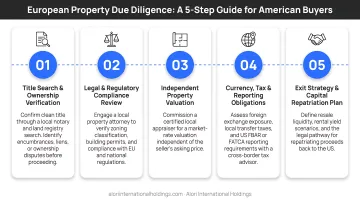
Working with an advisor who integrates global investment strategy with in-country execution is the most direct path to off-market opportunities and accurate pricing. Alori International Holdings, for example, pairs macroeconomic analysis with local market professionals in Portugal to ensure clients enter at the right price — with legal structure and exit strategy settled before capital is committed.
Conclusion
The case for buying a European holiday home now comes down to three compounding advantages:
- Capital appreciation in fundamentals-driven markets
- Rental income that offsets holding costs
- Portfolio diversification with a favorable USD entry point
All three are time-sensitive. Delay is a financial decision, not just a lifestyle deferral.
Acting on that decision means navigating real risks — legal complexity, foreign regulations, currency exposure — but none of these are dealbreakers with the right expertise in place. Buyers who get the most out of European property approach it as an ongoing investment strategy, building knowledge and relationships across cycles rather than executing a single transaction and stepping away.
The European holiday home market in 2025 rewards the thoughtful, long-term buyer. Sellers are realistic, markets are balanced, and the window between the 2022–2024 repricing period and the next demand-driven appreciation cycle remains open. That window won't stay open on the same terms.
Frequently Asked Questions
What is the best country in Europe to buy a holiday home?
Portugal and Spain lead on lifestyle quality, investment fundamentals, and rental market strength — Portugal delivering yields of 5–12% annually through transparent ownership frameworks and strong tourism demand. The right choice depends on whether you're prioritizing capital growth, rental income, or personal use frequency.
Is it still worth buying a holiday home in Spain?
Yes. Despite recent headlines about proposed foreign buyer taxes and rental restrictions, well-advised buyers in established markets (Balearics, Costa del Sol) are transacting with confidence. Clearer rental zoning and licensing requirements have made due diligence more straightforward, not more prohibitive. Foreign buyers purchased nearly 93,000 homes in Spain in 2024.
How much does it cost to buy a holiday home in Europe?
Entry-level properties are available from €150,000–€300,000 in markets like rural France or inland Portugal. The Algarve averages €3,988 per square meter, while Spain's Costa del Sol reaches €3,842 per square meter. Budget an additional 8–10% for transfer taxes, stamp duty, notary fees, and legal costs.
Can Americans buy property in Europe?
Yes. Americans can purchase property freely in most EU countries, including Portugal and Spain, with no restrictions on ownership. However, property purchase does not automatically confer residency rights — those require a separate visa or residency application through qualifying investment structures.
What are the tax implications of owning a holiday home in Europe as an American?
Americans owe taxes in the country where the property sits (property and rental income taxes) and must continue meeting US reporting requirements — FBAR, FATCA, and foreign income disclosures. Consult a cross-border tax advisor before purchasing to map your full compliance picture.
How do I finance a holiday home purchase in Europe?
Most non-resident American buyers in the $150,000–$400,000 range pay in cash or tap equity from existing US property. Local bank mortgages are available in Portugal and Spain for non-residents, typically at 60–70% LTV, though approval criteria are stricter than domestic lending.