

Introduction
European property prices have cooled from pandemic highs, the dollar still holds relative strength against the euro, and interest rates are shifting across the continent. For American investors watching these signals, the question is pointed: is this a genuine entry window, or a trap?
The answer isn't simple. Buying at the wrong stage of the cycle can mean overpaying by 15–20% and locking into a depreciating asset. Buying at the right time, with the right market and the right hold period, can build meaningful returns over 7–10 years.
This article breaks down the macroeconomic signals, investor-profile scenarios, and warning signs to help you decide whether the timing is right for your situation. In European real estate, the calendar matters less than the convergence of market conditions, your financial position, and how long you're prepared to hold.
Key Takeaways
- Europe's property market is in a post-correction phase, with prices stabilizing after 8–13% drops from 2022 peaks
- Timing depends on your investor profile, target country, currency position, and investment horizon
- Positive signals include ECB rate easing, structural housing undersupply, and normalizing price-to-rent ratios
- Watch for overvalued micro-markets, transaction costs of 8–15%, and entering without a clear exit strategy
- The biggest timing mistake: waiting for the "perfect" market bottom that's only visible in hindsight
Why Timing Matters When Buying Property in Europe
European real estate carries high entry and exit costs that make timing critical. Transfer taxes, notary fees, agent commissions, and legal fees can range from 8% to 15% depending on the country. In Spain, these costs often reach 10–12%; in Portugal, 8–10%; in Greece, 8–9%. Buying at the wrong point in the cycle means years of appreciation just to break even.
Longer Cycles, Higher Stakes
The European property market operates in longer cycles than typical U.S. property cycles — driven by ECB monetary policy, regional economic fundamentals, and political factors like Golden Visa programs, rental regulations, and foreign ownership rules. A poorly-timed entry in 2021 could still leave you underwater in 2025, even in fundamentally strong markets.
The Currency Layer
American investors face an additional timing dimension: currency. When the dollar is strong relative to the euro, U.S. buyers effectively get a discount on euro-denominated assets.
As of late 2024, the EUR/USD rate has hovered around 1.05–1.08 — a roughly 10–15% effective discount compared to the 1.15–1.20 range seen in 2020–2021. For a $400,000 property purchase, that spread translates to tens of thousands of dollars in real cost difference before a single negotiation begins.
Supply Acts as a Price Floor, Not a Cycle Eliminator
Structural housing undersupply in cities like Lisbon, Berlin, and Athens creates a long-term price floor. Portugal faces chronic housing shortages with annual construction completions well below demand, while Germany's residential construction has fallen to decade lows. But this doesn't eliminate cycle risk—entering during a sentiment-driven spike still leads to short-term paper losses and compressed rental yields.
Not All European Markets Move Together
Spain, Portugal, Greece, Germany, and Eastern Europe are each at different cycle stages right now. "Timing the European market" is actually timing a specific country or micro-market, which requires local intelligence, not just macro headlines.
Current Market Signals: What the Data Says in 2025–2026
ECB Rate Cuts Support Affordability
The European Central Bank began cutting interest rates from their 2023 peaks throughout 2024, with policy rates declining to support economic growth. Lower rates reduce financing costs for local buyers, stimulating demand and supporting price recovery. For cash buyers—including many American investors—this gives cash buyers a pricing advantage before rate cuts fully stimulate local demand and push prices higher.
Post-Correction Rebound Underway
Many European markets saw price corrections of 8–13% from 2022 peaks. As of 2025–2026, prices are beginning to recover, positioning this as a mid-cycle rebound rather than a new speculative peak.
Key market indicators:
- German residential prices rose for three consecutive quarters through Q3 2024
- Lisbon property prices stabilized in late 2024 after modest corrections
- Athens and other Greek markets showed consistent price appreciation throughout 2024
- Polish and Czech markets demonstrated strong resilience despite broader European cooling
Structural Undersupply Supports Long-Term Prices
Across major European markets, new construction completions fall well short of demand:
- Portugal's annual housing construction runs well below household formation rates, with Lisbon facing the most acute shortages
- Germany saw residential construction permits drop 28% in 2023, creating a multi-year supply deficit
- Spain's major cities are absorbing population growth and tourism-driven demand faster than new completions can meet
This supply pressure creates a fundamental floor under prices, even during cyclical corrections.
The Tactical Window: Buyer Leverage Right Now
That structural backdrop sets the stage for a timing question — and right now, conditions favor the buyer.
In several markets, closed sale prices are coming in below asking prices, sellers are more negotiable than in 2021, and inventory has risen. This gives buyers more negotiating power now than they'll likely have in 12–18 months as the recovery gains momentum.
Current market characteristics:
- Increased days-on-market in premium segments
- Sellers accepting offers 5–8% below ask in competitive neighborhoods
- Higher inventory levels providing buyer choice
- Reduced bidding war frequency compared to 2021–2022
Country-Specific Opportunities
Each European market carries a distinct investment case:
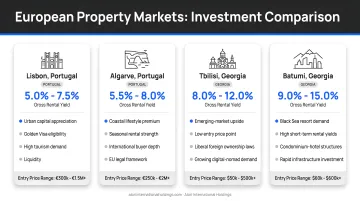
- Portugal combines structural undersupply with rental yields of 5–10% gross in key markets
- Greece offers the lowest entry prices in Western Europe alongside meaningful upside potential
- Poland and the Czech Republic pair strong economic fundamentals with gross yields of 6–10%
- Spain provides market depth and liquidity, though short-term rental regulations require careful due diligence
The Right Timing Depends on Your Buyer Profile
The best time to buy is not a market condition—it's the intersection of market conditions and personal financial readiness.
Based on Investment Horizon
7-10 year hold: The current moment is favorable across most European markets. Even if prices dip near-term, structural undersupply and the ECB easing cycle support long-term appreciation. Transaction costs spread over a decade become manageable.
3-4 year hold: Short-horizon buyers face meaningful timing risk. The minimum holding period to exit with profit in most European markets—after accounting for round-trip transaction costs—is typically 7-10 years, making a rushed exit one of the most costly mistakes buyers make.
Based on Investor Goal: Yield vs. Appreciation vs. Lifestyle
Yield-focused buyers: Timing matters less than market selection when targeting rental income. The key signal is vacancy rates and tenant demand — not purchase price timing. Current gross yield ranges:
- Greece: 6-9% in Athens and coastal markets
- Portugal's Algarve: 5-10% depending on property type
- Poland: 6-8% in Warsaw and Krakow
- Georgia: 7-10% in Tbilisi and Batumi
Appreciation-focused buyers: Entry timing matters significantly here. Buying at 2024-2025 prices versus 2021 peak prices represents a 10-15% structural advantage before any future appreciation.
| Scenario | Purchase Price | 2026 Recovery | Net Position |
|---|---|---|---|
| 2021 buyer | €500,000 | €480,000 | -€20,000 |
| 2024 buyer | €440,000 | €480,000 | +€40,000 |
Lifestyle or second-home buyers: Personal timing — life stage, income stability, actual desire to use the property — often drives the decision more than market cycles. That said, fiscal readiness must come first: down payment secured, currency reserves in place, and tax residency implications understood before committing.
Warning Signs: When You Should Hold Off on Buying
A favorable macro environment doesn't override bad entry conditions. Knowing when to hold off is just as important as knowing when to move.
Market-Level Red Flags
Speculative price spikes are the clearest warning sign. Avoid markets where prices are rising sharply on momentum rather than fundamentals — over-touristed zones in Mallorca or Santorini show pricing increasingly disconnected from local economic reality.
Regulatory headwinds are accelerating across Southern Europe. Watch for new rules that could directly crimp rental income or ownership rights:
- Spain's stalled 100% non-EU buyer tax (currently blocked, but signals political direction)
- Spain's new 21% VAT on short-term rentals (hits gross yields directly)
- Portugal's municipal AL license suspensions in Lisbon and other cities
- Palma de Mallorca's total ban on new tourist rentals
Significant shifts in property rights frameworks, foreign ownership restrictions, or taxation structures create risks that are hard to model into any return projection.
Personal/Financial Red Flags
Before committing capital, run through these personal red flags honestly:
- Insufficient liquidity — budget for the full transaction burden: purchase price + 8–15% in fees and taxes + currency conversion costs + a 12-month operating reserve
- No exit or rental strategy — buying without a defined plan for either is speculation, not investment
- Skipping in-country legal review — title defects, undisclosed encumbrances, and illegal structures are more common in Southern European markets than most buyers expect; independent legal due diligence is non-negotiable
What Buying at the Wrong Time Can Cost You
Quantifying the Timing Penalty
Consider a buyer who purchased at the 2021 peak in a market that corrected 12% by 2024:
- Purchase price: €500,000 (approximately $540,000)
- Market correction by 2024: -12% = €440,000
- Transaction costs at entry: 10% = €50,000
- Total invested: €550,000
- Current value: €440,000
- Loss position: -€110,000 (-20%)
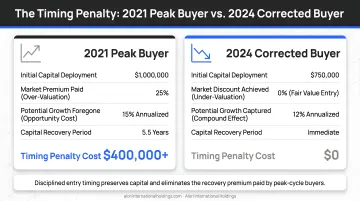
To break even, the property must appreciate 25% from current value. Even in a favorable recovery, that's a 3–5 year horizon.
Yield Compression Trap
Buying when prices are inflated suppresses gross rental yields:
| Scenario | Purchase Price | Annual Rent | Gross Yield |
|---|---|---|---|
| 2021 peak purchase | €500,000 | €20,000 | 4.0% |
| 2024 corrected purchase | €440,000 | €20,000 | 4.5% |
The same property purchased 12% cheaper generates meaningfully better cash-on-cash returns.
Legal and Regulatory Risk
Timing pressure doesn't just affect price — it often shortens the due diligence window, and that's where the real damage happens.
Rushed purchases frequently surface problems that patient buyers avoid:
- Title defects requiring legal resolution
- Undisclosed encumbrances or liens
- Properties with illegal structures or unpermitted modifications
- Rental license issues discovered post-purchase
In markets where property registries and permitting records lack transparency — including parts of Portugal, Spain, and Greece — resolving these issues post-purchase can cost tens of thousands of euros and months of legal wrangling.
How to Time Your European Property Purchase Correctly
Key Indicators to Track
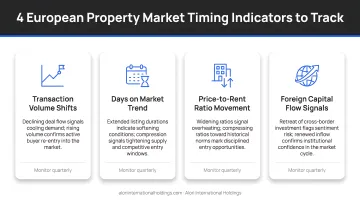
Four signals are worth tracking consistently:
- ECB rate direction — Favorable when cutting (as in the current cycle), less so when hiking. Rate cuts improve mortgage affordability and stimulate buyer demand.
- Price-to-rent ratios — Look for normalization, not bubble territory. Ratios above 25–30 signal overheated markets; ratios of 15–20 reflect healthier fundamentals.
- Transaction volume trends — Recovery in transaction volume signals real demand, not just thin-market price moves. Rising volumes confirm buyers are committing capital.
- Your USD-to-EUR position — Dollar strength provides a natural discount on euro-denominated assets. Track this alongside local price trends.
Local Intelligence Over Macro Headlines
National averages mask neighborhood-level divergence. A well-timed purchase in an undersupplied neighborhood of Lisbon or an emerging district of Athens can outperform a poorly-chosen asset in a "hot" market.
That gap between macro headlines and ground-level reality is where local expertise earns its value. At Alori International Holdings, we combine macroeconomic analysis with in-market professionals who identify disciplined entry points that remote research simply can't reach. Our focus on Portugal and Georgia reflects that philosophy — fewer markets, deeper understanding.
Preparation Over Prediction
Rather than waiting to time the perfect bottom, ensure you're financially prepared: liquidity secured, legal team identified, strategy clarified. The cost of waiting 12–18 months in a recovering market often exceeds any timing benefit.
Working through this checklist before you engage a market is the practical version of that preparation:
Pre-purchase preparation checklist:
- Currency reserves or hedging strategy in place
- Independent legal counsel identified in target country
- Tax residency implications understood
- Exit strategy defined (hold duration, target return)
- Rental management plan if applicable
- 12-month operating reserve budgeted
Frequently Asked Questions
What is the outlook for Europe real estate in 2026?
Most European markets are in a post-correction recovery phase, supported by ECB rate cuts, chronic housing undersupply, and stabilizing prices. Moderate price growth of 3–6% is expected across major markets, though the pace varies significantly by country.
Which European country is best to buy a house?
The right market depends on your objective. Yield-focused buyers gravitate toward Portugal and Greece (5–10% rental returns), while stability-seekers prefer Germany or Spain. Eastern European markets like Poland offer high growth potential but carry more regulatory uncertainty. Each suits a different investor profile and risk tolerance.
Where do most Americans move to in Europe?
Portugal (especially Lisbon and the Algarve), Spain (Barcelona, Costa del Sol), and Italy (Tuscany, Rome) consistently top the list for American expats and lifestyle buyers, driven by climate, cost of living, English accessibility, and residency pathways.
Is now a good time for Americans to buy property in Europe?
For U.S. buyers, 2025–2026 presents a reasonable entry window: the dollar holds relative strength against the euro, prices have corrected in several key markets, and ECB rate cuts are improving local affordability. That said, market timing matters less than being financially and legally prepared before you commit.
What are the biggest risks of buying property in Europe right now?
Main risks include overpaying in speculative micro-markets, underestimating transaction costs (8–15% of purchase price), regulatory shifts affecting rental income (like short-term rental bans), and making purchases without independent legal due diligence.
How do ECB interest rate changes affect European property investment?
ECB rate cuts improve local mortgage affordability, which drives buyer demand and pushes prices upward. For cash buyers — a common profile among American investors — entering before that demand cycle peaks tends to yield better pricing.