
Introduction
Europe draws American investors for two reasons: the lifestyle — warm climates, low cost of living, strong infrastructure — and the capital case. European short-term rentals generated €61 billion in total revenue in 2025, reflecting record international demand across the continent.
That demand creates a real challenge for buyers. With dozens of markets offering different legal frameworks, price trajectories, and rental dynamics, knowing where to deploy capital becomes the decisive question. This guide breaks down the top destinations through an investor-first lens, covering entry prices, rental yield potential, foreign buyer rules, and lifestyle infrastructure across five high-conviction markets.
Key Takeaways
- Greece and Spain lead summer rental profitability with average daily rates of €214 and €205 respectively
- Portugal and Georgia offer the most accessible foreign ownership frameworks, with minimal barriers for non-resident buyers
- Urban markets like Barcelona and Lisbon generate higher annual rental revenue (€20,000–€26,000) through consistent year-round occupancy
- Emerging markets like Georgia deliver entry prices 70-80% below Western European equivalents
- American buyers must evaluate tax treaty status, STR licensing requirements, and property management access before prioritizing lifestyle factors
Why Europe Is One of the Best Regions to Buy a Holiday Home
Europe's combination of transparent property registries, stable legal systems, and mature tourism infrastructure creates favorable conditions for foreign real estate investment — particularly for Americans seeking diversification beyond domestic equities and property markets. Unlike emerging markets with opaque title systems or developed markets with foreign ownership restrictions, European nations generally offer clear ownership rights, enforceable contracts, and accessible transaction processes.
European holiday homes serve dual investment purposes simultaneously. When owners aren't occupying the property, short-term rental demand generates cash flow — the European STR market reached 470 million stayed nights in 2025, demonstrating consistent tourist demand across cycles. Simultaneously, these properties appreciate as hard assets in structurally undersupplied coastal and urban tourism markets where development restrictions limit new supply.
American buyers face specific considerations that European or local buyers don't encounter. Three variables shape which market makes sense:
- Currency exposure: USD/EUR dynamics affect both purchase timing and ongoing rental income conversion
- Tax treaties: The US maintains treaties with Portugal and Greece that offer favorable provisions on rental income and capital gains; other markets require more careful structuring
- Ownership rules: Portugal and Georgia impose zero foreign ownership restrictions, while other countries require local entities or residency permits
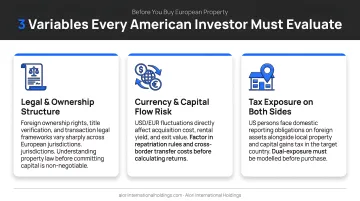
Understanding these variables before selecting a market reduces transaction risk and improves long-term returns.
Best Places to Buy a Holiday Home in Europe
Each destination below was assessed on property price trends, documented rental yield data, foreign buyer accessibility, tourism infrastructure quality, and long-term demand fundamentals — not popularity or lifestyle appeal alone.
Portugal — Algarve and Lisbon Coast
Portugal ranks among Europe's fastest-growing luxury property markets, with Lisbon now attracting significant millionaire migration and the Algarve maintaining its position as a top-tier coastal destination. The country combines structural tourism growth with investor-friendly frameworks rarely found in Western Europe.
What distinguishes Portugal for American investors is the absence of foreign ownership restrictions, favorable tax frameworks including the Non-Habitual Resident programme, and documented short-term rental demand in coastal areas. Property values remain competitive compared to France or Italy at similar quality levels. Alori International Holdings provides curated Portuguese property opportunities with defined legal structures and exit strategies built for international investors entering this market.
| Factor | Details |
|---|---|
| Entry Price Range | €150,000–€600,000 ($160,000–$640,000); Algarve coastal apartments from €200,000, Lisbon metro from €250,000 |
| Rental Yield Potential | Lisbon averages $23,900 annual revenue with 67% occupancy; Algarve coastal properties 5-8% gross yield with strong summer seasonality |
| Foreign Buyer Rules | No restrictions on foreign ownership; property registered through Conservatória do Registo Predial; Golden Visa programme currently paused for residential but evolving; NHR tax benefits available for qualifying residents |
Spain — Costa del Sol and Mallorca
As the most visited country in Europe, Spain hosts one of the continent's most active second-home markets. Mallorca and Marbella attract significant high-net-worth international capital, supported by exceptional lifestyle infrastructure including 40+ golf courses, world-class marinas, and fine dining establishments. Barcelona generates average annual STR revenue of $26,300 with 68% occupancy, demonstrating Spain's ability to deliver consistent rental performance.
The investment case rests on warm climate, year-round short-term rental demand, and a relatively liquid resale market compared to emerging destinations. The Golden Visa programme offers residency pathways for purchases above €500,000 — an added incentive for higher-budget investors. Purchasing processes can be slower than Portugal, and major cities face housing supply constraints that push prices upward.
| Factor | Details |
|---|---|
| Entry Price Range | €180,000–€550,000 ($190,000–$590,000); 1-2 bedroom coastal apartments in Marbella from €250,000, Mallorca from €280,000 |
| Rental Yield Potential | Spain achieved €205 average daily rate with 69% summer occupancy; Costa del Sol properties generate 5-7% gross yield with strong peak season dynamics |
| Foreign Buyer Rules | No restrictions for foreign buyers; Golden Visa available for €500,000+ investments; municipal STR licensing required in most coastal areas; verify local commune regulations before purchase |

France — Côte d'Azur and Provence
France remains a perennial prime real estate market, with the French Riviera ranking among the world's most expensive residential corridors and Provence offering more accessible entry points with strong cultural appeal. The country delivers economic and political stability, consistent long-term appreciation in prime areas, and strong rental demand from domestic and international tourists.
France's investment case centers on stability rather than high yields. Nice generates $19,100 average annual revenue with 66% occupancy — lower yields offset by strong historical capital appreciation and currency stability.
The appeal for American buyers lies in holding a stable, euro-denominated asset in a market with transparent legal frameworks and established resale liquidity. France has introduced new STR regulations requiring national registration; confirm local commune-level rules before purchasing.
| Factor | Details |
|---|---|
| Entry Price Range | €200,000–€800,000+ ($210,000–$850,000+); Provence village homes from €220,000, Côte d'Azur apartments from €400,000 with significant price gap between regions |
| Rental Yield Potential | 3-5% gross yield in Provence, 2-4% in French Riviera; lower yields offset by strong historical capital appreciation and currency stability |
| Foreign Buyer Rules | No restrictions for non-EU buyers; new national STR registration requirements in effect as of 2024; verify local commune-level regulations as restrictions vary significantly by municipality |
Greece — Crete and Ionian Islands
Greece has emerged as a strong Mediterranean investment destination, with Greek islands dominating European short-term rental performance rankings. Corfu achieved €230.50 average daily rates, while Greece overall reached €214 summer ADR with 70% occupancy, outpacing Spain and significantly exceeding France. Ongoing airport expansion projects across Greek islands are boosting tourism capacity and improving accessibility.
Lower property prices compared to Spain, France, or Italy make Greece one of the more cost-effective entry points in the Mediterranean, with high seasonal rental demand on islands like Crete, Corfu, and Zakynthos. The country recently simplified its foreign buyer process and introduced a Golden Visa programme for qualifying investments. New STR safety regulations remain modest and manageable compared to restrictive frameworks in other European markets.
| Factor | Details |
|---|---|
| Entry Price Range | €100,000–€400,000 ($105,000–$425,000); village homes in Apokoronas (Crete) from €120,000, coastal Corfu developments from €180,000 |
| Rental Yield Potential | Crete averages $16,300 annual revenue; gross yields of 6-9% on top-performing islands with strong summer occupancy rates exceeding 65% |
| Foreign Buyer Rules | Foreign buyers can purchase freely with no restrictions; Greek Golden Visa available (current threshold €250,000 in most areas); property transfer tax approximately 3% of declared value; registration through local land registry |
Georgia — Tbilisi and Black Sea Coast (Batumi)
Georgia is one of Europe's most overlooked holiday home markets. Positioned at the crossroads of Europe and Asia, the country has rapidly modernizing infrastructure, a flat income tax rate, and property prices that remain a fraction of Western European equivalents.
Key structural advantages for investors include:
- No restrictions on foreign property ownership
- 1% flat property tax
- Digital property registration completed within 24 hours
- Growing year-on-year tourism numbers
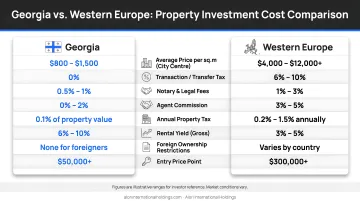
Batumi on the Black Sea coast is developing rapidly as a resort destination with strong short-term rental demand. The market generates $3,900 average annual revenue — modest in absolute terms compared to Barcelona or Lisbon, but entry prices of €1,200–€1,800 per square metre versus €4,000–€6,000+ in Western Europe create yield dynamics that Western markets simply cannot match. Early-mover advantage is still available here. Alori's local expertise and in-market networks provide practical guidance for American buyers navigating this less-familiar environment.
| Factor | Details |
|---|---|
| Entry Price Range | $50,000–$200,000; Tbilisi city centre from $1,400/sqm, Batumi beachfront from $1,200/sqm — representing 70-80% lower pricing than Western European coastal equivalents |
| Rental Yield Potential | 7-12% gross yields in Batumi and Tbilisi driven by strong regional and international tourism; lower absolute revenue offset by dramatically lower purchase prices |
| Foreign Buyer Rules | No restrictions on foreign ownership; 1% flat property tax; digital property registration completed within 24 hours; simple transaction process; residency available through $100,000+ property investment (based on certified appraisal value) |
What to Look for When Choosing a European Holiday Home
The most common mistake American buyers make is selecting a destination based on personal affinity or vacation experience rather than evaluating the investment case first. Short-term rental regulations, resale market liquidity, and management costs all need to clear before lifestyle preferences enter the equation. A market that delivers a great vacation doesn't automatically deliver a strong return — and the reverse is equally true.
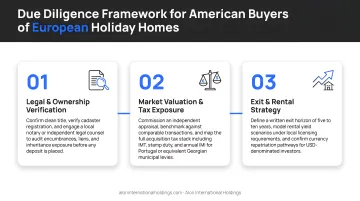
Three due diligence areas determine whether a purchase holds up structurally:
Foreign ownership legal structure — Determine whether you can hold property in your own name or whether a local entity or nominee is required. Portugal, Greece, and Georgia allow direct foreign ownership. Some markets require corporate structures that add cost and complexity.
Tax treaty status — Verify whether the US maintains a tax treaty with your destination country covering rental income and capital gains. Treaties prevent double taxation and clarify withholding rates. Portugal and Georgia maintain favorable treaty provisions.
Property management availability and cost — Most American buyers won't be on-site year-round. Assess the availability, quality, and cost of professional property management in your target market. Urban markets typically offer better management infrastructure than remote coastal areas. Expect 10–30% of rental income for professional management.
Markets with deeper local networks (rather than saturated tourist-facing agents) tend to produce better-priced acquisitions with cleaner legal structures. Access to off-market inventory and pre-vetted legal frameworks reduces both entry risk and transaction cost. Alori's approach is built around exactly this — fewer markets, deeper relationships, and curated opportunities that mass-market listing platforms don't surface.
Conclusion
Europe offers genuinely diverse holiday home markets, and the right choice depends on your timeline, budget, and whether income generation or capital growth takes priority. Each market has a distinct profile:
- Portugal and Spain — strongest combination of rental yield and appreciation potential
- Greek islands — exceptional seasonal rental rates with lower entry prices
- Georgia — frontier market access with dramatically lower costs and strong early-stage growth dynamics
- France — established prestige destination with stable long-term demand
Narrowing down the market is only half the equation. The real risk in European holiday home investment rarely comes from choosing the wrong country — it comes from entering the right one without adequate local intelligence, legal oversight, or a clear exit strategy. Markets behave differently, regulations change, and transaction processes vary. That gap between knowing where to invest and knowing how to execute it is where most investors run into trouble.
Alori International Holdings works with American investors to identify and execute high-conviction European property acquisitions — bringing in-country professionals who know local regulations, transaction norms, and where the real value sits. If you're evaluating Portugal or Georgia and want a structured, vetted path into either market, reach out directly at info@aloriinternationalholdings.com.
Frequently Asked Questions
What is the easiest country to buy a house in Europe?
Portugal, Georgia, and Greece impose the fewest restrictions on non-EU foreign buyers, allowing direct ownership without entity requirements or residency mandates. "Easy" typically means straightforward legal process, transparent property registration, accessible financing or cash purchase norms, and minimal bureaucratic friction. Georgia offers the fastest registration process at 24 hours digitally.
Where is Airbnb most profitable in Europe?
Greek islands, Portuguese coastal markets, and Spanish resort areas consistently produce the highest short-term rental yields. Profitability is driven by three factors: occupancy rate (Greece achieves 70% summer occupancy), average nightly rate (Greek islands command €214-€230 ADR), and seasonality length. Urban markets like Barcelona and Lisbon generate higher total annual revenue through year-round occupancy despite lower nightly rates.
Where is the best place in Europe to buy a holiday home?
The right answer depends on your priority: lifestyle, rental income, or capital growth. Portugal and Spain rank consistently strong across all three, with established tourism infrastructure and documented rental demand. Georgia is the strongest high-upside emerging option for investors comfortable with longer development timelines.
Where is the cheapest but nicest place to live in Europe?
Portugal's interior (Alentejo, Silver Coast), Georgia (Tbilisi, Kutaisi), and mainland Greece (Peloponnese, Thessaloniki) offer excellent quality of life at 40-60% lower monthly costs than London, Paris, or Barcelona, while maintaining access to quality healthcare and infrastructure.
Where is the cheapest beachfront property in Europe?
Georgia's Black Sea coast (Batumi), Bulgaria (Sunny Beach, Varna), and southern Italy (Calabria, Sicily) rank among the most affordable beachfront options in Europe. Batumi starts at approximately $1,200 per square meter — versus €4,000-€6,000+ per square meter in the Algarve or Costa del Sol — representing 70-80% lower entry costs for comparable coastal access.
Which country has the best beaches in Europe?
Greece, Portugal, and Croatia consistently rank highest in European beach quality surveys based on water clarity, sand quality, natural beauty, and Blue Flag certifications. Greece leads on sheer volume and variety; Portugal's Algarve and Croatia's Dalmatian coast are close rivals.