

Introduction
Yes, Americans can legally buy property in both Spain and Portugal — no citizenship or residency required. Both Iberian markets have drawn strong interest from American buyers seeking European lifestyle access, investment diversification, and rental income in economies built on steady tourism demand.
Spain offers dynamic urban markets and extensive Mediterranean coastline. Portugal delivers lower entry costs and well-established residency pathways. But many American buyers still hesitate — uncertain about unfamiliar legal procedures, unclear tax obligations, and the logistics of moving money across borders.
This guide covers what you need to know before buying:
- How the purchase process works in each country for American buyers
- What acquisition costs and taxes to budget for
- Which visa pathways are still available after recent Golden Visa changes
- How Spain and Portugal compare for different investor profiles
TL;DR: Quick Facts for American Buyers
- Americans can buy property in Spain and Portugal without permits, residency, or special approvals
- Both countries mandate a local tax ID before closing (NIE in Spain, NIF in Portugal)
- Budget 10–15% above purchase price in Spain, 6–10% in Portugal for taxes and fees
- Owning property does not extend your stay: the 90-day Schengen limit still applies to American buyers
- US tax obligations follow you abroad — rental income, capital gains, and foreign accounts over $10,000 must be reported to the IRS
Buying Property in Spain as an American
Americans face zero legal restrictions on Spanish real estate purchases. You can buy apartments, villas, land, or commercial properties outright with the same ownership rights as Spanish nationals. The one prerequisite: obtaining an NIE (Número de Identificación de Extranjero), Spain's foreigner tax identification number required for all financial transactions.
Purchase process steps:
- Obtain NIE through Spanish consulate or in-country application
- Open Spanish bank account (NIE required)
- Sign reservation contract (Contrato de Arras) with 5–10% deposit
- Conduct legal due diligence via Spanish property lawyer
- Sign title deed (Escritura de Compraventa) before notary
- Register property at Registro de la Propiedad
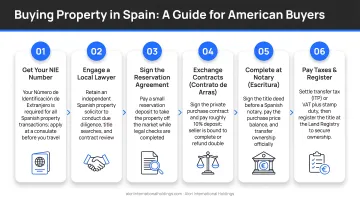
Typical timeline: 2–4 months from offer to registration.
Under Article 1454 of Spain's Civil Code, buyers who withdraw after signing the Contrato de Arras forfeit their deposit; sellers who default must repay double.
Costs and Taxes to Expect in Spain
Spain's transaction costs run higher than Portugal's, typically adding 10–15% above the purchase price.
Main purchase taxes:
- ITP (Property Transfer Tax) on resale properties: 6–10% depending on region (Madrid 6%, Andalusia 7%, Catalonia 10%, Valencia 9%, Balearic Islands 8–11%)
- New builds: 10% VAT (IVA) plus 0.75–1.5% stamp duty (AJD)
- Notary fees: 0.5–1%
- Land registry fees: 0.2–0.5%
- Legal fees: ~1%
Ongoing ownership costs:
| Tax | Rate | Notes |
|---|---|---|
| IBI (annual property tax) | 0.4–1.1% of cadastral value | Billed locally each year |
| Non-resident income tax (IRNR) | 19% on imputed income | Applies even if property is not rented; imputed income = 1.1–2% of cadastral value. A July 2025 ruling lowered this rate for non-EU residents and permitted expense deductions. |
| Wealth tax | Varies by region | Applies above ~€700,000. Madrid offers a 100% exemption, though Spain's national Solidarity Tax on Large Fortunes may still apply. |
Important note: Spain's proposed 100% additional property tax on non-EU non-resident buyers was submitted to parliament in May 2025 but has not become law as of April 2026. The proposal explicitly exempts new-build properties.
Residency and Visa Options in Spain
Spain's Golden Visa program — which offered residency for €500,000+ in real estate investment — was officially closed in April 2025 via Ley Orgánica 1/2025. Two primary pathways remain for Americans who want to stay longer than a tourist visit.
Current visa options for long-term stays:
| Visa | Best For | Income Requirement | Duration |
|---|---|---|---|
| Non-Lucrative Visa (NLV) | Retirees and passive income earners | 400% of Spain's IPREM + 100% per dependent | 1 year, renewable |
| Digital Nomad Visa (DNV) | Remote workers earning outside Spain | 200% of Spain's minimum wage (SMI) | 1 year (visa) / 3 years (residence permit) |
Critical limitation: Under Schengen rules, Americans can stay visa-free for 90 days in any 180-day period. Property ownership does not extend this limit — a visa is required for anything longer.
Buying Property in Portugal as an American
Portugal imposes no restrictions on foreign property buyers, including non-EU Americans. The mandatory first step is obtaining a NIF (Número de Identificação Fiscal), Portugal's tax identification number. Americans can complete this remotely through a Portuguese lawyer with power of attorney.
Purchase steps:
- Obtain your NIF via the local tax office or a legal representative
- Open a Portuguese bank account
- Sign the promissory contract (CPCV) with a 10–30% deposit
- Complete legal due diligence — title confirmation and encumbrance checks
- Sign the final deed (Escritura) before a notary
- Register ownership at the Conservatória do Registo Predial
Typical timeline: 1–3 months from offer to registration.
Costs and Taxes to Expect in Portugal
Portugal's transaction costs are notably lower than Spain's, typically adding 6–10% above purchase price.
Main purchase costs:
- IMT (Property Transfer Tax): Progressive sliding scale from 0–8% based on property value and type (up to 7.5% for primary residences over €1,150,853; up to 8% for second homes)
- Stamp Duty (Imposto do Selo): 0.8% of purchase price, plus 0.6% on mortgage amount if financing
- Notary and registration fees: €700–€1,500
- Legal fees: 1–2%
Ongoing costs:
- IMI (Municipal Property Tax): 0.3–0.45% of the property's tax value annually — generally lower than comparable US property taxes
Current Market Prices in Portugal
As of early 2026, Portugal's housing prices continue rising but remain accessible relative to peak European markets. Average prices per square meter:
- Lisbon: €6,082/m² (~$7,024/m²), up 9.6% year-over-year
- Algarve (Lagos): €5,438/m² (~$6,280/m²)
- Porto: €4,060/m² (~$4,689/m²), up 11.5% year-over-year
For American investors, these price points — particularly Porto and the Algarve — fall within a range where entry remains viable without overextending capital. Alori International Holdings targets this segment directly, focusing on opportunities in the $150,000–$600,000 range with vetted legal structures and defined exit strategies built in from the start.
Residency and Visa Options in Portugal
D7 Passive Income Visa is the most popular route for American retirees and those with investment income. It requires proof of regular passive income (pension, dividends, rental income) equal to Portugal's minimum wage — €920/month or €11,040/year in 2026. The D7 is renewable and offers a path to permanent residency after five years.
Digital Nomad Visa (D8) targets remote workers. Requires remote income of at least €3,680/month. Valid for one year (visa) or up to three years (residence permit).
Portugal's Golden Visa: Real estate and capital transfer routes were abolished in October 2023 following Portugal's housing reform. The primary remaining pathway is €500,000 investment in a qualifying Portuguese investment fund — not real estate. Property purchases remain attractive financial investments but do not automatically grant Golden Visa eligibility.
How Long Can You Stay Without a Visa?
Without a visa, Americans are limited to 90 days in any 180-day Schengen period — regardless of whether you own property. A D7 or Digital Nomad Visa enables full-time residency and removes that constraint entirely.
Spain vs. Portugal: How They Compare for American Buyers
Entry Costs
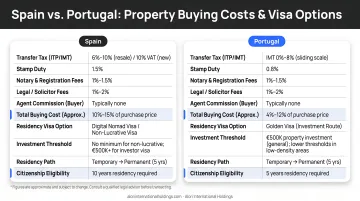
Spain's purchase costs run 10–15% above purchase price; Portugal's land in the 6–10% range, making Portugal's transaction costs significantly lower.
| Factor | Spain | Portugal |
|---|---|---|
| Tax ID Required | NIE | NIF |
| Transfer Tax Range | 6–10% (resale) | 0–8% (sliding scale) |
| Stamp Duty | 0.75–1.5% (new builds) | 0.8% |
| Annual Property Tax | 0.4–1.1% (IBI) | 0.3–0.45% (IMI) |
| Golden Visa Availability | Closed (April 2025) | Real estate route closed (Oct 2023); fund investment route remains |
| Schengen Stay Rules | 90 days/180 days | 90 days/180 days |
Investment Landscape
Spain offers a larger, more liquid market with strong demand in major urban centers like Madrid and Barcelona, as well as coastal regions. Rising prices and tightening regulations add real operational hurdles, though. Barcelona's short-term rental licenses all expire in November 2028, and Madrid has banned tourist flats in historic center residential buildings.
Portugal's market is smaller but growing fast. Lisbon posted 9.6% year-over-year price growth and Porto 11.5% as of Q3 2025, though absolute price levels still sit below Spain's premium markets. Lisbon and Porto have also tightened short-term rental rules — new licenses are halted in designated containment zones, and existing licenses expire on property transfer.
Visa and Residency Pathways
Portugal's D7 Visa is more accessible and better suited to American retirees and passive income earners than Spain's Non-Lucrative Visa. Spain's Golden Visa no longer exists; Portugal's Golden Visa remains available through fund investment, not real estate.
For lifestyle-focused buyers, Portugal is notably English-language-friendly (especially the Algarve), while Spain requires more engagement with Spanish-language processes.
Bottom Line for Different Buyer Profiles
- Retirees and passive income earners: Portugal's D7 Visa and lower entry costs make it the more accessible option
- Investors targeting urban rental markets or larger portfolio plays: Spain's depth and liquidity have advantages
- Buyers seeking a curated, lower-friction entry into European real estate: Portugal remains the simpler starting point
Top Regions to Consider in Each Country
Spain Highlights
Madrid — Business hub with strong international community and robust resale market. Transfer tax: 6%. Average price: €4,688/m² (~$5,414/m²), up 16.8% year-over-year.
Barcelona — Cosmopolitan city with strong rental demand but strict short-term rental regulations (all tourist flat licenses expire November 2028). Transfer tax: 10%.
Costa del Sol/Andalusia — Beach lifestyle with large expat community and year-round tourism. Marbella averages €5,572/m² (~$6,435/m²), up 9.2% annually. Transfer tax: 7%.
Valencia — More affordable Mediterranean option with growing expat base. Average price: €2,456/m² (~$2,836/m²), up 16% year-over-year. Transfer tax: 9%.
Balearic Islands — Premium island market with high-end tourism. Ibiza averages €7,065/m² (~$8,160/m²), up 8.1% annually. Transfer tax: 8–11%.
Portugal offers a different profile — lower entry prices in most markets, a well-established expat infrastructure, and historically strong appreciation in coastal and urban areas.
Portugal Highlights
Lisbon — Capital with strong rental demand and appreciation, though entry prices are higher. Average: €6,082/m² (~$7,024/m²).
Porto — More affordable than Lisbon with rising demand from international buyers. Average: €4,060/m² (~$4,689/m²).
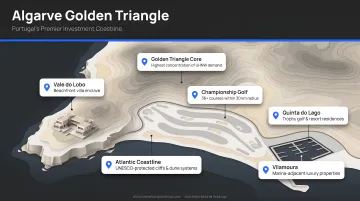
The Algarve — Western Algarve particularly popular with Americans and Northern Europeans. Warm climate, English widely spoken, strong tourism-driven rental demand. Lagos averages €5,438/m² (~$6,280/m²). The Algarve Golden Triangle (Quinta do Lago, Vale do Lobo, Vilamoura) is home to 40+ championship courses and consistently ranks among Portugal's top-performing property markets for year-over-year appreciation.
Silver Coast — Óbidos and Nazaré offer more affordable, less crowded alternatives to the Algarve.
Important: Short-term rental regulations vary significantly by location. Barcelona bans all new tourist flat licenses; Lisbon and Porto have strict containment zones. Verify local regulations before purchasing if you plan to generate Airbnb income.
Key Considerations for American Buyers in Both Markets
US Tax Obligations Don't Disappear
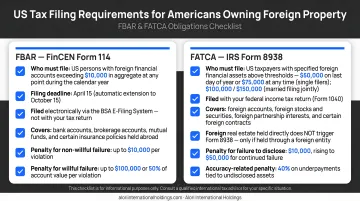
US citizens must report worldwide income—including foreign rental income and capital gains from property sales—on US tax returns. Both Spain and Portugal have tax treaties with the US designed to prevent double taxation, but compliance requires careful structuring.
Additional filing requirements:
- FBAR (FinCEN 114): Required if aggregate foreign financial accounts exceed $10,000 at any time during the year
- FATCA (Form 8938): Required for specified foreign financial assets exceeding thresholds ($50,000 on last day of tax year for unmarried US residents; higher thresholds for expats)
Tax obligations also shape how you structure financing—and non-resident lending terms are more conservative than most Americans expect.
Financing as a Non-Resident
Both countries offer mortgages to non-resident Americans, but terms are more conservative:
- Spain: 60–70% LTV (loan-to-value) for non-residents
- Portugal: 60–75% LTV for non-residents
Expect higher down payments, stricter income documentation, and currency conversion costs. Cash buyers must comply with strict anti-money-laundering documentation requirements for large international transfers in both countries.
Navigating both the tax and financing sides of a cross-border purchase is difficult without the right team in place. At minimum, American buyers should engage:
- Bilingual local property lawyer (essential for due diligence and contract review)
- Local real estate agent or buyer's agent with international client experience
- Cross-border tax advisor familiar with US reporting obligations
- Ideally, a firm with on-the-ground market expertise
Alori International Holdings works specifically with American investors in markets like Portugal, combining local legal and market expertise with a focus on verified deal structures and clear exit strategies.
Frequently Asked Questions
How long can I stay in Portugal if I own a house?
Property ownership alone does not extend stay rights. Without a visa, Americans are subject to the standard 90-day Schengen limit within any 180-day period. A D7 Visa or Digital Nomad Visa enables full-time residency for those wanting to live in Portugal long-term.
How much is an average house in Portugal in US dollars?
Average property prices vary significantly by region. As of early 2026: Lisbon averages $7,024/m², Porto $4,689/m², and Lagos (Algarve) $6,280/m². Inland and rural areas offer more affordable entry points, while prime coastal and urban markets push well above those figures.
Can Americans buy property in Spain without residency?
Yes, Americans can buy property in Spain as non-residents with no restrictions. You will need to obtain an NIE (tax identification number) and open a Spanish bank account to complete the transaction, but residency is not required.
Did Spain cancel its Golden Visa program?
Yes, Spain's Golden Visa was officially closed in April 2025 and no longer offers a residency pathway through real estate investment. Alternative visa options include the Non-Lucrative Visa (for retirees/passive income earners) and the Digital Nomad Visa (for remote workers).
Do I have to pay US taxes on property I own in Spain or Portugal?
Yes, US citizens must report worldwide income and assets to the IRS regardless of where property is located, including rental income and capital gains from foreign properties. Tax treaties with both countries help reduce double taxation, but professional tax advice is essential for compliance.
Which is better for Americans — Spain or Portugal?
It depends on your goals. Portugal tends to be simpler and lower-cost for retirees and passive-income buyers, with more accessible visa pathways and lower transaction costs. Spain offers a larger, more liquid market with stronger urban rental demand.