
This article delivers a data-driven analysis of the best countries to buy real estate abroad for investors in the $150,000–$600,000 range. We'll cover ROI potential, legal frameworks, entry pricing, market stability, and the structural demand drivers that separate sustainable markets from speculative traps.
Key Takeaways
- International real estate diversifies your portfolio beyond domestic markets — adding rental income and a hedge against local inflation
- The strongest markets share three traits: structural demand, foreigner-friendly ownership laws, and a credible path to rental yield or appreciation
- Portugal leads on residency programs and stability; Georgia on entry price and yield; UAE, Mexico, and Colombia on growth potential and lifestyle upside
- Entry costs range from under $80K in Georgia to $300K+ in Lisbon — with rental yields and regulatory complexity to match
- Working with local expertise reduces legal and transaction risk while unlocking off-market opportunities
Why More Americans Are Buying Real Estate Abroad Right Now
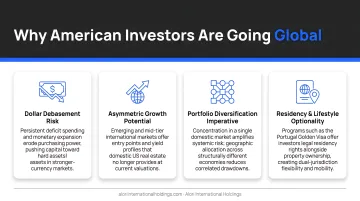
American investors are moving capital abroad for concrete, measurable reasons — and the momentum is accelerating in 2025. Four structural drivers are behind the shift:
Domestic Unaffordability: The median existing-home sales price hit $414,000 in 2024, and the national homeownership rate fell to 65.1% in early 2025. For investors who once relied on double-digit domestic returns, U.S. markets no longer offer the same risk-adjusted upside.
Currency Advantage: Dollar strength against emerging market currencies gives American buyers real purchasing power abroad. At roughly 17.86 MXN per USD in Mexico and 3,676 COP per USD in Colombia, American buyers can acquire higher-quality assets for less capital — a gap that doesn't exist in domestic markets.
Dual Financial Incentive: International property can generate rental income and appreciate simultaneously. In markets where demand is structural — driven by demographics, infrastructure investment, and regulatory openness — both returns compound over time. Speculative momentum reverses; structural demand persists.
Residency and Mobility: Several top markets offer Golden Visa or residency-by-investment pathways, giving American buyers a legal path to residency alongside their financial return. As remote work and lifestyle migration normalize, real estate abroad increasingly functions as both an asset and a personal mobility strategy.
Best Places to Buy Real Estate Abroad
Each market below was evaluated on macroeconomic fundamentals, foreign buyer accessibility, rental demand, capital appreciation trajectory, and on-the-ground investability.
Portugal
Portugal is one of Europe's most established markets for foreign buyers, attracting Americans and global investors with political stability, EU membership, strong tourism infrastructure, and clear legal frameworks for foreign property ownership. Lisbon, Porto, and the Algarve remain the core investment corridors, though emerging northern regions are gaining attention.
Why It Stands Out: Portugal has a long-term structural tourism tailwind—tourism exports exceeded €4.3 billion monthly in recent data—and a strong short-term rental market in major cities. The country offers accessible residency-by-investment pathways through capital transfers (€500,000 for investment funds), though the real estate Golden Visa route was permanently eliminated in October 2023 via Law 56/2023. Additionally, the Non-Habitual Resident (NHR) tax regime was replaced by the highly restrictive IFICI program, which now targets only highly qualified professionals in scientific research and innovation.
Firms like Alori International Holdings specialize in curating verified, off-market opportunities in Portugal for American investors seeking disciplined market entry with defined exit strategies.
| Metric | Details |
|---|---|
| Entry Price Range | €200,000–€500,000 for apartments in Lisbon/Porto (Lisbon: €5,060/sqm; Porto: €3,570/sqm); lower in secondary markets |
| Avg. Rental Yield / Growth | Lisbon: 3.82%; Porto: 4.02%; capital appreciation driven by tourism and expat demand |
| Foreign Buyer Framework | Foreigners can own property freehold; no restrictions on non-EU buyers; residency-by-investment via funds; notarial system ensures clear title |
Georgia (Caucasus)
The Republic of Georgia (Tbilisi, Batumi) offers some of the lowest entry prices among investable international markets. It features a flat 1% property tax, no capital gains tax for individuals holding property beyond two years, and a rapidly growing tourism and digital nomad ecosystem.
Why It Stands Out: Georgia's real estate market is in an early-to-mid appreciation cycle, meaning investors entering now benefit from lower prices before structural demand pushes values higher. Tbilisi offers 8.4%–9.0% long-term rental yields with average asking sale prices around $1,284/sqm. Batumi on the Black Sea coast has strong short-term rental demand (55% average occupancy, $46.4 ADR), while Tbilisi offers more stable long-term rental markets from a growing professional class.
Alori International Holdings has established in-market expertise in Georgia, giving investors access to local deal flow, legal vetting, and defined exit strategies.
| Metric | Details |
|---|---|
| Entry Price Range | $100,000–$300,000 typical range; Tbilisi averages $1,284/sqm; Batumi coastal properties command premiums |
| Avg. Rental Yield / Growth | Tbilisi: 8.4%–9.0% long-term rental yields; Batumi STR: 55% occupancy, $46.4 ADR; 10–14% annual appreciation documented |
| Foreign Buyer Framework | Full freehold ownership allowed; 5% flat tax on registered residential rental income; 0% capital gains tax after two years; fast digital registration |
UAE / Dubai
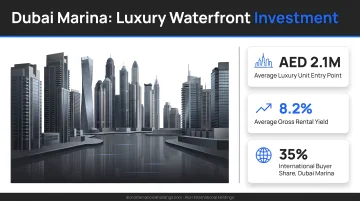
Dubai has established itself as a top destination for rental yield-focused investors—a tax-free environment (no income tax, no capital gains tax), world-class infrastructure, and a massive tourism and transient professional population create persistent rental demand.
Why It Stands Out: Dubai delivers gross rental yields averaging 6.8%, among the highest globally for a stable, liquid market. High-demand areas like Jumeirah Village Circle (JVC) and Business Bay offer strong tenant demand and competitive entry prices. The regulated market environment overseen by the Dubai Land Department (DLD) provides investor protections, including Law No. 8 of 2007 mandating escrow accounts for off-plan buyers. Residency visas are available via property investment: AED 750,000 qualifies for a 2-year Taskeen visa; AED 2,000,000 qualifies for a 10-year Golden Visa.
Key Risk: A massive pipeline of new units by 2030 introduces potential oversupply risks that could compress future rental rates.
| Metric | Details |
|---|---|
| Entry Price Range | $200,000–$500,000 for investment-grade apartments in Dubai Marina, JVC, Business Bay |
| Avg. Rental Yield / Growth | 6.8% average gross rental yield; recent year-on-year rental value growth strong but moderating due to supply |
| Foreign Buyer Framework | Freehold ownership in designated zones for non-UAE nationals; no property or capital gains taxes; residency visa linked to property value threshold; DLD oversees transactions |
Mexico (Riviera Maya / Los Cabos)
Mexico's Pacific and Caribbean coasts remain among the most accessible international markets for American investors. Proximity to the U.S. and a stable base of North American buyers underpin persistent demand across the Riviera Maya and Los Cabos corridors.
Why It Stands Out: Los Cabos commands Mexico's highest ADR at $352, while Playa del Carmen short-term rentals average 51% occupancy with $116.1 ADR. Foreigners cannot hold land directly in restricted zones (within 50km of coastline), but the fideicomiso (bank trust) system provides a legal and widely used ownership structure. This is a mature, deal-specific market—entry price and location within the corridor matter significantly for achieving above-average returns.
Important: Transaction costs are higher than domestic markets (6–10% total closing costs), and annual fideicomiso maintenance fees impact net ROI.
| Metric | Details |
|---|---|
| Entry Price Range | $200,000–$600,000 for condos/villas in Riviera Maya and Los Cabos |
| Avg. Rental Yield / Growth | Los Cabos: $352 ADR; Playa del Carmen: 51% occupancy, $116.1 ADR; strong gross annual rental returns in tourist zones |
| Foreign Buyer Framework | Foreigners use fideicomiso (50-year renewable bank trust) in coastal restricted zone; ownership secure and transferable; higher transaction costs (6–10%); no restrictions in interior zones |
Colombia (Medellín / Cartagena)
Colombia is one of the last genuinely undervalued emerging markets in Latin America accessible to foreign buyers. Medellín has undergone a dramatic urban transformation and now attracts a growing international expat and remote worker community.
Cartagena operates differently — its investment case is driven almost entirely by tourism-fueled short-term rental demand rather than a resident professional base.
Why It Stands Out: Medellín's El Poblado and Laureles districts see 10.3% annual price appreciation, while Medellín STRs achieve 56% occupancy and $80 ADR. Colombia allows full freehold ownership for foreigners with no restrictions. The Colombian peso's relative weakness against the dollar increases purchasing power for American buyers, and the government offers tax incentives for tourism-zone properties.
Key Risk: Political and regulatory volatility should be monitored; this is a higher-risk, higher-upside market suited to investors with diversified holdings.
| Metric | Details |
|---|---|
| Entry Price Range | Medellín: ~$1,200–$2,000/sqm in El Poblado and Laureles; entry-level condos from approximately $80,000–$200,000 USD (verify current listings for live pricing) |
| Avg. Rental Yield / Growth | Medellín STR: 56% occupancy, $80 ADR; 10.3% annual price appreciation in premium neighborhoods |
| Foreign Buyer Framework | Full freehold ownership for foreigners; no restrictions; favorable dollar exchange rate; tax incentives for tourism-zone development properties |

What Sets a High-Conviction Market Apart
Not every market deserves capital. A market earns "high-conviction" status when multiple independent data signals align—not just price growth, but structural demand drivers, capital flow indicators, and defensible entry pricing that doesn't rely on momentum to justify returns.
Structural Demand vs. Speculative Momentum
Structural demand is driven by demographics, employment, infrastructure, and income migration—it persists across cycles. Examples include Portugal's sustained tourism growth, Georgia's rising expat communities, and Dubai's transient professional population.
Speculative momentum is driven by media hype, short-term price spikes, and crowd behavior—it can reverse quickly. For investors with a $200,000–$600,000 commitment and a multi-year hold horizon, this distinction separates durable returns from timing risk.
Legal and Transaction Risk
One of the most common mistakes international buyers make is underestimating jurisdictional complexity. Each country has different ownership structures, title verification processes, tax treaties, repatriation rules, and exit mechanisms. For example:
- Mexico requires fideicomiso trusts in coastal zones with setup and annual fees
- Georgia offers simple digital registration with 0% capital gains tax after two years
- Portugal uses a notarial system with clear EU-standard protections
- UAE designates specific freehold zones for non-nationals
Verified legal structures and defined exit strategies must be established before committing capital.
The Value of In-Market Local Expertise
Global index data is a starting point. But navigating the legal complexity above—and finding off-market opportunities at defensible pricing—requires professionals embedded in the market who understand neighborhood-level dynamics and regulatory nuance firsthand. That on-the-ground access is what translates data into executable deals.
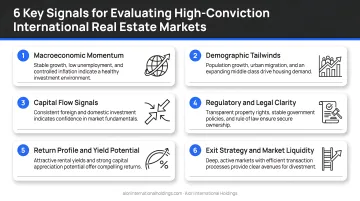
When evaluating any international market, these are the signals that matter:
- Macroeconomic stability and growth trajectory
- Foreign ownership rights and legal clarity
- Rental demand and documented yield data
- Capital appreciation trajectory supported by fundamentals
- Ease of transaction and transparent holding costs
- Clarity of exit strategy and market liquidity
Conclusion
The right international market depends on your capital size, risk tolerance, hold period, and return objective. Each market covered in this guide offers a distinct case: some favor yield, others favor capital preservation, and a few offer residency pathways that compound the investment rationale. For investors prioritizing legal transparency, structural demand, and long-term value, Portugal and Georgia consistently clear the highest bars.
For American investors navigating international real estate without a trusted local partner, the risks are concrete: overpaying on entry, misreading legal structures, or buying into a market with no clear exit.
Alori International Holdings focuses specifically on Portugal and Georgia—curating vetted opportunities with verified legal structures, accurate pricing, and defined exit strategies, backed by in-country professionals who know each market from the inside out.
Ready to explore international real estate opportunities? Contact Alori at info@aloriinternationalholdings.com or call (323) 515-4000 to discuss curated opportunities aligned with your investment goals.
Frequently Asked Questions
What are the best places to buy international real estate?
The top markets for American investors in 2025–2026 are Portugal, UAE, Georgia, Mexico, and Colombia. The right choice depends on your priorities: rental yield, capital appreciation, residency pathways, or entry affordability.
Which countries offer the highest real estate ROI?
UAE/Dubai (6.8% gross yields) and Mexico's tourist corridors (Los Cabos $352 ADR) consistently deliver strong rental yield. Portugal and Georgia offer stronger long-term capital appreciation potential relative to entry price. ROI is highly deal-specific and depends on property type, location, and hold period.
Where to invest $500,000 right now?
A $500,000 budget opens access to investment-grade assets across most of the markets covered here. A split approach — pairing one stable EU market with one higher-growth emerging market — can balance yield against appreciation across different risk profiles.
Can Americans legally buy property abroad?
Yes, Americans can purchase real estate in most countries globally, though ownership structures vary (freehold vs. fideicomiso in Mexico's coastal zones). All foreign property income must be reported to the IRS. Consult a tax attorney and local legal professional before completing any transaction.
What are the biggest risks of buying real estate overseas?
The four main risk categories are legal/title risk, currency risk, political/regulatory risk, and liquidity risk. Working with vetted local partners and verifying legal structures before closing reduces exposure across all four.