
Introduction
American investors are sitting in some of the most expensive domestic property markets in history — yet global alternatives with stronger yields and genuine growth potential remain largely overlooked. Select international markets offer combinations of rental income, capital appreciation, and structural demand that most U.S. portfolios never access.
Geographic diversification in real estate isn't purely a hedge against domestic cycles. For investors willing to look beyond U.S. borders, it's a direct path to higher returns and long-term wealth preservation.
The compounding math is stark: a $300,000 investment earning 3% annually grows to roughly $403,000 over ten years. At 10%, that same investment reaches approximately $778,000 — a $375,000 difference from the same starting capital. The country you choose determines not just your yield, but your currency exposure, legal protections, exit liquidity, and whether your investment builds durable income or exposes you to risks you didn't see coming.
This guide breaks down the top countries delivering the highest real estate ROI right now — and what separates markets worth entering from those worth avoiding.
Key Takeaways
- Strong ROI depends on rental yield, capital appreciation, and entry cost working together
- Dubai, Portugal, Georgia, Greece, Turkey, and Panama lead globally for ROI potential in 2025–2026
- Rental yields reach 7.4–7.8% in top markets (Dubai, Georgia, Panama) versus a 3.2% average in prime global cities
- Entry costs in Georgia and Turkey ($100,000–$150,000) enable higher percentage returns than Western Europe or UAE
- Currency stability, legal transparency, and exit liquidity are just as critical as headline yield numbers
What Makes a Country a High-ROI Real Estate Market?
Understanding ROI requires distinguishing between three return components that are often conflated but measure separate outcomes.
Gross rental yield expresses annual rental income as a percentage of purchase price — a $200,000 property generating $14,000 in annual rent delivers a 7% gross yield. Capital appreciation tracks price growth over time. Net yield accounts for actual cash flow after property taxes, management fees, vacancy periods, and maintenance costs.
Many investors chase gross yield percentages without modeling net returns. That gap between headline yield and actual performance is where most international real estate disappointments originate.
High-ROI markets share specific structural characteristics:
- Supply-demand imbalance where housing inventory can't meet growing population or tourism demand
- Migration or tourism inflows creating sustained rental demand from international visitors or expats
- Low property taxes preserving net cash flow (Georgia's 0% property tax versus Portugal's 0.3–0.45% IMI)
- Favorable foreign ownership laws enabling direct property ownership without residency restrictions
- Stable or USD-pegged currency eliminating exchange rate volatility
Entry price matters as much as yield percentage. A $150,000 property at 8% yield generates the same $12,000 annually as a $600,000 property at 4% — but requires 75% less capital and leaves room to diversify.
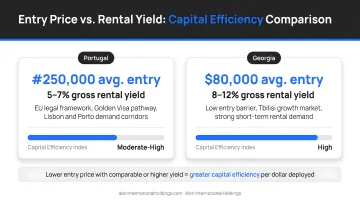
For investors in the $150,000–$600,000 range, choosing markets with lower entry prices isn't just about affordability. It's a portfolio construction decision that determines how many positions you can hold and how much risk you're concentrating in any single asset.
Top Countries for Highest ROI in Real Estate Investment
The markets below were selected using rental yield data, appreciation trends, foreign investor accessibility, legal framework quality, and structural demand—not speculative momentum or temporary price surges.
UAE (Dubai)
Dubai stands as the world's leading high-yield investment market, combining tax-free returns with currency stability and transparent property systems.
The emirate offers a zero-tax environment across all investment dimensions: no income tax on rental earnings, no capital gains tax on property sales, and no annual property tax. This tax structure maximizes net returns compared to European markets where combined taxes can reduce net yields by 30–40%.
Dubai's AED-USD currency peg eliminates exchange rate risk entirely, making it functionally equivalent to a USD-denominated investment.
Rental demand stems from Dubai's growing expatriate population, which reached 4.2 million residents by end-2024, with rental contracts jumping 81% from 531,000 in 2020 to 965,000 in 2024. The 10-year Golden Visa pathway for property investments exceeding AED 2,000,000 ($545,000) makes Dubai uniquely attractive for long-term hold strategies combining investment returns with residency optionality.
Dubai Real Estate Snapshot:
| Metric | Figure |
|---|---|
| Average Gross Rental Yield | 7.40% (apartments), 5.30% (villas) |
| Typical Entry Price (City Centre) | AED 1,689/sq ft ($460/sq ft); Golden Visa minimum AED 2,000,000 ($545,000) |
| Capital Appreciation Trend | +12.88% year-on-year (Dec 2025); villas +15.16%, apartments +12.52% |
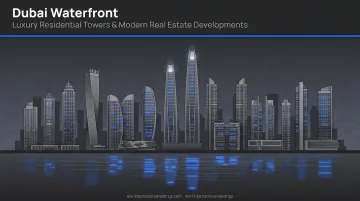
Sub-markets like Palm Jumeirah and Downtown Dubai continue outperforming citywide averages, particularly in villa segments where supply remains constrained relative to demand.
Portugal
Portugal combines stable governance, rising international demand, and persistent supply shortages to deliver one of Europe's most consistent appreciation plays.
The country's appeal rests on structural fundamentals: tourism-driven demand, digital nomad migration, and undersupply of quality housing in Lisbon and Porto pushed median property values up 19.0% year-on-year in Q3 2025. Bank appraisal values reached €4,556/sqm ($4,900/sqm) in Lisbon and €3,126/sqm ($3,360/sqm) in Porto by December 2025.
Portugal's legal framework offers strong foreign buyer protections and transparent title registration. While the residential Golden Visa route closed in October 2023, alternative pathways through €500,000 investment fund contributions remain available for residency-seekers. The country's undersupply crisis—driven by restricted new construction and surging international demand—supports continued appreciation despite already elevated price levels.
Alori International Holdings maintains deep in-market expertise in Portugal, offering curated access to vetted projects and off-market opportunities across Lisbon, Porto, and the Algarve through established developer relationships and local legal networks.
Portugal Real Estate Snapshot:
| Metric | Figure |
|---|---|
| Average Gross Rental Yield | 4.45% (Lisbon), 4.76% (Porto), 5.20% (Faro/Algarve) |
| Typical Entry Price (City Centre) | €2,065/sqm ($2,220/sqm) median transacted; Lisbon appraisals €4,556/sqm ($4,900/sqm) |
| Capital Appreciation Trend | +19.0% year-on-year (Q3 2025); sustained double-digit growth post-pandemic |
Short-term rental yields in tourism-heavy areas exceed long-term residential yields, though regulatory restrictions on Airbnb are tightening in urban centers.
Georgia (the Country)
Georgia delivers yield profiles comparable to Dubai at entry prices 60–70% lower than European capitals—a combination that few emerging markets can match.
This small Caucasus nation delivers a uniquely investor-friendly framework: 1% annual property tax, 0% capital gains tax for individuals holding property beyond two years, and fully dollarized real estate transactions (contracts priced in USD despite local currency being GEL). Tbilisi's tourism and expat economy welcomed 7.4 million international travelers in 2024, up 4.2% year-on-year, driving sustained short-term and long-term rental demand.
The operational framework stands out among emerging markets:
- Permits 100% foreign ownership with no restrictions
- Property registration completes within 24 hours via a digital registry system
- Average Tbilisi flats run GEL 4,297/sqm ($1,568/sqm) in Saburtalo and GEL 5,880/sqm ($2,146/sqm) in Vake
The country's EU Association Agreement and Deep and Comprehensive Free Trade Area (DCFTA) support long-term economic convergence with European standards, underpinning sustained appreciation potential.
Alori International Holdings has established in-country networks in Georgia, providing investors with access to vetted projects, verified legal structures, and defined exit strategies across Tbilisi and Batumi.
Georgia Real Estate Snapshot:
| Metric | Figure |
|---|---|
| Average Gross Rental Yield | 7.42% nationally; Tbilisi 7.78%, Batumi 7.28% |
| Typical Entry Price (City Centre) | GEL 4,297–6,769/sqm ($1,568–$2,471/sqm) in Tbilisi; minimum $150,000 for residency |
| Capital Appreciation Trend | +11.53% year-on-year (Q1 2025); +7.78% inflation-adjusted |
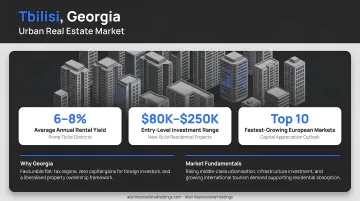
Batumi's Black Sea resort market offers higher yields (7–10% range) driven by tourism seasonality, while Tbilisi provides steadier year-round demand from expats and corporate tenants.
Greece
Greece transitioned from post-crisis undervaluation to sustained appreciation, driven by surging international tourism and short-term rental demand in Athens and island markets.
The investment case combines relatively accessible entry prices compared to Western European capitals, rising rental yields from tourism and digital nomad inflows, and EU residency pathways. Greece's Golden Visa program raised minimum investment thresholds to €800,000 ($860,000) in Athens, Thessaloniki, Mykonos, and Santorini effective September 2024, with €400,000 ($430,000) thresholds elsewhere—but notably prohibits short-term rentals on Golden Visa properties acquired after this date.
An important exception exists: investors can qualify with €250,000 ($269,000) by purchasing commercial properties for residential conversion or restoring listed heritage buildings, creating opportunity in Athens' gentrifying neighborhoods.
Property prices increased 7.6% year-on-year in Q4 2025 (Athens +5.9%, Thessaloniki +8.0%), with short-term rental yields in tourist areas outpacing long-term residential returns.
Greece Real Estate Snapshot:
| Metric | Figure |
|---|---|
| Average Gross Rental Yield | 4.40% nationally; Athens 5.43% |
| Typical Entry Price (City Centre) | Varies significantly; Golden Visa minimum €400,000–€800,000 depending on location |
| Capital Appreciation Trend | +7.6% year-on-year (Q4 2025); Athens +5.9%, Thessaloniki +8.0% |
Greece's appreciation is concentrated in Athens and high-tourism islands; secondary markets show more modest gains.
Turkey
Turkey presents a high-nominal-appreciation market where investors must carefully distinguish between lira-inflated gains and real USD-denominated returns.
The country's appeal lies in very low entry prices and a citizenship-by-investment program requiring $400,000 minimum property purchase with a three-year hold restriction. Istanbul and coastal resort markets (Bodrum, Antalya) attract rental demand from domestic and international tourists.
The critical challenge is currency erosion. Three figures tell the story:
- Nominal prices rose 26.4% year-on-year in February 2026
- Real inflation-adjusted returns were negative (-3.9%) once converted to USD
- The lira fell from 16.56 TRY/USD in 2022 to 39.48 TRY/USD in 2025, wiping out headline yield gains
Turkey works best for citizenship-motivated buyers willing to accept currency volatility in exchange for passport optionality—provided transactions are structured in USD with USD-denominated rental income.
Turkey Real Estate Snapshot:
| Metric | Figure |
|---|---|
| Average Gross Rental Yield | 7.32% nationally; Istanbul 8.17%, Antalya 6.14% |
| Typical Entry Price (City Centre) | Among lowest globally; $400,000 minimum for citizenship eligibility |
| Capital Appreciation Trend | +26.4% nominal (Feb 2026); -3.9% real USD-adjusted due to lira depreciation |
Turkey's yields appear attractive on paper but require rigorous currency hedging and USD transaction structuring to preserve value for American investors.
Panama
Panama offers the most financially sophisticated emerging market framework in Latin America for American investors—a fully dollarized economy eliminating currency risk entirely.
The country uses the US Dollar as official currency alongside the Panamanian Balboa (pegged 1:1, coins only), making it functionally equivalent to a domestic USD investment.
Panama's property tax exemptions for new construction preserve net cash flow during hold periods, tiered by assessed value:
- 20-year exemption on properties valued up to $120,000
- 10-year exemption on values between $120,001–$300,000
- 5-year exemption above $300,000
Rental demand stems from a large multinational expat community and regional business travelers, with mid-market neighborhoods like El Cangrejo delivering up to 8.7% gross yields. Panama's geographic position as a global logistics hub (Panama Canal) supports long-term economic growth and commercial real estate demand.
For investors combining returns with lifestyle migration, two residency pathways are available: the Friendly Nations Visa requiring $200,000 real estate investment and the Pensionado Visa requiring $1,000 monthly pension or $750 pension plus $100,000 property purchase.
Panama Real Estate Snapshot:
| Metric | Figure |
|---|---|
| Average Gross Rental Yield | 7.83% (Panama City); El Cangrejo studios 8.7%, Punta Pacifica luxury 6.4% |
| Typical Entry Price (City Centre) | $1,804/sqm average (March 2025); +2.38% year-on-year |
| Capital Appreciation Trend | Moderate but stable; +2.38% year-on-year; long-term growth tied to Canal expansion |
Panama's dollarized structure and established expat infrastructure make it the most operationally straightforward Latin American market for American investors.
How We Evaluated These Markets
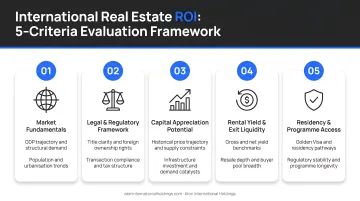
These markets were assessed across five core dimensions that determine durable ROI rather than speculative momentum.
Each market was scored across five criteria:
- Gross rental yield — income-generating capacity; markets delivering 6–10% are considered high-yield against the 3.2% prime global average
- Capital appreciation — minimum three-year price trends to distinguish structural growth from temporary spikes
- Entry cost accessibility — feasibility for investors in the $150,000–$600,000 range, affecting capital efficiency and diversification flexibility
- Legal framework quality — foreign ownership rights, title clarity, and transaction transparency, assessed using the JLL Global Real Estate Transparency Index, which ranks markets from highly transparent (Portugal, UAE, Greece) to semi-transparent (Turkey) or opaque (Panama)
- Exit liquidity — how readily assets can be sold to local or international buyers within reasonable timeframes at fair market value
Markets were excluded if high yields stem primarily from currency debasement rather than real demand. Turkey's lira-denominated yields appear inflated (8%+), but USD-real returns are negative. For American investors whose returns are ultimately measured in dollars, that distinction is decisive.
All ROI figures are gross estimates. Net returns vary based on management fees (typically 8–12% of rental income), vacancy rates (5–15% depending on market), local taxes (0% in Georgia and UAE versus 0.3–0.45% in Portugal), and financing structure. Investors should model net cash flow scenarios, not just headline yield numbers.
Key Risks That Can Erode International Real Estate ROI
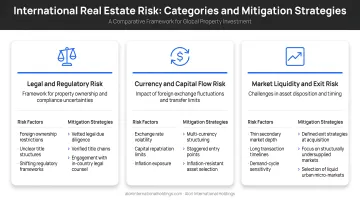
Three risks kill more international real estate returns than all other factors combined.
Currency risk occurs when the local currency depreciates against the dollar, converting a 7% yield into a net loss when repatriated. Turkey demonstrates this clearly: 7.32% nominal yields evaporated as the lira collapsed from 16.56 to 39.48 per USD in three years.
Investors can reduce this exposure by targeting dollarized economies (Panama), USD-pegged currencies (UAE), or structuring rental contracts in USD even in volatile-currency markets.
Legal and title risk encompasses unclear ownership structures, foreign ownership restrictions, or opaque transaction processes. Markets with lower transparency scores—like Panama's "opaque" designation—require far heavier title verification than "transparent" markets like Portugal or Dubai.
The cost of inadequate verification can be total investment loss. Work with partners who maintain verifiable in-country legal networks, not offshore brokers coordinating transactions remotely.
Liquidity risk surfaces when investors need to exit but can't find buyers at fair prices within a reasonable timeframe. Frontier markets like Georgia or resort-focused locations in Greece offer high yields but narrower buyer pools than established markets.
The mitigation is thorough local due diligence and partners with genuine on-the-ground execution capacity—not just online listings or offshore brokers without local transaction networks.
Over-concentration in a single international market creates the same vulnerability as domestic-only portfolios. Spreading exposure across two or three vetted markets—balancing tourism-driven economies, urban expat hubs, and stable currency environments—distributes yield, appreciation, and risk across different economic cycles.
Alori International Holdings focuses specifically on markets where the firm maintains in-country legal, transactional, and network depth. That means established developer relationships, vetted legal counsel, and documented market intelligence rather than remote coordination from offshore.
Conclusion
The countries delivering the highest real estate ROI share common structural traits: undersupplied markets, strong inbound demand from tourism or migration, low or zero property taxes, and accessible foreign ownership frameworks. These fundamentals—not market hype or temporary price momentum—sustain returns over investment horizons that matter.
Move beyond surface-level yield comparisons. Evaluate each market on the full ROI picture:
Move beyond surface-level yield comparisons. Evaluate each market across the full ROI picture:
- Entry cost vs. cash flow — what the asset generates relative to what you pay in
- Net yield — actual returns after taxes, fees, and carrying costs
- Appreciation potential — grounded in structural demand, not speculation
- Legal clarity — ownership protections that hold up under local law
- Exit strategy — a defined path to realizing gains when needed
The highest-conviction markets for 2025–2026—Dubai, Portugal, Georgia, Greece, Turkey, and Panama—each excel across different dimensions of this framework. Your optimal selection depends on capital availability, risk tolerance, residency objectives, and whether you prioritize immediate cash flow or long-term appreciation.
Once you've identified your criteria, execution is where most cross-border investments succeed or unravel—navigating local legal structures, verifying developer track records, and confirming exit mechanics before capital is committed. Alori International Holdings focuses specifically on Portugal and Georgia, two markets where the firm has built in-country legal networks, vetted developer relationships, and transaction processes designed to reduce the risks that derail most international buyers. If those markets align with your objectives, the groundwork is already done.
Frequently Asked Questions
Where is the highest ROI for real estate?
Dubai and Georgia currently deliver among the highest gross yields globally at 7.4%+ annually, but "highest ROI" depends on whether you optimize for rental yield, capital appreciation, or total return. Net ROI after taxes and costs (not gross percentages) determines actual investor outcomes.
What is a good ROI for real estate investment internationally?
Gross rental yields of 6–10% are considered strong in international markets. Markets delivering 8%+ yields combined with stable currencies and transparent legal frameworks represent the higher end of the risk-adjusted return spectrum, particularly when appreciation compounds annual income.
How does rental yield differ from total ROI on international property?
Rental yield measures annual rental income as a percentage of purchase price — for example, $14,000 annually on a $200,000 property equals 7% yield. Total ROI also incorporates capital appreciation and currency movement, so a 5% yield in a fast-appreciating market can far outperform a 7% yield in a stagnant one.
Can Americans legally buy real estate in the countries listed?
Yes — Americans can legally purchase property in all six countries featured. Ownership structures, registration requirements, and financing options vary by jurisdiction, so working with local legal counsel ensures proper title verification and compliance.
What are the biggest risks of investing in foreign real estate?
Currency risk (local returns converting unfavorably to USD), legal/title risk (especially in markets with less mature property registries), and liquidity risk (difficulty selling quickly if exit is needed) represent the primary risk categories requiring structured mitigation strategies.
Is it better to invest in one country or diversify across multiple international markets?
Diversifying across two or three vetted markets with different demand drivers (one tourism-driven, one urban expat-driven) provides more durable returns than single-market concentration. That said, fewer and deeper investments in thoroughly researched markets consistently outperform scattered exposure spread thin across unfamiliar ones.