

Introduction
Portugal has become one of Europe's most active cross-border real estate markets in 2026, driven by sustained foreign demand, steady price appreciation, and constrained housing supply. The country's median house price reached €2,111/m² in Q3 2025 — a 16.1% year-over-year increase — while monthly tourism revenues surpassed €4.3 billion. These are signals of structural demand, not speculative momentum.
Yet American buyers face real friction: unfamiliar legal systems, currency exposure, and opaque transaction processes. The mechanics alone — NIF acquisition, IMT tax calculations, CPCV contracts, post-purchase IRS reporting — can catch unprepared investors off-guard.
Understanding Portugal's market means understanding both the opportunity and the process.
This guide walks American investors and lifestyle buyers through every stage of a Portuguese property purchase in 2026 — from legal eligibility and transaction structure to tax obligations and regional pricing realities.
Key Takeaways
- Foreigners, including Americans, can buy property with no ownership restrictions—a NIF (tax number) and legal representative are the primary requirements
- Budget 7–10% above the purchase price for taxes, notary fees, and legal costs
- The buying sequence: NIF → financing → property search → CPCV contract → final deed (Escritura) → registration
- Property ownership does not grant residency—separate visa routes (D7, D8) apply for stays beyond 90 days
- US buyers face additional reporting obligations under FBAR and FATCA—cross-border tax advisors are essential
Why Portugal in 2026: The Investment Case
Market Trajectory and Regional Pricing
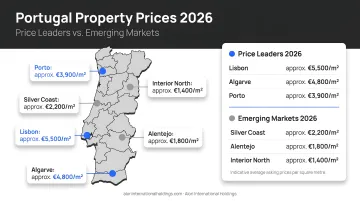
Portugal's property market shows clear structural momentum rather than speculative heat. The national median reached €2,111/m² in Q3 2025, up 16.1% year-over-year. But regional variations reveal where true value and appreciation potential lie:
Price Leaders:
- Lisbon: €4,657/m² average (March 2026), with premium parishes like Santo António commanding €7,289/m²
- Algarve: €3,988/m² average, driven by lifestyle demand and limited coastal supply
- Porto: €3,120/m² average, offering relative value compared to Lisbon with strong rental yields
Emerging Value Markets:
- Setúbal: €3,293/m², benefiting from Lisbon spillover and infrastructure development
- Braga: €1,902/m², attracting buyers seeking affordability with urban amenities
- Alentejo: €2,029/m², appealing to lifestyle buyers seeking authenticity and space
This regional spread matters: Lisbon and the Algarve deliver capital appreciation and established rental markets, while Braga, Setúbal, and Alentejo offer entry points for buyers who can tolerate longer hold periods and less immediate liquidity.
Structural Demand Drivers, Not Momentum
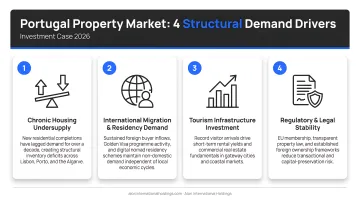
Portugal's market is supported by measurable, durable demand signals:
- 2025 provisional data recorded 32.5 million total guests (19.7 million foreign) and 82.1 million overnight stays — sustained international traveler volume that translates directly into rental income potential for property investors.
- The foreign resident population grew from 1,044,606 in 2023 to approximately 1,546,521 by year-end 2024, generating long-term rental demand from executives, digital nomads, and retirees — a tenant pool that isn't dependent on seasonal tourism.
- 2024 housing completions grew but remained well below the 2000–2011 annual average of 53,000 units. Persistent undersupply in Lisbon and Porto supports durable price floors where demand consistently outpaces inventory.
- Portugal ranked 7th globally in both the 2024 and 2025 Global Peace Index — a consistent safety and stability signal that attracts families, retirees, and risk-averse investors looking beyond higher-volatility markets.
Tax Advantages for New Residents
Portugal replaced its original Non-Habitual Resident (NHR) program with the updated IFICI tax regime (NHR 2.0), effective January 1, 2024. The new framework offers a 20% special IRS rate on employment and self-employment income for 10 consecutive years.
Qualifying categories include:
- Higher education teaching and scientific research
- Highly qualified professions (IT specialists, doctors, executives)
- Startup employees in approved sectors
For Americans planning to relocate or spend extended time in Portugal, the IFICI regime delivers meaningful tax efficiency on Portuguese-source income. Combined with the US-Portugal tax treaty (covering immovable property income and capital gains), buyers who establish tax residency can structure their affairs to minimize double taxation exposure.
Alori International Holdings focuses on Portugal based on the same macroeconomic indicators, demographic trends, and capital flow data outlined above — not speculative momentum. For American investors entering an unfamiliar market, Alori's approach centers on properties with verified legal structures, accurate pricing, and defined exit strategies, reducing the transaction risk that comes with buying internationally.
Can Foreigners Buy Property in Portugal?
No Ownership Restrictions
Portugal imposes **no restrictions on foreign ownership**. EU and non-EU citizens, including Americans, have identical property rights to Portuguese nationals under Article 14 of the Portuguese Civil Code. There are no nationality-based limits, approval requirements, or special permits needed to purchase real estate.
Two Non-Negotiable Prerequisites
1. NIF (Número de Identificação Fiscal): Your Portuguese tax identification number is required for every financial transaction—bank account opening, property contracts, tax payments, and utility transfers. Non-residents must appoint a fiscal representative (individual or entity) residing in Portugal to obtain a NIF.
You can request a NIF remotely through the Autoridade Tributária e Aduaneira's e-balcão portal via your fiscal representative. The process typically takes 1–2 weeks once documentation is submitted. You'll need to provide:
- Passport (valid)
- Proof of address from your home country
- Fiscal representative appointment documentation
2. Legal Representation: Portuguese law doesn't require a lawyer for property purchases, but proceeding without one is high-risk. A qualified lawyer will:
- Verify ownership via land registry certificates
- Confirm no outstanding debts or liens on the property
- Review zoning classifications and building licenses
This due diligence shields you from inherited debts and title problems that can surface after closing.
Portuguese Bank Accounts
Once your NIF and legal representation are in place, the next practical step is setting up a local bank account. It's not legally mandatory for cash buyers, but it simplifies deposits, tax payments, and utility transfers considerably. Non-residents can open accounts at major banks:
- Millennium BCP
- Santander Portugal
- Novo Banco
- Caixa Geral de Depósitos
Documentation requirements typically include your NIF, passport, proof of address (home country), and employment or income verification. Expect the account opening process to take 2–4 weeks.
Step-by-Step: How to Buy Property in Portugal
Phases 1–3: Prepare, Finance, and Search
Pre-Purchase Preparation: Define your goal clearly: investment income, lifestyle property, or future retirement residence. Establish a realistic budget including the 7–10% transaction cost buffer (IMT, stamp duty, legal fees, notary costs). If financing, secure mortgage pre-approval before making offers—this strengthens your negotiating position and prevents deal collapse due to financing failures.
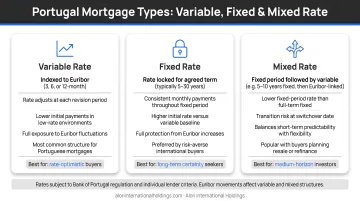
Financing Options: Portuguese banks typically lend 60–80% LTV to residents and 60–70% LTV to non-residents, with terms up to 30 years for non-residents (subject to age limits, e.g., maximum age 75 at loan maturity). Mortgage structures fall into three categories:
- Variable rates track Euribor (6 or 12 months) plus a bank spread — currently the most common structure
- Fixed rates lock your payment for 2–10 years, then revert to variable
- Mixed rates combine a fixed initial period (3–5 years) followed by variable
Early repayment penalty caps are regulated: maximum 0.5% of repaid capital for variable-rate loans; maximum 2.0% for fixed-rate loans.
Property Search: Use reputable listing portals (Idealista, Imovirtual, Casa Sapo) and work with licensed agents registered with AMI (Associação de Mediadores Imobiliários). Agent fees are paid by the seller (4–6% plus VAT), not buyers.
Conduct in-person or virtual viewings and hire a certified surveyor to check for structural defects, unlicensed extensions, and missing habitation licenses (Licença de Habitação). Unresolved issues here can block the transaction entirely or expose you to post-purchase liability.
Phases 4–6: Offer, Contract, and Due Diligence
The CPCV (Contrato de Promessa de Compra e Venda): Once your offer is accepted, both parties sign this legally binding promissory contract outlining price, conditions, and completion timeline. Buyers typically pay a 10–20% deposit at this stage.
The deposit terms create clear mutual accountability:
- If the seller withdraws, they must return double the deposit
- If the buyer withdraws, the deposit is forfeited
Have a qualified lawyer review this document line-by-line before signing. The CPCV governs your financial exposure — your lawyer's job here is contract protection, not yet property verification.
Legal Due Diligence: In Portugal, encumbrances — mortgages, tax seizures, liens — attach to the property itself, not the owner. They transfer to you at completion if not cleared beforehand.
Your lawyer addresses this directly: verifying ownership via the Certidão Permanente (permanent land registry certificate), confirming no outstanding debts or liens, and reviewing zoning, building licenses, and planning compliance. Missing this step means you can inherit a seller's financial obligations.
Phases 7–8: Final Deed and Registration
Escritura Pública de Compra e Venda (Final Deed): A notary presides over the final deed signing, verifies all documentation, and legally transfers ownership. The remaining purchase balance is paid at this stage. IMT and stamp duty must be settled before the deed is signed — bring proof of payment to the notary appointment or the transaction cannot proceed.
Post-Signing Registration: The transaction must be registered with the Land Registry Office (Conservatória do Registo Predial) and Tax Authority (Finanças) to legally establish your ownership and enforce rights against third parties.
After registration:
- Transfer utilities to your name
- Arrange home insurance
- If renting short-term, obtain an Alojamento Local (AL) license where required (subject to municipal restrictions in Lisbon and Porto)
Taxes and Total Buying Costs in Portugal
IMT (Property Transfer Tax)
IMT is the property transfer tax paid before the final deed. Rates vary by property type:
Rural properties: 5% flat rate
Commercial/Other urban: 6.5% flat rate
Secondary/Non-Permanent Residential Progressive Scale:
| Purchase Price | IMT Rate |
|---|---|
| €0–€106,346 | 1% |
| €106,346–€145,470 | 2% |
| €145,470–€198,347 | 5% |
| €198,347–€330,539 | 7% |
| €330,539–€633,931 | 8% |
| €633,931–€1,150,853 | 6% flat |
| >€1,150,853 | 7.5% flat |
Lower-value primary residences may qualify for partial exemptions. IMT is calculated and paid before the Escritura (final deed) is signed.
Stamp Duty (Imposto de Selo)
A flat 0.8% applied to the declared purchase price, payable alongside IMT. If financing, stamp duty also applies separately to mortgages at 0.6% for loans with terms of 5 years or more.
Annual Property Taxes
IMI (Imposto Municipal sobre Imóveis):
Charged yearly at 0.3–0.45% for urban properties (up to 0.5% in specific cases) and 0.8% for rural properties. Calculated on the VPT (Tax Asset Value), which is typically much lower than market value. Temporary IMI exemptions apply for qualifying primary residences.
AIMI (Wealth Tax):
Applies to properties above €600,000 individually or €1.2 million for married couples, based on VPT. Rates:
- 0.7% on excess VPT up to €1M
- 1.0% on €1M–€2M
- 1.5% above €2M
Capital Gains and Rental Income Tax
Capital Gains (Non-Residents):
Following 2023 tax reform, 50% of the capital gain is taxable, subject to mandatory aggregation at progressive IRS rates. Portugal and the US have a tax treaty covering capital gains, allowing US investors to claim Foreign Tax Credits to reduce double taxation exposure.
Rental Income (Non-Residents):
Flat rate of 25% for residential leases (reduced from 28%). Long-term leases receive further reductions:
- 5–10 year leases: 10 percentage point reduction
- 10–20 year leases: 15 percentage point reduction
Both rental income and capital gains must be reported on US federal returns — a cross-border tax advisor can help you structure your position correctly to avoid paying tax twice on the same income.
Total Cost Breakdown (€300,000 Purchase Example)
| Cost Item | Amount (€) | % of Price |
|---|---|---|
| Purchase Price | 300,000 | 100% |
| IMT (Secondary Residence) | 20,700 | 6.9% |
| Stamp Duty (0.8%) | 2,400 | 0.8% |
| Legal Fees (1.5%) | 4,500 | 1.5% |
| Notary & Registration | 800 | 0.3% |
| Total Transaction Cost | 28,400 | 9.5% |
| Total Cash Required | 328,400 | 109.5% |
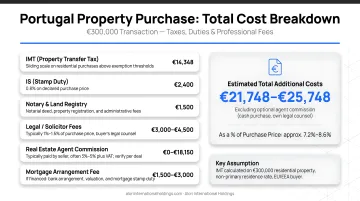
Transaction costs typically run 7–10% of purchase price — factor this into your acquisition model before agreeing to a price point, as it directly affects your entry yield and exit math.
Best Locations, Risks, and Residency Considerations
Best Locations for Different Buyer Profiles
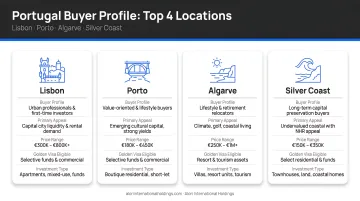
Lisbon — Capital Appreciation & Urban Rental Demand:
Average €4,657/m² (March 2026), with premium parishes like Santo António reaching €7,289/m². Lisbon delivers strong capital appreciation and consistent rental demand from corporate executives, digital nomads, and international residents. Note: Alojamento Local (AL) licensing restrictions in central parishes have been subject to ongoing regulatory review since 2023—verify current licensing status with your lawyer before purchasing for short-term rental investment.
Porto — Affordable Entry with Strong Rental Yields:
Average €3,120/m² (March 2026), offering relative value compared to Lisbon. AirDNA 2026 data shows average daily rates of €113 (approx. $122) with 66% occupancy for short-term rentals. Porto maintains containment zones in central parishes (Santo Ildefonso, Sé, Miragaia, São Nicolau, Vitória) where new AL registrations are restricted — confirm licensing availability before committing.
Algarve — Lifestyle Buyers, Retirees & Established Expat Communities:
Average €3,988/m² (March 2026). Home to 40+ championship courses and 300+ days of sunshine, the Algarve draws affluent international buyers year-round. The Golden Triangle (Quinta do Lago, Vale do Lobo, Vilamoura) commands premium pricing with strong villa-focused inventory. Rental yields range 5–10% annually, supported by limited coastal supply and consistent international demand.
Silver Coast (Costa de Prata) & Alentejo — Lower Entry Prices & Authenticity:
Alentejo averages €2,029/m² (March 2026), offering significant value for buyers seeking rural retreats, farmhouses, and agri-tourism properties. These regions suit lifestyle buyers prioritizing authenticity over urban convenience. Expect longer hold periods before resale — rural markets move more slowly than Lisbon or Porto.
Key Risks American Buyers Must Manage
Before signing anything, understand where deals most commonly go wrong:
Hidden Property Debts:
Encumbrances (mortgages, tax seizures) attach to the property in Portugal, not the seller, and transfer with the property if not cleared. Always request Certidão Permanente and Caderneta Predial before paying any deposit.
Unlicensed Construction or Missing Habitation Licenses:
Extensions, renovations, or conversions built without proper permits can render properties unsaleable or unbankable. Have a lawyer verify building permissions and a surveyor assess structural integrity before signing the CPCV.
Currency Risk:
USD/EUR fluctuations affect total cost for American buyers. The EUR/USD average was 1.0824 in 2024 and 1.1300 in 2025 — a 4.4% swing that can meaningfully shift your all-in cost on a €300,000 purchase. Budget conservatively and consider hedging strategies for large purchases.
Short-Term Rental Regulation Changes:
AL regulations are tightening in Lisbon and Porto. Lisbon's absolute containment zones ban new ALs in parishes with >10% density (e.g., Santa Maria Maior, Misericórdia, Santo António). Investment properties must account for these restrictions in yield projections.
Working with an advisor who has verified legal structures, confirmed licensing status, and benchmarked pricing against true market comparables significantly narrows where deals go wrong. Alori International Holdings structures its curated opportunities around exactly these checkpoints, with off-market access and defined exit strategies built in from the start.
Residency and Visa Reality Check
Property Ownership ≠ Residency:
Buying property does not grant residency rights. Americans can stay up to 90 days in any 180-day period as tourists. To live in Portugal longer-term, you must apply through qualifying visa routes:
D7 Passive Income Visa:
Minimum income threshold: €920/month (€11,040/year) for the main applicant, increasing by 50% for a spouse and 30% per dependent child (2026 figures). Designed for retirees and individuals with passive income (pensions, dividends, rental income).
D8 Digital Nomad Visa:
Minimum income threshold: €3,680/month (€44,160/year) for the main applicant, increasing by 50% for a spouse and 30% per dependent child (2026 figures). Designed for remote workers and digital nomads employed by foreign companies.
Property ownership strengthens visa applications as proof of accommodation and ties to Portugal, but is not a qualifying investment. After 5 years of legal residency, you may apply for permanent residency or citizenship, subject to language (A2 level Portuguese) and integration requirements.
The Golden Visa real estate route was officially closed on October 7, 2023 — no new applications are accepted under this route.
Frequently Asked Questions
How difficult is it to buy property in Portugal?
The process is relatively straightforward compared to many European countries, with clear legal steps and established procedures. Foreign buyers need a NIF, a qualified lawyer, and should budget adequate time for due diligence and registration, which typically takes 2–4 months from search to completion.
How hard is it to buy property in Portugal as an American?
Americans face no legal barriers to purchasing property. The main added complexities are currency conversion from USD to EUR, obtaining a NIF and fiscal representative, and US-specific tax reporting requirements—FBAR/FATCA filings for overseas assets—that call for a cross-border tax advisor.
Can foreigners buy property in Portugal?
Yes. Portugal imposes no restrictions on foreign ownership. Non-EU and non-resident buyers have identical rights to Portuguese citizens, provided they obtain a NIF.
Can I get permanent residency in Portugal if I buy a house?
No. Purchasing property alone does not grant residency. Buyers must apply through a qualifying visa route (D7, D8, or others). After five years of legal residency, you may apply for permanent residency or citizenship, which includes language and integration requirements.
Can I live on $1,000 a month in Portugal?
$1,000/month is very tight. It may cover basics in lower-cost inland towns, but falls short in Lisbon or Porto, where rent alone often exceeds that figure. Most expats budget $1,800–$3,000/month for a comfortable lifestyle.