

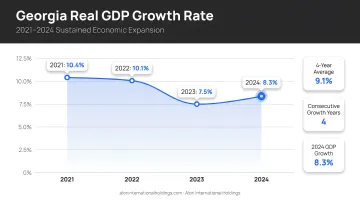
Georgia's emergence as a serious international investment destination isn't speculation. The country recorded 9.7% real GDP growth in 2024, maintains one of the lowest tax regimes globally (0% on retained profits, 15% on distributions), and offers foreign investors unrestricted property ownership with digital registration completed in 24 hours. Real estate markets in Tbilisi and Batumi are attracting capital from Gulf states, Asia, and Western investors seeking earlier-stage opportunities before pricing reaches Western European levels. This is the "why now" moment for investors willing to look beyond overheated markets toward fundamentals-driven growth.
Key Takeaways
- Georgia delivered 9.7% real GDP growth in 2024, building on consistent expansion of 7.8% (2023), 11.0% (2022), and 10.6% (2021)
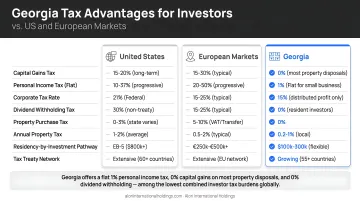
- The country offers 0% tax on retained profits, 15% on distributed profits, and no capital gains, inheritance, or wealth taxes
- Tbilisi's primary market averages $1,385/sqm with rental yields of 7.8–8.9%
- Batumi new-build properties average $1,334/sqm with 7.28% yields
- Free trade agreements with the EU, China, UK, Turkey, and CIS nations reach a combined market of 2+ billion consumers
- Foreign investors can own 100% of Georgian companies and register entities in one day, with property ownership unrestricted for non-agricultural land
Georgia's Economic Momentum: The Numbers Behind the Narrative
Georgia's growth trajectory stands out even against global emerging-market peers. The country's real GDP increased by 9.7% in 2024, following growth of 7.8% in 2023, 11.0% in 2022, and 10.6% in 2021. This sustained expansion is driven by structural demand across multiple sectors — domestic consumption, services growth (particularly IT, education, and public services), rising tourism revenues, and increasing foreign direct investment.
Foreign direct investments totaled $1.57 billion in 2024 (down 18.6% from 2023), but the composition tells a more important story than the headline number. The investor mix has diversified well beyond traditional EU and UK capital — Gulf states, Middle Eastern, and Asian investors now represent a larger share of inbound flows, particularly into real estate. In Q3 2025, real estate activities captured 17.2% of total FDI, confirming that property markets are a primary draw for international capital.
Tourism's connection to real estate demand is direct and measurable. Georgia recorded 7.8 million international visits in 2025, including 5.5 million tourist visits and $4.69 billion in travel receipts — a record that feeds short-term rental demand, hospitality development, and coastal property absorption. The Adjara region alone (home to Batumi) drew 301,800 visits in Q1 2025, representing 15.6% of total inbound traffic.
What that means for property investors:
- Short-term rental yields in Batumi benefit from year-round international visitor flow
- Coastal and urban development pipelines are backed by quantifiable demand, not projections
- Tourism diversification across Gulf, Middle Eastern, and Asian markets reduces seasonal concentration risk
The business environment reinforces this picture. Georgia's regulatory framework supports rapid company formation, transparent property registration, and low bureaucratic friction — advantages that show up consistently in international ease-of-doing-business rankings. For investors entering the market now, that regulatory clarity reduces transaction friction and compresses the timeline from capital commitment to income-generating asset.
An Investor-Friendly Tax Regime That's Hard to Match
Georgia employs an Estonian-style corporate income tax model: 0% tax on retained and reinvested earnings, with a 15% tax applied only when profits are distributed. For context, the standard US federal corporate tax rate is 21%, and many Western European countries impose rates between 19–30%. Georgia's structure allows businesses and real estate investors to compound returns tax-free as long as capital remains invested.
Additional tax advantages stack up quickly:
- No capital gains tax on property sales
- No inheritance or wealth taxes
- Dividend income tax of just 5%
- 0% VAT on property purchases
- 0% annual property tax for owners
For real estate investors, this translates to keeping more of rental income and sale proceeds compared to Western markets. A foreign investor purchasing a $300,000 apartment in Tbilisi, earning 8% annual rental yield ($24,000), pays just 5% tax on that income ($1,200)—compared to potential rates exceeding 20–35% in major US or European cities.
These advantages extend beyond real estate. Enterprises in Free Industrial Zones in Poti, Kutaisi, and Tbilisi are exempt from profit tax, property tax, and import duties. IT companies qualifying for "Virtual Zone" status receive exemptions from the 15% corporate tax and 18% VAT on export revenues—making Georgia attractive for tech-driven businesses as well.
The tax structure is also backed by frictionless entry. Registration can be completed in one day for a standard fee of 100 GEL (~$35), or same-day for 200 GEL. Foreign individuals and entities can own 100% of Georgian LLCs or JSCs with no minimum capital requirement, removing barriers that routinely complicate market entry in other jurisdictions.
The Real Estate Opportunity: Tbilisi, Batumi, and Beyond
Tbilisi: Capital City Fundamentals
Tbilisi offers the classic capital-city investment thesis: expanding infrastructure, mixed-use development pipeline, rising expat demand, and improving connectivity. TAV Airports is investing $150 million to expand Tbilisi International Airport to 10 million annual passengers by 2028, while metro system modernization includes extensions to Akhmeteli Theatre and Varketili stations.
Tbilisi's primary market averaged $1,385/sqm in January 2026, with secondary market properties at $1,296/sqm. Gross rental yields averaged 7.78% in Q1 2025, with some reports citing 8.9%—substantially higher than comparable European capitals.
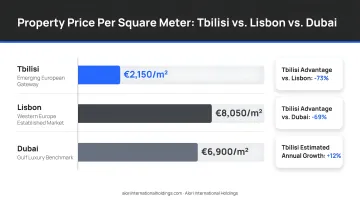
A $300,000 budget in Tbilisi acquires approximately 215 sqm (2,300 sqft) in a new-build development. The same capital buys far less in markets American investors commonly compare it against:
| Market | Avg. Price (USD/sqm) | $300K Buys Approx. |
|---|---|---|
| Tbilisi (primary) | $1,385 | ~215 sqm (2,300 sqft) |
| Lisbon | ~$6,900 | ~43 sqm (465 sqft) |
| Dubai | ~$5,260 | ~57 sqm (615 sqft) |
Batumi: Black Sea Resort Dynamics
Batumi's investment case centers on tourism growth, short-term rental income potential, and coastal lifestyle appeal. Batumi's real estate market surpassed $1 billion in 2025, with foreign buyers driving 70% of transaction growth and accounting for 47% of secondary market sales.
New-build apartments averaged $1,334/sqm in February 2026, up 12.6% year-over-year. Gross rental yields ranged from 4.61% to 9.96% across districts, averaging 7.28%.
Short-term rental data confirms the income potential. AirDNA data for 9,271 Batumi properties shows a 54% average occupancy rate, $46.50 average daily rate, and average annual revenue of $3,900 per unit. These are gross figures before expenses, but they reflect genuine tourism-driven demand — not speculative projections.
A $400,000 investment in Batumi acquires approximately 300 sqm (3,200 sqft) of new-build coastal property — substantially more than comparable budgets secure in established Mediterranean resort markets. For investors unfamiliar with Georgian transaction processes, the legal structure and exit strategy due diligence matters as much as the headline price.
Georgia's Strategic Position: How Geography Becomes an Investment Advantage
Georgia's location at the crossroads of Europe and Asia positions it as a critical East-West trade corridor—a role actively reinforced by infrastructure investment. The Port of Poti handled a record 636,466 TEU in 2025, while the Anaklia Deep Sea Port project is undergoing development with a first-phase capacity target of 600,000 TEU annually.
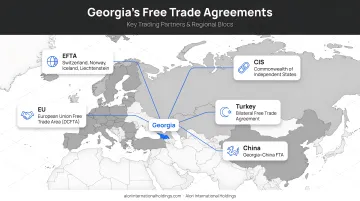
Free trade agreements provide preferential market access. Georgia maintains active agreements with:
- The European Union via the DCFTA (since July 2016)
- China (since January 2018)
- Turkey (since November 2008)
- EFTA and CIS countries
These agreements cover a combined population exceeding 2 billion people, providing Georgian-based businesses with preferential export access to major global markets—a structural advantage that extends beyond real estate into logistics, manufacturing, and energy sectors.
That trade infrastructure extends into Georgia's role along the revived Middle Corridor—the overland route linking China and Europe through the Caucasus. Sustained trade volume growth along this corridor supports commercial real estate, logistics facilities, and urban residential demand driven by employment expansion, making the investment case structural rather than speculative.
What Investors Should Know Before Entering the Georgian Market
Georgia's political landscape requires monitoring alongside economic fundamentals. Georgia was granted EU candidate status in December 2023, but following adoption of the "Law on Transparency of Foreign Influence" in mid-2024, the European Council stated that the accession process was de facto halted. This development has affected investor sentiment, particularly among Western capital sources prioritizing EU regulatory alignment.
Sovereign credit ratings remain stable despite political volatility:
- S&P Global Ratings affirmed Georgia at 'BB/B' with Stable outlook (February 2026)
- Fitch Ratings affirmed at 'BB' with Stable outlook (November 2025)
- Moody's affirmed at 'Ba2' but changed outlook to Negative (March 2025)
Taken together, these ratings indicate that institutional risk assessors consider Georgia's economic fundamentals resilient — even as its geopolitical alignment remains unsettled.
Practical due diligence remains essential. Before committing capital, investors should address three fundamentals:
- Verify legal title structures through Georgia's digital property registry
- Understand local transaction processes and closing requirements
- Define a clear exit strategy before entry
Partners who integrate global investment strategy with in-country execution — professionals fluent in local regulations, cultural nuances, and off-market access — are how international investors typically reduce entry risk in frontier and emerging markets.
Large-scale capital concentrations in a single sector — such as major mixed-use developments — warrant careful diversification. Investors should weigh sectoral exposure and avoid over-concentration in any single project or developer, regardless of scale or branding.
Frequently Asked Questions
Can Americans legally buy property in Georgia (the country)?
Yes. Foreign nationals, including Americans, can purchase residential and commercial property in Georgia with minimal restrictions. Foreign ownership is unrestricted except for agricultural land. Properties can be held personally or through Georgian corporate entities.
What taxes will I pay as a foreign investor in Georgian real estate?
Georgia offers significant tax advantages: 0% capital gains tax on property sales, 0% annual property tax, 0% VAT on purchases, and just 5% flat income tax on rental earnings. Corporate structures benefit from 0% tax on retained profits and 15% only on distributions.
What is the average rental yield in Tbilisi or Batumi?
Tbilisi averages 7.78–8.9% gross rental yields, while Batumi ranges from 4.61% to 9.96% across districts, averaging 7.28%. Both cities outperform most Western European and North American markets.
How does Georgia compare to Portugal or Dubai as an investment market?
Georgia is an earlier-stage, higher-upside alternative to more saturated markets. Entry prices run $1,300–$1,400/sqm versus $5,260/sqm in Dubai or $6,900/sqm in Lisbon — with comparable or higher rental yields and a more favorable tax structure. The trade-off includes title registry complexity and exposure to regional geopolitical dynamics, including proximity to ongoing conflict zones.
Is Georgia a politically stable country for foreign investment?
Georgia maintains a stable sovereign credit rating (BB/Ba2) and a well-regarded legal framework for property ownership. Investors should factor in the EU accession pause and regional proximity to active conflict zones — both of which warrant careful position sizing and independent legal review before committing capital.
What is the minimum budget needed to invest in Georgian real estate?
Entry-level quality apartments in Tbilisi or Batumi start around $100,000–$150,000. At that price point, buyers typically access 1–2 bedroom units in established neighborhoods with solid rental demand — a viable entry for investors seeking international diversification without six-figure minimums.