

Introduction
Batumi's residential property market recorded 1,315 apartment sales in February 2026 alone — a nearly 20% year-on-year increase — positioning it as one of the fastest-growing coastal real estate markets in Europe's eastern periphery. This growth reflects a fundamental shift in how international investors view this Black Sea city: low entry costs, a fully dollarized economy, and surging foreign demand have moved it from curiosity to conviction.
For American investors, Batumi offers something rare: entry prices far below Western European comparables, dollar-denominated transactions, and zero restrictions on foreign ownership. That combination is compelling — but compelling markets reward disciplined investors and punish underprepared ones equally.
This article breaks down the latest market data, the shifting buyer landscape, yield realities, and what U.S. investors need to understand before committing capital here.
TLDR
- Batumi's residential transaction volume grew nearly 20% year-on-year in February 2026, with total market value rising 33% to $82 million
- Foreign buyers now account for more than half of all purchases, with Israeli investors leading at 13–14% of the market
- New-build prices have climbed to approximately $1,334/sqm (primary market +23% YoY), but gross yields have compressed from ~10% in 2023 to ~7.4% in 2025
- Supply is expanding rapidly — 58,000 new units are planned through 2029 — making asset selection and entry timing critical
- Foreigners can purchase property in Batumi with no restrictions, and Georgia's flat-tax system and dollar-aligned economy reduce friction for international buyers
Batumi's Market by the Numbers: What 2025–2026 Data Reveals
Transaction Growth vs. Value Growth
According to Colliers Georgia's February 2026 report, Batumi recorded 1,315 residential transactions — a 19.7% year-on-year increase. Total market value reached $82 million, representing a 33.1% YoY jump. The gap between transaction volume growth (+19.7%) and market value growth (+33.1%) signals a critical market dynamic: per-unit prices are rising faster than volume, indicating sustained price inflation rather than mere market expansion.
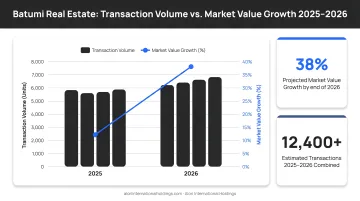
This divergence matters because it reveals pricing power. When market value outpaces transaction count, buyers are paying more per unit — a sign of either quality upgrades, location premiums, or genuine price appreciation. For investors, this means entry price discipline matters more than ever.
The New-Build vs. Secondary Market Split
The market is experiencing a structural shift in buyer preferences:
- New-build transactions rose 22.7% YoY — buyers are gravitating toward turnkey, modern units with contemporary finishes
- Secondary market transactions fell 12.8% YoY — older housing stock is losing ground despite lower per-sqm pricing
This preference shift reflects several factors: newer properties offer hotel-grade amenities, professional management options, and clearer title structures. American investors, in particular, favor new-build units because they reduce renovation risk, simplify rental management, and align with short-term rental (STR) platforms like Airbnb.
Full-Year Context and Inventory Accumulation
Galt & Taggart's 2025 data shows that total transactions reached 17,478 (+15% YoY). For the first time in years, secondary market transactions (9,500) overtook new builds (8,000) — but this inversion is partly driven by unsold inventory accumulation in new projects, which rose 13.9% to 12,400 units.
Developers are completing units faster than the market can absorb them. Unsold inventory creates downward price pressure over time, particularly in mid-market segments where differentiation is weak. For investors, this points to one clear priority: selecting projects with genuine demand drivers — beach proximity, branded management, or a scarcity position that mass-market supply can't replicate.
The Supply Pipeline Through 2029
Batumi's housing stock grew from 86,000 apartments in 2020 to 119,000 in 2024 — a 38% increase in four years. Now, 58,000 additional units are planned through 2029. If delivered as scheduled, this represents a 49% increase over current stock.
That level of supply expansion requires sustained demand growth to hold price appreciation and rental yields in place. If absorption lags, net yields could compress further — analysts project potential declines to 1.5–2% if supply significantly outpaces rental demand. Investors should track occupancy rates, tourism arrivals, and district-level absorption, not just city-wide transaction counts.
Data Reliability and the Registration Lag
Colliers notes that some primary market transactions are registered with delays at Georgia's National Agency of Public Registry (NAPR). This creates a timing distortion: headline price data may lag actual market conditions by several months. For investors, this cuts both ways. Early entrants may capture underreported price gains before data catches up — but the same lag can make markets appear stable when corrections are already underway. Tracking on-the-ground transaction activity, not just published figures, is the more reliable read on current conditions.
Who Is Buying in Batumi — and Why the Buyer Mix Is Shifting
Foreign Buyers Cross the 52% Threshold
Foreign buyers represented 52% of the Batumi market in 2025 — the first time non-Georgian buyers have exceeded domestic demand. In February 2026 alone, foreign buyer transactions surged 53.9% in the primary market and 47.6% in the secondary market year-on-year.
This threshold matters because it signals a fundamental market transformation. Batumi is no longer primarily a domestic resort town; it's becoming an international investment destination where foreign capital drives pricing, project selection, and developer behavior. When foreign buyers dominate, markets become more sensitive to geopolitical events, currency movements, and international travel patterns.
The Nationality Breakdown
According to Galt & Taggart's 2025 full-year data, the buyer mix has shifted significantly:
- Georgians: 48% (up from 38% in 2024) — restored local confidence
- Israelis: 13–14% (up from 6% two years prior) — now the #1 foreign buyer group
- EU buyers: 13% (down from 18%) — high-base normalisation
- Russian/Ukrainian/Belarusian: 11% (declining from prior years)
- Central Asian buyers: ~3% (stable)
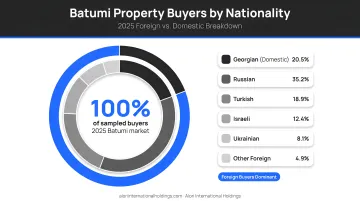
Israeli buyers surged because geopolitical instability in the Middle East pushed investors toward safe-haven assets abroad. Georgia checks the right boxes: low entry costs, direct flights, and a straightforward property registration process. Israeli tourist arrivals to Georgia also jumped 33.8% YoY in Q4 2025, creating both lifestyle demand and rental income visibility.
EU buyers declined from 18% to 13%, likely due to a high-base effect. European buyers rushed into Georgia in 2023–2024 as an alternative to Turkey and Montenegro. As those markets stabilised, Georgia demand normalised from that elevated baseline.
What This Means for American Investors
Americans don't yet show up as a significant share in institutional data, but the structural case for U.S. entry is clear:
- Dollar-aligned economy: Property transactions clear in USD or GEL (pegged to USD), eliminating currency conversion friction
- English-friendly legal process: Georgian property law operates with bilingual documentation and digital registration
- Low entry pricing: Batumi's $150,000–$600,000 typical price range is accessible compared to Western European alternatives
Alori International Holdings works with American investors navigating this market — providing vetted projects, verified legal structures, and defined exit strategies that close the knowledge gap most self-directed buyers face when purchasing across borders.
Price Trends, Yields, and What Investors Actually Earn
Current Price Landscape
Colliers reports a weighted average price for new-build apartments at $1,334/sqm in February 2026 (up 12.6% YoY), with the primary market up 23.2% and the secondary market up 6.9%. However, Galt & Taggart's 2025 annual figure shows $1,865/sqm for new builds and $1,450/sqm for secondary market.
Why the discrepancy? Colliers uses raw NAPR monthly snapshots, which include delayed registrations and varying finish standards. Galt & Taggart uses turnover-weighted "turnkey" developer surveys, which better reflect actual buyer pricing for move-in-ready units. Investors should use the $1,865/sqm figure for budgeting new-build purchases, as it accounts for typical finishes and developer margins.
The Yield Compression Story
Gross rental yields in Batumi have compressed from ~10% in 2023 to 7.4% by December 2025. Two forces are driving this compression: rising purchase prices and supply expansion outpacing rental rate growth.
Current rental performance data shows:
- Average short-term rental rates: Approximately $35.60/sqm/year (2025)
- Average occupancy: 54–55% annually (AirDNA data)
- Gross yields: 7.4% (declining trend)
Gross vs. Net Yield: The Reality Check
A 7.4% gross yield looks solid on paper. Deduct management fees, OTA commissions, maintenance, vacancy, and taxes, and net yields often fall to 2–4%.
Example: A $150,000 property generating 7.4% gross yield produces $11,100 annually. After:
- Property management fees (15–20%): -$1,665 to -$2,220
- OTA commissions (Airbnb/Booking.com, 12–15%): -$1,332 to -$1,665
- Maintenance and repairs (5–8%): -$555 to -$888
- Vacancy periods (actual occupancy ~55%): Built into rental income
- Georgian income tax (5%): -$555
Net income: Approximately $4,500 to $6,000 annually, or 3–4% net yield.
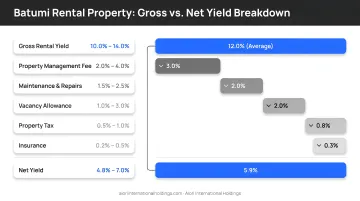
Investors evaluating Batumi on gross yield alone will overestimate their actual cash flow. Whether 3–4% net is acceptable depends on your appetite for appreciation upside, portfolio diversification, and any lifestyle component — not just income return.
The Supply-Driven Yield Risk
With 58,000 units planned through 2029 and approximately 80% targeted at short-term rental use, the market faces saturation risk. If absorption lags, analysts project net yields could fall to 1.5–2% — below inflation and below most investors' hurdle rates.
What to track:
- District-level occupancy rates (avoid oversaturated micro-markets)
- Tourism growth rates (Georgia welcomed 6.9 million visitors in 2025, +6.2% YoY)
- New unit delivery pace vs. hotel occupancy trends
The Hotel-Sector Alternative
As residential yields compress, branded hotels and serviced apartments are outperforming. Batumi hotels maintained 50% occupancy and a $75 average daily rate (ADR) in Q4 2025, delivering superior RevPAR (revenue per available room) compared to individually owned STR apartments.
Why hotels perform better:
- Professional revenue management optimizes pricing in real time
- Integrated guest services (concierge, housekeeping, F&B) command premium rates
- Brand recognition drives direct bookings, reducing OTA dependency
- Operational efficiency spreads fixed costs across more units
For investors prioritizing cash flow over appreciation, hotel-sector investments deserve a closer look. Alori International Holdings curates branded residence opportunities in Batumi structured around professional hotel management — removing landlord responsibilities while targeting yields that outperform the residential STR market.
Why Batumi Appeals to International Investors — and What Americans Should Know
Structural Advantages
Batumi offers several framework benefits that reduce friction for international buyers:
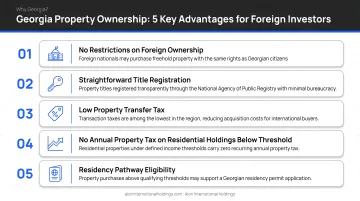
No restrictions on foreign property ownership: Foreigners have full, unrestricted rights to purchase residential and commercial property with the same legal protections as Georgian citizens. The only exception is agricultural land.
Transparent registration process: Property transactions are completed at Georgia's Public Service Hall with Georgian and English documentation. Registration fees range from 50 GEL ($19) for standard 4-day service to 350 GEL ($130) for same-day processing.
No property transfer tax: Despite widespread online claims of a "1% transfer tax," Georgia charges zero property transfer tax. Buyers pay only NAPR registration fees.
Dollar-aligned economy: Property transactions clear in USD or GEL, eliminating currency conversion risk and simplifying financial modeling for American investors.
Low ongoing property taxes: Georgia's flat-tax system includes 0% annual property tax and 5% income tax on rental earnings — significantly lower than most European jurisdictions.
Demand Drivers and Rental Income Potential
Batumi's rental income potential is supported by several structural factors:
- Tourism growth: Georgia welcomed 6.9 million international visitors in 2025, generating $4.7 billion in tourism revenue
- Black Sea coastline: Year-round appeal for both tourism and residential demand
- Digital nomad community: Growing remote worker population seeking 1–12 month rentals
- Infrastructure improvements: Ongoing airport expansion and road connectivity projects
Residency pathway: Property investments of $100,000+ qualify American investors for Georgian permanent residency, adding a residency option on top of the financial return.
How Alori International Holdings Serves American Investors
For American buyers navigating Batumi's market, Alori provides structured access through:
- Pre-vetted developments screened for location quality, rental yield potential, and long-term capital growth drivers
- Developer due diligence covering project financials, construction timelines, and completion track records
- Defined exit pathways: rental income through professionally managed residences, capital appreciation based on 5-year market data, or residency-linked holds
The result: American buyers get market access with the legal groundwork already done — without the transaction risk that typically comes with self-directed international purchases.
Risks and Considerations: A Realistic Look at Batumi's Market
Oversupply Risk and District-Level Saturation
With 80% of the 58,000-unit pipeline targeted at short-term rental use, neighborhood-level absorption capacity becomes critical. Districts like New Boulevard and Alley of Heroes already account for the vast majority of new investment supply, creating tightly contested submarkets.
City-wide demand figures can mask district-level saturation. Investors must assess location-specific occupancy rates, competitive density, and proximity to tourism infrastructure — not just Batumi's aggregate growth numbers.
Geopolitical Context
Georgia's proximity to Russia and ongoing domestic political uncertainty have historically introduced volatility. Foreign demand has accelerated despite these factors, but they remain relevant for risk-sensitive investors.
The IMF's 2026 Article IV statement confirms Georgia's economy is robust — 8.4% growth in early 2026 — yet flags vulnerability to external shocks, including Middle East instability affecting Israeli capital flows into the Georgian market.
Developer and Project Vetting
Not all new developments in Batumi offer equal quality in terms of delivery track record, title clarity, and management company reliability. Investors should verify:
- Developer completion history (ask for previous project addresses and delivery timelines)
- Legal title structure (confirm NAPR registration and absence of liens)
- Management company quality (for branded residences, verify operator credentials and contract terms)
- Payment milestone structuring (avoid full upfront payments; use escrow and stage capital deployment)
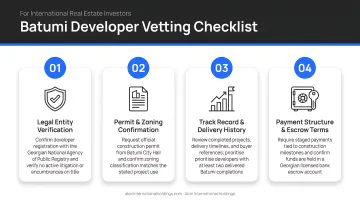
Independently confirming transaction records through Georgia's National Agency of Public Registry — and monitoring construction progress on-site or through a local representative — is the most direct way to reduce exposure to delays or project abandonment.
Frequently Asked Questions
Are home prices in Georgia dropping?
No. Overall prices in Georgia, particularly in Batumi, have been rising. New-build prices in Batumi were up 12.6% year-on-year as of February 2026, with primary market gains exceeding 23%. Secondary market prices are growing more slowly (+6.9% YoY) but are not declining.
Which is cheaper, Batumi or Tbilisi?
Batumi and Tbilisi currently have comparable average price points for new builds — Batumi at $1,865/sqm (turnkey, 2025) and Tbilisi at $1,373/sqm (white frame, December 2025). However, Batumi offers higher short-term rental yield potential due to tourism demand, while Tbilisi provides stronger local rental demand depth and stability.
Is Batumi good for real estate investment?
Transaction growth (+20% YoY) and foreign buyer demand (52% of market) are positive signals, but the right answer depends on your goal. Gross yields sit at 7.4%, yet net yields often land at 2–4% — making entry price and asset selection critical. Generic mid-market studios face oversupply risk; differentiated properties tend to hold performance.
Where is the best place to buy investment property in Georgia?
Batumi leads for rental-income plays given tourism infrastructure and short-term rental demand. Tbilisi offers more stable long-term capital appreciation (8.6% gross yields, February 2025) backed by population and business demand. Conservative capital favors Tbilisi; yield-focused investors with active management capacity lean toward Batumi.
Can foreigners buy property in Batumi?
Yes. Georgia places no restrictions on foreign property ownership. Foreigners can purchase, register, and sell property with the same rights as Georgian citizens. The transaction process requires a passport, proof of funds, and a bilingual purchase agreement, completed at the Public Service Hall. Property transfer carries zero tax — buyers pay only NAPR registration fees (50–350 GEL, or $19–$130).
What is the 7% rule in real estate?
The 7% rule is an investor heuristic: a property should generate at least 7% gross annual return to cover financing costs, operating expenses, and deliver acceptable cash flow. Batumi gross yields sit near that threshold at approximately 7.4%, but net yields (2–4%) are the more important figure to scrutinize when evaluating actual cash returns.