 Properties](https://file-host.link/website/aloriinternationalholdings-0sh9n1/assets/refined-images/1782379501514000_830a710ea80442f1a2e847b4c8e17461/360.webp)
Introduction
Tbilisi stands out as one of the most accessible and undervalued capital city real estate markets for international investors. Located at the crossroads of Europe and Asia, the Georgian capital offers affordable entry prices compared to Western markets while attracting growing foreign investor interest. In 2025 alone, real estate activities in Georgia attracted $185.7 million in foreign direct investment, accounting for 11% of the country's total FDI.
That opportunity is real — but so are the pitfalls. Success depends on neighborhood selection, legal preparation, and local execution. First-time foreign buyers routinely encounter title gaps, unlicensed agents, and asking prices inflated for international buyers who don't know local benchmarks.
This guide covers whether Tbilisi real estate fits your goals, what you need before you start, the exact purchase steps, the variables determining returns, and the most costly mistakes to avoid.
Key Takeaways
- Foreigners can fully own residential property in Tbilisi with no restrictions—registration takes 1–4 business days
- Tbilisi offers strong rental yields compared to European capitals, with citywide gross yields averaging 8.9% in early 2026
- Entry costs remain affordable: premium central districts average $2,800–$3,200/m², while emerging areas range from $1,050–$1,650/m²
- Georgia's tax structure is investor-friendly: 5% rental income tax, 0% capital gains after two years, and no annual property tax
- Success depends on local relationships, verified legal structures, and a clear exit strategy backed by in-market professionals
Why Tbilisi Real Estate Makes Sense for Foreign Investors
A Growing Capital with Structural Demand
Tbilisi is a capital city of over 1.2 million residents, representing roughly one-third of Georgia's population. The city benefits from expanding infrastructure including metro lines, international schools, and new residential developments. Unlike speculative or tourism-only markets, Tbilisi offers consistent demand from long-term tenants, a growing expat community (over 107,000 foreigners hold residence permits in Georgia as of early 2026), and an expanding digital nomad population.
Favorable Regulatory Environment
Georgia's regulatory framework ranks well across international benchmarks. The World Bank's B-READY 2025 report notes Georgia's legal obligations to verify identities and register sales transactions, reflecting transparency in property transfer standards. In the 2023 Worldwide Governance Indicators, Georgia ranked in the 79.72 percentile for Regulatory Quality.
In practice, that means:
- Unrestricted foreign ownership of residential and commercial property
- Rapid digital registration through the National Agency of Public Registry
- Straightforward transaction processes with low administrative friction
Two Core Return Drivers: Yield and Appreciation
Rental Income: Tbilisi delivers attractive rental yields, with performance varying significantly by neighborhood:
| District | Classification | Avg. Price (USD/m²) | Est. Gross Yield |
|---|---|---|---|
| Mtatsminda | Premium Central | $3,178 | 5.0%–5.5% |
| Vake | Premium Central | $2,798 | 5.0%–5.65% |
| Saburtalo | Established Hub | $1,628 | 5.89%–6.85% |
| Didi Dighomi | Emerging Outer | $1,096 | 7.38%–10.18% |
| Gldani | Emerging Outer | $1,050 | 6.38%–8.36% |
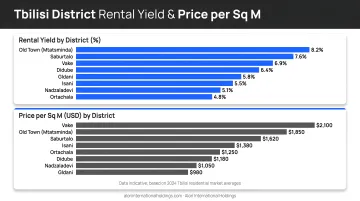
Data sources: Galt & Taggart (Jan 2026) and Global Property Guide (Q1 2025/2026)
Premium central districts like Vake and Mtatsminda attract international professionals and expats near business hubs and schools. Yields are lower, but tenant quality and retention tend to be stronger.
Emerging outer districts like Gldani and Didi Dighomi offer higher gross yields — in some cases exceeding 10% — at the cost of longer tenant-sourcing timelines and higher turnover risk.
Capital Appreciation: Approximately 81% of Tbilisi's apartment stock was built before 1991, creating persistent supply pressure. New-build developments and renovated properties in well-connected districts have shown consistent appreciation, particularly near metro stations, universities, and international employers.
Georgia's Tax Advantages
Georgia offers one of the most investor-friendly tax regimes in the region:
- Rental income tax: 5% flat rate on gross residential rental income for individuals
- Capital gains tax: 0% on properties held more than two years
- Annual property tax: Families earning under 40,000 GEL annually are exempt from property tax on real estate; those earning 100,000 GEL+ pay 0.8%–1% of market value
- VAT threshold: Short-term rental income above 100,000 GEL in any 12-month period triggers mandatory 18% VAT registration
These tax structures deliver significant net return advantages over comparable European markets.
Geopolitical Risk: A Balanced View
Georgia's geopolitical positioning carries both strengths and real risks. The country has maintained relative political stability compared to regional peers, with a regulatory environment that protects property rights and enforces contracts. Regional tensions — particularly Russia's proximity — and a small domestic market remain genuine considerations for foreign buyers.
The data presents a mixed but investable picture. Georgia scored 50 out of 100 on Transparency International's 2025 Corruption Perceptions Index, ranking 56th globally. At the same time, it ranked 15th globally in the Fraser Institute's 2023 Economic Freedom report — a strong signal of open-market commitment that meaningfully offsets governance concerns.
Foreign buyers who price in geopolitical risk rather than ignore it will find Tbilisi's structural demand story holds up: rising urbanization, constrained housing supply, and continued foreign direct investment point to a market built on durable fundamentals, not short-term momentum.
How to Invest in Tbilisi Real Estate: Step-by-Step
Step 1: Define Your Investment Strategy and Budget
Start by clarifying your investment profile:
Rental yield investors should target emerging districts like Didi Dighomi or Saburtalo — smaller units (studio to 2-bedroom) near universities or business centers perform best.
Capital appreciation investors should focus on premium districts like Vake or Vera, with larger units near metro stations or international schools better suited to buy-and-hold strategies.
Establish a realistic budget inclusive of:
- Purchase price (based on per-sqm pricing in your target district)
- Transaction fees: registration (150–350 GEL), notary (~692 GEL for a $100,000 property), and legal ($300–$1,500)
- Renovation costs if buying secondary market: $150–$500/m² depending on quality
- Property management fees: 5–10% for long-term rentals, 20–40% for short-term
- Currency conversion costs for international wire transfers
Most transactions in Georgia are USD-based and cash-driven.
Step 2: Research Neighborhoods and Identify Target Properties
Online listings on place.ge and ss.ge are frequently outdated or already sold. The most reliable inventory comes through local agents ("maklers") and off-market networks. Attempting to source properties remotely without in-country support has a high failure rate.
Local agent quality varies — reliable ones come through trusted referrals, not cold outreach. Firms like Alori International Holdings provide access to curated, off-market opportunities with in-country execution support.
Step 3: Conduct Legal Due Diligence and Verify the Property
Before any purchase, complete these checks:
- Confirm ownership history through Georgia's Public Registry (extract costs 15–20 GEL)
- Verify no liens, mortgages, or encumbrances exist
- Confirm the property is fully registered and not in disputed status
- Commission an independent condition assessment for secondary market properties
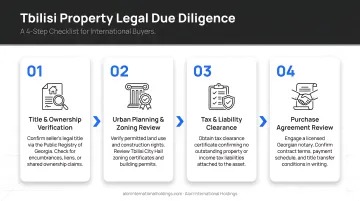
A local licensed attorney is essential for contract review and title verification. Georgian sellers don't always disclose shared ownership disputes or unregistered encumbrances — buyers without legal representation face real risk of pricing manipulation or title disputes.
Step 4: Execute the Purchase and Register Ownership
Transaction mechanics:
- Sign the purchase agreement with your passport attached as an official annex
- Provide proof of funds (bank statement, transfer receipt)
- Complete payment via cash or international wire transfer (most sellers prefer USD)
- If not present in Georgia, execute a notarized Power of Attorney — as of October 2023, foreign PoAs require notarization as a public deed by a Georgian notary
Registration process: Submit documents to the National Agency of Public Registry. Registration takes 1–4 business days: 150 GEL for 4 days, 270 GEL for 1 day, 350 GEL for same-day processing.
Step 5: Set Up Your Rental or Exit Strategy Before You Close
Define your intended use before closing — your rental strategy directly shapes which neighborhood to target, how to furnish the unit, and what property management structure you'll need.
| Strategy | Income Profile | Management Needs | VAT Threshold |
|---|---|---|---|
| Long-term rental | Lower, stable | Basic furnishing + local manager (5–10% of rent) | Not applicable |
| Short-term rental (Airbnb) | Higher gross in tourist districts | Active management, seasonal demand | Required above 100,000 GEL income |
Practical setup:
- Open a Georgian bank account (Bank of Georgia and TBC Bank are leading options)
- Register rental income for tax purposes (5% flat rate)
- Decide between self-management vs. local property manager based on your location and involvement capacity
What You Need Before You Start Investing
Legal and Financial Readiness
- Valid passport (must remain valid through the full payment schedule if buying in installments)
- Proof of funds or source of funds documentation (bank statements, sale contracts, tax returns)
- SWIFT confirmation (MT103) with payment purpose clearly stated as "property purchase"
- Confirmation that your US bank supports international wire transfers to Georgia — some have restrictions worth checking in advance
Local Professional Network
- Vetted local attorney (non-negotiable minimum)
- Reliable real estate agent with verifiable transaction history
- An investment firm or advisor with in-market execution capability — in Georgia especially, this determines deal quality
Georgia's real estate market is relationship-driven. Buyers introduced through trusted networks often get first access to inventory and better pricing on pre-launch units — neither of which is available to cold inbound buyers.
Clear Property Brief
Before engaging agents, define in writing:
- Target district
- Maximum budget
- Preferred property type (new build vs. secondary market)
- Minimum size
- Intended use (long-term rental, short-term rental, eventual resale)
A written brief lets agents filter inventory before your first conversation — and signals that you're a serious buyer worth prioritizing.
Key Variables That Determine Your Investment Returns
Neighborhood and Proximity to Infrastructure
Two properties with the same purchase price in different districts can produce significantly different rental yields and appreciation rates. Proximity to metro stations, universities, international employers, and expat amenities is a primary driver.
Tenant pool quality, occupancy rates, and resale liquidity are all tied directly to location fundamentals — properties near metro stations fill faster and command higher rents.
The yield gap between districts is significant. Emerging areas like Didi Dighomi offer 7.38%–10.18% gross yields, while premium districts like Vake yield 5%–5.65%. New buyers often overpay for Old Town charm at the cost of yield.
Property Condition and Renovation Scope
Your entry point — new-build or secondary market — shapes both your upfront cost and your path to income.
- New-build properties: Predictable, move-in ready, but priced at a premium. Finishing a "white frame" (developer shell) costs $150–$500/m² on top of the purchase price.
- Secondary market properties: Lower entry cost with higher upside if renovated well. These dominate Tbilisi's transaction volume, but renovation complexity is routinely underestimated.
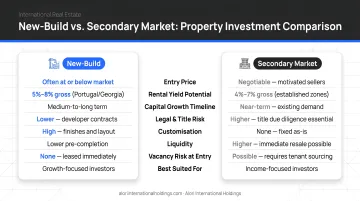
Renovation timelines and costs determine when a property starts generating income — and what your true all-in cost actually is. Older Soviet-era buildings often carry hidden infrastructure issues — wiring, plumbing, communal area rules — that inflate budgets and delay timelines. In some cases, neighbor consent is required before certain improvements can proceed.
Rental Strategy and Management Quality
How you rent the property determines your income profile, tax obligations, and how much hands-on involvement — or local infrastructure — you actually need.
- Short-term rentals: Higher gross income, but require active management, seasonal occupancy planning, and VAT registration once income exceeds 100,000 GEL annually.
- Long-term rentals: Lower but stable, passive income. Better suited for remote investors working with a local property manager.
The gross-versus-net gap matters here. Short-term rental yields look attractive on paper, but management fees (20–40%), cleaning costs, vacancies, and maintenance typically push net returns 20–35% below advertised gross figures. Long-term rentals carry 5–10% management fees and deliver more predictable net returns — a meaningful difference for investors prioritizing capital preservation over headline yield.
Common Mistakes Foreign Investors Make in Tbilisi
Attempting to Buy Without Local Representation
Foreigners without a trusted local attorney and agent are regularly quoted inflated prices (the "foreigner premium"), shown inferior inventory, and exposed to title or contract risks that local buyers sidestep. The financial gap between a well-represented buyer and an unrepresented one often exceeds any fees paid for local counsel.
Skipping Property Verification Through the Public Registry
Georgian sellers don't always volunteer information about liens, shared ownership disputes, or unregistered encumbrances. Due diligence through the Registry is non-negotiable and inexpensive (15–20 GEL). Failure to do this has resulted in buyers being unable to sell or rent their property freely.
Misjudging Renovation Scope on Secondary Market Properties
Many attractive low-price properties in older Tbilisi buildings require more structural intervention than they appear. Before making an offer — not after — commission an independent condition assessment. Two additional factors catch buyers off guard:
- Neighbor consent requirements for certain renovation types can delay or block improvements entirely
- Structural deficiencies in Soviet-era buildings often aren't visible during a standard walkthrough
Over-Prioritizing Yield Projections Without Stress-Testing
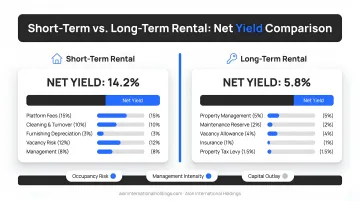
Short-term rental yield figures are often quoted at full occupancy during peak season. Real net yields — after management fees, cleaning costs, vacancies, and maintenance — typically run 20–35% below headline gross figures. Any financial model that doesn't account for off-season occupancy and recurring costs will overstate returns from day one.
Frequently Asked Questions
Can foreigners buy property in Tbilisi, Georgia?
Yes. Foreigners can fully own residential and commercial property in Tbilisi with no restrictions. The only exception is agricultural land, which is prohibited for foreign individuals and entities. The registration process is fast and transparent.
Is Tbilisi a safe investment?
Tbilisi offers consistent appreciation, high rental demand, and growing international investor interest. Georgia's Regulatory Quality ranking (79.72 percentile) and strong FDI inflows signal a stable emerging market, though regional geopolitical risks should be factored into any long-term position.
Is Georgia good for real estate investment?
Georgia offers a highly favorable investor profile: 5% rental income tax, 0% capital gains tax after two years, no annual property tax for most owners, unrestricted foreign ownership, and strong rental yields averaging 8.9% citywide. It represents one of the better-value markets in the broader European/Caucasus region.
What is the minimum budget to invest in Tbilisi real estate?
A realistic minimum entry point for a functional investment property in Tbilisi is approximately $100,000–$150,000, factoring in purchase price, legal fees (typically $300–$1,500), registration fees (150–350 GEL), and basic setup costs. This varies significantly by district and property condition—emerging districts offer lower entry points than premium central areas.
What taxes apply to rental income from property in Tbilisi?
Residential rental income is taxed at a flat 5% rate for individual owners. There is no annual property tax for most residential holdings, and capital gains are exempt after two years of ownership. These rates apply to foreign owners on the same terms as Georgian nationals.