

Introduction
The 2023 "Mais Habitação" law eliminated residential real estate from Portugal's Golden Visa program entirely—ending the route that most investors had relied on. What remains is a narrower set of options, and the differences between them carry real financial consequences. For investors committing €500,000 or more (roughly $550,000 USD), choosing the wrong structure isn't just inconvenient—it can affect liquidity, tax exposure, and whether the visa actually qualifies.
Investment funds have emerged as the dominant qualifying route post-reform. Commercial real estate and hospitality-linked projects remain eligible in certain structures, but their qualification depends heavily on how each project is set up and how Portuguese immigration authorities interpret it at the time of application.
This article breaks down funds versus qualifying real estate structures side by side—covering cost, tax burden, management requirements, and exit strategy—so you can match the right option to your investor profile.
Key Takeaways
- Portugal's 2023 law removed residential real estate from Golden Visa eligibility; qualifying routes are now CMVM-regulated funds (€500,000 minimum) and select commercial or hospitality projects
- Funds offer passive, tax-efficient management — no property taxes, no rental income tax, and straightforward exits at the five-year mark
- Eligible real estate routes carry higher upfront costs, recurring taxes (IMT, stamp duty, annual IMI), and ongoing management obligations
- Choose funds for simplicity and a hands-off process; choose real estate if you want a tangible asset and direct control over your investment
- Both routes qualify for Portuguese residency and Schengen access, with citizenship eligibility after five years and as few as seven days per year on the ground
Real Estate vs Investment Funds: Quick Comparison
The five factors below cover what most Golden Visa applicants care about most: cost, tax exposure, time commitment, exit flexibility, and how much work the due diligence process actually requires.
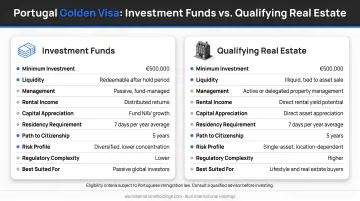
Minimum Investment Threshold
Funds: €500,000 into a CMVM-regulated, non-real estate fund with at least five-year maturity and 60% deployment in Portuguese-headquartered companies.
Real Estate: €500,000 for qualifying commercial property, or €400,000 for rehabilitation projects in interior/low-density zones (20% reduction applies). Residential property in Lisbon, Porto, and coastal areas no longer qualifies.
Upfront & Ongoing Tax Burden
Funds:
- No stamp duty
- No transfer tax (IMT)
- No annual property tax (IMI)
- No rental income tax
- Exempt from Portuguese income tax on dividends and capital gains after the minimum holding period
Real Estate:
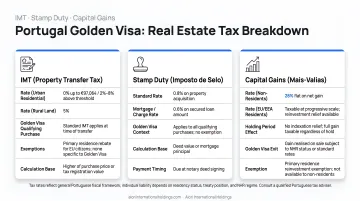
- IMT (Transfer Tax): 6.5% flat rate for commercial properties (€32,500 on €500,000)
- Stamp Duty: 0.8% on acquisition (€4,000 on €500,000)
- Annual IMI: 0.3% to 0.45% of property value, set by municipality
- Capital Gains Tax: 50% of gain taxed at progressive rates (12.5% to 48%, plus solidarity surcharges)
Management Involvement
Funds: Fully passive. Professional fund managers handle all operational and investment decisions with no investor involvement required.
Real Estate: Requires ongoing attention across several fronts:
- Property management and tenant relations
- Maintenance coordination and regulatory compliance
- Or outsourcing each of these to a local management firm at added cost
Exit & Liquidity
Funds: Predefined redemption period (typically 8–10 years for qualifying Golden Visa funds); proceeds transferred directly without intermediaries upon maturity.
Real Estate: Exit involves finding a buyer, paying agent commissions (5% + 23% VAT = ~6.15%, borne by the seller), and navigating a timeline that depends entirely on market conditions at the time.
Due Diligence Process
Funds: Can be conducted entirely remotely via CMVM's public database; regulatory oversight provides transparency on fund structure, managers, and compliance.
Real Estate: Typically requires:
- In-country visits and on-site inspections
- Local legal expertise to verify title and property condition
- Confirmation that the specific project qualifies under post-2023 Golden Visa rules
Investment Funds for the Portugal Golden Visa
Eligible funds must be non-real estate collective investment vehicles—typically private equity or venture capital—regulated by Portugal's CMVM (Securities Market Commission). Core eligibility requirements include:
- Minimum five-year maturity at time of investment
- At least 60% of capital deployed in Portuguese-headquartered companies
- No direct or indirect aim toward real estate investment (per the 2023 law)
That said, funds investing in operating companies—hospitality businesses, nursing homes, agricultural operations—that happen to own real estate as part of their business may still qualify under some interpretations. Investors must verify eligibility with qualified Portuguese immigration counsel before committing.
Tax Advantages for Non-Residents
For non-residents, dividend income from qualifying funds is generally not subject to Portuguese income tax, and capital gains upon exit are often exempt after the holding period. US investors, though, face worldwide taxation by the IRS regardless of Portuguese tax treatment.
Under the US-Portugal Income Tax Convention:
- Withholding tax on dividends is capped at 15% for US residents (10% if the beneficial owner holds ≥25% of capital)
- Portugal retains the right to tax capital gains from shares in companies whose assets consist principally of Portuguese immovable property
US citizens must consult a cross-border tax advisor familiar with the treaty to understand their total exposure before investing.
Practical Appeal for International Investors
The entire investment process can be completed remotely—from fund selection and due diligence through application submission. No physical presence in Portugal is required during the investment phase. For Americans and globally mobile professionals unable to travel regularly to Portugal, this remote capability is a significant advantage.
Fund Returns and Fees
Based on CMVM-registered fund prospectuses, typical structures include:
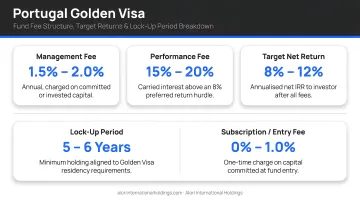
- Management fees: 1.0% to 2.0% annually
- Performance fees: 20% to 30% of profits, often subject to hurdle rates (5% to 8%)
- Target returns: 6% to 15%+ IRR, depending on strategy (agriculture, renewable energy, tech startups)
- Lock-up periods: 8 to 10 years, with most funds structured as closed-end vehicles with no early redemption rights
Risk Profile
Funds expose investors to market volatility, fund manager performance risk, and sector-specific downturns. Diversification within the fund mitigates individual asset risk, but investors are ultimately trusting a management team's judgment. Unlike direct property ownership, you have no ability to inspect, manage, or influence the underlying assets—your returns depend entirely on the manager's decisions.
Use Cases for Investment Funds
Funds tend to work best for two investor profiles:
- Residency-focused investors who want a low-friction path to Portuguese residency without managing property or traveling for due diligence
- Globally mobile professionals (particularly US-based) who prioritize a time-efficient structure over building a tangible property portfolio
The fund is a qualifying vehicle, not a lifestyle asset—that distinction matters when weighing it against direct real estate.
A word of caution on retirement accounts: Some US investors have explored using self-directed IRAs or 401(k)s to fund the €500,000 investment. Still, this carries severe IRS risks under IRC §4975. The IRS views obtaining personal residency as a prohibited indirect benefit, which can trigger disqualification of the entire IRA, immediate taxation of the account at fair market value, and potential 10% early withdrawal penalties. Consult a specialist before attempting this structure.
Real Estate for the Portugal Golden Visa
Residential property in Lisbon, Porto, and coastal areas no longer qualifies under post-2023 rules. What remains are commercial real estate projects, rehabilitation of properties in interior or low-density regions (at the reduced €400,000 threshold), and hospitality-linked assets such as hotels or serviced apartments.
Eligibility depends heavily on the specific project structure. Not all commercial or rehabilitation projects qualify automatically—investors must verify with a Portuguese immigration lawyer before committing funds.
The Appeal of Tangible Asset Ownership
Unlike funds, real estate gives investors something physical—a property they can visit, potentially use as a holiday home or future residence, rent out for income, and hold as an inflation-resistant asset. Portugal's interior regions have shown rising interest from tourism and remote work trends, though growth data is less robust than in Lisbon or Porto.
True Cost of Entry
Real estate carries substantial acquisition costs beyond the purchase price:
- IMT (Transfer Tax): 6.5% for commercial properties (€32,500 on €500,000)
- Stamp Duty: 0.8% (€4,000 on €500,000)
- Notary & Registration: €500 to €1,000
- Legal Fees: €1,500 to €2,500+
- Annual IMI: 0.3% to 0.45% of property value (€1,500 to €2,250 annually on €500,000)
Over the minimum five-year holding period, total effective cost includes acquisition expenses (€38,000+ upfront) plus annual IMI and any rental income taxes.
Due Diligence Complexity
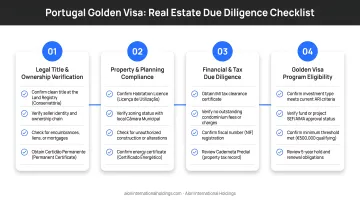
Purchasing qualifying real estate means confirming that the specific property and project structure meets 2023 Golden Visa rules—not all commercial properties automatically qualify. Due diligence typically involves:
- Verifying Golden Visa eligibility with a Portuguese immigration lawyer
- Conducting physical inspections and reviewing title deeds
- Confirming commercial classification under current legal frameworks
- Engaging an in-country legal team familiar with Portuguese property law
Exit Complexity
Selling a qualifying property after the five-year period requires finding a buyer (which can take months in secondary markets), paying agent commissions (standard 5% + 23% VAT = 6.15% of sale price), and potentially triggering capital gains tax. Non-residents selling Portuguese property now face taxation on 50% of the capital gain at progressive rates up to 48%, plus solidarity surcharges—a significant change from the previous flat 28% rate.
Who Real Estate Works For
Real estate is the stronger choice for investors with a genuine lifestyle interest in Portugal—those planning extended stays, retirement, or a family base abroad—who are willing to accept higher management demands in exchange for direct ownership.
It also suits investors already comfortable with property markets who want to apply that expertise internationally. Access to off-market qualifying projects and verified legal structures matters here; the difference between a compliant acquisition and a costly mistake often comes down to local advisory quality. Alori International Holdings focuses specifically on this—curating qualifying projects with confirmed legal structures and defined exit strategies for international investors who want clarity before committing capital.
Real Estate vs Funds: Which Is Right for You?
The decision hinges on three core factors:
1. Investment Objective Is residency the primary goal, or does owning a physical asset matter equally? If the Golden Visa is a means to an end—European residency and eventual citizenship—funds are the more direct route. If you want the asset to serve dual purposes (personal use and financial return), real estate makes more sense.
2. Time and Involvement Funds require zero involvement once invested. Real estate requires ongoing oversight, even with professional property management. For time-constrained investors or those based outside Portugal, funds remove the operational burden entirely.
3. Tax Efficiency US citizens face worldwide taxation regardless of route. Funds avoid Portuguese property taxes, IMT, stamp duty, and annual IMI. Real estate triggers multiple layers of Portuguese taxation, plus potential US tax on rental income and capital gains—a meaningful cost difference over the holding period.
These three factors typically determine which route fits best. Here's how that plays out in practice.
Clear Situational Guidance
Choose investment funds if:
- You want the most straightforward, tax-efficient path to residency
- You're investing primarily to secure the visa, not to generate rental income
- You're based outside Portugal and prefer a fully remote process
- You're comfortable with an 8-10 year lock-in period and trusting professional managers
Consider qualifying real estate if:
- You have a lifestyle reason to own property in Portugal and want the asset to serve a dual purpose
- You're experienced with international property and have strong local legal and management support
- You've confirmed the specific project is Golden Visa-eligible under post-2023 rules
- You want direct control over a tangible asset you can visit and eventually use personally
Combining Both Routes
Investors are not limited to one approach. Some choose to invest in a qualifying fund for the Golden Visa while separately purchasing residential property in Portugal as a personal asset outside the visa framework. This separates the residency goal from the lifestyle goal, handling each on its own terms.
Conclusion
For most international investors today, investment funds offer a more efficient, tax-advantaged, and low-friction path to Portugal's Golden Visa. But "most" is not "all." Investors with specific lifestyle goals or real estate expertise may still find qualifying property structures worth exploring, provided the project's legal structure is independently verified and eligibility confirmed before any capital is committed.
Both routes lead to the same destination: Portuguese residency, Schengen access, and a five-year path to EU citizenship. The real question is which structure fits your capital goals, tax situation, and how involved you want to be with the underlying asset. Getting that match right is where the decision actually gets made.
Frequently Asked Questions
Can Americans still invest in Portuguese real estate for the Golden Visa?
Residential real estate in major urban and coastal areas is no longer eligible since 2023. Some commercial, rehabilitation, and hospitality-linked property structures may still qualify, but Americans must verify the specific project's eligibility with a qualified Portuguese immigration attorney before committing funds.
What is the minimum investment for a Portugal Golden Visa through a fund?
The minimum is €500,000 into a CMVM-regulated fund with at least five-year maturity and 60% deployment in Portuguese-headquartered companies. The fund cannot be directly or indirectly aimed at real estate investment.
How long does my investment need to be held for the Portugal Golden Visa?
The minimum holding period is five years to maintain residency eligibility and progress toward citizenship. Most qualifying funds are structured around this timeline, with typical lock-up periods of 8-10 years.
Are investment fund returns taxed for US citizens investing in Portugal?
Non-residents generally do not face Portuguese income tax on fund dividends or capital gains after the holding period. However, US citizens are taxed on worldwide income by the IRS regardless of Portuguese tax treatment. A cross-border tax advisor familiar with the US-Portugal tax treaty can clarify your specific exposure before investing.
Can I use my IRA or 401(k) to fund a Portugal Golden Visa investment?
Some US investors have used self-directed IRAs, but the IRS views obtaining personal residency as a prohibited indirect benefit under IRC §4975 — which can disqualify the IRA and trigger severe tax penalties. Specialist guidance is required before pursuing this structure.
What happens to my Golden Visa if the Portugal program changes again?
Investments already made under qualifying rules at the time of application are grandfathered in. Portugal has historically honored existing applications through legislative transitions — the 2023 law explicitly protected pending applications submitted before the effective date. That said, program terms can evolve, so staying current with Portuguese immigration law remains prudent.