

Introduction
Most Americans assume buying property abroad is legally complicated or restricted. In practice, non-citizens can own property outright in the majority of European countries — with no special permits, no ownership caps, and no residency requirement in most cases.
What the law permits and what the process demands are two different things. The experience varies sharply depending on the country, the buyer's nationality, and whether the goal is investment, residency, or lifestyle.
A Portuguese apartment purchase follows a different legal process than a Georgian coastal villa. A non-EU buyer faces different administrative requirements than an EU national. The team assembled on the ground often matters as much as the property itself.
This guide walks through the legal landscape, a practical step-by-step buying process, the strongest markets for non-citizen buyers, true cost breakdowns, and the mistakes that derail otherwise sound purchases — so you can move forward with clarity rather than guesswork.
Key Takeaways
- Most European countries allow non-citizens to purchase property without residency, though some require permits (Hungary, Malta) or government approval before closing
- Purchasing follows 4–6 steps — market research, legal prep, offer, due diligence, contract, and registration — and a buyer-side lawyer is essential throughout
- Total acquisition costs typically add 7–13% above the listed price when taxes, notary fees, legal fees, and agent commissions are included
- Portugal and Georgia offer full freehold ownership, competitive transaction costs, and established residency pathways for property investors
- Buying without a clear exit strategy, rental plan, or accurate pricing data is the fastest route to poor returns
Can a Non-Citizen Buy Property in Europe?
Most European countries permit foreigners to purchase residential property outright in their own name, with no citizenship or residency required. For EU citizens, property rights are nearly identical to nationals across member states. Non-EU buyers — Americans, Canadians, and other third-country nationals — face slightly more friction in certain markets, but ownership remains accessible in nearly every destination worth considering.
Exceptions and Nuances
Some countries impose additional requirements:
- Hungary requires non-EU buyers to obtain a government purchase permit, issued within 30–45 days for a fee of HUF 50,000
- Malta restricts purchases outside Special Designated Areas (SDAs), requiring an Acquisition of Immovable Property (AIP) permit for non-EU buyers
- Switzerland enforces strict cantonal quotas and use restrictions on holiday homes for non-residents under the Lex Koller legislation
Even in restricted markets, these requirements are workable — they add weeks to the timeline, not months of uncertainty. Plan for them early and they won't derail a transaction.
Property Ownership Does Not Automatically Grant Residency
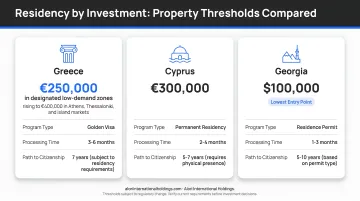
Purchasing property does not automatically grant residency in most European countries. However, several countries offer formal residency-by-investment pathways tied to qualifying property purchases:
- Greece: €400,000 in most regions; €800,000 in high-demand areas including Athens, Thessaloniki, Mykonos, and Santorini; €250,000 for commercial-to-residential conversions
- Cyprus: €300,000 investment in new residential or commercial real estate, plus proof of €50,000 annual foreign income
- Georgia: $150,000 property investment for a 1-year renewable short-term residence permit; $300,000 for a 5-year investment residence permit
Spain terminated its Golden Visa real estate route in April 2025. Portugal closed its real estate Golden Visa pathway in 2023, though alternative investment routes remain open — including €500,000 in qualifying investment funds.
How to Buy Property in Europe as a Non-Citizen: Step-by-Step
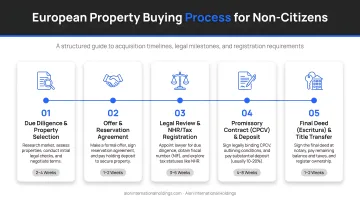
Step 1: Define Your Goals and Choose a Market
Determine upfront whether the primary objective is capital growth, rental yield, lifestyle access, or a residency pathway. An investor targeting yield in a high-tourism city has different criteria than someone seeking a low-cost second home.
Research macroeconomic fundamentals:
- Tourism trends and demographic demand
- Local supply constraints
- Currency stability (EUR vs. non-EUR markets like Georgia)
- Regulatory trajectory
Markets that look attractive on the surface can conceal weak fundamentals — rental oversupply, currency risk, or tightening foreign ownership rules.
Step 2: Understand the Legal Requirements for Your Nationality
Before contacting agents or viewing properties, identify whether your nationality triggers any special permit, approval, or restriction.
Key questions:
- Do non-EU/non-EEA buyers require government approval? (e.g., Hungary's non-EU purchase permit)
- What ownership structures are permitted? (Direct personal ownership, joint ownership, or local company structure for certain land purchases)
Company structures add cost and compliance obligations — which makes having the right local professionals in place before you proceed essential.
Step 3: Assemble Your Local Professional Team
Hire a buyer-side real estate lawyer before making any offers. In most European markets, real estate agents represent the seller—not the buyer. A local lawyer is the only party with a fiduciary obligation to protect your interests.
Other professionals required:
- Notary (required in most continental European countries to finalize the deed)
- Licensed real estate agent familiar with the specific region
- Currency specialist for large international transfers
- Local tax advisor to understand ongoing obligations
Step 4: Search, Make an Offer, and Negotiate
Use licensed agents, reputable local listing platforms, and firms with access to off-market inventory to identify properties. Off-market deals often offer better pricing and less competition, particularly in markets like Portugal and Georgia.
Make the offer in writing through your lawyer. The preliminary contract — called a promessa in Portugal, compromis de vente in France, or contrato de arras in Spain — combined with a deposit of typically 10–20%, creates a legally binding obligation.
Do not sign without legal review. At this stage, pulling out typically means forfeiting your deposit.
Step 5: Conduct Due Diligence and Finalize the Purchase
Your lawyer should verify:
- Clean title with no encumbrances or unpaid debts
- Correct zoning and permitted use
- Valid building permits
- Compliance with local planning rules
- Seller's legal authority to sell
In some markets (e.g., Italy, Spain), undisclosed debts or renovation violations can transfer to the buyer upon completion.
Once due diligence clears, closing moves to the final notarized deed of sale. Plan international wire transfers well in advance — delays at this stage can jeopardize completion. After signing, proceed immediately to land registry registration.
Registration timelines vary:
- Georgia: As little as one business day with expedited service
- Portugal, Spain, Greece: Typically 2–3 months
- Hungary, Malta: 3–4 months with government permits
Best European Countries to Buy Property as a Non-Citizen
Country selection is the single most consequential decision in the process. It determines legal complexity, transaction costs, property rights, residency options, and long-term return potential.
Portugal
Portugal allows full freehold ownership for all nationalities with no restrictions. Buyers need only a Portuguese tax number (NIF), obtainable quickly through a local representative. Purchase costs run approximately 6–10% of sale price.
Average Prices (March 2026):
| Region | Average Price | Year-on-Year Growth |
|---|---|---|
| Lisbon Metro | €4,356/m² | +12.8% |
| Algarve | €3,988/m² | +12.6% |
| Porto (Norte) | €2,566/m² | +9.4% |
| Silver Coast (Centro) | €1,764/m² | +12.9% |
Prime Lisbon parishes like Santo António exceed €7,289/m².
Real estate no longer qualifies for Portugal's Golden Visa, but the fundamentals supporting long-term value remain intact. Portugal recorded 32.5 million tourist guests in 2025 — a 3% increase from 2024 — sustaining structural rental demand across major markets.
On the supply side, building permits decreased by 14.2% in Q4 2025, compressing inventory and supporting continued price growth. Portugal is one of Alori International Holdings' primary focus markets for this reason.
Georgia
Sitting at the crossroads of Europe and Central Asia, Georgia offers one of the most accessible entry points for foreign buyers: no restrictions on residential or commercial purchases for any nationality, registration completed in one business day, and total transaction costs under 1.2% of purchase price.
Average Prices:
Investment-Linked Residency: A qualifying real estate investment of $150,000 or more makes the buyer eligible for a one-year renewable residence permit; $300,000 offers a 5-year permit leading to permanent residency.
Georgia welcomed a record 5.5 million international tourists in 2025 — an 8.4% increase — driving rental yields averaging 8.6% in Tbilisi and 7.4% in Batumi.
Georgia is the second of Alori's core focus markets. In-country networks provide access to vetted opportunities and accurate pricing intelligence that's difficult to replicate without local presence.
Greece, Spain, and Hungary: Comparative Overview
Greece
Foreign ownership is permitted for all nationalities. The Golden Visa remains active with thresholds of €400,000 (most regions) to €800,000 (high-demand zones). Process typically takes 2–3 months. Transaction costs add 8–10%.
Prices (Q3 2025):
- Athens South: €4,091/m²
- Athens Center: €2,439/m²
- Crete: €2,105/m²
- Peloponnese: €1,410/m²
Spain
Foreign ownership is unrestricted; buyers need only an NIE (Foreigner Identification Number). Transaction costs run higher than most European markets at 10–13%.
Spain's Golden Visa via real estate ended in April 2025, removing a major buyer incentive. Coastal tourist zones still offer competitive rental yields for income-focused investors.
Prices (2024–2026):
Hungary
Non-EU buyers require a government purchase permit, typically issued in 30–45 days for HUF 50,000. Otherwise the process is straightforward, with transfer tax around 4%. Budapest remains affordable relative to Western European capitals, with newly constructed homes averaging HUF 1.53 million/m².
Costs, Taxes, and Fees Every Non-Citizen Buyer Should Know
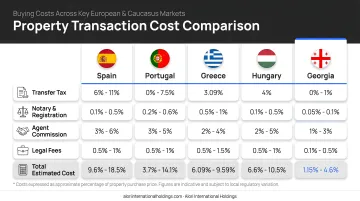
The listed sale price is only the starting point. Total acquisition costs in Europe consistently run 7–13% above the stated price, and buyers who fail to budget for this are frequently caught short at closing.
Transaction Costs at Purchase
| Country | Transfer Tax / VAT | Notary & Registry Fees | Legal Fees | Buyer Est. Total |
|---|---|---|---|---|
| Spain | 6–13% ITP (resale) or 10% VAT + 0.5–1.5% AJD (new) | €1,000–€2,000 | ~1% + VAT | 8–13% |
| Portugal | 0–7.5% IMT + 0.8% Stamp Duty | €375–€700 | 1–2% | 6–10% |
| Greece | 3.09% Transfer Tax | 1.5–2% Notary + 0.5–0.8% Registry | 1–2% | 8–10% |
| Hungary | 4% Transfer Duty | Included in Legal | 1–2% | ~5–10% |
| Georgia | 0% Transfer Tax | 50–200 GEL | Flat fee | < 1.2% |
Example: €200,000 Property in Spain vs. Georgia
- Spain: €200,000 + €20,000 (10% ITP) + €1,500 (notary) + €2,000 (legal) + €2,000 (misc.) = €225,500 total
- Georgia: €200,000 + €5 (registration) + €500 (legal) = ~€200,505 total
Ongoing Ownership Costs
Annual Property Taxes:
- Spain: Local IBI (Impuesto sobre Bienes Inmuebles) plus non-resident imputed income tax (IRNR) at 19% (EU) or 24% (non-EU) applied to 1.1–2% of cadastral value
- Portugal: IMI ranges 0.3–0.45% of cadastral value
- Georgia: Up to 1% annual property tax, often under €200/year on a €200,000 home
Other Costs:
- Property management fees (if rented or left vacant)
- Building maintenance or community charges (apartments in managed complexes)
- Insurance (buildings and contents)
Financing and Currency
Non-resident mortgages are available in most European markets. Requirements typically include:
- 30–40% down payment (vs. 20% for residents)
- Proof of foreign income and at least two years of tax returns
- Higher interest rates than resident borrowers receive
Currency conversion adds a hidden cost most buyers overlook. High street banks embed FX markups of 3–6% into exchange rates, while specialist FX providers charge around 0.4% at mid-market rates. On a €200,000 transfer, that difference can reach €5,000–€11,000.
Common Mistakes Non-Citizens Make When Buying European Property
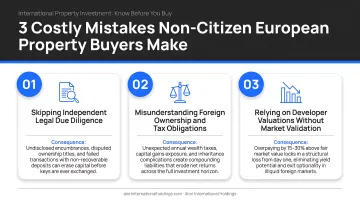
Skipping the local lawyer and relying on the seller's agent:
Without a buyer-side lawyer conducting title searches, debt checks, zoning verification, and contract review, buyers routinely inherit encumbrances, unpaid taxes, or planning violations. In several European markets, these liabilities transfer automatically with the deed — making pre-purchase due diligence non-negotiable.
Underestimating total costs and failing to plan for currency timing:
Budgeting only for the listed price consistently catches buyers short at closing. Transaction costs, currency conversion losses, and local tax registrations can add 8–12% on top of the purchase price. Beyond that, poor timing on international wire transfers has caused buyers to miss closing deadlines entirely — or pay materially more due to exchange rate movement between contract signing and settlement.
Buying without a defined exit or rental strategy:
Entering a market because it "seems affordable" — without understanding rental demand, short-term letting restrictions, capital gains tax on exit, or realistic resale timelines — leads to illiquid, underperforming assets. Regulatory shifts have already caught investors off-guard in major cities:
- Barcelona will not renew tourist flat licenses after 2028
- Athens extended its ban on new short-term rental registrations in central districts through end-2026
Buyers who define their hold period, income expectations, and exit pathway before signing have far fewer surprises — and far better outcomes.
Frequently Asked Questions
Can Americans buy property in Europe without residency?
Yes, most European countries—including Portugal, Spain, Greece, Italy, and Georgia—allow Americans to purchase property without holding residency first, though some require a local tax number (Portugal's NIF, Spain's NIE) or government purchase permit (Hungary) before completion.
Does buying property in Europe give you residency or a visa?
Property ownership alone does not grant residency automatically. Greece, Cyprus, and Georgia offer formal residency-by-investment pathways linked to qualifying property purchases above specific financial thresholds (€400,000–€800,000 in Greece; €300,000 in Cyprus; $150,000 in Georgia).
Do I need to be physically present in Europe to complete the purchase?
Many European countries allow buyers to complete the purchase via a notarized power of attorney granted to a local lawyer or representative. You don't need to travel for every step, though an in-person visit to view the property is strongly recommended.
How long does it take to buy property in Europe as a non-citizen?
Timelines vary: Georgia can complete in as little as a few days; Portugal, Spain, and Greece typically take 2–3 months; markets requiring government permits (Hungary, Malta) can extend to 3–4 months. Due diligence and financing add additional time.
Can I buy a property in Spain for $50,000?
A $50,000 budget is tight for livable, investment-grade Spanish property. Inland Andalusia or parts of Murcia may have options at this price, but expect heavy renovation requirements and limited rental or resale liquidity.
What taxes will I owe as a non-resident property owner in Europe?
Non-residents owe annual property tax, and countries like Spain and France also levy non-resident income tax on imputed or actual rental income — even if the property sits vacant. Capital gains tax applies on sale in most markets: 15% in Hungary, 24% for non-EU sellers in Spain, and suspended in Greece until end-2026.
Conclusion
Buying property in Europe as a non-citizen is legally accessible in most markets. The quality of the outcome comes down to three decisions:
- Choosing the right country based on fundamentals, not aesthetics
- Working with qualified local professionals from the start
- Entering with a clear thesis — whether investment or lifestyle — that includes a defined exit or rental plan
The markets which consistently produce strong outcomes for non-citizen investors—such as Portugal and Georgia—share common characteristics: clear property rights, low-friction transaction processes, transparent tax regimes, and structural demand drivers that support long-term value rather than speculative momentum.
Identifying markets that meet these criteria takes time, local knowledge, and a disciplined filter. Alori International Holdings combines data-driven market analysis with in-country execution to give investors direct access to vetted opportunities in high-conviction markets — without the trial-and-error that makes international buying unnecessarily expensive.