

Introduction
Over 14,000 Americans have officially registered as residents in mainland Portugal — and that number climbs every year. The pull is straightforward: up to 300 days of sunshine, a cost of living well below most major U.S. cities, and daily life that blends European culture with surprisingly strong English accessibility.
For American expats, Portugal also offers something beyond lifestyle. The real estate market has delivered consistent capital appreciation, making the move a financial decision as much as a personal one.
But Portugal isn't one-size-fits-all. The country offers five distinct regions suited to different expat profiles: the career-focused urbanite, the budget-conscious retiree, the remote worker seeking cultural immersion, the family prioritizing international schools, and the investor hunting early-stage appreciation plays. Which city makes sense for you comes down to what matters most: lower costs, a strong expat community, access to schools, or long-term property upside.
Key Takeaways
- Lisbon suits career expats needing urban infrastructure, a large expat network, and proximity to international schools
- Porto draws digital nomads and creatives with lower costs, a walkable city, and genuine cultural depth
- The Algarve (Lagos, Faro, Tavira) is Portugal's retirement hub—sunshine, beaches, and established English-speaking services
- Cascais offers upscale coastal living near Lisbon, popular with affluent families
- The Silver Coast (Caldas da Rainha/Óbidos) suits budget-conscious expats who want tight-knit community and a slower pace without remote isolation
Why Portugal Is on Every American Expat's Radar
Portugal combines a mild Atlantic climate, high-quality healthcare, and top-tier safety in a package accessible on a U.S. pension or remote income. The country ranks #7 globally on the 2025 Global Peace Index (score: 1.371), and its healthcare system outperforms the EU average — life expectancy sits at 81.7 years, with preventable mortality rates 19% below the EU benchmark.
Urban areas offer broad English fluency, particularly in Lisbon, Porto, Cascais, and the Algarve, which removes one of the biggest friction points for newly arrived Americans.
Cost of living is the clincher: Portugal runs 29.6% cheaper than the U.S. excluding rent, with rental costs 37.4% lower according to April 2026 data. A retiree on $2,500/month can cover rent, groceries, and leisure in most Portuguese cities without drawing down savings.
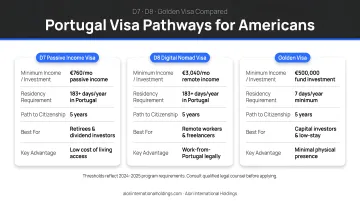
Getting there is more straightforward than most Americans expect. Three visa pathways cover the majority of American arrivals:
Visa pathways Americans use:
- D7 Passive Income/Retirement Visa: €920/month minimum income (€11,040/year) — suited for retirees and those with rental or dividend income
- D8 Digital Nomad Visa: €3,680/month minimum (4x Portuguese minimum wage) — designed for remote workers and freelancers employed outside Portugal
- Golden Visa: €500,000 investment in qualifying funds (real estate no longer eligible since 2023) — provides residency with a path to citizenship after five years
Tax note: U.S. citizens owe federal taxes on worldwide income regardless of residency location, though the US-Portugal Totalization Agreement prevents double Social Security taxation.
Portugal's regions differ sharply in climate, cost, pace of life, and expat community density. Picking the wrong one — a sleepy coastal town when you need city infrastructure, or a crowded tourist hub when you want quiet — shapes the entire experience. The five locations below are where American expats have put down real roots, selected for lifestyle fit, community depth, and long-term livability.
Best Places to Live in Portugal for American Expats
Each location below is evaluated on expat community size, English accessibility, healthcare quality, cost of living, and real estate fundamentals — the factors that shape both lifestyle fit and investment outcomes.
Lisbon
Lisbon is Portugal's cosmopolitan capital and home to the largest American expat presence in the country. With 118,000 foreign residents (15.1% of the municipality's population), the city offers established international infrastructure: 60+ museums, family-friendly beaches, international schools in Chiado and Príncipe Real, widespread English fluency, and an international airport connecting to the U.S. and Europe.
The downside: Lisbon is Portugal's most expensive city. Property prices hit €6,082/m² in March 2026, and foreign buyers pay a 61.9% premium over domestic buyers in Greater Lisbon.
Investment appeal: Sustained demand from international buyers, tourism, and a growing tech sector. Savills forecasts prime residential capital growth of 4–5.9% in 2026, driven by limited supply and continued international interest.
| Cost Level | High (highest in Portugal, but significantly below comparable U.S. cities) |
|---|---|
| Best For | Career-focused expats, families needing international schools, urban lifestyle seekers |
| Real Estate Outlook | Strong long-term demand; €6,082/m² avg. property price (Mar 2026) |
| Avg. 1-Bed Rent | €1,370/month (city center), €1,044/month (outside center) |
Porto
Portugal's second city sits on the Douro River, renowned for port wine, medieval architecture, and a growing creative and tech scene. English is widely spoken, cost of living undercuts Lisbon, and the American/international expat community is expanding. Porto has its own international airport and a walkable, cobblestoned city center. Winters, however, are rainier and cooler than southern Portugal — worth factoring in if climate is a priority.
Investment appeal: Lower entry price than Lisbon (€3,844/m² in late 2025) with strong short-term rental demand. Porto recorded 5.9 million overnight stays in 2023 (up 21.9% year-over-year) and won "Europe's Leading Seaside Metropolitan Destination 2024" at the World Travel Awards.
| Cost Level | Medium (lower than Lisbon, significantly below U.S. urban centers) |
|---|---|
| Best For | Digital nomads, creatives, expats seeking culture with lower overhead |
| Real Estate Outlook | Rising values with strong short-term rental potential; €3,844/m² avg. (Oct 2025) |
| Avg. 1-Bed Rent | €1,099/month (city center), €810/month (outside center) |

The Algarve (Lagos, Faro, Tavira)
Portugal's sun-drenched southern coast is the top destination for American retirees. Over 300 days of sunshine, dramatic beaches, mild winters, and an entrenched English-speaking expat community (historically British, now increasingly American) define the region.
Three distinct towns:
- Lagos: Vibrant old town, younger expat scene, active nightlife
- Tavira: Quiet, old-world charm near the Spanish border, slower pace
- Faro: Regional capital with international airport, broadest healthcare and commercial services
Summer brings heavy tourist crowds and seasonal price spikes — manageable for full-time residents but worth weighing for those planning short stays.
Property prices run below Lisbon and Cascais, tourist rental demand is strong, and a large year-round retiree base provides demand stability that purely tourism-dependent markets lack. The Algarve accounted for 25.4% of Portugal's total overnight stays in 2025 (20.8 million nights). Healthcare infrastructure has improved but specialist care often requires travel to Lisbon.
| Cost Level | Medium (varies by town; Lagos costs more than Tavira) |
|---|---|
| Best For | Retirees, beach lifestyle seekers, holiday-home investors |
| Real Estate Outlook | Solid short-term rental yields; €4,545/m² in Lagos vs. €3,421/m² in Tavira (Mar 2026) |
| Est. Monthly Cost (Couple) | ~€2,393 excluding rent |
Cascais
An upscale coastal town 30 minutes west of Lisbon by train, historically a royal resort now favored by affluent expats and international families. Key draws: access to 17 beaches, top-ranked international schools (St. Julian's, CAISL), a marina, golf courses, and a strong English-speaking community. Cascais combines tranquil coastal living with easy Lisbon commutability.
Premium housing reflects the sustained demand from international buyers — Cascais ranks among Portugal's most expensive locations as a result.
Investment appeal: Established international schools, proven property value retention, and proximity to Lisbon's airport and business infrastructure. Popular with American families and investor-expats seeking coastal living without sacrificing urban access.
| Cost Level | High (premium pricing; on par with or exceeding Lisbon) |
|---|---|
| Best For | Families, affluent retirees, expats wanting coastal living with Lisbon access |
| Real Estate Outlook | Strong capital retention; €5,561/m² avg. (Mar 2026) |
| Avg. 1-Bed Rent | €1,565/month (city center) |
The Silver Coast (Caldas da Rainha / Óbidos Area)
An underappreciated stretch of Atlantic coastline about an hour north of Lisbon, centered on Caldas da Rainha and near the medieval village of Óbidos. Daily farmers' markets, compact city center, public and private hospitals, a growing but not oversaturated expat community, and proximity to lagoon beaches. For Americans who want genuine integration into a working Portuguese community — not an expat enclave — without paying Lisbon or Algarve prices, this area delivers.
The tradeoff is real: winters are cold and rainy, and English-speaking services are noticeably thinner than in Lisbon or the Algarve.
Entry prices are significantly lower than Lisbon or the Algarve, infrastructure is improving, and proximity to the capital supports long-term appreciation potential. Direct bus connections to Lisbon take only 1 hour 10 minutes. Markets like this—where data and local expertise reveal structural demand before prices fully reflect it—represent high-conviction opportunities for value-oriented investors.
| Cost Level | Low to Medium (among the most affordable expat-friendly areas in western Portugal) |
|---|---|
| Best For | Budget-conscious expats, long-term settlers, value-oriented investors |
| Real Estate Outlook | Lower entry price with appreciation potential; ~€1,402/m² avg. in Leiria district (Mar 2026) |
| Avg. 1-Bed Rent | €808/month (city center) |
How to Choose the Right Location as an American Expat
Five key decision factors:
- Lifestyle priorities — Urban vs. coastal vs. quiet town
- Budget — Monthly cost of living and real estate entry price
- Expat community size — Do you need English-speaking neighbors, schools, and doctors nearby?
- Visa pathway alignment — Some visa types (especially the D7) process more smoothly with stable accommodation in major cities
- Investment intent — Consider rental demand, tourism density, and long-term capital appreciation by region
The most common mistake is choosing a location based on aesthetics or a summer visit, without testing it for year-round livability. Before committing, stress-test each shortlist city across four areas:
- Healthcare access — proximity to English-speaking clinics and private hospitals
- Language support — availability of expat-oriented services and legal professionals
- Year-round character — some areas go quiet (or overwhelming) outside tourist season
- Exit liquidity — resale demand if you decide to leave in five to ten years
Visit off-season, connect with existing expat communities on the ground, and consult local legal and real estate professionals before signing anything.
For Americans treating Portuguese property as part of a broader investment portfolio, working with an advisor who integrates global strategy with in-market execution — the way Alori International Holdings approaches its Portugal mandates — reduces the risk of overpaying and ensures pricing intelligence is grounded in current local data.
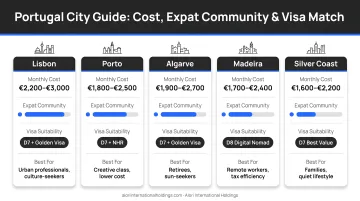
Quick reference matrix:
| City | Lifestyle Type | Cost Level | Expat Community | Rental Potential | Best Visa Match |
|---|---|---|---|---|---|
| Lisbon | Urban, career-focused | High | Very large | Strong | D8, Golden Visa |
| Porto | Cultural, creative | Medium | Growing | Strong (short-term) | D8, D7 |
| Algarve | Beach, retirement | Medium | Very large | High (seasonal) | D7 |
| Cascais | Upscale coastal | High | Large | Moderate | D7, Golden Visa |
| Silver Coast | Quiet, community | Low-Medium | Small but growing | Moderate | D7 |
Conclusion
Portugal genuinely delivers on its promise for American expats—stable, safe, affordable, and welcoming. The right city, though, depends on where you are in life, what you're trying to build financially, and how much friction you're willing to accept along the way. Each of the five cities offers a distinct version of the Portuguese lifestyle, and both lifestyle migration and property investment are stronger when those two dimensions align.
Depending on your priorities, each city opens a different door:
- Lisbon — urban energy, career networks, and a cosmopolitan expat scene
- Porto — authentic culture, lower costs, and a rising creative economy
- Algarve — year-round sunshine, resort-quality infrastructure, and strong rental demand
- Cascais — family-friendly coastal living with European schooling and easy Lisbon access
- Silver Coast — value-oriented community, slower pace, and underpriced property fundamentals
Across all five, Portugal offers a measurably better quality of life at a fraction of U.S. costs.
For Americans who want to move to Portugal not just as a life change but as a smart capital decision, Alori International Holdings offers carefully vetted property opportunities in Portugal's most compelling markets—with verified legal structures, off-market access, and defined exit strategies built in from the start. Reach out via info@aloriinternationalholdings.com to explore current opportunities.
Frequently Asked Questions
Can I live comfortably in Portugal on $3,000 a month?
Yes, in most non-Lisbon locations. Porto, Algarve towns like Tavira, and the Silver Coast comfortably support this budget, covering rent, groceries, utilities, and local transport. Lisbon and Cascais require more.
Can an American just move to Portugal?
No—Americans need a residency visa to stay beyond 90 days in the Schengen Area. The most common pathways are the D7 (passive income/retirement), D8 (digital nomad), or Golden Visa (investment fund). The process is bureaucratic but manageable with proper legal support.
Which city in Portugal has the most Americans?
Lisbon has the largest American expat concentration, followed by the Algarve region and Porto. Official Portuguese statistics recorded over 14,000 registered American residents in mainland Portugal, with most in Lisbon's metropolitan area.
Is there a good expat community in Portugal?
Yes. Portugal has well-established expat communities in Lisbon, the Algarve, and Cascais, with active social groups, English-language events, international schools, and English-speaking healthcare professionals accessible in all major expat hubs.
Is Portugal still welcoming American expats?
Portugal remains one of Europe's most welcoming countries for American expats, ranking #7 on the Global Peace Index with accessible residency visa pathways and a culturally open population. That said, rapid expat growth has created real housing pressure in Lisbon and popular Algarve towns.
Can I still collect Social Security if I move to Portugal?
U.S. Social Security benefits can be received in Portugal, deposited directly to a U.S. bank account. The U.S.-Portugal Totalization Agreement prevents double social security taxation, though a tax professional can clarify how Portuguese residency affects your U.S. filing obligations.