

Introduction
Over 14,000 Americans are now registered residents in Portugal—and the number keeps climbing. This guide is a practical 2026 roadmap built on current visa thresholds, real cost-of-living data, and the legal structures you need to understand before you land.
Americans move to Portugal for two distinct reasons: lifestyle—lower costs, safety, quality healthcare, climate—or financial strategy, including real estate investment, portfolio diversification, and tax structuring.
Both paths converge on the same core decisions: choosing the right visa, understanding the true 2026 cost of living, selecting where to live, and getting your tax and financial setup right before arrival.
Key Takeaways:
- Portugal offers safety, affordable healthcare, and EU travel access
- Visa choice depends on income source: D7 for passive income, D8 for remote workers, Golden Visa for investors
- Lisbon is no longer a bargain; Porto and the Algarve offer better value
- Americans must keep filing US taxes regardless of where they live
- Property ownership does not equal residency—secure your visa separately
Why Americans Are Moving to Portugal in 2026
The pull factors are concrete. Portugal ranks 7th globally on the Global Peace Index, and the financial case for relocating is equally hard to ignore:
- Healthcare costs run 50-70% below US rates, with private insurance starting at €30-40/month versus $400-900+ in the States
- Cost of living runs 30-40% lower than major US metros
- Visa-free travel across the 27-country Schengen Area
- Political stability that consistently ranks among Western Europe's highest
The push factors are equally real. Rising healthcare costs, economic uncertainty, and political polarization are driving more Americans toward second residency than at any point in the past decade. Portugal's visa framework is unusually accessible for non-EU citizens, offering multiple pathways depending on your income structure and timeline — something most of Europe doesn't provide.
According to the InterNations Expat Insider survey, over 60% of expats report settling in Portugal more easily than the global average — citing manageable bureaucracy, widespread English usage in major cities, and a genuinely welcoming attitude toward foreign residents.
Visa Options for Americans in 2026
The Baseline Rule
US citizens enter Portugal visa-free for up to 90 days in any 180-day period. Staying longer requires a formal residence visa applied for through the Portuguese consulate before arrival.
In 2026, border processing operates under the EU Entry/Exit System (EES), fully operational as of April 10, 2026. This digital biometric system captures facial images and fingerprints, retaining data for three years (five if you overstay). Violations are now digitally recorded and automatically flagged — manual passport stamping is gone.
D7 Visa (Passive Income / Retirement Visa)
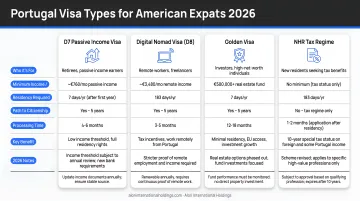
The D7 is the primary route for retirees and passive-income households. The 2026 income benchmark is tied to Portugal's minimum wage: €920/month for the main applicant, with percentage additions for dependents (50% for a spouse, 30% per child). Consulates expect a file stronger than the bare minimum—demonstrating stable, recurring income from pensions, dividends, rental properties, or annuities.
Key details:
- Leads to permanent residency eligibility after 5 years
- Processing time: 2-4 months
- Proof required: bank statements, pension letters, investment account statements
D8 Digital Nomad Visa
The D8 targets remote workers and online contractors earning active income from outside Portugal. The 2026 benchmark is 4× the monthly minimum wage—approximately €3,680/month average over the prior three months.
The key distinction: D7 covers passive income (pensions, dividends, rental income), while D8 applies to active remote earnings (salary, freelance contracts, consulting fees). Mixing these categories or misrepresenting income sources will result in denial.
D2 Entrepreneur Visa
The D2 route is for Americans building or expanding a business with genuine economic activity in Portugal. You must submit a credible business plan detailing:
- What the business does
- Who the customers are
- How it will generate revenue in Portugal
- Job creation potential
D2 vs. D8: D2 means establishing a business entity in Portugal. D8 means working remotely for clients abroad. If you're opening a café in Lisbon, that's D2. If you're a graphic designer with US clients working from Porto, that's D8.
Golden Visa (ARI)
Since the 2023 "Mais Habitação" law, residential real estate no longer qualifies. Current AIMA-approved pathways:
- €500K in eligible investment funds
- €500K in scientific research
- €250K in cultural/heritage support
- €500K in a Portuguese company with job creation
The Golden Visa requires minimal physical presence: 7 days in year one, 14 days per subsequent two-year period. It offers a clear path to citizenship after 5 years. Because qualifying investments must meet specific AIMA requirements, vetting deal structure and legal compliance upfront matters significantly. Alori International Holdings focuses specifically on this segment — sourcing and screening Portuguese investment opportunities that meet Golden Visa criteria, with in-market professionals who understand local regulations and transaction processes.
Visa Comparison Table
| Visa Type | Best For | 2026 Financial Requirement | Processing Time |
|---|---|---|---|
| D7 | Retirees, passive income earners | €920/month minimum | 2-4 months |
| D8 | Remote workers, digital nomads | €3,680/month average | 2-4 months |
| D2 | Entrepreneurs, business owners | Business plan + capitalization | 3-6 months |
| Golden Visa | Investors seeking minimal stay | €250K–€500K investment | 6-12 months |
Cost of Living: Portugal vs. the US
The Real Numbers
Portugal remains 30-40% more affordable than major US cities overall, but savings vary dramatically by location. Lisbon and Cascais have risen sharply and no longer qualify as bargain markets. Compared to New York, San Francisco, or Los Angeles, Portugal runs 35-45% cheaper overall — and housing accounts for the largest share of that difference.
Housing: Where the Caution Lives
2026 rental ranges for a 1-bedroom apartment:
- Central Lisbon: €900–€1,400/month
- Porto: €750–€1,150/month
- Algarve: €750–€1,250/month
- Coimbra: €550–€900/month
Compare these to New York ($3,000-$4,500), San Francisco ($2,800-$4,200), or Los Angeles ($2,200-$3,500), and the savings are clear—but Lisbon and Cascais now sit firmly in the mid-tier range. Budget-conscious movers will find better value in Porto, Coimbra, or smaller coastal towns.
Daily Expenses: Where Portugal Wins
Portugal outperforms the US on everyday costs:
- Groceries: 40-50% lower
- Dining out: Coffee €1.20 vs. $5+ in the US; lunch €8-12 vs. $15-25
- Public transport: Monthly pass €40 vs. $100-150
- Private healthcare: €30-40/month vs. $400-900+
A few categories where Portugal doesn't win on price:
- Imported electronics (10-20% premium)
- International goods
- Private school tuition (€8,000-€18,000/year)
Monthly Budget Benchmarks
Single person living modestly outside premium neighborhoods: €1,300-€1,900/month
Couple living comfortably: €2,300-€3,400/month
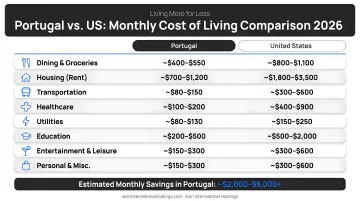
These are real-life budgets, not visa minimums. Lisbon and Cascais will push totals 20-30% higher.
The NHR Tax Regime Change
Tax treatment directly affects whether those budget numbers hold in practice. The old Non-Habitual Resident (NHR) regime closed to most new arrivals after December 31, 2023 — don't assume a blanket 10-year tax break.
The replacement IFICI framework is narrower:
- Who qualifies: Researchers, innovators, and certain qualified professionals
- Who doesn't: Most retirees and remote workers no longer benefit automatically
Verify your eligibility with a Portuguese tax advisor before factoring in any income tax savings.
Best Places to Live in Portugal for Americans
Best Places to Live in Portugal for Americans
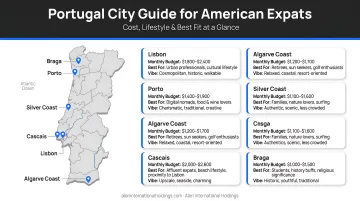
Lisbon
The most internationally connected landing point. Strong infrastructure, English-speaking services, widest range of international schools. Ideal for professionals, entrepreneurs, and families who want urban energy with European lifestyle. The trade-off: the most expensive housing market in Portugal.
Porto
More affordable, compact, and authentic — with a growing expat community strong for remote workers and young professionals. The vibe is cultural, walkable, and less tourist-saturated than Lisbon. Rental costs run 15-25% below Lisbon.
The Algarve
Top choice for retirees. Warm climate, resort infrastructure, established English-speaking communities. Costs are lower than Lisbon, but healthcare access outside Faro can be limited, and a car is often essential.
Hidden-Value Cities
| City | Cost vs. Lisbon | Best For |
|---|---|---|
| Cascais | On par with Lisbon | Families, higher-budget households; excellent international schools and beach access |
| Coimbra | Lowest of major cities | Budget-conscious retirees and families; university-town energy without tourist crowds |
| Madeira | Moderate | Lifestyle-focused remote workers; mild year-round climate, smaller community |
Americans often start in Lisbon or the Algarve, then migrate toward mid-tier cities for better value and deeper integration. Where you land also shapes your property entry point — costs, rental yields, and resale liquidity vary considerably between these markets.
Buying Property in Portugal: Lifestyle Move or Smart Investment?
Legal Clarity First
Americans can buy property in Portugal with no nationality-based restrictions and enjoy the same property rights as Portuguese citizens. However, owning property does not confer residency. A visa must be established separately.
Rent First, Buy Later
Most newcomers benefit from renting for 6-12 months to test neighborhoods, commute patterns, seasonal tourism pressure, and lifestyle fit. The buyer transaction cost structure—IMT transfer tax, stamp duty, notary and registration fees—makes a rushed purchase costly to reverse.
Portuguese Real Estate as an Asset Class
Portugal's property market is driven by strong demand-side fundamentals: tourism growth, limited housing supply in key markets, and inbound capital flows from international buyers. Property prices in Lisbon and Porto have appreciated 6-8% annually in recent years, with rental yields ranging from 5-10% depending on location and property type.
Approaching this market with investment discipline — verifying legal structures, assessing exit options, and understanding local pricing — is where execution separates good outcomes from expensive mistakes. Alori International Holdings works with American buyers to do exactly that, providing access to off-market opportunities, verified legal structures, and defined exit strategies across the Portuguese market.
Mortgage Access for Americans
Non-resident and newly arrived American buyers can obtain Portuguese mortgages, but expect closer file scrutiny. Core documents:
- Passport
- NIF (tax ID number)
- Proof of income
- Recent tax returns
- Bank statements
Self-employed buyers and non-residents should expect additional documentation. Engage a local lawyer to verify title, debts, and planning permissions before signing any purchase agreement.
Practical Setup: Healthcare, Banking & US Tax Obligations
Healthcare
As a legal resident, you're entitled to Portugal's public SNS healthcare system. Register at a local health center and obtain an SNS user number. The system is affordable for routine visits, but wait times for specialists can stretch weeks — particularly outside Lisbon and Porto.
Many expats use a hybrid approach:
- Public system for routine care
- Private insurance for specialists and speed
Private insurance starts around €30–40/month. Medicare does not cover care in Portugal, so plan your coverage before your flight — there's no grace period once you arrive.
Banking and NIF
Once healthcare coverage is in place, your next priority is the NIF (Número de Identificação Fiscal) — the Portuguese tax identification number required for leases, bank accounts, utility contracts, and nearly everything else administrative.
Opening a Portuguese bank account requires:
- Passport
- NIF
- Proof of address
FATCA regulations make some Portuguese banks reluctant to open accounts for US citizens. Major international banks with Portuguese branches — Banco Santander and BPI — tend to be more accommodating for American expats.
US Tax Obligations
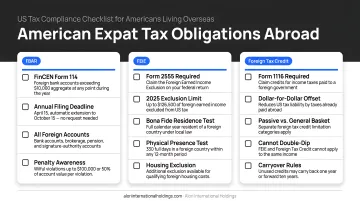
Americans do not exit the US tax system upon moving abroad. Key obligations:
- Annual Form 1040 filing on worldwide income
- FBAR (FinCEN 114) if foreign accounts exceed $10,000 aggregate at any point
- Form 8938/FATCA for higher foreign asset thresholds
The Foreign Earned Income Exclusion (FEIE — $126,500 for 2024, adjusted annually) and the Foreign Tax Credit (FTC) are the primary tools to avoid double taxation. The US-Portugal tax treaty helps with withholding rates and some pension income, but it does not eliminate the US filing obligation. Portuguese tax residency generally kicks in after 183+ days in-country, triggering worldwide income taxation in Portugal as well — so coordination between both systems is essential from day one.
Frequently Asked Questions
Can American expats live in Portugal on $1,000–$3,000 a month?
$1,000/month is extremely tight even in low-cost areas. $2,000–$3,000/month is workable for a single person or couple in mid-tier cities like Porto or the Algarve if housing costs are managed carefully. Lisbon and Cascais will stretch that budget significantly.
Where do most American expats live in Portugal?
Lisbon, the Algarve, and Cascais are the most popular concentrations. Official INE data shows over 14,000 registered Americans in Portugal, with the majority on the mainland and smaller communities in Madeira and the Azores.
What visa do most Americans use to move to Portugal?
The D7 (passive income/retirement) suits retirees and passive-income earners; the D8 covers remote workers. The Golden Visa is structured for investors. Each visa ties to a specific income source, so choosing the right one depends on how you actually earn.
Do Americans have to pay US taxes while living in Portugal?
Yes. US citizens must continue filing annual US tax returns regardless of where they live. The FEIE and Foreign Tax Credit help prevent double taxation. FBAR reporting is required for foreign accounts exceeding $10,000.
Can Americans buy property in Portugal?
Yes, with no nationality-based restrictions. Americans have the same property rights as Portuguese citizens. However, property ownership alone does not confer residency rights, which must be established through a separate visa process.
How long does it take to get Portuguese citizenship?
Naturalization eligibility typically begins after 5 years of legal residence. Requirements include demonstrated Portuguese language ability (A2 level) and a clean criminal record. Processing times after filing currently range from several months to over a year.