

Introduction
According to Portuguese Statistics Institute (INE) data, 19,258 US citizens officially resided in Portugal in 2024—a 36% increase in a single year. That kind of growth doesn't happen by accident. For Americans wrestling with rising housing costs and healthcare expenses, Portugal offers structural advantages that go beyond lifestyle appeal.
The appeal comes down to four measurable factors:
- Cost of living: 40–50% lower than major US cities
- Visa pathways: D7 Passive Income and D8 Digital Nomad visas offer clear entry routes
- English proficiency: Portugal ranks 6th globally in the EF English Proficiency Index
- Safety: 7th worldwide on the Global Peace Index
What follows is a location-by-location breakdown matched to different expat profiles — retirees, families, investors, and digital nomads. Each entry includes real estate benchmarks, lifestyle context, and cost-of-living data to help you identify where your priorities actually fit.
Key Takeaways
- Lisbon: Best for career-focused expats and families — top international schools, strong networks, highest prices
- Porto: Urban culture at roughly 40% lower cost than Lisbon, popular with creatives and digital nomads
- Cascais: Coastal living for affluent families, with elite schools and a 30-minute train ride into Lisbon
- The Algarve: Retirees and remote workers drawn by year-round sun, English-speaking services, and low costs
- Madeira: Island pace with remote-work incentives, best suited to digital nomads and nature-focused expats
Why Portugal Remains a Top Destination for US Expats in 2026
Portugal solves problems Americans increasingly face at home. New York renters pay $3,872 for a one-bedroom city-center apartment; Porto residents pay just $1,099—72% less. Private health insurance in Portugal costs a fraction of US premiums, with high-quality care accessible without the bureaucratic maze most Americans know well.
Safety and language barriers round out the picture. Portugal holds the 7th-place ranking on the Global Peace Index and has widespread English proficiency—factors that make day-to-day integration far more manageable than in most European alternatives.
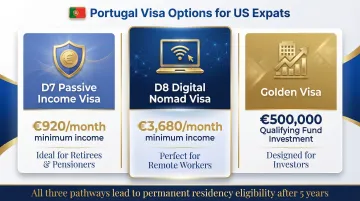
For Americans ready to make the move, three primary visa pathways cover the most common relocation profiles:
- D7 Passive Income Visa: Requires €920/month passive income (pensions, dividends, rentals)—ideal for retirees
- D8 Digital Nomad Visa: Requires €3,680/month active income—designed for remote workers and freelancers
- Golden Visa: Requires €500,000 investment in qualifying funds (no longer available for real estate purchases)—targets investors seeking European residency
Beyond the visa pathways, Americans face no restrictions buying property in Portugal and hold the same ownership rights as local citizens. For investors, this means property acquisition can serve double duty: securing a residence base while building an appreciating asset in a market with strong structural demand.
Best Places in Portugal for US Expats in 2026
Each location below is evaluated on lifestyle fit, cost of living, expat community strength, property market accessibility, and suitability for common US expat profiles: retirees, families, investors, and remote workers.
Lisbon
Lisbon is Portugal's capital and largest expat hub — a cosmopolitan city with a thriving tech ecosystem, abundant coworking spaces, multiple international schools, and direct TAP Air Portugal flights to 8 US cities (JFK, Newark, Boston, Miami, Los Angeles, San Francisco, Washington D.C., and Chicago).
Professionals, entrepreneurs, and families who prioritize career infrastructure cluster in established neighborhoods like Príncipe Real, Chiado, and Parque das Nações, where the American expat community is most concentrated.
Lisbon holds the largest concentration of English-speaking services, the widest international school selection, and the strongest job market in Portugal. However, that comes at a price — rental costs are the highest in the country and the housing market is genuinely competitive. When expats ask "where do most Americans live in Portugal," Lisbon is the answer.
| Criteria | Details |
|---|---|
| Ideal Expat Profile | Career-driven professionals, families with school-age children, entrepreneurs, first-time expats wanting strong support networks |
| Avg. Property Price Range | €6,082/sqm (March 2026) |
| Typical Monthly Cost (1-bedroom, single expat) | €2,414 (rent + living expenses) |
Source: Idealista 2026, Numbeo 2026
Porto
Porto is Portugal's second city — a walkable, culturally rich riverside destination with a growing expat community particularly popular among creatives, digital nomads, and young professionals. Its lower cost of living versus Lisbon, thriving café and coworking culture, and expanding international connectivity via Porto Airport make it an attractive alternative to the capital.
Housing runs roughly half the cost of Lisbon (€3,120/sqm versus €6,082/sqm), and the arts, food, and street-level energy of the city give it a character that feels genuinely lived-in rather than expat-optimized. The trade-offs worth knowing: a smaller formal job market, fewer international schools, and foggy winters that contrast sharply with Portugal's sunny south.
| Criteria | Details |
|---|---|
| Ideal Expat Profile | Digital nomads, creatives, budget-conscious expats, remote workers, those seeking cultural immersion over corporate infrastructure |
| Avg. Property Price Range | €3,120/sqm (March 2026) |
| Typical Monthly Cost (1-bedroom, single expat) | €1,909 (rent + living expenses) |

Source: Idealista 2026, Numbeo 2026
Cascais
Cascais is an upscale coastal town 30–40 minutes from Lisbon by train — one of Portugal's most desirable addresses for affluent American families. The combination of 17 beaches, top international schools (including St. Julian's School and the International School of Cascais), a marina, golf courses, and safe walkable neighborhoods with easy access to Lisbon's airport makes it Portugal's premier family destination.
For families where one parent commutes to Lisbon or works remotely, Cascais hits a rare combination:
- Elite international schooling within the town itself
- California-style coastal living with beaches, marinas, and golf
- 30-minute train access to Lisbon's CBD and international airport
That combination carries a premium — rental and purchase costs are the highest outside Lisbon's city center.
| Criteria | Details |
|---|---|
| Ideal Expat Profile | Affluent families with children, expats seeking California-style coastal living, those who want Lisbon access without city-center density |
| Avg. Property Price Range | €4,713/sqm (Q3 2025) |
| Typical Monthly Cost (family household) | €3,500–4,200 (rent + living expenses) |
Source: INE 2025, Numbeo 2026
The Algarve (Lagos, Faro, Tavira)
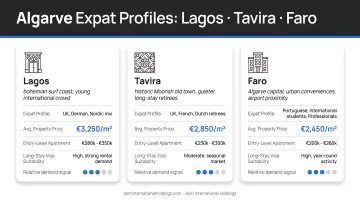
The Algarve is Portugal's southernmost coastal region and the top retirement destination for Americans in Portugal. With over 3,000 hours of sunshine annually and some of Europe's most acclaimed beaches, it draws a large established English-speaking expat community.
Three towns anchor most American arrivals — each with a distinct character:
- Lagos — bohemian, international, popular with younger retirees and nomads
- Tavira — quiet, traditional, preferred by those wanting genuine Portuguese immersion
- Faro — the regional gateway city, with the main airport and the most urban amenity access
For American retirees, the Algarve checks the most critical boxes: high English-language service density, affordable private healthcare, strong D7 visa suitability for passive-income earners, and housing costs well below Lisbon (€3,549/sqm in Faro versus €6,082/sqm in the capital). The practical drawbacks — heavy summer tourism and car dependency outside major towns — are worth factoring in before committing to a specific area.
| Criteria | Details |
|---|---|
| Ideal Expat Profile | Retirees, passive-income expats, remote workers prioritizing climate and lifestyle over career infrastructure, golf and outdoor enthusiasts |
| Avg. Property Price Range | €3,549/sqm (Faro) to €4,545/sqm (Lagos) (March 2026) |
| Typical Monthly Cost (1-bedroom, single expat) | €1,707 (rent + living expenses) |
Source: Idealista 2026, Numbeo 2026
Madeira
Madeira is Portugal's autonomous Atlantic island region, gaining rapid popularity among digital nomads and nature-oriented US expats. Known for dramatic volcanic landscapes, year-round mild temperatures distinct from mainland Portugal, a government-backed Digital Nomad Village program in Ponta do Sol, and a slower pace of life centered on hiking, surfing, and sailing, Madeira offers island living with European residency rights.
Funchal is compact and walkable, costs run below Lisbon, and the Digital Nomad Village program in Ponta do Sol has seeded a connected international remote-work community. For the right profile, it's a compelling combination. For others — particularly families or those needing career mobility — the island's limitations matter: every mainland trip requires a flight, international schooling options are limited, and the property market is notably smaller than any major mainland city.
| Criteria | Details |
|---|---|
| Ideal Expat Profile | Digital nomads, solo remote workers, nature and outdoor lifestyle seekers, expats wanting island living with European residency rights |
| Avg. Property Price Range | €3,993/sqm (Funchal, March 2026) |
| Typical Monthly Cost (1-bedroom, single expat) | €2,475 (rent + living expenses) |
Source: Idealista 2026, Numbeo 2026
How We Chose These Locations
These five locations were selected based on the factors that matter most to US expats relocating to Portugal. The goal was to cover distinct lifestyle profiles — not just rank the most popular cities.
Selection criteria included:
- Size and accessibility of the existing American community
- Availability of English-language services and international schools
- Visa pathway suitability (including Golden Visa and D7 eligibility)
- Public transport links and proximity to international airports
- Housing options across a range of budgets
Common mistakes US expats make when choosing a location:
- Prioritizing cost of living alone without accounting for healthcare access quality
- Underestimating international school placement lead times (waitlists can be 12+ months in Lisbon and Cascais)
- Ignoring seasonal infrastructure differences (the Algarve operates very differently in January versus July)
- Choosing based on vacation experience rather than year-round living realities
A few locations didn't make the main list but are worth knowing about depending on your priorities:
- Budget-first families often find what they're looking for in Braga — affordable, unhurried, and firmly northern Portuguese in character
- Coimbra suits academics and students drawn to Portugal's oldest university city
- The Azores are ideal for those seeking true island isolation, off-grid living, and direct immersion in nature
Portugal Real Estate: What US Buyers Should Know Before Investing
Americans can buy property in Portugal with no ownership restrictions and the same legal rights as locals. The key financial consideration: upfront transaction costs typically run 7–10% of the purchase price, including:
- IMT (Property Transfer Tax): Progressive tax reaching 7.5% for properties over €1,150,853
- Stamp Duty: Flat 0.8% of purchase price
- Legal fees: 1–2% of purchase price for independent legal representation
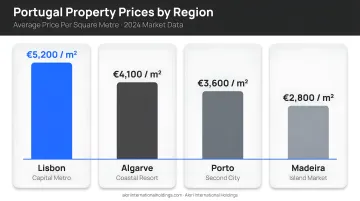
Property prices vary significantly across markets. As of March 2026, Lisbon city center averages €6,082/sqm, coastal Algarve ranges from €3,549/sqm (Faro) to €4,545/sqm (Lagos), and Porto averages €3,120/sqm—roughly half the cost of Lisbon.
Portugal's property market has historically delivered capital appreciation in high-demand coastal and urban areas, alongside rental income potential supported by strong tourism infrastructure — 32.5 million guests and 82.1 million overnight stays in 2025. That demand story is real, but it doesn't eliminate risk.
Speculative purchasing without understanding local regulations, transaction processes, and exit strategies can be costly. Working with an investment firm that combines global strategy with in-market execution — like Alori International Holdings — helps reduce legal and transaction risk, provides accurate pricing benchmarks, and ensures exit strategies are defined before you commit capital.
Rent-vs-buy decision framework for expats:
- Rent first: Recommended for the first 12–24 months to learn the market and test neighborhoods before committing
- Buy when: You have a 5+ year horizon, stable residency status, and clear financial objectives (primary residence, rental income, or long-term capital investment)
- Closing costs include: IMT, stamp duty, and legal fees — budget these from the start, not as an afterthought
Conclusion
Portugal's diversity of regions means there is no single "best" location — the right choice depends on your profile:
- Lisbon and Cascais suit career-focused families and those wanting urban infrastructure
- The Algarve draws retirees seeking warm weather, amenity-rich communities, and a slower pace
- Porto and Madeira attract remote workers, digital nomads, and creatives
Before committing, visit the shortlisted areas in person. Then stress-test a realistic monthly budget covering rent, healthcare, and transport — with a 20% buffer — before signing a lease or making a purchase.
For those treating this move as an investment decision, choosing the right location is only the first step. Navigating Portuguese property law, pricing, and transaction structure as an American buyer requires in-country expertise and a clear exit strategy from the outset.
Alori International Holdings works with American investors on curated Portugal property opportunities — sourcing off-market projects, verifying legal structures, and defining exit and rental strategies before any capital is committed. Reach out directly at info@aloriinternationalholdings.com to explore current opportunities.
Frequently Asked Questions
Where is the best place for US expats to live in Portugal?
It depends on your priorities. Lisbon suits career-focused expats and families; Porto offers culture at a lower price point; the Algarve draws retirees chasing sunshine; and Cascais appeals to those wanting upscale coastal living. Most Americans settle in Lisbon, the Algarve, or Porto.
What city in Portugal has the most American expats?
Lisbon has the largest concentration of American expats due to its job market, international schools, and expat infrastructure, followed by the Algarve (especially among retirees) and Porto. INE data shows 19,258 registered US residents in Portugal as of 2024, with Lisbon hosting the majority.
Is Portugal a good place for Americans to retire in 2026?
Yes — Portugal consistently ranks among the top retirement destinations for Americans. Key reasons include:
- Cost of living 40–50% lower than major US cities
- Accessible private healthcare at a fraction of US costs
- Ranked 7th globally on the Global Peace Index
- The D7 Passive Income Visa designed for retirees with pensions, Social Security, or investment income
What visa do most US expats use to move to Portugal?
Three visas cover most scenarios: the D7 (passive income, min. €920/month), the D8 Digital Nomad Visa (remote workers, min. €3,680/month), and the Golden Visa (investors, min. €500,000 in qualifying funds). All three lead to permanent residency eligibility after five years.
Can Americans buy property in Portugal?
Yes — Americans buy property in Portugal under the same rules as local citizens, with no foreign ownership restrictions. Budget for upfront transaction costs of 7–10% of the purchase price, covering IMT property transfer tax, 0.8% stamp duty, and legal fees.
What is the cost of living in Portugal compared to the US?
Living expenses run 40–50% lower than in major US cities. A comfortable single-expat lifestyle in Porto or the Algarve typically costs €1,700–1,900/month all-in — well below equivalent living costs in New York or Los Angeles. City-specific breakdowns appear in the cost tables throughout each location section above.