

This guide covers the practical realities Americans face when seriously evaluating a move to Tbilisi: visa requirements, tax obligations, neighborhood selection, true cost of living, daily friction points, and the property-buying process. Whether you're testing a six-month trial run or committing to a long-term lifestyle shift, this is what you need to know before booking the flight.
TLDR:
- US citizens can stay visa-free for 365 days, but a 2026 work permit rule now requires formal authorization for paid employment
- Qualifying Individual Entrepreneurs pay just 1% tax on income up to 500,000 GEL, though Americans still face US tax obligations
- Monthly budgets range from $800–$1,200 for singles in decent apartments; couples typically spend $1,400–$2,000
- Vake offers premium apartments and cleaner air; Saburtalo provides affordability with metro access; Marjanishvili attracts long-term expats
- Property investment of $150,000+ qualifies for Georgian residence permits with no ownership restrictions for foreigners
Why Tbilisi Is Attracting Expats and International Investors
Tbilisi occupies a rare position in the global expat landscape: a capital city offering low cost of living, liberal immigration policy, extremely low taxes, and a growing expat infrastructure. While digital nomad hotspots in Southeast Asia attract short-term visitors, Georgia's 365-day visa-free window and favorable tax environment have built a stable, long-term foreign community. As of early 2026, Georgia hosts an estimated 257,000 foreign residents, with over 70% arriving from post-Soviet countries, the EU, the US, and Israel.
The city itself is a study in contrasts. Ottoman-era bathhouses and Orthodox churches share streets with Soviet-era apartment blocks and modern café culture. The walkable Old Town remains largely free of mass tourism despite the city's growing international profile.
Tbilisi's Bassiani club draws recognition as a premier global techno destination, while the surrounding wine country preserves an 8,000-year winemaking tradition recognized by UNESCO.
The 2022 Russian invasion of Ukraine brought over 125,000 relocators to Georgia, spiking rents and raising the city's international profile. That wave has normalized, but it left behind expanded infrastructure:
- 42 new coworking facilities opened in 2025, accommodating 8,600 members
- Average occupancy across these spaces runs at 87%
- Expats arriving today step into an established ecosystem, not a frontier one
Visas, Residency, and Tax Benefits for Americans in Georgia
US citizens can enter Georgia visa-free and remain for up to 365 days without additional permits. The clock resets upon exit and re-entry, making this one of the world's most generous immigration policies. However, effective March 1, 2026, Georgia's Decree No. 70 requires foreign nationals to obtain a formal "Right to Work" permit for all paid employment and self-employment, regardless of visa-free status.
Tax Residency and the 183-Day Rule
Under Article 34 of the Georgian Tax Code, staying in Georgia for 183 or more days in any continuous 12-month period makes you an automatic tax resident. Registering as an Individual Entrepreneur (IE) before triggering residency takes advantage of this — qualifying IEs pay just 1% tax on gross income up to 500,000 GEL annually. The regime excludes licensed activities, financial services, legal consultancy, and crypto exchange services.
US Tax Obligations Remain
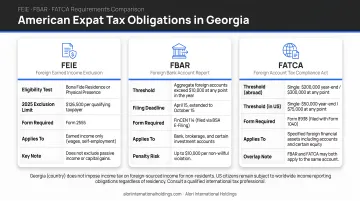
Americans remain taxed on worldwide income regardless of Georgian residency. The Foreign Earned Income Exclusion (FEIE) excludes up to $132,900 for 2026, but higher earners face additional liability. You must file FinCEN Form 114 (FBAR) if foreign financial accounts exceed $10,000 at any point during the year, and FATCA Form 8938 if aggregate foreign assets exceed $200,000 (single) or $400,000 (married filing jointly).
Residency Through Property Investment
Foreigners can fast-track Georgian residence permits by purchasing property valued at $150,000 or more (as of March 2026), verified by certified appraisal. This grants residency to the buyer and qualifying family members without employment-based requirements.
For Americans using the $150,000 threshold as a residency pathway, Alori International Holdings works with international buyers to identify property investments in Tbilisi that meet the appraisal requirement with verified legal structures and defined exit strategies.
Tax and residency planning must happen before arrival — the timing of IE registration relative to your 183-day count can mean the difference between a 1% and a 20% effective rate on the same income.
Cost of Living in Tbilisi: What to Realistically Expect
Cost-of-living estimates for Tbilisi vary widely depending on neighborhood and lifestyle, but realistic monthly budgets break down as follows:
Monthly Budget Benchmarks (April 2026):
| Expense Category | Cost (USD) |
|---|---|
| Single person (excluding rent) | ~$630 |
| Family of 4 (excluding rent) | ~$2,320 |
| 1-bedroom rent (city center) | $680 |
| 1-bedroom rent (outside center) | $428 |
| Basic utilities (915 sq ft) | $84 |
| Internet (60+ Mbps) | $20 |
| Meal for two (mid-range restaurant) | $37 |
Source: Numbeo April 2026 data
A comfortable monthly budget for a single person in a decent apartment typically ranges from $800 to $1,200, while couples living comfortably budget $1,400 to $2,000 including dining out, day trips, and activities. For Americans accustomed to coastal city costs, Tbilisi typically runs 50–60% cheaper than comparable living in cities like Los Angeles or New York.
Grocery Reality Check
Local produce, Georgian wine, and staple foods are genuinely affordable — a week's worth of fresh vegetables and proteins at a local market typically runs $20–$35. Imported goods, specialty dietary items (gluten-free, organic), and Western-brand products cost significantly more, sometimes matching European prices. If your diet relies heavily on imports, add $100–$200 per month to your grocery estimate.
Best Neighborhoods in Tbilisi for Expats
Neighborhood selection in Tbilisi determines not just your rent, but your daily quality of life, commute options, and social circle. Here's what you need to know about the four primary expat districts:
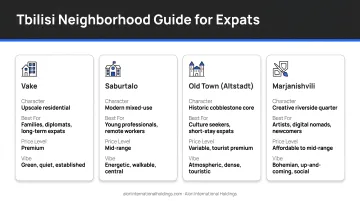
Vake
Historically Tbilisi's most upscale district, Vake attracts expats who prioritize modern apartments, cleaner air (Upper Vake sits on a hill), and access to quality restaurants and Vake Park. Rents run higher here—expect $700+ for a renovated one-bedroom.
The major drawback: Vake has no metro access, making car ownership or frequent taxis a practical necessity.
Saburtalo
Tbilisi's largest residential district, Saburtalo mixes Soviet-era blocks with newer high-rises. It's more affordable than Vake, and metro stations at State University, Delisi, and Vazha-Pshavela give you easy access across the city. Dining and entertainment options are thinner than in central neighborhoods, but the value proposition is clear for cost-conscious expats.
Old Town (Sololaki, Abanotubani)
The Old Town delivers maximum atmosphere: colorful wooden balconies, winding streets, historic bathhouses. The tradeoffs are real, though:
- Noisiest and most tourist-heavy part of the city
- Aging buildings with frequent utility and heating issues
- Limited parking; walkability cuts both ways
Best suited for short-term stays or expats who genuinely prioritize character over convenience.
Marjanishvili
Located across the river from the Old Town, Marjanishvili centers on the Fabrika creative complex—a converted Soviet sewing factory now housing a hostel, coworking space, and nightlife courtyard. Metro access at Marjanishvili station, a younger local atmosphere, and lower rents than Vake or the Old Town make this the neighborhood where longer-term expats are steadily concentrating.
Beyond renting, some Americans move through Tbilisi and decide to buy. Alori International Holdings works with investors evaluating Georgia property across these districts, with a focus on legal clarity and defined exit strategies.
Culture, Food, and Daily Life as a Tbilisi Expat
Georgian Hospitality
Georgian hospitality runs deep — the culture holds guests as near-sacred, a tradition that predates modern tourism by centuries. This creates a genuinely warm environment for foreigners integrating into local life. Making friends with locals is easier here than in many expat-heavy destinations, particularly if you show genuine interest in the culture, language, or food.
Food, Wine, and Nightlife
Georgian cuisine is one of Tbilisi's primary draws: khachapuri (cheese bread), khinkali (dumplings), walnut-based vegetable dishes, and an extraordinary wine tradition. Archaeological excavations confirmed 8,000 years of unbroken winemaking history, with Georgia widely recognized as the birthplace of wine. Beyond local cuisine, Tbilisi offers a cosmopolitan restaurant scene, thriving café culture, and world-ranked nightlife including Bassiani.
Trade-Offs Worth Knowing
Every developing-country capital comes with trade-offs. In Tbilisi, they include:
- Aggressive driving culture makes central streets stressful for pedestrians and passengers
- Air pollution along major corridors is real, though IQAir generally classifies Tbilisi as "Good" to "Moderate"
- English coverage is uneven — Georgia ranks 23rd out of 34 European countries on the 2023 EF English Proficiency Index, and fluency drops sharply outside Tbilisi's urban core
- Older buildings carry infrastructure risks: inconsistent heating, water cuts, and outdated plumbing
These are worth knowing in advance, not disqualifiers. Most expats absorb them readily given that the same income stretches 2–3x further here than in Western Europe.
Buying Property in Tbilisi as a Foreign National
Ownership Rights and Transaction Costs
Foreigners can purchase residential property in Georgia with no restrictions—no stamp duty, no citizenship requirements, and a streamlined transaction process. The only exception is agricultural land, which is restricted for foreign buyers. Purchasing property valued at $150,000 or more (as of March 2026) triggers eligibility for a Georgian residence permit.
Current Property Prices (Q1 2025):
| District | Average Price per Sqm (USD) | YoY Growth |
|---|---|---|
| Mtatsminda (Old Town) | $2,471 | +21.4% |
| Vake | $2,146 | +20.8% |
| Chugureti (Marjanishvili) | $1,626 | +28.3% |
| Saburtalo | $1,568 | +12.0% |
Source: Global Property Guide / Geostat Q1 2025
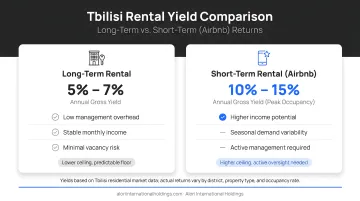
Tbilisi remains one of the few capital cities where a well-located investment property is attainable in the $100,000–$300,000 range, making it accessible to middle and upper-middle-income buyers. Gross rental yields average 6-10% for long-term leases, with short-term Airbnb rentals in tourist areas generating 12-18% gross yields (though net yields drop 15-25% after management fees).
Due Diligence is Non-Negotiable
Georgia's title registry is fully digitized and publicly searchable, but foreign buyers still need to verify several things before signing:
- Confirm clean title with no encumbrances through the National Agency of Public Registry
- Verify zoning classifications, especially for mixed-use or commercial-adjacent properties
- Ensure purchase contracts are correctly structured under Georgian civil law
Transaction costs are minimal. Public Registry registration fees run 50–200 GEL depending on processing speed, plus optional notary and legal due diligence fees. For foreign buyers navigating this process without local contacts, Alori International Holdings provides in-country legal oversight, verified pricing intelligence, and defined exit strategies — covering exactly the gaps where most international buyers encounter friction.
Frequently Asked Questions
Is Tbilisi good for expats?
Yes, Tbilisi ranks among the most expat-friendly cities in Eastern Europe and the Caucasus. The 365-day visa-free window, low taxes, affordable cost of living, and established international community make it highly accessible—though it works best for those with remote income or their own business.
Where do expats live in Tbilisi?
The most popular neighborhoods are Vake (upscale, clean air, modern apartments), Saburtalo (affordable, metro access), and increasingly Marjanishvili (trendy, good value). The Old Town attracts short-term stays but is less practical for long-term living due to noise, tourism, and infrastructure challenges.
Are Georgians friendly to Americans?
Georgians are famously hospitable to foreigners in general, and Americans are well-received. The cultural tradition of treating guests as "gifts from God" translates into genuine warmth, though English fluency is more common among younger and urban Georgians.
Can you drink alcohol in Tbilisi?
Yes, alcohol is freely available and central to Georgian culture. Georgia is the birthplace of wine, and wine, beer, and spirits are sold widely and affordably. Drinking plays a prominent role in Georgian social gatherings known as supras.
Can Americans buy property in Tbilisi?
Yes, Americans and other foreign nationals can purchase residential property in Georgia without restrictions. Property purchases above $150,000 (as of March 2026) qualify the buyer for a Georgian residence permit, making ownership both a lifestyle choice and a legal residency strategy.
How long can Americans stay in Georgia without a visa?
US citizens can stay in Georgia for up to 365 days visa-free, with the window renewing upon departure and re-entry. However, effective March 2026, paid work and self-employment require a formal "Right to Work" permit, even under visa-free status.